
Billing for AI-Assisted Work: How Firms Do It
Last Updated: November 2026
Billing for AI-assisted work is how a firm charges for a job when software did part of the drafting, research, or checking. It is not a new kind of fee. It is the old question of what your fee rests on, asked again now that the clock is no longer a fair measure. Three things must line up: what the client agreed to pay for, what your trade body expects you to explain, and what your invoice says.
AI Smart Ventures has guided growing businesses through AI adoption at the point where the work speeds up, and the bill does not. A team saves hours in month two, nobody revisits what the fee rests on, and the hard talk arrives from the client.
Leave that basis unwritten, and your client will write it for you. They see the speed long before you raise it. So the first time anyone asks what they are paying for, you answer under pressure about a choice you never made.
Key Takeaways
- Hourly fees have one hard limit: a legal ethics opinion approved by the Supreme Court of Virginia says time-based billing “can only be based on the actual time spent on a task”.
- Faster is not a smaller job: the same opinion found the fee rule “does not equate reduced time with proportionally reduced fees”, since the skill needed to check output can rise.
- Clients want to be told: in Clio’s 2026 consumer survey, written up by 2Civility, 82% wanted to know when a lawyer used AI and 70% trusted one more for saying so.
- The price talk has started: a survey of 258 leaders at large US and UK firms, reported by Accounting Today in March 2026, found 79% had seen AI change how they talk about price.
Read those four together, and the risk is not the fee. It sits in the gap between a bill that still counts hours and a job that no longer runs on them. Your client reads that gap first.
How does AI change time-based billing?
It breaks the link between effort and output. An hourly fee must match the hours someone worked, so a task that once filled an afternoon and now takes minutes bills as minutes. The Supreme Court of Virginia approved a legal ethics opinion on this in November 2025: time-based billing “can only be based on the actual time spent on a task”. Those hours did not move to the software; they stopped existing.
The squeeze only bites where your fee is a function of time. Clio’s 2026 Legal Trends Report, written up by 2Civility on 4 November 2026, projects the largest one-year rise in hours billed per working day in the report’s history, up 3.1 points. Firms are winning back more of their own day rather than charging more per task. Half said the wait between finishing work and sending the bill got shorter.
Do you have to say AI helped with the work?
Sometimes, and your own trade body decides when. Where AI use changes what the fee rests on, or what the client relies on, that is something they need told. Where a tool sits in your own systems and only speeds up admin, most notes treat it as normal practice. The detail moves by trade and by country, so read your body’s current note, not a summary of someone else’s.
Client appetite runs ahead of the duty, which makes silence the costly choice. In that same Clio consumer survey, 82% wanted to know when a lawyer had used AI on their work, and 70% said they trust one more for saying so. The Alabama State Bar issued Formal Opinion 2026-01 on this ground, and a firm’s duty to bill “appropriately and transparently” holds however the work was produced, as written up in August 2026.
What should your engagement letter say?
Four lines, and none of them is a disclaimer. What the fee rests on, in words a client could repeat to a colleague. Whether AI tools may be used on this job, and on which parts. Who stays answerable for checking output before it reaches them. And what moves the fee: a change in scope, not a change in method. Put all four in the letter you send at the start.
Explaining the basis matters more, not less, once the time drops. The Virginia opinion says so directly: where time spent falls sharply because of a time-saving tool, the client “may need additional explanation” of why your skill still shapes the fee. Write that sentence before you need it. The exact wording belongs to your trade body and your insurer, so draft the plain version, then have someone in your field check it.
How do you switch from billing hours to billing work?
In one service line, never across the firm at once. Choose the job you have done most often, because you already know its real shape. Price it as a piece of work with a named result and end point. Run it that way for a quarter, then compare what you recorded against what you agreed. Move the next line after that. Change everything together and you lose the only baseline you had.
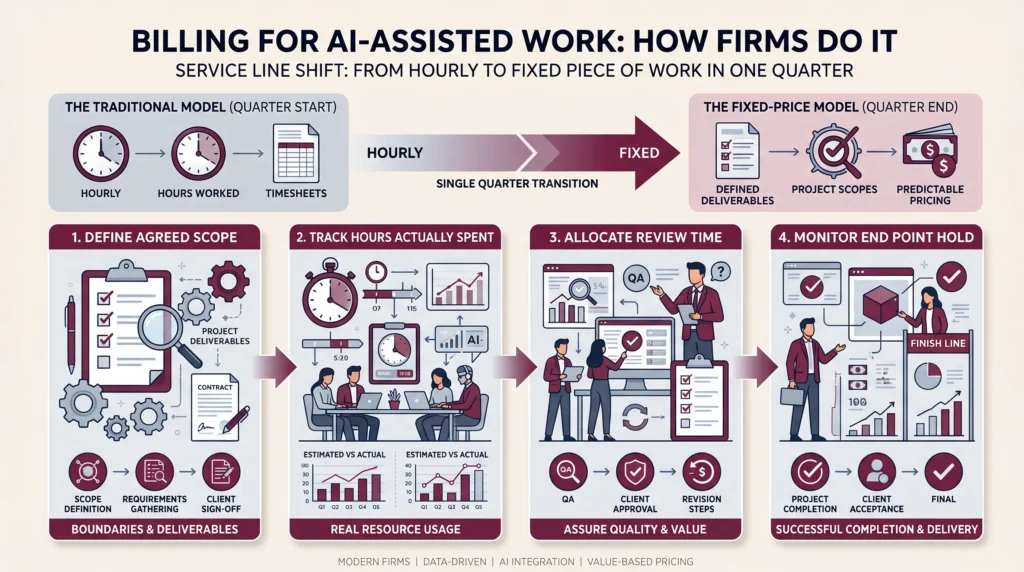
The market is moving slowly, so there is room. In the General Assembly survey of 258 consulting, accounting and legal leaders reported by Accounting Today, 79% said AI had changed their pricing talks. Among the accounting firms alone, one in ten were moving off billable hours, while 65% planned to invest more in their own people instead. AI gurus with zero operational depth will push a full rebuild this quarter; change management works better one line at a time.
AI Advisory works through that sequence with you: one service line, one written fee basis, one quarter of evidence before anything else moves.
Who pays for the checking that AI creates?
The client does, and it belongs inside the fee, not on a line of its own. AI moves work from making to checking, and checking is skilled time someone has to spend. Virginia’s opinion says the skill needed may rise, because using these tools well means knowing how to prompt, verify, supplement and integrate what comes back. So price the review in. Leave it out and your own margin absorbs it, quietly, every month.
Start by making the review visible to yourself. Log checking as its own line for a fortnight and the real total often shocks people. Then give it an owner by name, with hours against it, and say who signs off. AI Smart Ventures observes that firms naming a reviewer early stop arguing about speed and start talking about scope. Capability building here is mostly AI literacy: knowing where this crop of tools invents things.
What if a client asks for less because AI helped?
Answer on what they are buying, not on how long it took. Your fee covers judgment, the checking and the result, and a shorter route to the same result is not a smaller job. The Virginia opinion backs that reading: the fee rule “does not equate reduced time with proportionally reduced fees”. Where you do bill by the hour, though, the saving already belongs to the client, so say so plainly.
Expect the question; many buyers already hold that view. The same 2Civility write-up records that 47% think AI makes legal advice worth less, and 42% of firm leaders had clients questioning their model. The opinion even grants that the market rate may drop as speed improves. None of that makes a reduction a given. So prepare the answer in writing, offer a scoped fixed price instead, and keep the talk on the result.
| What the client says | What answers it |
|---|---|
| AI did this, so charge me less | the scope, the review, and who signs it |
| why did this come back so fast | the same checks ran, in a shorter sequence |
| are we funding your software | tools are our overhead, like the office |
| can we agree this for next year | yes, as scoped work with an end point |
Frequently Asked Questions
Can you bill hourly for a task AI finished fast?
Only for the time you really spent. Under that 2025 Virginia opinion, time-based billing has to rest on real hours, so you cannot bill the afternoon a task used to take. You can bill the time spent prompting, checking, fixing and shaping the output, because someone did that. If the job no longer suits an hourly basis, change the basis rather than the entry.
Is it fair to keep a fixed fee when AI sped it up?
Often yes, and one approved opinion says so. Virginia’s regulator found that the fee rule does not treat reduced time as a smaller fee, since the skill needed to run and check AI output can be higher than before. The test stays whether the fee is fair overall, judged on the result and difficulty. Views differ by trade, so confirm how yours reads it.
How do you word the AI line in a fee agreement?
Plainly, and in the letter the client signs. Name the kinds of task where tools may be used. Say that a named person reviews everything before it leaves, and state what the fee rests on. Avoid blanket consent to “AI use”: it tells the client nothing and ages badly. Then have the wording checked by someone qualified in your field, since the duty varies.
Do AI tool costs belong on the client’s invoice?
Often not as their own line. Plans you buy for the whole firm are overhead, like your office or your practice software. Usage charged job by job is different, and notes in several trades allow passing that on only when the client agreed first. The safe default is to bundle, say once how you handle it, and keep the broken-out version off the bill.
What do you say when a client spots the speed?
Name it before they do, then move to the result. Explain that the sequence changed, the same checks ran, and a person reviewed the output first. Clients take that well: in the Clio survey, 70% said they trust a lawyer more when told AI was involved. The talk only turns hard when a client works it out alone and decides you were hiding it.
Does your trade body have rules on this already?
Almost certainly, and more than you expect. Bodies for lawyers, accountants and tax advisers have published notes applying existing duties on fees, skill and client contact to AI use, and few have written new ones. The Alabama State Bar’s Formal Opinion 2026-01 works that way. Search your body’s site for its current AI note, check its date, and read the fee section first.
How do you price a task AI now does end to end?
Price the output and who carries it, because nothing else is left to charge for. Work out what the result is worth, what review it needs before you sign it, and what you carry if it is wrong. That last part is often the real product. Tasks needing no human judgment at all tend to become a product or a plan people subscribe to.
What should a time entry say about AI use?
What you did, in the same plain words as any entry. Record the task rather than the tool: drafted, reviewed, corrected, checked against the source. Two habits cause trouble: one is billing the hours a job would have taken by hand. The other is a note so vague that nobody can audit it. Keep review as its own line and the invoice defends itself.
Can two clients be billed differently for one task?
Yes, and that is normal rather than awkward. One client may be on an hourly basis, another on a fixed price for named work, with the same task under both. What matters is that each client was told what their own fee rests on. Trouble starts when neither deal is written down, because then the difference looks like a judgment about the client.
How do you start changing your billing this month?
Start with your three most repeated jobs. For each one, write in a sentence what its fee rests on today. Then log the hours and the review time for a fortnight to test it. Where the sentence no longer matches what the work takes, rewrite the engagement letter for that job alone. Schedule a consultation with AI Smart Ventures to turn those sentences into a fee basis you can explain.
Executive Summary
Billing for AI-assisted work comes down to what your fee rests on, written down before the client asks. Hourly fees can only carry the hours someone really worked, so a task that drops to minutes bills as minutes. Other fees are judged on the whole job, and one approved opinion holds reduced time does not mean a smaller fee. Say in the engagement letter what the fee rests on, where tools may be used, and who reviews output. Then move one service line at a time, measuring each for a quarter.
What Should You Do Next?
This week, pick your most repeated job and write one sentence saying what its fee rests on. Log the hours and review time on the next two of those jobs, then read the sentence again. If it no longer matches the work, rewrite that job’s engagement letter before the next one starts.
AI Smart Ventures offers AI Advisory for growing businesses whose delivery has outrun how they bill for it. Schedule a consultation to settle one service line’s fee basis and the words you use to explain it.
People Also Read
About the Author
Nicole A. Donnelly is the Founder of AI Smart Ventures and an AI Adoption Specialist with 20 years of experience as a founder and CEO and over a decade leading AI adoption initiatives. She helps businesses integrate artificial intelligence with clarity and confidence, driving innovation and sustainable growth. Nicole has trained over 20,217 professionals in Applied AI, delivered 624 workshops, and worked with close to 1,000 organizations across diverse industries.
Expertise: AI Transformation, AI Strategy, AI Implementation, AI Adoption, Applied AI, Marketing, Business Operations
Disclaimer: This content is for informational purposes only and does not constitute professional business or technology advice. Results vary based on industry, existing systems and implementation commitment. Contact AI Smart Ventures for a consultation regarding your specific situation.