Agentic AI Workflows: When Should Your Business Use Them?
Last Updated: August 2026
An agentic AI workflow is a chain of tasks that an AI system plans and runs on its own, checking its own work as it goes. It reads a goal, splits it into steps, opens the software it needs, then asks whether the result is good enough to pass on. If not, it tries a new route. A set script does the same thing each time. An agentic workflow writes the script while the job is running.
AI Smart Ventures has guided founder-led organizations through AI adoption for more than ten years, and one pattern keeps showing up. Teams that get real value from agentic AI workflows start with one messy job they know well, not with the slickest demo they saw last month. The tech is rarely what breaks first. The fuzzy job under it is.
Pick wrong and you pay twice. You lose the months spent building an agent that a plain rule could have handled, and you lose the trust of a team that watched it fail in front of a client. Pick right and a job that ate a full day each week now runs quietly in the background.
Key Takeaways
- Use an agentic workflow for open-ended work that shifts shape from run to run. If you can write the exact steps up front, a plain rules-based tool costs less and earns trust faster.
- Start with one job your team already does by hand each week, and map it before you hand it over. That map turns workflow optimization into something you can measure.
- Check your data before you check your tools. Agents stall on scattered, unlabeled records far more often than they stall on hard thinking.
- Keep a person on the sign-off step for work that is hard to undo: contracts, payments, deleted files and any message that leaves your building.
- Watch the agent standards work now running at NIST and the Agentic AI Foundation, because the link layer under these tools is turning into a shared standard, not one vendor’s private road.
- Plan for month two. The first build almost always guesses wrong somewhere, and the payoff lands once you have read the logs and redone the rules two or three times.
Notice what those six points share: not one is about picking the right model. The hard part of AI adoption sits in the shape of the job, in the data under it, and in the call about where a human still signs off.
What are agentic workflows in AI?
Agentic workflows in AI are multi-step jobs where the system picks its own next move. It reads the current state, plans a route to the goal, acts through the tools it can reach, then looks at what came back. That loop repeats until the goal is met or the system asks for help. A set script runs the same path each time, whatever it finds.
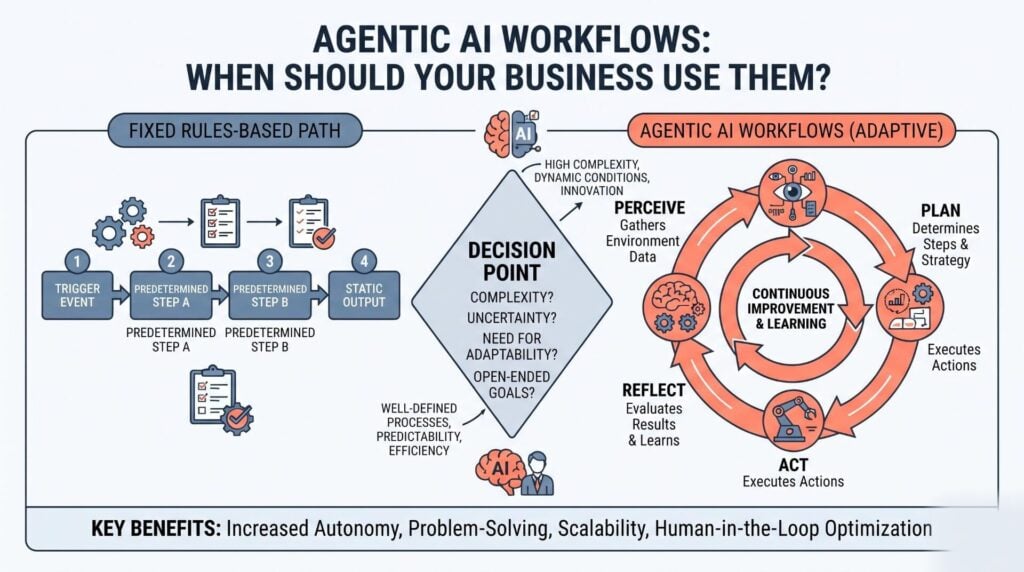
Anthropic draws a helpful line here: it splits workflows, where code picks the path, from agents, where the model picks the path itself. Both count as agentic systems, and the simpler one is nearly always the right place to start. Its guidance is blunt about the trade: agents cost more and can stack up their own errors.
When does an agent beat a set script?
An agent beats a set script when the input is messy and the right next step turns on what the last step found. Scripts handle tidy shapes very well: same form, same fields, same order, each run. Agents earn their keep on rough input such as long email threads, mixed vendor files, or open research questions where no two runs look alike.
| Signal in your job | Set script | Agentic AI workflow |
|---|---|---|
| Steps known up front | Strong fit | Freedom goes to waste |
| Input format shifts a lot | Breaks often | Strong fit |
| A judgment call lands mid-run | Not possible | Strong fit |
| Output must match every time | Strong fit | Harder to promise |
Most growing businesses run both kinds of work side by side. The costly mistake is stretching one tool across both, then blaming the tool when operational efficiency will not budge.
What is an example of an agentic workflow?
A common example is client onboarding. The workflow wakes up when a signed deal arrives, pulls the client details out of the file, opens a project folder, sends the intake form and books the kickoff call. If a field is blank, the agent hunts for it in older email rather than stopping with an error. Your team sees the finished folder, not the fifteen small steps.
A second example sits on the sales side. An agent watches a short list of rival pages, notes what changed since last week, weighs whether that matters to your pricing, then writes a one-page brief for Monday.
What are the four types of agentic AI?
Agentic AI is often sorted into four types: reactive agents, planning agents, tool-using agents and multi-agent systems. They differ in how much each one decides alone, and in how deep it reaches into the software you already run. Most business workflows only ever need the middle two. Working out which type a vendor is selling you is the fastest way to test the pitch.
- Reactive agents fire on a trigger and do one narrow thing well, then forget it ever happened.
- Planning agents split a goal into ordered steps, then shuffle those steps when one of them fails.
- Tool-using agents reach into your calendar, files or client records to read and write real data.
- Multi-agent systems split a job between helpers, so one digs for facts while a second drafts and a third checks it.
How do you build your first agentic workflow?
Build your first agentic workflow by picking a low-stakes job you already do by hand, writing out the steps just as you do them, then giving the agent only the tools those steps need. Test it on real cases from last month, not made-up ones. Read the logs. Rewrite the rules wherever the agent guessed, and keep going until the guessing stops.
Data readiness settles more of this than tool choice does. In research from Teradata and Wakefield out in July 2026, based on 1,000 senior tech and data leaders in six markets, 77% said a fifth or less of their data was labeled well enough for agents to use. Only 7% had agents running at a stage that showed clear results.
Mapping that first workflow is often a half-day job, and it is where the build stays simple or turns costly. AI Smart Ventures runs AI Implementation work with owner-operators who want one agentic workflow running well before anyone talks about scale.
What rules now govern business AI agents?
No single law governs agentic AI workflows yet, though the standards work started in earnest in 2026. On 17 February 2026 NIST, the US standards agency, opened an AI Agent Standards Initiative through its Center for AI Standards and Innovation. It rests on three pillars, and each one hints at where agent buying is headed. None of it binds your business today.
- Industry-led standards. NIST holds working meetings and gap studies so agent rules come out of real practice, not from new law. Since April 2026 it has run listening sessions on what blocks uptake in health, finance and schools.
- Community-led protocols. The Agentic AI Foundation formed under the Linux Foundation in December 2025, moving Anthropic’s Model Context Protocol, OpenAI’s AGENTS.md and Block’s goose into neutral hands, backed by Amazon, Google, Microsoft and Cloudflare.
- Security and identity. The OWASP Top 10 for Agentic Applications, built by more than 100 experts and out the same month, gives your team a review list written for agents rather than for chatbots.
For an owner, the short read is this. The plumbing that links agents to your systems is turning into a shared standard, so what you build this year is less likely to be stranded when one vendor changes course.
What goes wrong with agentic AI workflows?
Three failures turn up again and again: agents that loop without ever finishing, agents that give a wrong answer and sound sure of it, and agents handed far more access than the job ever needed. None of these are exotic. Each one is stopped by the same habit, which is keeping the agent narrow and checking its output before anyone acts on it.
Owner caution here is well earned. A Bluevine survey of 942 US business owners, taken in April 2026, found that 74% already use or test AI tools while 82% hit something that stops them going deeper. Trust in accuracy was named by 31% and data safety by 33%. Those are oversight questions, and they ease with AI literacy and human-first AI habits rather than one more subscription.
Frequently Asked Questions
What are the 4 steps of agentic AI?
The four steps are plan, act, observe and refine. The agent first turns your request into an ordered set of tasks. It then works through them, often by calling other software such as email or a database. Next it checks the result against what it expected. Last, it tunes the plan and runs the loop again, stopping when the goal is met or a person steps in.
How is an AI agent different from a chatbot?
A chatbot answers, while an agent acts. Ask a chatbot about your overdue invoices and it tells you where to look. Ask an agent the same thing and it opens the accounts tool, pulls the list, drafts the reminders and queues them for your sign-off. The difference is tool access paired with a goal that spans several steps. That is why an agent needs far tighter permissions than a chatbot.
Can agentic workflows link to software we already use?
Often yes. Most agent platforms link through published hooks or a shared link standard, and the common business tools now support it: client records, shared drives, calendars and chat apps. The real test is whether your own systems expose the fields the workflow needs, and whether someone on your team can grant narrow, scoped access instead of handing over a full admin login.
Which tasks should stay off an agent?
Keep anything hard to undo under human control. Sending contracts, moving money, deleting records, posting to clients and making hiring calls all belong behind a sign-off step, even when the agent drafts the work well. The same rule covers any job where you could not explain later why a call was made. Agents are great at teeing up a decision and poor at owning one.
What skills does a team need to run AI agents?
Three skills matter most: writing clear rules, reading logs, and writing down how your business really makes a given call. None of that needs an engineering hire. Most owner-operators name one person to own the workflow, check how it performs each week and update the rules as the job shifts. AI upskilling for that one role pays back more than a broad rollout, because capability building beats tool sprawl.
How long does a first agentic workflow take?
Plan on a few weeks rather than a few days. Mapping the manual job honestly takes a day or two. Linking the tools and running the first tests takes about a week. The rest goes on the stage people skip: watching real cases, spotting where the agent guessed and rewriting the rules. Teams that rush that last stage are the ones whose pilots quietly stall.
Do agentic workflows need a written policy?
Yes, and a short one does the job. Write down which systems agents may touch, which actions always need a human signature, who reads the logs and how often, plus what happens when an agent gets something wrong. One page is enough for most growing businesses. Change management matters more than the page itself, because a policy no one has read works exactly like no policy.
How do we get started with agentic AI workflows?
Start by listing each task your team repeats weekly that moves data between two or more systems. Pick the one with the clearest rules and the smallest fallout if it goes wrong, then run it by hand for a week while noting each call you make. That written record becomes the brief for your agent. Schedule a consultation with AI Smart Ventures to stress-test the workflow you pick.
Executive Summary
Agentic AI workflows suit open-ended, multi-step work where the right next move turns on what the last step found. They fit badly on jobs you can fully script, and they stall when the data under them is scattered or unlabeled. Standards are landing fast: NIST opened an agent standards program in February 2026, and the Model Context Protocol now sits in neutral hands. For a growing business the winning move stays narrow. Pick one weekly job, map it by hand, and redo the rules until the guessing stops.
What Should You Do Next?
This week, list the three jobs your team repeats most often, then mark which shift shape from run to run. Take the messiest one, do it once by hand, and write down each call you make and each system you open. That page tells you whether an agentic workflow is worth building at all.
AI Smart Ventures offers AI Implementation for growing businesses putting their first agentic workflows into daily use. Schedule a consultation to map one job and decide whether an agent belongs in it.
People Also Read
About the Author
Nicole A. Donnelly is the Founder of AI Smart Ventures and an AI Adoption Specialist with 20 years of experience as a founder and CEO and over a decade leading AI adoption initiatives. She helps businesses integrate artificial intelligence with clarity and confidence, driving innovation and sustainable growth. Nicole has trained over 20,217 professionals in Applied AI, delivered 624 workshops, and worked with close to 1,000 organizations across diverse industries.
Expertise: AI Transformation, AI Strategy, AI Implementation, AI Adoption, Applied AI, Marketing, Business Operations
Disclaimer: This content is for informational purposes only and does not constitute professional business or technology advice. Results vary based on industry, existing systems and implementation commitment. Contact AI Smart Ventures for a consultation regarding your specific situation.