AI Agent Reliability: How AI Smart Ventures Sets the Benchmark for Critical Business Tasks
When it comes to automating your most important business processes, reliability isn’t optional-it’s everything. At AI Smart Ventures, we help organizations deploy AI agents that don’t just promise results, but deliver them safely, consistently, and with full accountability. Explore how we set the standard for AI agent reliability in high-stakes business environments-and see how your organization compares.
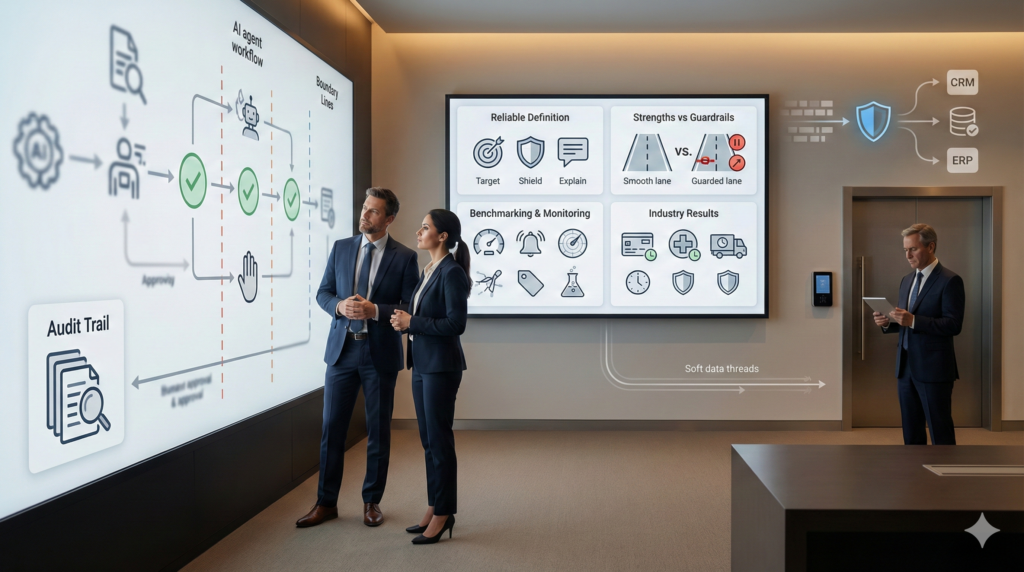
If you’re evaluating AI automation for critical business tasks, start here:
- What “reliable” actually means in a business-critical context
- Where today’s AI agents are strong, and where they still need guardrails
- How AI Smart Ventures benchmarks, improves, and continuously monitors agent performance
- What results companies are seeing across finance, healthcare, and logistics
Trusted by leaders who need reliability, not hype. If your workflows touch money movement, compliance, customer access, or operational safety, this page will help you make confident decisions.
Let’s define what ‘reliable’ means for business-critical AI
In everyday AI use, “reliable” often means “pretty good most of the time.” In business-critical AI, that standard is far too loose. AI agent reliability means the system performs predictably under real-world conditions, produces outputs you can validate, and behaves safely when something is unclear, missing, or out of policy.
For critical business tasks, reliability has five non-negotiable pillars:
- Accuracy: The agent’s outputs match verified sources, calculations, or approved logic with a low error rate.
- Consistency: Given the same inputs and conditions, the agent produces repeatable, policy-aligned results.
- Safety: The agent avoids unsafe actions, privacy leakage, and policy violations, even when prompted incorrectly.
- Auditability: You can trace what happened, why it happened, what data was used, and what was approved.
- Resilience: When the system encounters uncertainty or risk, it slows down, escalates, or stops instead of guessing.
That last point is where most AI automation fails. A base model can be impressive, but it is still probabilistic. Guardrails are what transform impressive outputs into dependable operations. Guardrails are the validation layers, permission boundaries, escalation rules, and monitoring that make an agent behave like a well-designed system, not a chat window with access to your business.

Here’s why reliability matters more than ever in automation
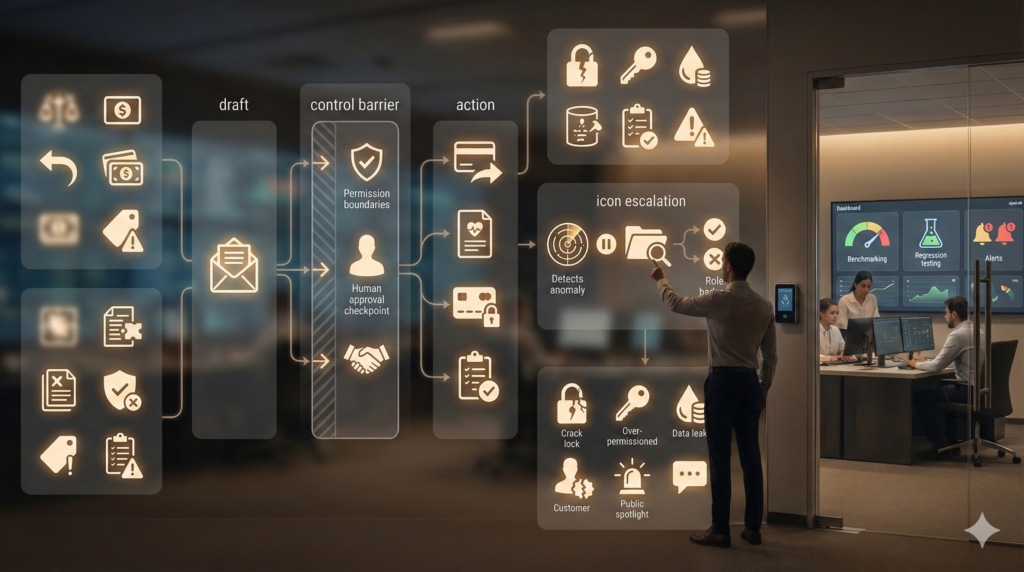
AI automation is moving from “assist” to “act.” That shift is exciting, but it also raises the stakes. When an AI agent drafts an email, a mistake is annoying. When an agent triggers a refund, updates a patient record, changes user access, or submits a regulatory report, a mistake can become a financial loss, a compliance event, or a trust-breaking customer experience.
Here’s what unreliable AI can cost in real business terms:
- Financial exposure: Incorrect approvals, pricing errors, chargebacks, misapplied credits, and duplicated payments.
- Compliance risk: Incomplete audit trails, inconsistent policy enforcement, and incorrect reporting in regulated environments.
- Security breakdowns: Over-permissioned actions, mishandled credentials, and accidental data exposure through logs or prompts.
- Reputation damage: Customers remember the one failure that affects them, especially when it feels automated and unaccountable.
This is why reliability is no longer a “nice-to-have” feature. It’s a business requirement. For high-impact workflows, human oversight and system-level controls are not optional. The goal is not to remove humans from the process. The goal is to put humans in the right parts of the process, while the agent handles the repeatable work with clear boundaries and measurable performance.
If you want AI agents you can trust, you need a reliability approach built on AI benchmarking, business risk controls, and continuous improvement.
What can you expect from today’s AI agents in high-stakes roles?
Today’s AI agents can be remarkably effective, but only when you give them the right job and the right operating environment. In our work across AI automation projects, we see a clear pattern: agents perform best when tasks are structured, inputs are well-defined, and “success” can be measured objectively.
Where AI agents are already strong
AI agents tend to be reliable when the work is constrained and verifiable, such as:
- Routing and triage: Classifying requests, prioritizing tickets, and assigning work using clear categories.
- Extraction and transformation: Pulling data from invoices, forms, SOPs, and structured documents into defined fields.
- Workflow orchestration: Moving tasks forward across tools with permission limits and validation checks.
- Knowledge support: Answering internal questions using approved sources, with citations and confidence controls.
These use cases benefit from a simple truth: when the agent is required to reference authoritative systems or structured data, it has less room to guess. Reliability improves dramatically when the agent is not asked to “remember” facts, but is designed to retrieve, verify, and validate.
Where AI agents still need firm boundaries
AI agents become less reliable when they encounter ambiguity, shifting policies, or incomplete data. Common high-risk situations include:
- Ambiguous rules: Edge cases in HR, legal interpretation, nuanced policy enforcement, or exceptions-based approvals.
- Evolving policy and live data needs: Regulatory updates, pricing rules that change weekly, or time-sensitive contract terms.
- High-impact autonomous decisions: Approving large transactions, terminating access, or making irreversible system changes without review.
In these workflows, the correct approach is not “no AI.” The correct approach is human-in-the-loop with clear thresholds. The agent can recommend, summarize evidence, and prepare actions, but a human should approve the final step when risk crosses a defined boundary.
The practical expectation you should set
If you’re asking, “Can AI agents be trusted with critical business tasks?” the most accurate answer is this:
AI agents can be trusted when the system is engineered for reliability. That means task boundaries, tool-based verification, validation layers, escalation rules, and monitoring. Without those, you should assume the agent will occasionally be confidently wrong.
That’s exactly why AI Smart Ventures focuses on reliability as a measurable standard, not a marketing claim.
Here’s how AI Smart Ventures benchmarks and improves agent reliability
Most teams try to improve reliability by swapping models, rewriting prompts, or adding more context. Those tactics can help, but they do not create a reliability standard you can operate against. AI Smart Ventures takes a systems approach to AI benchmarking that is designed for real business environments.
1) We define the task contract before we automate anything
Every agent we build starts with a reliability contract:
- What the agent is allowed to do (and not do)
- What data it can access
- What tools it must use for verification
- What outputs are acceptable (schemas, formats, thresholds)
- When it must escalate to a human
- What actions require approval
This transforms “AI automation” into a controlled operating model. It also makes reliability measurable, because we can test the agent against defined expectations.
2) We benchmark performance using real workflows and real edge cases
Our benchmarking process combines:
- Anonymized workflow data from real operations
- Industry averages where available, so performance is comparable
- Edge-case libraries that reflect real-world exceptions
- Regression suites that catch drift after updates
We evaluate reliability using metrics decision-makers care about, including:
- Verified accuracy rate (outputs match sources and rules)
- Escalation quality (does the agent escalate at the right time?)
- Time-to-resolution (how quickly work moves with controls in place)
- Rework rate (how often humans need to fix agent output)
- Policy adherence (does the agent stay within boundaries consistently?)
3) We engineer guardrails that prevent “confident guessing”
High-stakes reliability comes from layered controls, not a single mechanism. Depending on the workflow, our guardrails include:
- Validation layers: Schema checks, field completeness checks, range checks for numeric outputs, and business rule enforcement.
- Permission boundaries: Least-privilege access, tool allowlists, and action scopes that prevent unintended changes.
- Escalation protocols: Clear thresholds that route risky cases to humans with the right context and evidence.
- Audit trails: Logged inputs, tool calls, outputs, approvals, and decision rationale for traceability.
- Safety filters: Redaction rules, sensitive-data handling, and policy-alignment checks before actions execute.
The point is simple: a reliable AI agent behaves like a well-built product. It does not “wing it.” It verifies, validates, and escalates when required.
4) We monitor reliability continuously, not just at launch
Reliability is not a one-time implementation. Models evolve, workflows change, and edge cases appear. That’s why we treat agents like production systems with ongoing oversight:
- Automated alerts for unusual error spikes or drift
- Weekly or monthly quality sampling for critical workflows
- Feedback loops that turn real failures into new tests
- Version control for prompts, tools, and policies
- Clear rollback paths when performance changes after updates
5) The benchmark report turns reliability into a business decision
The Release Reliability Benchmark Report is designed to help leaders compare their current approach to a proven standard. It includes:
- A practical reliability framework you can apply internally
- Benchmark ranges for common critical workflow categories
- Guardrail patterns that improve outcomes without slowing operations
- A readiness checklist for launching agents safely
- A path to a personalized reliability assessment
What results are companies seeing with our approach?
When reliability is engineered into the system, companies move faster with less risk. Below are representative outcomes we see when teams adopt a benchmarking-first approach to AI agent reliability in critical business tasks. Results vary by workflow complexity, data quality, and risk thresholds, but the pattern is consistent: fewer errors, smarter escalation, and more stable performance over time.
Industry highlights
Finance and payments:
Teams typically see improved reliability when approvals follow clear thresholds and evidence must be pulled from authoritative systems. A common win is reducing back-and-forth on exceptions while keeping humans in the loop for high-impact approvals.
Healthcare operations:
Reliability gains show up when agents are restricted to approved workflows, sensitive data handling is enforced, and actions are fully auditable. The biggest advantage is consistency: fewer process variations across teams and shifts.
Logistics and customer operations:
Agents perform extremely well in triage, scheduling, exception routing, and document handling when the workflow is structured. Teams often see faster resolution times with fewer escalations caused by missing information.
An AI Strategy That Actually Works
Stop wasting time on scattered AI experiments. Get a business-aligned strategy and a practical roadmap that turns AI into measurable results, with governance and security built in.
FAQ: Common questions about AI agents in critical business tasks