

AI and Critical Thinking: Is Your Team Still Deciding?
Last Updated: September 2026
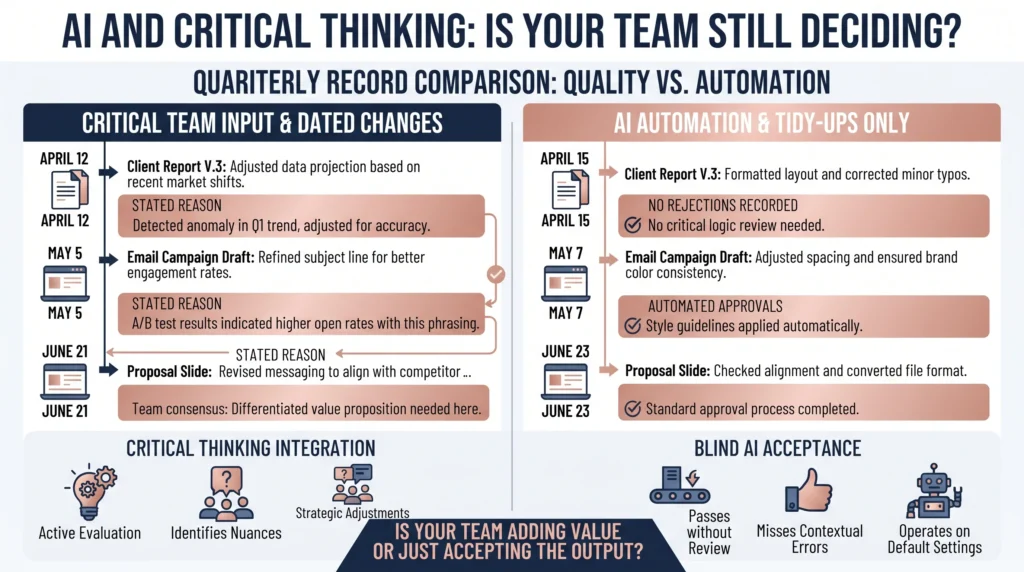
Critical thinking with AI is the judgment a person adds after the tool answers: keeping it, changing it, or throwing it out. It is not a mood, and it is not a policy. It shows up as an act on a real piece of work, so it leaves a mark. That mark is the only honest proof you have, because the work remembers what a person did long after everyone has forgotten doing it.
AI Smart Ventures has guided growing businesses through AI adoption long enough to watch this question get answered badly. A leader asks the team if they check the output. Everyone says yes, since a yes costs nothing and sounds right. The useful question is harder to fake, and it starts with a date.
What is at risk is not one wrong answer. It is a quarter of calls that no one made, where the tool proposed and the calendar signed off. By the time that shows up in a client complaint or a redone job, the habit is months old and hard to undo.
Key Takeaways
- Stop asking, start dating: find the last time someone changed or refused an AI output, and if no one can name a date, you have your answer.
- Read the silence, not the yes: a workflow where the tool is never overruled is not a tuned workflow, it is an unmeasured one.
- Look where the work is kept: version history, drafts, ticket notes and review comments hold the record of who changed what.
- Edits are not proof: light rewording leaves the meaning intact, so check whether the call moved, not whether the words did.
- Watch which questions stop: teams that still decide ask about sources, edge cases and what the tool missed, and those questions fade first.
Notice what those five share. Judgment is invisible while it happens and plain to see later, so look behind you rather than around you. The record already sits in tools you pay for.
Why can you not just ask if your team checks AI output?
Because the question has one right answer and no cost to give it. No one reports skipping the check. People also misjudge how much they lean on it, so honest answers come out wrong. A Stanford study from May 2026 asked 2,691 people to guess how often they would reach for AI, then measured what they did. They guessed 33% of tasks. The real rate was 47%.
That gap matters, because what you asked about and what you care about are not the same. A self-report tells you what someone believes about their habits. The work tells you what the habits are. So stop surveying and start reading. Take two recent jobs that used AI, trace each back to the point where a person changed something, and note the date. An hour of that beats a month of AI literacy slides.
What does the absence of disagreement tell you?
It usually tells you the checking has stopped. A run of AI outputs that no one has touched in weeks is not proof of a good tool, because no tool is that good on your own clients. Research published by the American Psychological Association in April 2026 found that 58% of 1,923 people agreed AI “did most of the thinking” across ten work tasks.
Silence reads as a yes, a yes reads as quality, and that is how a workflow gets marked healthy while no one is home. The same study found the other pattern too: people who changed, argued with or refused AI advice felt more sure of their own reasoning and more like the author. Pushback is not friction here. It is the part of the thinking you can see, so its absence is worth counting first.
Where do your records show the last override?
In four places you already keep. Version history shows who edited an AI draft and how much of it lived. Ticket and project comments show where someone argued with the advice before it became a plan. Email and chat threads catch the point where work changed hands. Meeting notes show which options got weighed. All of it carries a date, and the date is what tells you something.
Read them backwards from today until you hit a real change. If you reach last month and find nothing but tidy-ups, that is the finding, and it is sharp enough to act on this week. Take one workflow at a time, because workflow optimization tends to fall over when it starts wide, and a single quote, report or client thread gives you a cleaner view than asking the whole firm does.
What does a healthy override pattern look like?
Three things show up together: changes happen at all, they carry a stated reason, and they cluster in the work your clients see. A Founder Reports survey of more than 2,000 employed US adults in April 2026 found 45% had fixed or redone a colleague’s work that leaned too hard on AI, while 77% read a colleague’s work more carefully once they knew AI was involved.
That second number is the more useful one. People change how they read as soon as they know what they are holding. A healthy team makes that knowledge normal, not awkward. You see AI use named in the work, you see why a suggestion got dropped, and you see initials against the change. Generic AI consultants count logins instead, which only says a tool was opened. Practical AI leaves a paper trail.
How do you tell an override from a light edit?
Check whether the call moved. A light edit changes wording, order and tone while the advice underneath lives on. A real change alters what the work now says: a different option picked, a claim cut, a caveat added that shifts who does what by when. Both look the same in a version history, so read the two drafts side by side rather than counting the edits between them.
Editing on its own is a weak signal. University of Maryland researchers asked 81 people to rewrite AI drafts in their own voice, on tasks where personal style mattered a lot. The writers felt the results sounded like them. A later text analysis found the finished pieces still sat closer to the AI draft than to the same person’s own unaided writing. Heavy editing shows effort, which is not the same as judgment.
Which questions actually surface a missing judgment step?
Ask for a date and an outcome, never for a habit. “Do you check the output?” invites a yes from anyone. “When did you last argue with it, and what went out instead?” asks about an event, which either happened or did not. No one can answer that one just to be agreeable, and it works for exactly that reason. Ask it about one named job.
How sure people feel moves this in both directions. A Microsoft Research and Carnegie Mellon survey of 319 knowledge workers, who gave 936 first-hand examples, found that more trust in the tool went with less critical thinking, while more trust in one’s own skill went with more of it. So ask about the person’s own edge, not just the tool. Anyone who cannot say where they beat the model has stopped weighing the two.
- Ask for the last date: when did you last change or refuse what the tool gave you, and what did you send instead?
- Ask what it misses: what does this tool get wrong about our clients that a new hire would too?
- Ask about the option you dropped: which suggestion did you weigh and refuse, and why?
- Ask who read it after you: who saw this before it left the building, and what did they change?
A team that answers those four in a minute has kept the judging step alive. If yours cannot, AI Training builds that habit into work people already do, rather than bolting a review meeting on the end.
Frequently Asked Questions
How do you stop AI from killing your critical thinking?
Start by finding out whether it already has. Take one workflow, open the last month of drafts and comments, and hunt for a change a person made to what the tool proposed. If the newest one is old or missing, the habit has slipped, and telling people to think harder will not move it. Name the gap first, because you cannot repair a habit you have not dated.
Can AI think critically?
No. A model predicts likely text from patterns, so it can copy the shape of an argument without holding a view or knowing what it does not know. Ask it to argue for an option, and it will; then ask for the case against, and it will do that just as well. Critical thinking is where a person picks which case survives for your clients.
What is the 30% rule in AI?
There is no agreed 30% rule. Several versions float about: spend 30% of a task on AI drafting, or give 30% of the time saved back to checking, or change at least 30% of what a model writes. None come from a standards body or a peer-reviewed source, and the number shifts with whoever is selling it. Treat them as rough habits, not measures.
What was Stephen Hawking’s warning about AI?
In a BBC interview from 2 December 2014, Stephen Hawking said the development of full artificial intelligence could spell the end of the human race. He warned that such machines would redesign themselves while humans stayed limited by slow biological evolution. He meant something far more capable than anything on sale today. The carryover for a business is narrower: keep people who can still say no.
How do you use AI without losing critical thinking?
Do part of the thinking before the tool starts. Sarah Baldeo, who wrote the 2026 APA study on AI reliance, suggests trying a problem yourself first, reworking a prompt two or three times rather than taking the opening answer, and spending some days each week away from the tools. The thread through all three is that you keep holding the question.
What are the signs of cognitive offloading in a team?
Watch for the questions that stop. A team that has handed over the thinking stops asking about sources, edge cases and what a tool missed, and it stops bringing you two options. Output goes up while the range of ideas narrows, and everything reads the same. The clearest sign is that no one can name a time they argued with a tool and won.
Does using AI make people less capable?
The proof points at engagement rather than raw skill. The April 2026 APA research found no clear loss of thinking power, but weaker trust in one’s own reasoning among people who took AI output as it came. Those who argued with it or rewrote it showed neither effect. The risk is judgment going unused rather than lost, which is also why it comes back.
Where should a leader look first for evidence of judgment?
Look at version history on the papers that reach clients. It is dated, it names people, and it shows what changed between one draft and the next, which is what a survey can never give you. Ticket comments and email threads come second, since that is where advice gets argued with before anyone commits. Start with one workflow and read a month of it.
How often should you check that judgment is still happening?
Once a quarter suits most growing businesses, plus any time a workflow changes its tools or its owner. The check is short: take two recent jobs, find the last real change to an AI output in each, and write down the date. Quarterly spacing matters because this pattern drifts over months, not days, and a weekly check turns a useful signal into a review of people.
How do we get started with AI training for our team?
Begin with one workflow rather than a tour of tools, and expect the first session to run on your own papers. Time and scope depend on how many people take part and how much gets built on real work. AI Smart Ventures runs AI upskilling for growing businesses inside the workflows they already use. Schedule a consultation to map where judgment has gone quiet.
Executive Summary
Critical thinking with AI shows up in the work, never in what people say about the work. Ask whether the team checks its output, and you get a yes every time, and self-reports are off. The better test is a date: when did someone last change or refuse what the tool gave them, and what went out instead? Version history, ticket comments, and email threads hold that record now. A long run of untouched outputs is the finding, not the comfort. Designing a step where pushback is expected is a separate job.
What Should You Do Next?
Take the workflow that touches clients most often and read the last month of it backwards, until you find a change a person made to an AI output. Write down the date and what changed. If you find none at all, you have the clearest starting point a founder-led team can get, and it took an hour of reading rather than a change management programme.
AI Smart Ventures offers AI Training for growing businesses that want the judging step living inside daily work rather than in a policy. Schedule a consultation to review what your own records show.
People Also Read
- AI for Quote-to-Cash: Where Owner-Operators Save the Most Hours
- AI Adoption Curves: Why Week Six Is When Owner-Operator Teams Quit
About the Author
Nicole A. Donnelly is the Founder of AI Smart Ventures and an AI Adoption Specialist with 20 years of experience as a founder and CEO and over a decade leading AI adoption initiatives. She helps businesses integrate artificial intelligence with clarity and confidence, driving innovation and sustainable growth. Nicole has trained over 20,217 professionals in Applied AI, delivered 624 workshops, and worked with close to 1,000 organizations across diverse industries.
Expertise: AI Transformation, AI Strategy, AI Implementation, AI Adoption, Applied AI, Marketing, Business Operations
Disclaimer: This content is for informational purposes only and does not constitute professional business or technology advice. Results vary based on industry, existing systems and implementation commitment. Contact AI Smart Ventures for a consultation regarding your specific situation.

