
AI Best Practices for Agency Managing Directors in 2026
Last Updated: July 2026
AI best practices for agency managing directors are written rules. They set standards for using AI across your agency. They cover workflows, client services, and business growth. These standards help leaders do more than just automate tasks. They build lasting value across your whole operation.
These rules cover tool selection, data governance, staff training, and client openness. When you follow them well, they cut risk and improve output quality. They also speed up client work.
AI Smart Ventures has guided hundreds of growing businesses through AI adoption. The firm’s advisory work focuses on practical steps. It helps directors build AI practices that fit their current team and client base. The goal is not to chase the newest tech.
Agency leaders face growing pressure from clients. Clients want faster work, more custom campaigns, and stronger data. McKinsey’s State of AI research shows AI adoption is now a top focus for business leaders. At the same time, AI tools are growing fast. It can be hard to know which ones actually work. The sections below cover the key practices. Managing directors need to set these up this year.
Key Takeaways
- Start with a pilot program in one department. Measure impact and build a business case before you roll out to the full agency.
- Create a written AI governance policy. Define which tools are approved and what data is off-limits. Also set rules for how AI content must be reviewed before it reaches clients.
- Train your account managers, strategists, and creative staff in prompt building and AI workflows. This is better than searching for expensive new technical hires.
- **\\Use AI to speed up market research and build data-backed output forecasts that make new business pitches more competitive.
- Measure AI success using business outcomes like project profitability and client retention. Do not just count hours saved on individual tasks.
- Set clear ethics standards for AI use. Include a written client openness policy. Also define a step for verifying AI-made facts and statistics.
The sections below give step-by-step frameworks for each of these priorities. They fit your current team structure. No full overhaul is needed.
What Is the First AI Step for an Agency Director?
The best starting point for a managing director is a pilot program in one department. Choose a busy workflow to test AI in a set area. Content creation or output reports are good starting points. This focused approach makes it easier to set clear success metrics.
It also limits trouble for client work. You gather the proof needed to back a broader investment. Pick one or two tools with free or low-cost access. Run them alongside your current process for 30 to 60 days.
Assign one team member as the point person. This gives you a single owner of results. Track staff comments and notes alongside output data.
Agencies that test in one area first see 40% faster time-to-value. This beats a broad rollout from the start. Use this period to find where AI saves time without cutting quality. Fix issues before you scale to more sensitive, client-facing roles.
How Do You Create an Agency AI Governance Policy?
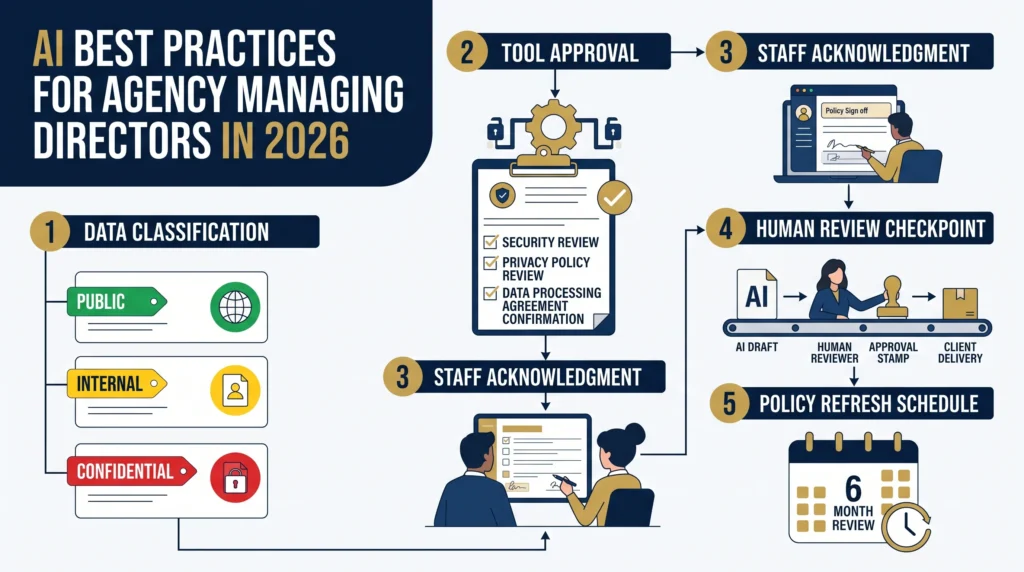
An agency AI governance policy is a written document. It defines which tools your team can use. It also sets rules for what data cannot enter those tools. And it says how AI content must be reviewed before it reaches clients.
This policy protects your agency from data leaks, legal risk, and quality failures. Research from Harvard Business Review shows that careful agencies focus on governance first. Without it, team members make these decisions on their own. This creates mixed and often risky outcomes across client work.
Start by grouping your data into three tiers: public info, internal files, and private client data. Decide which groups staff can enter into basic AI tools. Others will need enterprise platforms with signed data agreements. Publish an approved tool list. Require all staff to sign a written form.
Add a required human review step for any AI-made client output. Assign final sign-off to a named role in each department. Review and update the policy every six months as tools and rules change.
Which AI Roles Should Your Agency Hire or Train For?
Your best AI candidates are already on your team. Current account managers, strategists, and creative staff know your clients and market. They bring deep knowledge of client goals and agency culture. Training them in AI strategy and prompt building builds on that knowledge. Outside hires take months to reach the same level.
Training your current team costs much less than hiring AI experts. The job market for these roles is tight. Find two or three employees per department. Look for those who show real interest in new tools. Train them first. Let them become internal champions who coach colleagues and fix issues.
Some roles need real technical depth, like data pipeline management. For those, consider a part-time specialist or a project-based contractor. This is often better than a full-time hire.
Define clear output standards for what AI-assisted work looks like in each role. Teams that build this in-house skill adapt faster when tools change.
Ready to put your team’s new AI skills to work for clients? AI Smart Ventures offers AI Marketing services for growing businesses. Schedule a consultation to explore how your agency can turn internal AI skills into stronger client results.
How Can AI Improve Your Agency’s Client Pitches?
AI can make new business pitches faster and more data-driven. These pitches go beyond what manual research alone can do. It can check a prospect’s digital presence, rival position, and audience behavior. Your team would spend much more time doing this by hand.
This lets you include real market insights in proposals. You avoid the vague claims that every other agency makes. Use AI to build multiple creative concepts or campaign structures during pitch prep. Then have your strategists refine the strongest options.
AI can also produce rough output forecasts based on industry data. This gives prospects a clear view of expected results. Include these forecasts with simple method notes. This helps clients follow the logic behind the numbers.
According to HubSpot’s State of Marketing report, data-backed proposals always win more business than generic decks. Track your win rates by pitch type over 90 days. This shows which AI-assisted approaches are actually working.
How Do You Measure AI Success at Your Agency?
To measure AI success, track business outcomes, not just task counts. Hours saved is useful data. But it does not show if AI is making your agency more money. It also does not show if you are keeping clients longer.
Strong AI tracking connects directly to your business model. Track project profit, client retention, and new business wins. These are the numbers that tell the real story.
Check project profit before and after AI use in a given workflow. If AI cuts production time but quality drops, your net gain is lower than it looks. Watch for more revision requests as a warning sign.
Monitor client scores and retention rates alongside internal output data. Compare win rates for AI-assisted pitches versus standard ones. Set a 90-day review cycle to build up enough data.
This helps you see real trends instead of reacting to short-term noise. Write up your findings and share them with agency leaders and clients. This gives them clear proof of AI’s impact.
What AI Ethics Rules Should Agency Directors Set?
Agency directors need a written ethics policy. It should cover openness, accuracy, and fairness in AI-assisted work. Clients want to know when AI tools play a key role in their campaigns. This is most true for content creation and strategy work.
Clear standards protect your agency from brand risk. They also build long-term client trust. That trust directly supports retention.
The MIT Sloan Management Review finds that open AI practices are a key factor in client confidence. Start with an openness rule. State in writing which parts of your process use AI tools. Also explain how human review applies at each stage.
Add an accuracy rule. Check any AI-made stats, forecasts, or facts before they reach a client. Set a fairness standard for data inputs to guard against biased targeting. Address intellectual property clearly in client contracts. Say how ownership of AI-assisted creative work is handled. Review these standards every six months alongside your governance policy.
How Do You Scale AI Across Your Whole Agency?
Scaling AI across your agency needs a step-by-step approach. Build each phase on what you learned in your pilot program. Do not move to the next department until you have clear results. Moving too fast creates confusion and quality issues that are hard to fix.
A set rollout keeps standards steady. It also gives team members the time and training they need. This helps them adapt at each stage. Create a rollout plan. Name which department comes next and what training is needed. Also set success metrics for each phase.
Assign an AI lead in each department. This person owns the change and reports on progress. Update your tool list, governance policy, and training materials as you scale. This ensures everyone works from current standards. Share progress across the agency at set times. This helps staff see that AI adoption is a top goal.
Celebrate visible wins. For example, a faster production cycle or a pitch that closed based on AI research. A set scale-up builds AI skill across your whole agency. This becomes a lasting edge.
Frequently Asked Questions
What are AI best practices for agency managing directors?
AI best practices for agency managing directors are written rules. They govern how agency teams pick, use, and review AI tools in daily work. They cover data safety, staff training, output checking, and client openness. Strong practices help agencies adopt AI in a way that protects clients. They maintain quality standards and build strong features over time. Review and update these rules at least twice a year as tools and standards change.
How quickly can an agency see results from AI adoption?
Most agencies see clear results within 60 to 90 days of a focused pilot program. Early wins often show up in time saved on busy tasks such as content drafts, output reports, and research. Larger outcomes like better client retention or higher win rates take longer. Expect three to six months for those. Results depend on how clearly you set success metrics from the start. They also depend on how well your team follows the new workflow.
What data should agencies never put into AI tools?
Agencies should never enter client personal data into basic AI tools. The same goes for draft campaign plans, contract terms, pricing, or private creative briefs. These carry legal and brand risk if exposed in a data breach. Risk also comes if the platform allows training on user inputs. Always check whether a tool’s data agreement gives enough protection before using it for client work.
Which AI tools work best for marketing agencies?
The best AI tools for marketing agencies depend on your workflows and client needs. Common options include large language models for content drafts and research. AI data platforms are useful for output insight summaries. Social media tools with built-in copy help are also popular. Check each tool against your governance policy and data safety needs. Also check it against the tasks your team does most often. Do this before paying for a plan.
How much does AI adoption cost for a growing agency?
Costs vary based on agency size, the number of tools used, and training needed. Many agencies start with free or low-cost tiers during a pilot phase. As use grows, costs rise to include enterprise tool plans, training programs, and some expert support. Setting a budget per phase helps you manage spending and check return on investment before signing larger contracts. Contact AI Smart Ventures to explore a cost-good approach for your situation.
How do you train staff on AI without disrupting client work?
Train staff on AI in phases that run alongside current workflows rather than replacing them. Start with a small group who test tools without risking live client outputs. Create short sessions focused on specific tasks rather than full tool tours. Use recorded sessions so team members who miss live training can catch up later. Build a shared tool library. Staff can post prompts and examples that work well for your clients.
What governance rules do agencies need for AI content?
Agencies need four core governance rules. First, a data sorting rule defines what info is safe to enter into each tool. Second, an approved tool list limits which platforms staff can use for client work. Third, a required human review step must happen before any AI content reaches a client. Fourth, a clear sign-off step assigns ownership for final output quality. These four rules fix the most common failure points in agency AI adoption without large process changes.
How does AI change the client bond?
AI raises client standards for speed, custom work, and data openness. Clients who know AI may expect faster outputs and more detailed insights. Agencies that use AI well can meet these standards and stand apart from rivals who do not. Openness is key. Clients respond well when agencies clearly explain how AI tools help them deliver better work. Do not treat AI use as a hidden back-end step.
Can AI replace account managers or strategists?
No. AI works best when it handles routine, high-volume tasks. This frees account managers and strategists to focus on client bonds, strategic thinking, and creative judgment. These roles need deep knowledge of client goals, industry nuance, and people skills. Current AI tools cannot match this. Agencies that treat AI as a tool for their current talent always outperform others. Those that try to cut headcount through AI tend to fall behind.
What is the biggest AI risk for agency managing directors?
The biggest AI risk is data leaks through unsecured tool use. Team members who enter client data into basic AI platforms without oversight create legal and brand risk for the agency. Other risks include mixed output quality that damages client bonds. Leaning too hard on AI content that lacks strategic depth is also a concern. A written governance policy with required human review fixes all three risks before they become problems.
Executive Summary
Agency managing directors who build structured AI practices now will outperform rivals who delay. The key steps are a pilot program and a written governance policy. Also add internal staff training. Add a tracking plan tied to real business outcomes. Starting small limits risk while building the proof needed to back broader investment.
Agencies that follow these practices speed up campaign output. They also strengthen new business pitches. Client bonds built on data-backed work become stronger too.
The goal is not to replace your team’s talent. It is to give them better tools to deliver the work clients already expect.
What Should You Do Next?
Start by finding one busy workflow. Look for one where AI can cut production time without affecting quality. Write a one-page governance document covering data handling and tool approval. Do this before your team begins testing any new tools. Then set three success metrics to track. Follow them during the first 90 days of your pilot.
AI Smart Ventures offers AI Marketing services for growing businesses. Want a clear, proven path to AI adoption for your agency? Schedule a consultation to map out a plan that fits your current team and client base.
People Also Read
- How to Check an AI Marketing Agency Before You Hire
- Should You Hire an AI Consultant, Freelancer, or Agency?
About the Author
Nicole A. Donnelly is the Founder of AI Smart Ventures and an AI Adoption Specialist with 20 years of history as a founder and CEO and over a decade leading AI adoption plans. She helps businesses connect AI with clarity and confidence, driving innovation and lasting growth. Nicole has trained over 20,217 experts in Applied AI, delivered 624 workshops, and worked with close to 1,000 businesses across diverse industries.
Expertise: AI Transformation, AI Strategy, AI Rollout, AI Adoption, Applied AI, Marketing, Business Operations
Disclaimer: This content is for informational purposes only and does not constitute expert business or tech advice. Results vary based on industry, current systems and rollout commitment. Contact AI Smart Ventures for a consultation about your specific situation.