
AI Briefing Templates for Agencies: How to Pre-Brief AI Right
Last Updated: July 2026
An AI briefing template is a structured document. It gives an AI model the context, goals, and audience details it needs. It also tells the model what to avoid. This helps it produce consistent, on-brand work.
Unlike a single-line prompt, a template captures repeatable items. These include tone of voice, audience personas, output format, keyword focus, and constraints. Teams use templates for content creation, ad copy, research, and social media. A good template cuts revision cycles. It keeps every output aligned with your client’s brand from the first draft.
AI Smart Ventures has guided hundreds of growing businesses through building structured AI briefing systems. These systems reduce rework and improve content quality at scale. Agencies that standardize how they instruct AI tools see faster production cycles and cleaner first drafts.
Marketing teams that use ad hoc prompting often find the same problem. Their outputs are inconsistent. They take longer to fix than to rewrite from scratch. A repeatable briefing template solves this. It puts your brand standards directly into the instruction. The sections below show you exactly how to build and use an AI briefing system. They also show how to measure it.
Key Takeaways
- A complete brief covers context, audience, tone, and constraints. Giving an AI model all four elements reduces unclear outputs. It also shortens the editing cycle for every content type your agency produces.
- Poor briefing is the main cause of AI rework. Vague instructions force your team to spend extra hours fixing tone, facts, and format. This happens before content is ready to publish or send to a client.
- Proven frameworks like AIDA structure briefs for better results. Embedding a known content flow gives the model a goal-oriented path. Every output then drives the reader toward a specific action.
- Shared template libraries scale your step across teams. Storing your best briefs in a shared workspace lets every team member start from a tested baseline. They don’t have to guess the format.
- Tracking speed metrics shows where to improve. Measure revision rates and time-to-approval. This shows which templates deliver the highest return and which ones need a refresh.
What makes a good AI briefing template?
A good AI briefing template removes guesswork before the model starts working. It includes a project overview, a detailed audience persona, and a defined tone of voice. It also covers specific output formats and a list of constraints. When each element is present, the tool has enough context to match your client’s brand. Agencies that use detailed briefs reach an accurate first draft up to 40% faster than teams using single-line commands.
According to the HubSpot State of Marketing report, AI adoption in marketing is growing fast. Structured inputs are key to getting consistent results. The template must also address what the model should never do. These constraints might include avoiding competitor names or certain phrases. They can also rule out a writing style that doesn’t fit the brand.
For each client account, add a short glossary of approved terms. Also add two or three brand voice examples. The more specific the input, the more consistent the output. Store the template in a shared workspace. This lets the whole team access and update it.
How do you brief AI for content creation?
To brief AI for content creation, build your instructions around a proven content structure. Fill in every key field before you make a single word. A strong brief needs a primary keyword and a target reading level. It should also have a clear call-to-action. It should also note the buyer journey stage. Without those four anchors, the model defaults to generic content.
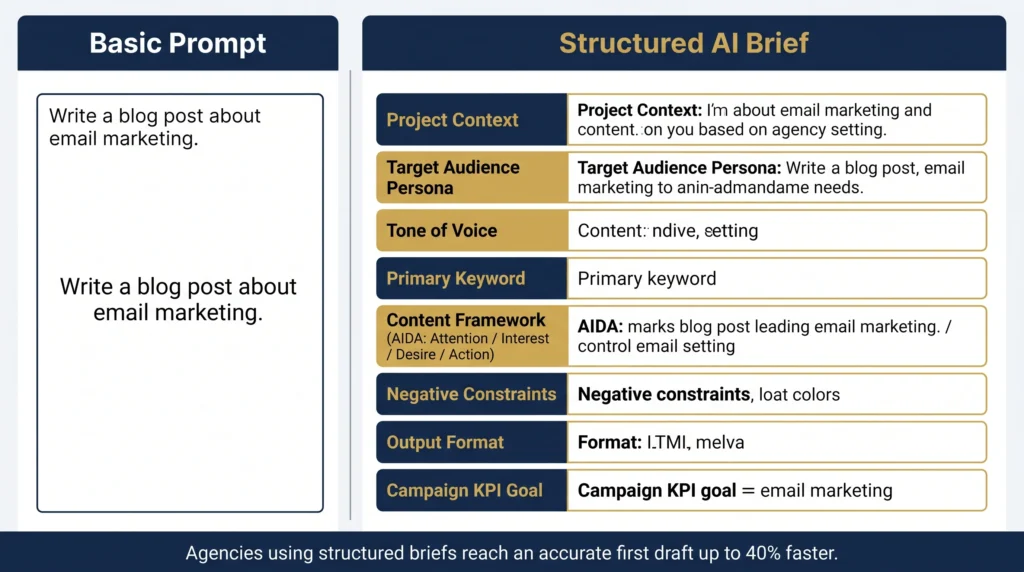
The AIDA framework (Attention, Interest, Desire, Action) is one of the most reliable structures for your briefs. Embed it in every template you build. Telling the model to follow this sequence keeps the content goal-oriented. It stays on track from start to finish. Add at least one example of a high-performing piece. Make sure it is in the style you want. Also add one example of what to avoid. This contrast helps the model calibrate faster than a written description alone.
Review the first output against your brief field by field. If a field in the template did not change the output, rewrite that field. Add more detail.
What are the risks of poor AI briefing?
Poor AI briefing creates outputs that miss the brand voice. They may also contain inaccurate info and fail to serve the campaign goal. Each of those failures adds editing time and hurts team confidence in AI tools. When an agency sends vague instructions, the model fills in the gaps. It uses generic content to do so. That content does not connect with the target audience.
The costs add up quickly. A single poorly briefed long-form piece can need several hours of rewriting. It won’t be ready for client review until then. At scale, that rework removes the time savings AI was supposed to deliver. Agencies also risk publishing inaccurate content. This happens when the model has no source material. The fix is straightforward. Invest time upfront in building a detailed brief. The model will return that investment in cleaner, faster first drafts.
Which frameworks work best for AI briefs?
The strongest frameworks for AI briefing are AIDA, PAS, and the Five Ws. AIDA stands for Attention, Interest, Desire, and Action. PAS stands for Problem, Agitation, and Answer. The Five Ws cover who, what, when, where, and why. Each one gives the model a logical sequence to follow. This reduces the chance of disorganized or off-topic content.
AIDA works best for persuasive content and ad copy. PAS works well for email campaigns and landing pages. The Five Ws is ideal for research summaries, press releases, and news-style content. Harvard Business Review notes that structured AI inputs always outperform vague prompts across business use cases.
You can layer frameworks together for more complex content. For a long-form blog post targeting a top-of-funnel audience, use the Five Ws for context. Then add AIDA for structure. State this combination in the template. The model will then know how to sequence the content. Document which framework performed best for each content type. Build a standing reference your team can consult. This reference also becomes a useful onboarding tool for new hires.
How do you build a reusable prompt library?
A reusable prompt library is a shared collection of tested, approved briefing templates. Start by finding the ten to fifteen content types your agency produces most often. Build one template for each type. It should capture the structure, tone, voice, and constraints for that format. Store these in a shared workspace such as Notion, Google Docs, or your project management platform. Every team member should have access right away.
Once your library has a foundation, assign a version number to each template. Set a quarterly review schedule. As your agency finds which briefs produce the best outputs, update the master template. Then retire older versions. Encourage every team member to flag briefs that under-deliver. This helps you spot patterns and fix weak spots. A living library grows in value over time. Each update reflects real output data from your own client work.
Ready to build a standardized AI content system for your agency? AI Smart Ventures offers AI Marketing services designed to help growing businesses create reliable, repeatable AI workflows. Schedule a consultation to start building your agency’s briefing library today.
How do you measure briefing template success?
You measure briefing template success by tracking two types of data. The first is speed metrics. These include time spent on the first draft and number of revision rounds. Also track time from completed brief to client approval. The second is output quality metrics. These include use rates on published content and conversion rates on copy-driven assets. Also track client satisfaction scores.
Set a baseline before you introduce templates. This gives you a clear comparison point. After sixty days of consistent use, compare your revision rates against that baseline. Also compare your draft-to-approval times. According to McKinsey’s State of AI research, companies that track AI output metrics see better returns over time. Agencies that move from ad hoc prompting to structured briefing always see time-to-value improve by 40%. Use the data to rank your templates by output. Focus your updates on the formats with the highest volume. These are also the ones with the most room to improve.
Frequently Asked Questions
What is an AI briefing template for marketing agencies?
An AI briefing template for marketing agencies is a structured document. It gives an AI model all the context it needs to produce a specific output. It typically includes fields for project context, audience details, tone of voice, keyword focus, output format, and constraints. The goal is to replace a single-line prompt with a complete set of instructions. This reduces unclear outputs and produces more consistent, on-brand content.
Why do agencies need AI briefing templates?
Agencies work across multiple clients and content types at the same time. Without a shared briefing standard, each team member prompts AI tools differently. This leads to inconsistent outputs and extra revision rounds. Templates create a common starting point so every piece of content begins from the same quality baseline. This saves time on corrections, improves brand alignment, and makes it easier to bring new team members up to speed.
What should every AI brief include?
Every AI brief should include a project overview, a target audience persona, and a tone of voice guide. Also include primary and secondary keywords, a defined output format, and a list of constraints. Add one high-quality example of the style you want. Also add a note on the specific call-to-action the output should drive. The more complete the input, the less editing the output needs before it is client-ready.
Can I use the same template for every client?
Start with a master template structure but set up it for each client. The core fields, such as output format and constraint list, stay consistent across accounts. The tone of voice guide, audience persona, and brand glossary must reflect each client’s specific standards. Create a master version, then duplicate and set up it per client. Store each version in the client’s folder so it is easy to find and update.
What is the AIDA framework and how does it apply to AI briefs?
AIDA stands for Attention, Interest, Desire, and Action. It is a content structure that guides a reader from first contact to conversion. When you embed AIDA into an AI brief, you instruct the model to open with a hook. Then it builds interest with supporting info. Next it presents a compelling reason to act. It closes with a clear call-to-action. The result is content that is organized, persuasive, and focused on driving the reader toward a specific goal.
What are negative constraints in an AI brief?
Negative constraints are instructions that tell the model what to avoid. Examples include specific phrases, competitor names, industry jargon, or a writing style that does not match the brand. Adding a negative constraints field to every template prevents the model from defaulting to filler content. It also prevents the model from using language your client has asked to avoid. Negative constraints are one of the most underused elements in agency briefing workflows. Yet they often have the biggest impact on first-draft quality.
How do I get my whole agency team using AI briefing templates?
Start with a short training session. Walk through one complete template from brief to final output. Show a side-by-side comparison of a briefed output and an unbriefed output to make the value clear. Require every content request to start with a completed template before the AI tool is opened. Make templates easy to find in your shared workspace. Assign one person to manage updates so the library stays current and trusted.
How can I get help building AI briefing templates for my agency?
AI Smart Ventures works with growing agencies to design and build AI briefing systems tailored to their content workflows. From initial template design to team training and output tracking, the step covers every stage of the rollout. Schedule a consultation to discuss how a structured briefing system can reduce rework. You will also improve output quality across every client account.
Executive Summary
AI briefing templates give marketing agencies a repeatable system for instructing AI tools. A complete template includes project context, audience personas, tone of voice, output format, and constraints. Using proven frameworks like AIDA and PAS inside your briefs keeps every output focused. It also keeps content goal-oriented. Build a shared prompt library and review it quarterly. This turns a one-time setup into a growing asset for your team. Track revision rates and time-to-approval. This shows which templates deliver the most value and where to focus next.
What Should You Do Next?
Audit the prompts your team now uses. Find the five content types that need the most revision rounds. Build a master briefing template for each of those formats and store them in a shared workspace. Run a short training session to walk through filling out each template before opening an AI tool. AI Smart Ventures offers AI Marketing services for growing businesses that want a proven framework for AI content production. Schedule a consultation to build a briefing system that reduces rework and improves output quality across every client account.
People Also Read
About the Author
Nicole A. Donnelly is the Founder of AI Smart Ventures and an AI Adoption Specialist with 20 years of history as a founder and CEO and over a decade leading AI adoption plans. She helps businesses connect AI with clarity and confidence, driving innovation and lasting growth. Nicole has trained over 20,217 experts in Applied AI, delivered 624 workshops, and worked with close to 1,000 businesses across diverse industries.
Expertise: AI Transformation, AI Strategy, AI Rollout, AI Adoption, Applied AI, Marketing, Business Operations
Disclaimer: This content is for informational purposes only and does not constitute expert business or tech advice. Results vary based on industry, current systems and rollout commitment. Contact AI Smart Ventures for a consultation about your specific situation.