The Ultimate Guide to Shortlisting AI Consulting Partners for SMBs
AI has moved from a boardroom talking point to a daily tool inside small and medium businesses. Owners sign up for free trials, sit through webinars, and read the newsletters. Then most of them walk away without a clear next step. The gap between wanting AI and actually running it well inside a business is where most AI budgets quietly disappear.
Here’s what we’ve learned from working with close to 1,000 organizations and training more than 20,217 professionals in applied AI: the tool is rarely the problem. The plan is. For an SMB, the single strongest predictor of measurable ROI from AI is the partner you choose to guide it. This guide walks through what an AI consulting partner does, how to tell if your business is ready, what a working AI implementation roadmap looks like, how to protect your data, what it costs, and how to build a shortlist that holds up under pressure.
Why Your SMB Needs an AI Consulting Partner, Not Just New Tools
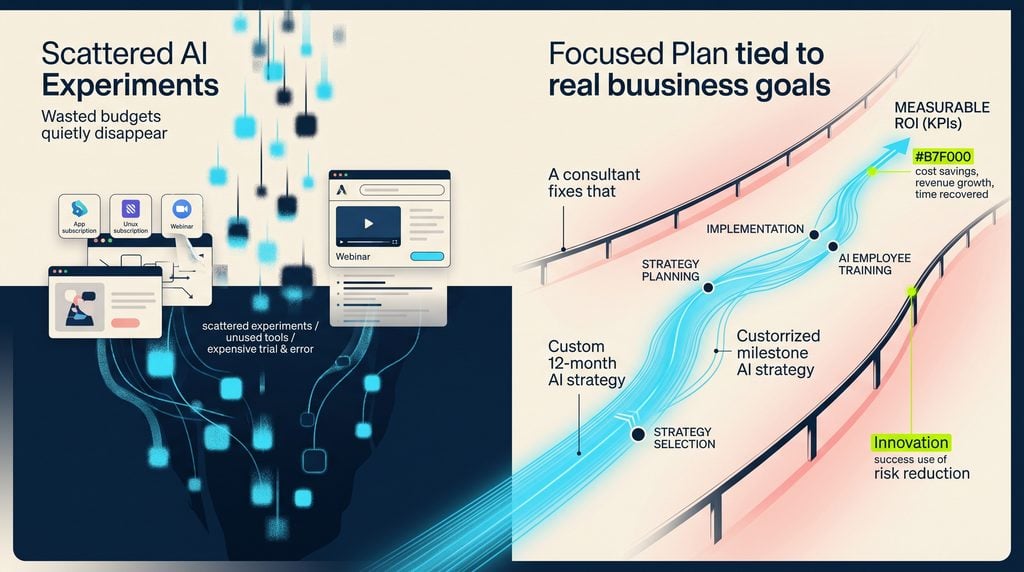
An AI consulting partner helps small and medium businesses turn scattered AI experiments into a focused plan tied to real business goals. That covers strategy, tool selection, implementation, AI employee training, and ongoing advisory. At AI Smart Ventures, the core deliverable is a custom 12-month AI strategy with defined actions, owners, timelines, and KPIs tied to cost savings, revenue growth, and time recovered.
Buying off-the-shelf AI tools feels like progress, but it usually isn’t. We see the same pattern again and again: a company buys 3 or 4 AI subscriptions, a few people try them, and 6 months later nobody uses them. The software works fine. Nobody mapped it to a workflow, trained the team, or measured the result.
A consultant fixes that by starting with the business, not the tool. When we run discovery with a client, we look at operations, team capacity, competitive pressure, and growth goals before we recommend a single platform. That order matters. It keeps you out of “shiny object syndrome,” where every new AI launch pulls attention away from the plan you already have.
The biggest value is risk reduction. Every AI decision carries a cost: money, time, data exposure, and team morale. A good partner has already seen what works and what fails across dozens of businesses like yours, so you skip the expensive trial and error.
| Approach | What Happens | Typical Result |
| Tool-only (DIY) | Buy subscriptions, hope for adoption | Low usage, unclear ROI |
| Consulting partner | Strategy first, tools matched to workflows, team trained | Measurable outcomes tied to KPIs |
Is Your Business Ready? Preparation and Pre-Discovery Checklist
Your business is ready for an AI implementation expert when you have repeatable processes, a clear business goal, and leadership willing to commit time to the change. You don’t need a technical team. You don’t need to know which model is best. You need to know where your time and money are leaking.
Signs Your Business Is Ready for AI Implementation
- Your team repeats the same manual tasks every week, such as data entry, reporting, or email follow-ups.
- Customer service volume grows faster than your headcount.
- Different people already experiment with AI tools, but nobody coordinates it.
- You bought AI software that nobody uses consistently.
- Leadership agrees AI matters but can’t agree on where to start.
Process Bottlenecks That Signal Readiness
The best early targets are bottlenecks that are high-volume, rule-based, and time-heavy. Client onboarding, proposal drafting, internal reporting, support tickets, and content production show up on almost every discovery call we run. If your team says “this takes forever and it’s the same every time,” that’s an AI opportunity.
What to Gather Before Your Discovery Call
- Workflow maps: A simple list or sketch of your 5 to 10 most time-consuming processes.
- Software stack: Every tool you pay for, including CRMs, project management, and communication platforms.
- Current AI usage: Which tools people already use, officially or not.
- Business goals: 2 or 3 outcomes you care about most in the next 12 months.
- Data inventory: Where your customer, financial, and operational data lives, and who can access it.
- Pain points by team: Short notes from department leads on their biggest time drains.
Clear goals matter more than technical knowledge. We can teach the technology. We can’t invent your priorities. Leadership buy-in matters just as much. When the owner or CEO commits to the process before the first call, projects move in weeks instead of stalling for months.
What a Successful AI Adoption Roadmap Looks Like
A successful AI adoption roadmap for an SMB moves through 5 phases: Discovery, Strategy, Pilot, Full Implementation, and Scaling. Each phase has a clear output, and nothing moves forward until the previous phase proves its value.
| Phase | Goal | Output |
| Discovery | Find the highest-value AI opportunities | Prioritized opportunity list |
| Strategy | Build the plan | 12-month roadmap with KPIs, owners, and timelines |
| Pilot | Test on 1 or 2 workflows | Proven results on a small scale |
| Full Implementation | Deploy across teams | Live, integrated AI systems |
| Scaling | Expand to new use cases | Compounding gains across the business |
We run this through our Map, Act, Reflect, and Tune cycle. Map builds the plan. Act deploys solutions and trains the team. Reflect measures results against the KPIs. Tune adjusts what isn’t working. Then the cycle repeats, and each round builds on the last.
AI workflow automation starts with low-hanging fruit: tasks with high volume, low risk, and clear rules. We pick 1 or 2 workflows where a win is visible within weeks. Early wins build confidence across the team and fund the next phase.
To avoid disrupting daily operations, we shadow processes before we replace them. The AI system runs alongside the existing workflow first. Your team keeps working the old way while we compare outputs, catch errors, and tune the instructions. Only when the AI version matches or beats the manual one do we switch over. Nobody wakes up to a broken process on a Monday morning.
This structure turns vague AI goals into measurable outcomes. One client described going from “a dozen scattered ideas to a focused, funded roadmap in six weeks.” That shift, from chaos to a plan with numbers attached, is the whole point of the roadmap.
Prioritizing Data Management and Security in Smaller Companies
AI data security for SMBs starts with one rule: your proprietary data should never flow into a tool you haven’t vetted. Most owners worry, correctly, that pasting customer records or financial data into a public AI chatbot could expose it. A reputable consulting partner builds guardrails before any data moves.
The difference between tools matters. Free consumer AI tools may use your inputs to improve their models, depending on settings and terms. Business and enterprise versions, along with private AI instances, keep your data inside controlled environments with clear retention rules. When we build solutions for clients, we follow secure-by-design principles and build to SOC 2 and GDPR standards from day one. We set up secure data pipelines, limit access by role, and put a human review step on AI outputs before they reach a customer.
Baseline Security Expectations for Any AI Partner
- A clear explanation of where your data goes and who can see it
- Role-based access controls on every AI system
- Business-grade or private AI instances for sensitive data
- A written AI use policy for your team
- Compliance alignment with your industry, such as healthcare, finance, or legal requirements
- Human-in-the-loop review for customer-facing outputs
For regulated industries, data security isn’t a checkbox. It shapes every technical decision, and your partner should treat it that way.
The Critical Role of Change Management and Ongoing Training
AI projects fail more often from low adoption than from bad technology. A perfect system that your team avoids is worth nothing. Change management, meaning how you prepare, train, and support people through the shift, decides whether your AI investment pays off.
Training works when it’s hands-on. In our workshops, participants open accounts, share screens, build tools, and finish real projects during the live session. We call it the “get your hands dirty” approach. Lectures get forgotten. Building something that saves you 2 hours on Tuesday does not. We’ve documented that employees with high AI literacy save an average of 50% of their time on tasks by moving from blank-page starts to AI-assisted refinement.
Job anxiety is real, and we address it directly. Save a Life, a medical training company, went through hands-on AI training with us and then automated 99% of its customer service operations. The support team went from 4 people to 1, and the company generated $177,000 in combined savings and repurposed labor value. Nobody was laid off. Every person was upskilled into a new, higher-value role. That’s the story we help clients tell their teams: AI takes the repetitive work so people can do the work that matters.
AI Smart Ventures provides ongoing employee training and post-launch support. Our options include:
- Applied AI Course Level 1: A 10-week cohort certification that takes professionals from AI-curious to AI-capable, with no technical background required.
- AI Your Ops: A 4-week live course where operators map their workflows and build working automations, at 3 to 5 hours per week.
- Custom AI Courses and Workshops: Training built around your tools, workflows, and industry.
- Post-launch support: Q&A sessions, troubleshooting, and continuous improvement as your team applies what they learned.
Continuous upskilling protects the investment. AI tools change every few months. A team that keeps learning keeps getting value long after launch.
Budgeting for AI: Are AI Consulting Services Worth the Investment?
The cost of end-to-end AI consulting depends on scope: how many workflows you automate, how much custom building you need, how many people you train, and whether you want ongoing advisory. A focused strategy engagement costs far less than a full implementation program, and most SMBs start with strategy and expand as results come in.
What Drives the Cost of AI Consulting
- Strategy scope: A single department or the whole business
- Implementation complexity: Simple automations versus custom AI agents and integrations
- Training size: A small leadership team or every department
- Ongoing support: One-time project or monthly advisory
- Compliance needs: Regulated industries require extra security work
Budget in phases, not in one lump sum. A realistic SMB plan funds the strategy first, then a pilot, then full implementation once the pilot proves ROI. That way every dollar you spend has evidence behind it. We scope and price every engagement after a discovery call, because a quote without understanding your operations is a guess.
The ROI model rests on 3 numbers: time saved, errors reduced, and revenue gained. When we build a client strategy, we define those KPIs up front so the return is visible, not assumed. Across the organizations we’ve served, the results add up to an estimated 10 million hours saved.
Compare that to the hidden cost of a failed internal AI project: unused subscriptions, months of staff time spent experimenting, security gaps, and a team that now distrusts AI. For growing businesses, AI Smart Ventures’ strategy and implementation services are built to pay for themselves through measurable outcomes, with training and advisory that keep the gains growing.
Building Your Shortlist: Key Criteria and Vendor Red Flags
A strong shortlist of AI consulting partners includes firms with a proven track record, a clear framework, a focus on measurable ROI, and a real commitment to training your team. Everything else is secondary.
Must-Have Criteria for an AI Consulting Partner
- Proven track record with businesses your size, backed by named results
- A clear, repeatable framework that moves from strategy to execution to measurement
- ROI focus with KPIs defined at the start of the engagement
- Integration ability with your current tech stack, including your CRM and project tools
- Training built in, not sold as an afterthought
- Security standards such as SOC 2 and GDPR alignment
- Ongoing support after launch
- Vendor neutrality, recommending tools that fit you rather than tools they resell
Integration ability deserves extra attention. The best AI system is the one that plugs into how your team already works. A partner who wants to rip out your stack before doing anything is creating work, not value.
Red Flags When Evaluating AI Implementation Vendors
- Promises of overnight transformation or guaranteed results with no discovery
- Pushing proprietary, black-box software you can’t maintain without them
- No training plan, or training treated as optional
- One-size-fits-all pitches that ignore your industry and team size
- Vague answers about data handling and security
- No defined KPIs or success metrics
- Heavy jargon with no plain-language explanation
One-size-fits-all pitches are especially dangerous for SMBs. Your margins, team size, and workflows differ from an enterprise and from your competitor down the street. A partner who hasn’t asked about them can’t plan for them.
Questions to Ask During Evaluation
- What results have you delivered for businesses our size?
- How do you define and measure success in the first 90 days?
- How will your solutions integrate with our current tools?
- Where does our data go, and who can access it?
- What training do our employees receive, and what support continues after launch?
- Can our team maintain what you build without you?
Finding the Right Fit: Enterprise vs. SMB-Focused Consultants
Enterprise consultants like IBM and Accenture are built for large-scale transformation programs at global organizations. Their model typically involves large teams, long multi-phase engagements, and pricing structured for enterprise budgets. For a Fortune 500 company rebuilding its entire technology infrastructure, that model makes sense.
For mid-market and small businesses, it often doesn’t. SMBs need speed, budget alignment, and a partner who works directly with the owner and the operators, not a rotating team of junior consultants. Enterprise timelines can stretch for quarters before a single workflow changes. A growing business can’t wait that long for a return.
| Factor | AI Smart Ventures | Accenture (Enterprise Model) |
| Primary focus | SMBs and mid-market | Large global enterprises |
| Budget alignment | Scoped in phases for SMB budgets | Structured for enterprise budgets |
| Implementation speed | Weeks to first wins | Longer multi-phase programs |
| Team involvement | Senior practitioners work directly with you | Large, layered consulting teams |
| Training | Hands-on, built into every engagement | Varies by engagement |
| Ongoing support | AI Advisory, courses, and post-launch support | Varies by contract |
When comparing AI Smart Ventures vs Accenture for SMB AI adoption, the deciding factors are budget alignment and implementation speed. We’re practitioners, not just advisors. We build the tools we teach, train the teams we build for, and measure every engagement against business outcomes. Clients have described our AI Advisory work as having “an AI expert on our leadership team,” without the cost of a full-time senior AI hire.
Specialized partners deliver faster time-to-value because they’re built for how growing businesses actually operate: lean teams, tight budgets, and no patience for decks that sit in a drawer. The right partner gives you a clear plan, the right tools, and a team that knows how to use them.
Ready to Transform Your Business with AI? Book a tailored consultation with AI Smart Ventures to identify your best AI opportunities and the fastest path to real results.