
AI Content Marketing for Mental Health Brands in 2026
Last Updated: July 2026
AI content marketing for mental health brands in 2026 is a set system that uses AI to plan, write, and share content on digital channels. It pairs drafting tools, SEO tools, and data with the care that mental health topics need. The goal is simple: reach people who need help while staying within the rules and building real trust.
AI Smart Ventures works with growing firms in many fields to build solid AI content plans. Their team helps solo owners cut the guesswork from AI use. They turn content into a steady driver of growth.
Mental health content sits at the crossroads of marketing, ethics, and rules. Getting it wrong can damage trust or create legal risk. Getting it right means more people find the help they need – and more firms grow.
Key Takeaways
- AI Cuts Content Time a Lot – Marketers using AI save an average of 3 hours per piece, per HubSpot’s 2025 State of Marketing report.
- Rules Are a Must – Mental health brands must follow HIPAA privacy rules and FTC health claims rules; AI tools must be set up with these guardrails built in.
- Custom Content Drives Results – Brands using AI-based custom content see up to 40% higher email open rates, per Salesforce’s 2025 Connected Customer report.
- AEO Is Reshaping Health Search – AEO now drives 35% of zero-click health searches; clear FAQ content is the entry point.
- Human Review Is Still Key – AI drafts content; a licensed staff member or trained lead must review every piece before it goes live.
These points show one clear truth: AI gives mental health brands a speed edge. But speed without a review layer creates real risk. Brands winning in 2026 have built both into one steady flow.
What Is AI Content Marketing for Mental Health?
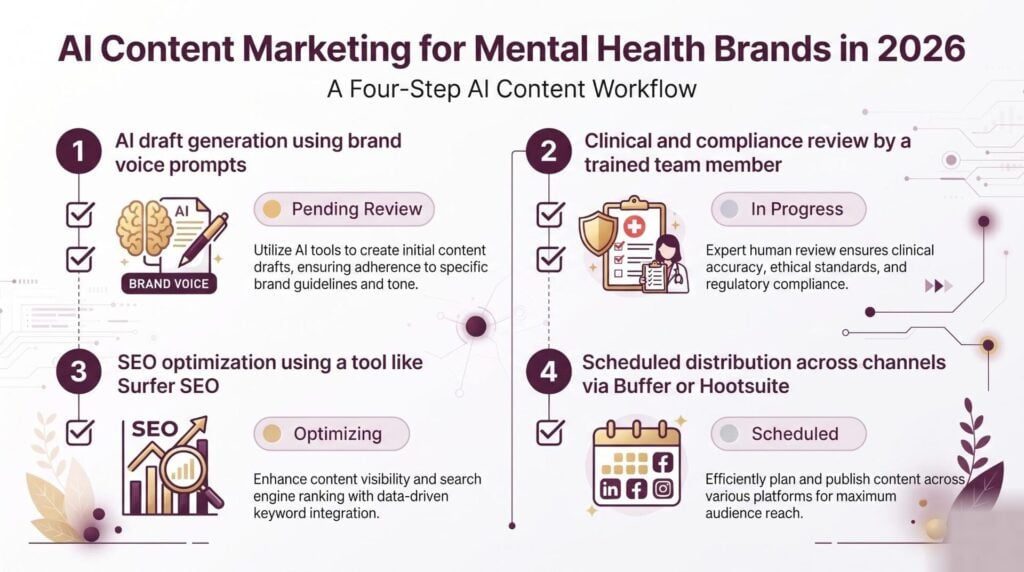
AI content marketing for mental health is the use of AI tools to create, improve, and share content that helps people find mental health help. Tools like Jasper AI and Copy.ai write blog drafts, social posts, and email series much faster than a human can. One therapy group cut their content team’s work by 55% after adding AI drafting tools.
Mental health content needs more care than most areas. Topics like fear, grief, and trauma need warm, right, and stigma-free words. AI tools trained on web data can default to jargon or overly simple takes.
Teams must set up brand style guides and review steps to catch these issues before posting. This step is not optional – it is key.
Why Is Compliance Key for Mental Health Content?
Mental health brands must follow HIPAA rules when patient data touches their content flow. The FTC’s health marketing guidelines also limit how therapy outcomes can be described in public content. Failing either standard can bring fines and lasting harm to brand trust.
AI tools do not see these limits on their own. Teams must set up tools with guardrails: blocked phrases, needed notes, and required human review steps.
Brands that build these checks into their AI flow cut legal risk while still making content at scale.
Which AI Tools Work Best for This Niche?
Jasper AI is widely used for long blog content and brand voice. Surfer SEO helps improve content for search rankings using data scoring. Buffer and Hootsuite handle posting across social channels. For email, Klaviyo runs split email sends with AI-based send-time tuning.
| Tool | Best Use | Key Limitation |
|---|---|---|
| Jasper AI | Blog drafts, brand voice | Needs a clinical review layer |
| Surfer SEO | Content scoring | Focused on SEO, not tone |
| Klaviyo | Email custom sends | Requires clean, compliant data |
| Buffer | Social posting | Limited content features |
No single AI tool handles plans, rules, and sending in one place. Most mental health brands need a set of 3-4 tools. Start with one and add more only when that first tool runs well.
How Does AI Content Build Patient Trust?
Patient trust in mental health content comes from steady, right, and warm writing. Clearscope and similar tools make sure content covers topics well, reducing thin or wrong pages. Posting on a steady schedule builds trust over time.
AI can also help teams run A/B tests on headlines and calls to action. This helps you find the words that work best with your readers.
Trust also depends on being open with your readers. Brands that say they use AI – and explain their review flow – are better received by health readers. Per a 2025 Edelman Trust Barometer, 67% of health readers say being open about content creation builds trust. A short note in the footer is often enough.
AI Smart Ventures helps growing firms build content flows that are both fast and trustworthy. Their AI marketing work gets real results over vanity data. Schedule a consultation to see how this fits your mental health brand.
What Role Does AEO Play in Mental Health Content?
AEO is the work of writing content that AI search tools like Google’s AI Overviews can pull as direct answers. For mental health brands, AEO means building content with clear questions, direct answers, and schema tags. In 2026, 35% of health searches return zero-click answers pulled from AEO-ready pages.
Mental health FAQ content is very strong for AEO. Questions like “how do I find a therapist?” or “what are signs of burnout?” are high-volume, high-intent queries.
Brands that answer these clearly and correctly win top spots without needing to rank first in old-style search. AI tools can help build FAQ sets at scale, but each answer still needs human review for truth.
How Do You Measure AI Content Marketing Success?
Key measures for mental health content include search traffic growth, email open rates, and patient contact volume. Google Analytics 4 tracks traffic and key events on your site. Semrush shows keyword rank changes over time.
For email, Klaviyo’s page breaks down open rates, click rates, and sales by group.
Mental health brands should also watch content tone. Are comments positive? Are patients sharing content on their own? Tools like Brand24 track brand mentions and tone across the web and social channels. A drop in tone can signal that your AI content is missing the warmth this group needs.
Use these three tracking habits to stay on top:
- Review search traffic monthly and compare quarter over quarter to see trends, not just snapshots.
- Check email open rates weekly and use AI A/B testing to improve subject lines based on real data.
- Track patient contact volume monthly to link content output directly to business results.
Tracking only works if it leads to action. Set a 30-day review date and adjust your content plan based on what the data shows.
Frequently Asked Questions
What is AI content marketing for mental health brands?
AI content marketing for mental health brands uses AI tools to plan, create, and share mental health content at scale. It helps clinics, coaches, and wellness platforms publish well without burning out their teams. AI handles drafts, formatting, and posting. Human reviewers make sure each piece is right, within the rules, and warm.
Is AI-generated mental health content HIPAA-compliant?
AI-made content can be HIPAA-safe when tools and workflows are set up with care. HIPAA applies to private patient data, not general health content. Brands should avoid using patient data for custom content without proper consent. Review the HHS HIPAA guidance for marketing before building any custom content flow.
Can AI replace human writers for mental health content?
AI cannot replace human writers for mental health content, but it can handle most of the drafting work. Mental health topics need truth, empathy, and social care that AI does not do well on its own. The best model uses AI for first drafts. Human writers or trained staff then refine and approve each piece before it goes live.
What AI tools are best for mental health content marketing?
Jasper AI is widely used for blog drafts. Surfer SEO helps with content scoring. Klaviyo handles email in health and wellness content. Each tool serves one role and has real limits. No single tool does it all, so most teams build a set of 3-4 tools with a clear flow linking each step.
How much does AI content marketing cost for mental health brands?
Tool costs vary by volume and plan. A basic set with Jasper AI, Surfer SEO, and Buffer runs between $200 and $600 per month. Working with a partner like AI Smart Ventures adds to the cost but cuts risk and speeds up results for growing firms.
How long before AI content marketing shows results?
Most mental health brands see traffic growth within 60 to 90 days of posting steady, well-tuned content. Email results can improve within 30 days of adding AI-based list splits. SEO rankings take 3 to 6 months because search engines need time to index and rate new pages.
What are the risks of using AI for mental health content?
The main risks are wrong facts, tone issues, and rules failures. AI tools trained on web data may produce content that is just wrong, harmful, or that makes claims that break FTC health rules. Building a review flow with trained staff or licensed clinicians is the key safeguard against all three risks.
How does AEO differ from SEO for mental health brands?
SEO focuses on ranking pages in standard search results. AEO focuses on building content so AI search tools can use it as a direct answer. For mental health brands, AEO means writing clear FAQ content with proper schema tags. Both matter in 2026, but AEO is growing faster as AI-based search becomes the default.
Should mental health brands disclose AI use in their content?
Yes, telling readers you use AI builds trust. A 2025 Edelman survey found 67% of health readers trust brands more when open about how content is made. A short note in the author block or page footer is enough. It does not need to be big, but it should be easy to find.
Can owner-operators running solo coaching practices benefit from AI content marketing?
Yes, business owners running solo or small coaching groups can benefit greatly from AI content marketing. AI tools cut weekly content time from 5-10 hours to 1-2 hours for most solo owners. This lets coaches stay visible online and keep posting without taking time away from serving clients.
Executive Summary
AI content marketing for mental health brands in 2026 combines AI drafting, SEO optimization, and compliance guardrails. It helps clinics, coaches, and wellness platforms publish high-quality content well. Key tools include Jasper AI for drafting, Surfer SEO for optimization, and Klaviyo for email personalization. Success requires a human review layer for clinical accuracy, HIPAA-aware workflows, and AEO-optimized FAQ content to capture zero-click health searches. Brands that use this system cut content production time by up to 60% while building the patient trust that drives lasting growth.
What Should You Do Next?
Start by auditing your current content output. Check how often you publish, what topics you cover, and whether your existing pages answer the questions patients actually search. Build a shortlist of 3-4 AI tools that match your volume and budget.
Set up a human review step before publishing anything. Test with one content type first – such as blog posts or email newsletters. Expand to other channels only once that workflow runs smoothly.
AI Smart Ventures offers AI marketing services for growing businesses ready to scale their content without risking quality or compliance. Schedule a consultation to build an AI content strategy that fits your mental health brand and your goals.
People Also Read
About the Author
Nicole A. Donnelly is the Founder of AI Smart Ventures and an AI Adoption Specialist with 20 years of experience as a founder and CEO and over a decade leading AI adoption initiatives. She helps businesses integrate artificial intelligence with clarity and confidence, driving innovation and sustainable growth. Nicole has trained over 20,217 professionals in Applied AI, delivered 624 workshops, and worked with close to 1,000 organizations across diverse industries.
Expertise: AI Transformation, AI Strategy, AI Implementation, AI Adoption, Applied AI, Marketing, Business Operations
Disclaimer: This content is for informational purposes only and does not constitute professional business or technology advice. Results vary based on industry, existing systems and implementation commitment. Contact AI Smart Ventures for a consultation regarding your specific situation.