
AI Decision Records: What to Keep, and for How Long
Last Updated: November 2026
An AI decision record is a short written note of a choice your team made about AI. It says what was decided, by whom, on what date, on what evidence, and what would make you look again. It is not a policy or a project plan, and one page is plenty. A person writes it, often on the day, because the reason fades first.
AI Smart Ventures has guided growing businesses through AI adoption into the second year, which is when this starts to bite. The first year is tool choices. The second is being asked why: by a client, an auditor, or a new hire who wants to change something no one can explain. The answer nearly always exists, and it lives in one person’s head.
Heads are where this goes wrong, because a choice no one wrote down is a choice you will make twice, two ways, under pressure. You will not spot the drift until two teams end up following two sets of rules. AI decision records take ten minutes each, and skipping them loses the argument in front of the person who asked.
Key Takeaways
- A person writes it, not the tool: the record holds a human choice and its reasoning, not what a system stores about its own runs.
- Using AI does not create a record: an August 2026 US National Archives memo says using AI platforms does not, by itself, create federal records.
- Use is the test: the same memo asks whether the material was used in a decision, shared with others, or built into a system.
- Retention follows the subject: Western Australia’s records office ties retention and disposal of these records to the business function they sit under.
- The tool is not the filing cabinet: Queensland State Archives says generative AI systems are not recordkeeping systems.
Read those together, and the test stops being about AI at all. What makes a thing worth keeping is the use you put it to, and how long you keep it follows the subject it touches. That leaves two questions you can answer this week: which choices get written down, and who sets the clock.
What goes into one AI decision record?
Six things, on one page. Name the decision, the date, the person who made it, the evidence in front of them, the limits agreed, and the trigger that reopens it. Name the tool and its version too, since both move. Western Australia’s records office asks public bodies for much the same set in its January 2026 advice. It wants the tool used, the data behind it, and why anything was ruled out.
The trigger field is the one teams skip and later wish they had. A line like “we look again when the vendor changes the model” turns a stale choice into a scheduled one. The exclusions field earns its place too: write down what you chose not to feed the tool, and why. That habit is quiet AI literacy work, and tool-first AI agencies rarely leave it behind with the tool they set up.
Which AI choices are worth writing down?
Five kinds, in practice: which tool was approved and for what work, what the limits are, and why a request was turned down. The other two are what a client was told about AI touching their work, and what changed when a version update landed. The rough test is whether the choice would be awkward to explain in a year. If no one would ever think to ask, let it go.
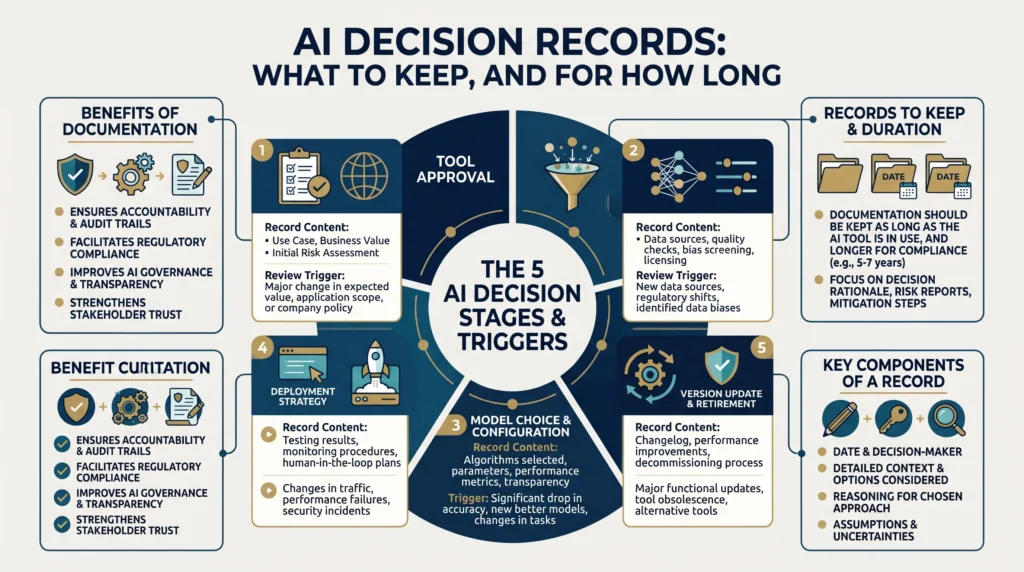
Version updates deserve their own line, because they quietly void the reasons rather than the choice itself. You approved a tool after watching it handle your own documents. A year on, the model behind it is different and no one re-ran the check. A dated record makes that gap visible, because the date of the proof sits right on it. AI Smart Ventures observes that this is the choice teams never think to write down.
How long should an AI decision record last?
Longer than the tool it describes, though your own rules set the number. Retention periods come from law and from sector rules that differ by country and trade, so your counsel or compliance lead sets the clock. What you can work out in-house is what drives the answer. Three things do: the subject the record touches, whether personal data was involved, and who could still ask about it later.
Public records bodies help here, not because their rules bind you, but because they show the thinking. Western Australia ties retention to the business function, so the subject decides and the tool does not. The US memo makes the same move: if AI helped produce a report, the schedule that applies is the report’s own. The fact AI was used matters less, and that logic travels past the public bodies it binds.
| What drives it | What to ask your advisers |
|---|---|
| Subject of the decision | which function it sits under, and what you keep there |
| Personal data involved | what your privacy rule says for data like this |
| Who could ask later | a client, an auditor, a regulator, or your successor |
| Whether it still stands | replaced records stay in place, marked as such |
Where should these records actually sit?
In the system you keep records in, not inside the AI tool itself. Queensland State Archives is blunt about it in advice last updated in December 2024: generative AI systems are not recordkeeping systems. So anything worth keeping goes where your other records live: one folder, one naming pattern, one index. If last year’s decision takes more than a minute to find, the record is not doing its job.
Two homes work for most teams. Code teams keep these as text files beside the code, so a change and the note explaining it travel together through review. Other teams do better with a shared folder and a one-line index of number, date, decision and status. Number them in sequence, never reuse a number, and that index becomes the thing people use. It answers “has this been decided?” without anyone opening a file.
Our AI Advisory team can turn a year of unwritten AI choices into a short decision log your people will keep. Bring the three tools your team uses.
Is this the same as an architecture decision record?
Close relative, wider subject. An architecture decision record, or ADR, is a short note on one big technical choice and why it was made, kept with the code. The ADR template page collects several formats, and Michael Nygard’s original has five fields: title, status, context, decision and consequences. An AI decision record borrows that shape and covers choices that are not technical at all, such as what a client was told.
The fields carry over, and two are worth copying word for word. Status comes first: proposed, accepted, superseded, deprecated, with a replaced record left in place and a pointer onward. That is how you end up with a history instead of a snapshot. Consequences comes second, and people fill it in badly, writing what they hope will go right. Write what you expect to go wrong instead, since that is the line a reviewer reads first.
What is a record worth once its author leaves?
It becomes the only version of the thinking you have left, which is the point of writing it down. The federal records law behind the August 2026 memo says records policies should let officials and their successors in office act. Swap in your own team and the test still holds, because no one writes one of these for themselves. A decision record earns its keep on the day its author cannot be asked.
Handover is where thin records get found out, and “approved Tool X for drafting” tells a successor nothing. “Approved for first drafts only, because it invented two citations in the trial” tells them what to watch for. Add the review trigger and they know when to look again, so write for the stranger, not for the room. Capability building is mostly this: the next person inherits your thinking, not just your conclusion.
Frequently Asked Questions
Does a decision record need special software?
No, because a decision record is a short text file, so a shared drive, a wiki page or your code store all work. Free templates are published openly, and most teams copy one and cut the fields they do not need. What matters is that each record sits in one place, carries a date and a status, and is numbered in sequence.
Can you keep decision records in a code repository?
Yes, and most code teams should, since that is where the practice began. Stored as plain markdown files beside the code, each record travels through review with the change it explains. Public examples of the layout are easy to find, and copying one into your project takes an afternoon. If your team has no repository, a dated shared folder does the same job.
What counts as an architectural decision about AI?
Any choice that changes how your AI setup behaves, what it can reach, or who may use it. Picking a model, plugging in a data source, setting a limit on what a tool may do alone: all structural. A reworded prompt is not, and the test is whether undoing the choice next month would mean redoing something else. Write those down; skip the rest.
Who in the room should write the record?
The person who made the call, in their own words, on the day. Hand it to whoever has time and you get a summary of a summary, when the thinking is what you came for. Three honest sentences from the decision maker beat a polished page from someone who was not in the room. If a group decided, one named person still writes it.
How short can one record be?
Short: a date, a decision, a reason, a name and a trigger cover most choices in well under a hundred words. Long records go unread, then unwritten, because people avoid starting them. The exception is a choice touching client work or personal data, where the proof deserves its own line. Err on short and finished: practical AI habits survive, perfect ones do not.
What do you write when you say no?
Write the request, the reason it was turned down, and the trigger that would change the answer. That last part stops the same question coming back each quarter with more heat attached. Keep the tone factual, because refusal records get read by the person who asked. A no with a named trigger reads as a not yet, which is often what it is.
Does a model version change need a new record?
Often, yes: if your approval rested on testing one version, a new version means that proof has gone stale. You do not need a fresh page each time a vendor ships an update. Write one when the behaviour you relied on could have shifted, and note what you re-checked. Point the old record at the new one so the history stays readable.
Can a record be edited after the fact?
Correct typos, but never the thinking. These records are worth keeping because they show what was known at the time, so tidying them up later destroys the point. When a decision changes, write a new record and mark the old one superseded, with a pointer between the two. That habit comes from the software practice, and it is the first rule worth copying.
What if nobody wrote it down at the time?
Write it now and date it straight: a late record marked as written later beats no record at all. Ask whoever was involved, note what you could not pin down, and say so on the page. Gaps labelled as gaps are useful; gaps that read like facts are not. Start with the tools still live, and with the choices still in force.
Can you build a decision log in one afternoon?
Yes, for a first pass. List the AI choices in force: tools approved, limits agreed, refusals given, and what clients were told. Write one short record for each from memory, dated today, then agree who writes the next one. The list itself shows where your AI strategy is thin. Schedule a consultation to turn that list into a log people will keep.
Executive Summary
An AI decision record is a short written note of a human choice about AI: what was decided, by whom, when, and on what evidence. Six fields cover most of them. Using AI does not create a record; relying on it in a decision is what does, per the August 2026 memo. How long you keep each one follows the subject it touches, while your own counsel or compliance lead sets the period. Keep them where your other records live, number them, and mark the replaced ones.
What Should You Do Next?
This week, write down the three AI choices your team lives with: the approved tool, the assumed limit, and the refused request. Date each one, name who decided, and add the trigger that would reopen it. Then pick where they live and tell people where that is.
AI Smart Ventures offers AI Advisory for growing businesses that want their AI choices on paper before the next version update lands. Schedule a consultation to set up a decision log and the retention questions worth putting to your own advisers.
People Also Read
About the Author
Nicole A. Donnelly is the Founder of AI Smart Ventures and an AI Adoption Specialist with 20 years of experience as a founder and CEO and over a decade leading AI adoption initiatives. She helps businesses integrate artificial intelligence with clarity and confidence, driving innovation and sustainable growth. Nicole has trained over 20,217 professionals in Applied AI, delivered 624 workshops, and worked with close to 1,000 organizations across diverse industries.
Expertise: AI Transformation, AI Strategy, AI Implementation, AI Adoption, Applied AI, Marketing, Business Operations
Disclaimer: This content is for informational purposes only and does not constitute professional business or technology advice. Results vary based on industry, existing systems and implementation commitment. Contact AI Smart Ventures for a consultation regarding your specific situation.