
AI for Agency New Business: From First Pitch to Signed Proposal
Last Updated: July 2026
AI for agency new business pitches and proposals is a workflow that uses AI tools to find prospects, build pitch decks, and write proposals in less time. Agencies using AI in their sales process report cutting prep time by 40-50%, according to Salesforce’s State of Sales report (2024). This approach covers everything from lead sourcing to final contract delivery.
AI Smart Ventures helps growing businesses build AI workflows that save time and close more deals. The team works with businesses across many industries to make AI adoption practical. The focus is on tools and processes that fit how your team actually works.
Winning new business has always been hard. The agencies moving fastest today are not just doing more outreach. They use AI to make every step of the pitch process faster, sharper, and more personal. The gap between AI-using agencies and those that don’t is growing fast.
Key Takeaways
- Cut Proposal Prep Time – Agencies using AI writing tools like Jasper report cutting proposal prep time by up to 50%, according to Salesforce (2024)
- Surface Better Leads – Tools like Apollo.io build qualified lead lists in under an hour, compared to a full day of manual research
- Draft Proposals Faster – AI writing tools like ChatGPT generate first proposal drafts in under 10 minutes, freeing time for strategy
- Personalize at Scale – Tools like Lavender pull live prospect data to make each pitch feel tailored without extra manual work
- Track Proposal Performance – Platforms like Proposify show open rates and time spent per section so teams know what works
The real shift is not just speed. AI gives your team a clearer picture of what clients respond to. Over time, that data becomes a repeatable edge that grows with every deal.
How Does AI Help Agencies Find New Leads?
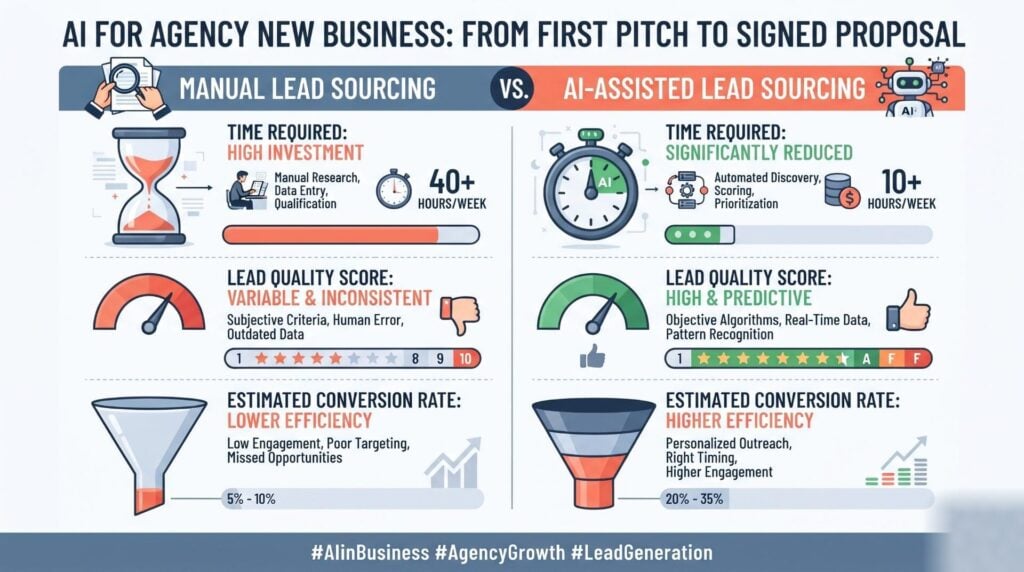
AI lead tools like Apollo.io and LinkedIn Sales Navigator scan millions of data points to find your best-fit prospects. Your team can build a list of 50 or more qualified leads in under an hour. That same work used to take a full day of manual research.
Finding the right prospects was once slow. You would search directories, check LinkedIn profiles, and hope your list was accurate. AI tools now handle that search for you. Set filters for industry, company size, role, and revenue. The tool returns a targeted list in minutes.
These tools surface contacts, not relationships. Human outreach still drives the actual conversion.
What AI Tools Work Best for Pitch Decks?
Tools like Beautiful.ai and Gamma create pitch deck drafts from a brief in minutes. They apply smart layouts and design logic on their own. Most agencies cut deck creation time by 30-40% with these tools.
A pitch deck is often your first real impression on a prospect. AI tools help you build a clean, well-designed deck faster than starting from scratch. You add your brief, and the tool generates slides with structure and design built in.
These tools produce generic layouts by default. You will need to refine the story and tailor the visuals to fit each client.
| Tool | Best For | Time to First Draft | Limitation |
|---|---|---|---|
| Beautiful.ai | Design-forward decks | 15-20 min | Limited brand control |
| Gamma | Narrative-led presentations | 10-15 min | Basic export options |
| Canva AI | Brand-consistent decks | 20-30 min | Slower for complex layouts |
How Can AI Improve Proposal Writing?
AI writing tools like ChatGPT and Copy.ai generate proposal sections from a brief in under 10 minutes. Teams that use AI drafts spend more time refining strategy and less time on formatting. This shift often leads to stronger, more focused proposals.
Good proposals are specific. They address the client’s exact problem and show a clear path forward. AI helps you draft faster, so you have more time to sharpen your strategy and add real proof points.
AI drafts can sound generic without your input. Always review and add specific case studies and numbers before you send.
Here is what a strong AI-assisted proposal workflow looks like:
- Pull client data from their website, LinkedIn, and recent news
- Paste key facts into your AI writing tool along with a clear brief
- Generate a first draft covering the problem, solution, and pricing
- Review and add proof points, case studies, and a specific next step
Teams using this workflow cut proposal time from half a day to 60-90 minutes. The output is often sharper too. AI forces a clear structure from the start. That makes it easier to spot gaps before the proposal goes to the client.
Can AI Personalize Pitches at Scale?
Tools like Lavender and Instantly pull prospect data and generate personal outreach at scale. Agencies can send 100 tailored messages in the time it takes to write 10 manually. Response rates improve when messages feel specific to each person.
Personalization used to mean spending more time on each message. Now it means better data feeding a faster process. AI tools pull company news, job changes, and LinkedIn activity to help you write messages that feel relevant to each prospect.
Over-automation creates its own problem. If every message sounds the same, prospects will notice fast. Use AI to personalize your research, not to replace your voice in the message itself.
What Proposal Platforms Work Well with AI?
Platforms like Proposify and PandaDoc combine AI writing support with tracking, e-signatures, and engagement data. Teams can see when a prospect opens a proposal and how long they spend on each section. This data helps you follow up at exactly the right time.
Proposal platforms do more than store documents. They show you how prospects engage with your offer. When someone spends five minutes on your pricing section, that is a signal worth acting on.
The best platform is the one your team will actually use every day. A complex tool that gets abandoned closes zero deals.
| Platform | AI Features | Tracking | E-Sign | Starting Price |
|---|---|---|---|---|
| Proposify | Content library, AI suggestions | Yes | Yes | $49/mo |
| PandaDoc | AI drafting, smart templates | Yes | Yes | $35/mo |
| Better Proposals | Smart templates | Basic | Yes | $19/mo |
AI Smart Ventures offers AI consulting services to help growing businesses choose the right proposal tools. Schedule a consultation to build a pitch and proposal workflow that fits your team.
How Do You Keep AI Proposals on Brand?
AI tools work best when you give them a clear brand brief. Include tone guidelines, sample copy, and key phrases before you generate any output. Teams that do this report up to 70% fewer revisions than teams that edit from a blank AI draft.
Brand consistency is the biggest risk with AI-generated proposals. The tools write what you tell them to write. Your brief quality determines your output quality.
Before you start, document your brand voice and your preferred phrases. Note the exact problems you solve best. Use that document as your AI prompt foundation every time you start a new proposal. This setup takes about an hour and saves hours on every proposal that follows.
Build a short proof library for your proposals. Store approved case results, client quotes, service facts, and team bios in one place. Your AI tool should draw only from this approved set when it drafts a proposal. This cuts false claims and keeps your message consistent across your whole team.
Frequently Asked Questions
Does AI replace sales staff at agencies?
AI does not replace sales staff. It handles tasks like writing first drafts, building lead lists, and formatting proposals. Your team still manages strategy, client relationships, and negotiation. According to Salesforce’s State of Sales (2024), top sales teams use AI to spend more time on high-value conversations, not to remove them.
How much does AI proposal software cost?
Costs range from $19 per month for basic tools to over $200 per month for full platforms with AI drafting and engagement tracking. Most growing businesses start with one affordable tool and expand as their workflow grows. AI Smart Ventures has reviewed over 40,000 AI tools and can help you find the right fit for your budget and goals.
Is it safe to put client data into AI proposal tools?
It is safe if you choose tools with strong data controls. Most proposal platforms let you set data storage and sharing options. Review each tool’s privacy policy before adding client data. For agencies in regulated industries, check whether the tool meets GDPR or HIPAA standards before using it for sensitive work.
How long does it take to build an AI proposal workflow?
Most agencies can build a basic AI proposal workflow in two to three days. That includes tool selection, template building, and team training. A full workflow with brand guidelines, lead automation, and proposal tracking takes about two weeks to set up and refine.
Can AI help agencies respond to RFPs?
Yes. AI tools work well for RFP responses because RFPs follow structured formats. Paste the RFP into a tool like ChatGPT and ask it to draft a response outline. Teams using this approach report cutting RFP response time by 40-60%. The final version still needs human review and client-specific proof points to be strong.
What if AI-generated proposals sound generic?
Generic output usually means a generic brief. The more specific your input, the better your output. Include the client’s name, their exact challenge, your proposed solution, and two or three proof points before you generate any copy. Reviewing and refining the draft is always part of the process, not an optional step.
How do agencies measure ROI from AI proposal tools?
Track three numbers: time per proposal, win rate, and average revenue per deal. Compare those figures before and after adding AI tools. Most agencies see the biggest gains in time saved first. Win rate gains take longer because proposal quality is just one factor in closing a deal.
Can AI help with follow-up after a pitch?
Yes. Tools like HubSpot can trigger follow-up sequences based on proposal activity. If a prospect opens your proposal, you can send a timed, relevant follow-up on its own. This keeps deals moving without adding tasks to your team’s daily workload.
Executive Summary
AI tools are changing how agencies pitch and win new business. From lead sourcing to proposal delivery, AI cuts prep time by up to 50% and helps teams personalize outreach at scale. The agencies seeing the best results pick one or two tools, build clean workflows, and keep human judgment at the center of every deal. A clear strategy matters more than the number of tools you adopt.
What Should You Do Next?
Pick one part of your pitch process to improve first. Choose lead sourcing, proposal writing, or follow-up. Then find one tool for that task and use it for 30 days. Measure time saved and track win rate changes. Add more tools once the first one is working well and your team feels confident.
AI Smart Ventures offers AI consulting services for growing businesses ready to build smarter sales workflows. Schedule a consultation to get a custom roadmap for your pitch and proposal process.
People Also Read
- Practical AI Tool Guide for Growing Businesses
- AI for Proposals and SOWs: Win More Business in Less Time
About the Author
Nicole A. Donnelly is the Founder of AI Smart Ventures and an AI Adoption Specialist with 20 years of experience as a founder and CEO and over a decade leading AI adoption initiatives. She helps businesses integrate artificial intelligence with clarity and confidence, driving innovation and sustainable growth. Nicole has trained over 20,217 professionals in Applied AI, delivered 624 workshops, and worked with close to 1,000 organizations across diverse industries.
Expertise: AI Transformation, AI Strategy, AI Implementation, AI Adoption, Applied AI, Marketing, Business Operations
Disclaimer: This content is for informational purposes only and does not constitute professional business or technology advice. Results vary based on industry, existing systems and implementation commitment. Contact AI Smart Ventures for a consultation regarding your specific situation.