
AI for Business Development: Keeping the Personal Touch
Last Updated: August 2026
AI for business development is the use of software that helps you find, sort and reach new buyers. It covers lead research, list building, lead scoring, meeting notes and first drafts of your outreach. The tools read public signals such as funding news, job posts and product launches, then turn them into context a seller can act on. The software supports the sales cycle; it does not run it, and a person still owns every conversation.
AI Smart Ventures has guided growing businesses through this shift for more than ten years, and one pattern shows up again and again. Teams rarely stall because the tools are weak. They stall because no one has said which parts of the pipeline should stay human, so the tool gets aimed at all of them at once.
That choice matters more this year than last, because buyers have grown much harder to reach. Reply rates drop when a note reads like automation. A damaged sender score can take months to fix, and getting the split right protects the ties that close deals.
Key Takeaways
- Give AI the digging, not the relationships. It is strong at list building, scoring and clean CRM data, and weak at the calls that move a deal.
- Buyer trust is now a real edge. Just 27% of Americans say they trust firms to use AI responsibly, so obvious bot work can cost more than it saves.
- Start with one bottleneck. Pick the task that eats the most hours each week, fix it with a single tool, then expand once you see a gain.
- Keep a person in the loop before you send. Any note that reaches a buyer should carry a fact the tool could not find.
- Track time and quality, not volume. More email sent is not the same as more pipeline built.
All five share one root idea: AI changes the cost of preparation, not the cost of trust. Homework that once took a rep forty minutes per account now takes a few. The talk that follows still moves at human speed, and that is where most plans come apart.
What Can AI Automate in Business Development?
AI can take over the grunt work: buyer research, list building, CRM data entry, lead scoring against set rules, call notes and first-draft messages. These tasks share one useful trait, since each has a right answer a person can check fast. According to G2, 60% of B2B software teams already use AI across their sales work, and the tools it surveyed cut manual research and qualification time by more than half.
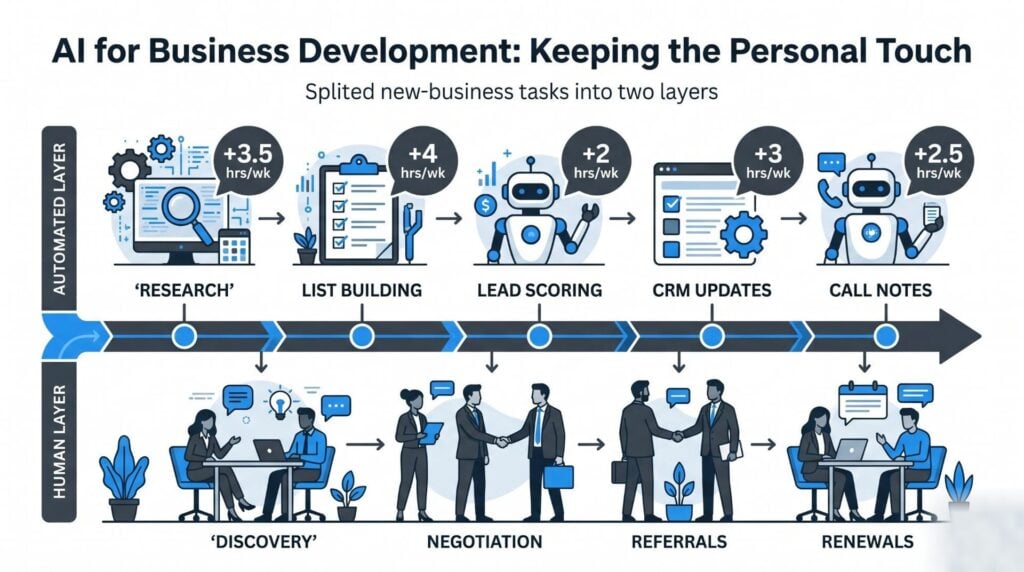
The gain is not the tool but what your team does with the hours it hands back. A rep who stops rebuilding a list each Monday can spend that time on the twelve accounts most likely to buy. Workflow optimization pays off only when you aim that free time on purpose.
| Pipeline stage | What AI handles well | What stays human |
|---|---|---|
| Research | Firmographics, funding news, job posts | Judging whether the timing is real |
| Outreach | First drafts and follow-up sequencing | The specific reason you are writing |
| Negotiation | Deal history and comparable terms | Trade-offs, concessions and trust |
How Can I Use AI for Business Development?
You use AI for business development by giving it one task at a time, starting with the step that eats the most hours. Most growing businesses begin with buyer research, since it is high-volume, low-judgment work a person can check in seconds. The steps below fit almost any pipeline, and each can be tested on its own before you add the next.
- Review one week of your reps’ calendars and note where the hours really go.
- Pick the biggest manual task, then link one AI tool to the CRM you use now.
- Set a rule that no AI draft reaches a buyer before a person edits it.
- Run the new flow for thirty days against your old baseline.
- Keep the tool only if it hands back real hours or lifts lead quality.
This order matters because AI adoption fails on process far more often than on tech. Teams that link five tools in a month end up with clashing records and no clear owner. One tool, one flow and one owner is slower to set up and far easier to keep.
What Is the Best AI for Business Development?
There is no single best AI for business development, and the best tool is simply the one that fixes your bottleneck. If research eats your week, a data and signal tool helps most. If reply rates are the problem, pick an assistant that scores drafts before you send. HubSpot found that only 8% of the reps it surveyed use no AI at all, so fit now matters far more than access.
| If your bottleneck is | Look for this kind of tool | What good looks like |
|---|---|---|
| Manual buyer research | Data enrichment and signal tracking | Hours handed back per rep each week |
| Weak reply rates | Draft scoring and message coaching | More replies per hundred sent |
| Slow lead qualification | Scoring against your ideal profile | More leads that turn into deals |
Two tests split a good tool from a costly one. First, does it write back into the system your team opens each morning? Second, can a new hire get a usable output in week one without an expert beside them? A tool that fails either test gets dropped within a quarter, whatever the demo showed.
Picking between crowded, look-alike tools is where most teams stall. AI Smart Ventures offers vendor-neutral AI Advisory drawn from work with close to 1,000 organizations, so you can match a tool to your bottleneck instead of to the loudest pitch.
Why Is Buyer Trust Falling as AI Adoption Rises?
Buyer trust is falling because use has raced ahead of confidence, and 2026 data shows that gap growing. Gallup reported on 28 July 2026 that just 27% of Americans now trust firms to use AI responsibly, down from 31% in 2025. The same Bentley University-Gallup survey found 39% think AI does more harm than good, up from 31% a year before.
- Use keeps climbing. Pew Research Center found in June 2026 that about half of US adults now use AI chatbots, up from a third in 2024.
- Confidence moves the other way. The same Pew study found 59% are not sure US firms will build and use AI responsibly.
- Buyers spot the pattern now. A note built from a funding item and a job title reads like a bot, since thousands of senders quote those same signals.
- The fix is restraint plus openness. Send fewer notes, make each one carry a fact the tool could not know, and say when AI drafted a summary you share.
None of this argues against AI in your pipeline. It argues for keeping the visible surface human while the hidden work speeds up, which is the idea behind human-first AI. Your buyer never needs to see the research engine, but they should always be able to tell that a person chose to write.
Will AI Replace Business Development Reps?
No, AI will not replace business development reps, though it is already changing what the job looks like. The parts built on empathy, negotiation and long relationships do not automate, since someone has to read a room and carry risk. Gallup found that 79% of Americans expect AI to cut US jobs over the next ten years, so the worry is real and worth naming with your team.
What does change is the skill mix a strong rep needs. Speed of homework stops being an edge once everyone holds the same tools, so judgment becomes what you hire and coach for. AI upskilling works best when it teaches people to push back on an output rather than take it. Capability building of that kind is a change management job, not a software buy.
How Do You Measure Returns From AI in Sales?
You measure returns with three numbers: hours handed back per rep each week, the rate at which leads turn into deals, and replies per hundred notes sent. Volume looks great and tells you almost nothing, since twice the email with fewer replies is a loss dressed as a gain. Set your baseline before the tool lands, because a number you cannot hold against anything is not a measure.
Give each number a full quarter before you judge it, since pipeline effects lag the change that caused them. A rep who saves six hours in week one will not post a better close rate until those hours go into real conversations. Operational efficiency leads and revenue lags, and mixing up the two makes teams kill plans that work.
Frequently Asked Questions
What 3 jobs will not be replaced by AI?
Three hold up best: complex deal-making, high-stakes account ties, and strategy under pressure. Each rests on reading people, owning the outcome and deciding when the data is thin. AI can lay the groundwork by pulling history, notes and summaries, but it cannot carry the risk. Gallup found in July 2026 that 79% of Americans expect AI to cut US jobs, yet judgment roles stay hardest to automate.
Can AI make you a fixed amount of money each day?
There is no set formula, and any offer that promises a fixed daily figure deserves real doubt. What AI does do is lift output per hour, so an advisor doing billable work can serve more clients with the same effort. The better version of this question is how many hours AI hands back each week, and what you then choose to sell with them.
Can AI write cold emails that do not sound automated?
Yes, but only when a person supplies the reason for writing and then edits the draft. AI is good at shape, length and clarity, and poor at knowing why this buyer matters this month. The notes that fail are built only from public signals such as funding rounds, because thousands of senders quote the same ones. Give the model one fact it could not have found alone.
Should I tell prospects that AI helped write my message?
You need not label every draft, but never claim you know something you do not. The test is simple: anything you present as your own read on their business should really be yours. Where AI wrote a summary, transcript or research brief that you pass on, say so plainly. Gallup puts trust in business use of AI at 27%, so openness is now an edge.
What are the biggest risks of using AI in sales?
The three biggest are data exposure, a damaged sender score, and notes that read like a bot. Reps who paste client records into public tools can leak private data without knowing it. Ask each vendor for a Data Processing Agreement (DPA), the contract that sets out how they store and handle your client data. Then write a short policy on approved tools, allowed data and sign-off.
How long does it take to see results from AI in business development?
Expect time savings in two to four weeks and pipeline results within one full sales cycle. Admin load drops almost at once, since the hours a rep spends on research are easy to count before and after. Deal rates take longer, because a lead that lands this month may not close for another quarter. Judge a pilot on hours handed back first, then hold the tool one more quarter.
Does AI work for a team of fewer than five sellers?
Yes, and leaner teams often see the sharpest gains, since each hour saved is a bigger share of what they have. A two-person team that wins back eight hours a week has added a fifth of a seller. The trap is buying a platform built for a fifty-desk sales floor, then paying for controls no one uses. Start with one tool that links to the CRM you have.
How do I train my team to use AI for business development?
Train on one workflow at a time, using your own live accounts rather than sample data. Run a working session where each rep does the same research task with and without the tool, then compare outputs as a group. That side-by-side builds AI literacy and honest judgment faster than any lecture. AI Smart Ventures runs AI workshops and advisory work for growing businesses. Schedule a consultation to map a training plan around your pipeline.
Executive Summary
AI for business development works when it takes over the prep and leaves the selling to people. The strongest uses are buyer research, list building, lead scoring, clean CRM data and first drafts, where teams report cutting manual research time by more than half. The real limit is trust, not skill: Gallup put trust in business use of AI at 27% in July 2026, down from 31% a year before. Start with one bottleneck, keep a person editing every note that goes out, and track hours handed back beside your lead-to-deal rate.
What Should You Do Next?
This week, pull a week of calendar data for each rep and find the task that eats the most hours. Choose one AI tool that fixes that single task and links to the CRM you already run, then test it for thirty days against your baseline. Set the rule now that no AI draft reaches a buyer before a person edits it.
AI Smart Ventures offers AI Advisory for growing businesses choosing between crowded, look-alike sales tools. Schedule a consultation to match the right tool to your biggest pipeline bottleneck.
People Also Read
- How Does AI Workflow Automation Actually Work?
- Why Does Traditional Automation Break and How Does AI Fix It?
About the Author
Nicole A. Donnelly is the Founder of AI Smart Ventures and an AI Adoption Specialist with 20 years of experience as a founder and CEO and over a decade leading AI adoption initiatives. She helps businesses integrate artificial intelligence with clarity and confidence, driving innovation and sustainable growth. Nicole has trained over 20,217 professionals in Applied AI, delivered 624 workshops, and worked with close to 1,000 organizations across diverse industries.
Expertise: AI Transformation, AI Strategy, AI Implementation, AI Adoption, Applied AI, Marketing, Business Operations
Disclaimer: This content is for informational purposes only and does not constitute professional business or technology advice. Results vary based on industry, existing systems and implementation commitment. Contact AI Smart Ventures for a consultation regarding your specific situation.