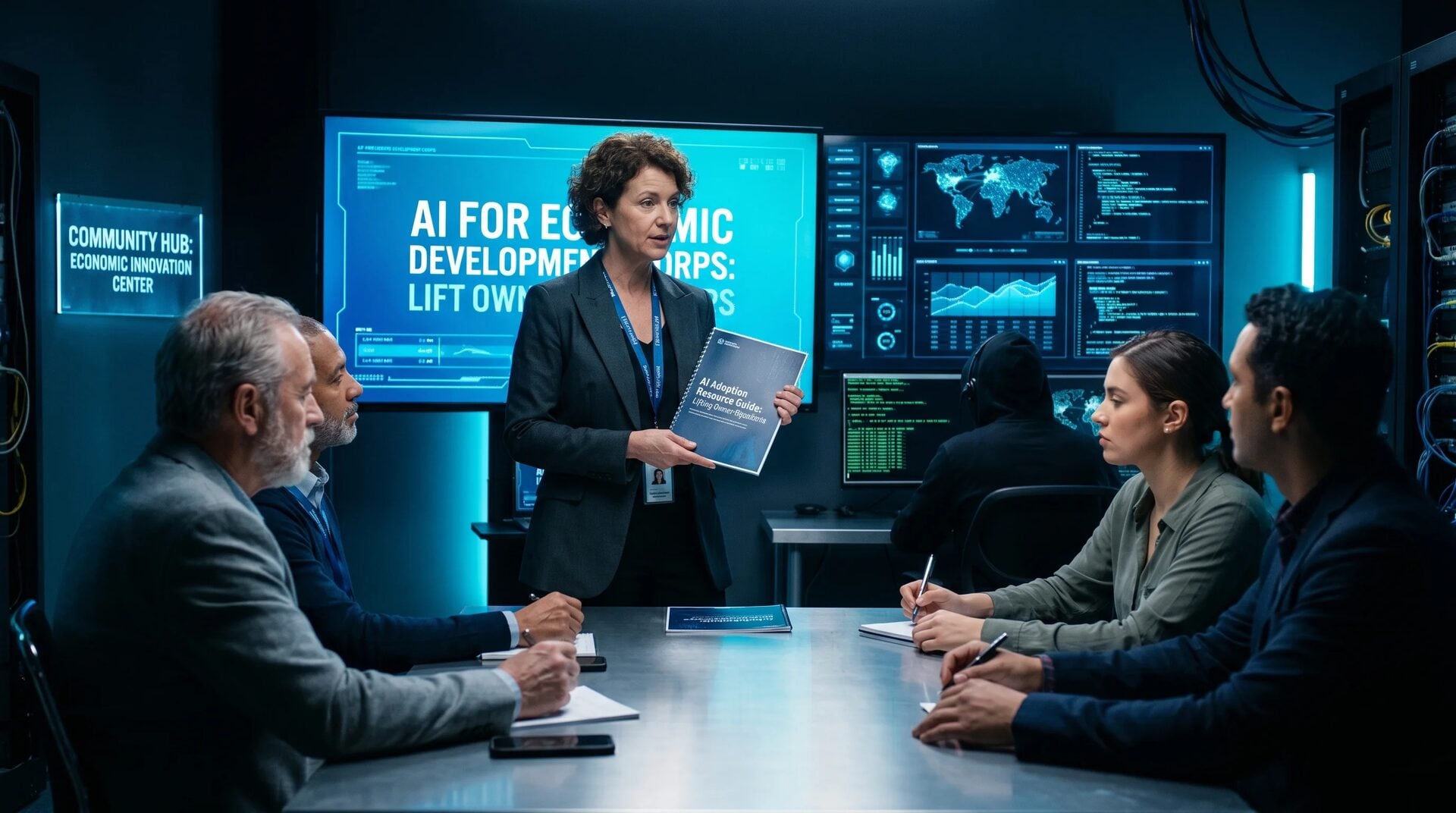
AI for Economic Development Corporations: Lifting Local Owner-Operators
Last Updated: June 2026
AI programs for EDCs help owner-run businesses cut admin time and find funding faster. Per the U.S. Small Business Administration 2024 Small Business Profile, owner-run companies make up 99.9% of all U.S. employer firms. Most lack the staff and budget to adopt new tech without hands-on help. EDCs are in a unique spot to change that.
AI Smart Ventures has helped growing businesses across many industries. Companies that apply a clear AI strategy before deploying tools reach value 40% faster. That is faster than those that start with tools alone.
Most EDC staff handle grant work, business support, and local outreach all at once. AI programs need to be fast to set up and low in cost. They also need to be easy to use right away.
Key Takeaways
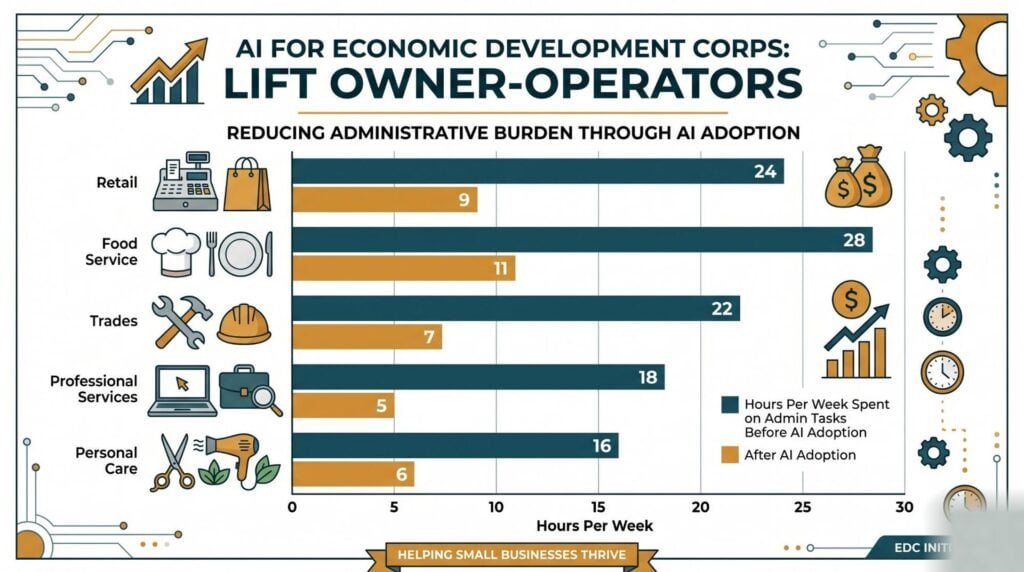
- Time Recovery – Owner-operators using AI for email drafts save 8 to 12 hours per week. This is per McKinsey (2023).
- Low Entry Cost – ChatGPT Plus costs $20 per user per month. It covers drafting, research, and data review for most EDC-supported business tasks.
- Funding Access – AI tools can scan grant databases in seconds. Drafting grant stories takes a fraction of the time a human needs. This cuts prep time by up to 40%.
- Staff Readiness – AI training workshops of 4 to 8 hours have raised trust scores by 35 points on average. This is per the ATD 2024 State of the Field Report.
- Adoption Ceiling – Without a clear AI adoption plan, fewer than 30% of people keep using AI tools past 90 days. One-time training rarely leads to lasting use.
The tools are low-cost. The time savings are real. The barrier is not price. It is structure.
Owner-operators need a clear sequence. They need a short training, a set starting task, and a follow-up check-in. EDCs that build this into their programs see lasting use. Those that treat AI as a one-time workshop see tools dropped by week six.
Why Do EDCs Need AI Tools in 2026?
EDCs face a resource problem. Most run with small teams. They handle grant work, business support, and local reports all at once. AI tools cut that load by 25% to 50%. Staff can then spend more time on direct support.
The owner-operators EDCs serve face the same pressure. A landscaping owner in rural Ohio runs marketing, planning, and payroll alone. A food truck operator in Las Vegas does the same. AI tools do not replace these roles. They cut the time each task takes.
What AI Tools Fit EDC and Owner-Operator Workflows?
Four AI tool types work well for EDC clients. First: general-purpose AI helpers. Second: AI workflow automation tools. Third: grant research tools. Fourth: AI-assisted CRM tools. Most owners start with just one. They add others after they build a steady habit.
The table below compares common options at price points open to EDC programs.
| Tool | Monthly Cost | Best For | Limitation |
|---|---|---|---|
| ChatGPT Plus | $20/user (person plan) | Drafting, research, grant stories | No live data by default; needs prompting discipline |
| Google Gemini Pro | $20/user (Google One AI Premium) | Research, Docs connection, real-time info | Best results inside Google Workspace |
| Microsoft Copilot | $30/user/month (Microsoft 365 Copilot add-on) | Word, Excel, Outlook drafting | needs Microsoft 365 subscription; minimum 1 seat |
| Zapier | Free to $20/month (Starter plan) | Connecting apps, automating repetitive tasks | needs some setup; complex automation rules need paid plan |
| Notion AI | $10/user/month (add-on to Notion plan) | Notes, SOPs, knowledge base | Less useful without current Notion workspace |
For a current list of AI tools vetted for owner-operators, see AI tools and apps on the AI Smart Ventures resource hub. The list is updated each month. Each tool is tested for common owner-operator workflows.
ChatGPT Plus is the most common first tool. It needs no setup. If you use Microsoft 365, Microsoft Copilot may suit you better. It works inside tools you use every day.
How Do EDCs Run a 60-Day AI Pilot?
A 60-day AI pilot does not need a large budget. Most pilots cost under $5,000. That covers tool plans, one trainer session, and quick guides. The AI pilot fails when it runs as a single event. It needs a guided sequence instead.
Here are the three phases:
- Phase 1: Orient (Days 1-14) – Select one tool. Build 3 to 5 starter prompts for common tasks. Run a 2-hour kickoff workshop with live demos.
- Phase 2: Practice (Days 15-45) – Assign one AI task per day per person. Run weekly 15-minute group calls to share wins and fix problems. Track time saved per task.
- Phase 3: Measure and Scale (Days 46-60) – Survey people on time saved and trust. Find the top 2 to 3 tasks with the most value. Decide which tools to keep and what to add.
Owner-operators who finish all three phases report clear output gains. These often show up in the first two weeks. People who only attend the kickoff rarely keep using AI past day 30. Structure drives results.
Ready to get started? AI Smart Ventures offers AI consulting for growing businesses. Book a call to map a pilot plan that fits your budget.
How Does AI Help Owner-Operators Win More Grants?
Grant writing is one of the hardest tasks for owner-operators. Most grant apps need a business story, a financial summary, and supporting documents. AI tools can draft each section in under 30 minutes. That compares to 4 to 8 hours done by hand.
The process is simple. The owner-operator shares a one-page recap with the grant rules and key financials. The AI drafts the story. The owner edits it. The EDC counselor does a final check. This three-step model cuts submission time by roughly 40%.
Over $100 billion in grants were open to U.S. companies in 2024. Source: Candid’s 2024 Philanthropy Outlook. Most owners do not apply because the process feels too hard. AI makes it easier. It does not replace EDC counselors.
What Are the Risks EDCs Should Manage?
AI tools bring three risks in an EDC context: data privacy, output errors, and unequal access. None should block use. All three need a clear policy before rollout. AI governance does not need to be complex. A one-page policy is enough. It should cover what data can go into AI tools, who reviews AI content, and how errors are handled.
Output errors are the most common risk. AI tools sometimes give confident-sounding mistakes. This is especially true in financial or legal details. Never use AI output for legal or money matters without a human review. EDCs should build this step into their process.
Equity of access matters too. Not all owner-operators have the same online skills or device access. Programs that use EDC computer labs see higher finish rates. Programs in multiple languages also do better.
How Do Large Consultancies Compare to EDC-Led AI Programs?
Consultancies like Accenture and Deloitte offer full AI programs. Their pricing often starts above $50,000 per contract. This puts them out of reach for most owner-operators.
EDC-led programs serve a different group. The goal is not a full AI overhaul. The aim is one or two well-chosen tools and one clear habit. That scope fits the budget of most owner-run businesses.
Frequently Asked Questions
What is an economic development corp and how does it use AI?
An economic development corp is a public or quasi-public entity. It supports business growth and job creation in a defined area. EDCs use AI to automate internal reports and help owner-operators draft grant apps. They run AI training workshops that cut the cost of support help.
How much does it cost for an EDC to launch an AI program?
A base AI program for an EDC often costs $2,000 to $8,000. This covers the first 60 days. That covers tool plans, a trainer workshop, and materials. Most general-purpose AI tools cost $20 to $30 per user per month. Book a call to get a cost estimate for your program.
Which AI tools are easiest for owner-operators to learn?
ChatGPT Plus is the most common starting point. It needs no current software setup and costs $20 per user per month. It handles drafting, research, and basic data analysis. Owner-operators who already use Google Workspace often find Google Gemini Pro easier. It works inside familiar tools. The best tool is the one that fits the tasks the owner runs most often.
Can AI help owner-operators with payroll and bookkeeping?
AI tools can help sort expenses and draft financial summaries. They are not a substitute for accounting software or a licensed bookkeeper. QuickBooks has built-in AI for categorization. For payroll, use dedicated payroll software and consult a tax pro.
How do EDCs measure the ROI of AI programs?
EDCs measure AI program ROI through three metrics. These are: hours saved per week and grant finish rates. Trust scores from surveys complete the picture. A baseline survey before the program starts makes it easy to show funders results. Most programs see results within the first 30 days.
Who are the big 5 AI tools?
The five most referenced AI tools in 2026 are ChatGPT, Gemini, Claude, Copilot, and Llama. Each serves a different use case. They come from OpenAI, Google DeepMind, Anthropic, Microsoft, and Meta. For owner-operators, the key question is which tool fits their workflow. ChatGPT Plus, Gemini Pro, and Copilot are the most used in EDC programs.
Which jobs are most safe from AI job loss?
Jobs with physical presence are most safe. Complex human judgment roles are also safe. Relationship trust roles are protected too. Examples include licensed trades (plumbing, electrical, HVAC) and healthcare roles with direct patient contact. For owner-operators, AI is far more likely to help than to replace them.
Is AI going to replace CDL drivers?
Full self-driving trucks at scale are not expected before the 2030s. Source: MIT Technology Review. CDL drivers will see AI in route planning first. Jobs are safe for now. Trucking owners can use AI today for dispatch, invoicing, and DOT compliance tracking.
How do EDCs fund AI adoption programs for owner-operators?
EDCs often fund AI adoption programs through federal grants and state funds. Local chamber support also helps. The Economic Development Administration (EDA) offers grants that support local business growth. Many state workforce boards fund online skills programs too. AI training is often a valid use under these grants.
What is the timeline to see results from an EDC-led AI program?
Most people in a clear EDC AI program report time savings within the first two weeks. Full use across a group often takes 45 to 60 days. Programs without follow-up see most people drop off within 30 days. A 90-day review with a simple survey gives you the data needed for funders.
What AI skills do owner-operators need most?
The most valuable AI skills for owner-operators are prompt writing and output review. Basic workflow automation rounds out the set. Prompt writing means knowing how to ask AI the right question. Output review means knowing when to trust and when to check AI content. Workflow automation means using tools like Zapier to connect apps and cut manual steps.
Executive Summary
AI for economic development corporations is a useful, low-cost plan. Tools under $30 per user per month handle grant writing, planning, and reports. EDCs that run 60-day pilots with weekly check-ins see lasting use above 60% at 90 days. One-time workshop models see under 30%. The three key parts are affordable tools, a defined starting task, and a clear follow-up sequence. Missing one stalls the program.
What Should You Do Next?
This week, find one admin task that takes your team more than two hours per week. Test ChatGPT Plus or Google Gemini on that task for five days. Track the time saved. Use that data to build the case for a 60-day cohort pilot. Aim for 10 to 20 people.
AI Smart Ventures offers AI consulting services for growing businesses. We help you build a clear AI adoption program. Book a call to design a pilot that fits your EDC’s schedule, budget, and local needs.
People Also Read
- What Is AI Talent Development? Building Staff Capability for AI Transformation
- AI for Health and Wellness Brands 2026
About the Author
Nicole A. Donnelly is the Founder of AI Smart Ventures. She is an AI Adoption Specialist with 20 years of experience. Her background includes work as a founder and CEO. She has spent over a decade leading AI adoption work. She helps businesses integrate AI with clarity and confidence, driving innovation and sustainable growth. Nicole has trained over 20,217 professionals in Applied AI and delivered 624 workshops. She has worked with many organizations across diverse industries.
Expertise: AI Transformation, AI Strategy, AI Implementation, AI Adoption, Applied AI, Marketing, Business Operations
Disclaimer: This content is for informational purposes only and does not constitute professional business or technology advice. Results vary based on industry, existing systems and implementation commitment. Contact AI Smart Ventures for a consultation regarding your specific situation.