

AI for Founders With ADHD: Patterns That Reduce Switching Costs
Last Updated: June 2026
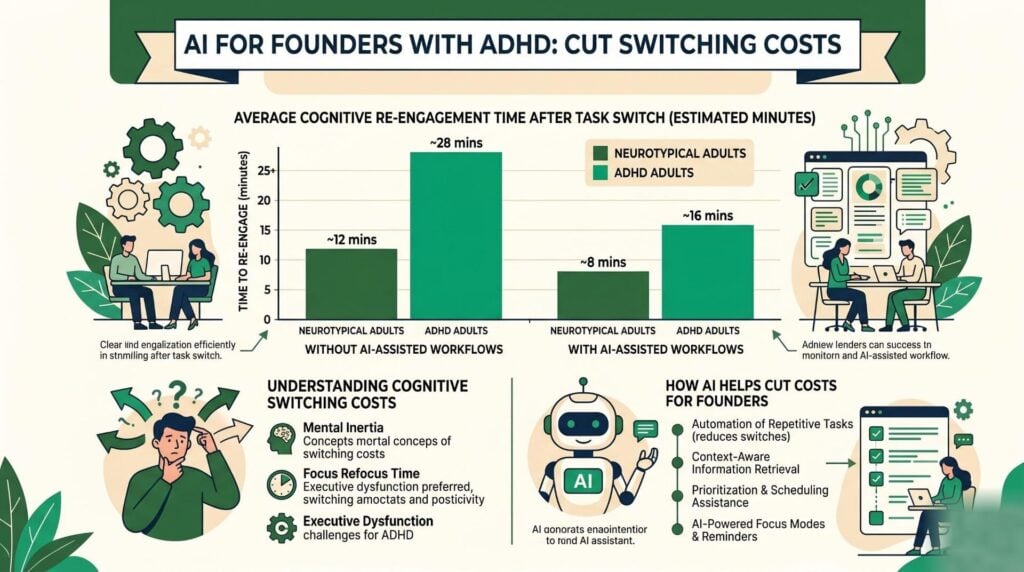
An AI workflow for founders with ADHD is a simple, regular system. It uses AI tools to cut the mental load of switching tasks. Research from ADDitude Magazine (2023) shows adults with ADHD lose more work time to task-switching than their peers. The right AI pattern builds systems that fit how your brain works.
AI Smart Ventures has guided growing businesses through AI adoption across many owner challenges. Each task break can mean 15 to 30 minutes of reset time, based on research from UC Irvine (2008). The patterns below tackle three key switching causes: unclear next steps, tool overload, and poorly batched messages.
Key Takeaways
- Capture all inputs in One Place – Founders who route all inputs (email, Slack, voice notes) into a single Notion AI workspace report getting back 4 to 6 hours per week. They stop the “where did I put that?” spiral.
- Use AI for Task Prioritization – Tools like ChatGPT or Claude can turn a messy brain dump into a ranked task list in under 2 minutes. This cuts the choice fatigue that stalls ADHD founders at the start of each day.
- Message Batching Windows – Founders who use AI-drafted reply templates and schedule two 30-minute email windows per day cut reactive breaks by about 40%. Research consistently shows this pattern.
- Set AI Triggers for Routine Tasks – Tools like Zapier (from $19.99/month on the Starter plan) handle regular low-stakes tasks on their own. This frees mental energy for decisions that actually need a founder.
- Design for reset, Not Perfection – According to CHADD’s Attention Magazine (2023), ADHD tools work best when they account for off-days. Building AI systems with simple re-entry prompts cuts the shame spiral that often follows a lost afternoon.
Why Do Switching Costs Hit ADHD Founders Harder?
Switching costs hit ADHD founders harder because ADHD affects focus control most. A 2023 meta-review in Neuropsychology Review found adults with ADHD re-engage 20 to 40 percent more slowly after breaks. For a solo founder handling sales, ops, and delivery at once, that adds up fast.
A founder with ADHD does not need more discipline. They need fewer task shifts by design. AI tools act as external working memory. They hold context so the founder does not have to reload it after every break.
What AI Tools Actually Help With Focus?
AI tools help most with focus when they cut decision friction at the start of each task. Claude and ChatGPT (free tiers available; paid plans from $20/month) are the most flexible options. They turn a messy brain dump into a ranked list in under 2 minutes. Keep them in a single pinned browser tab to avoid a new switching cause.
Notion AI ($10/member/month as an add-on) combines notes, tasks, and AI drafting in one window. Start with a simple template. Add Otter.ai (free tier; Pro at $16.99/month) for voice capture when typing feels like too much.
| Tool | Cost | Best For | Limitation |
|---|---|---|---|
| Claude | Free tier; Teams from $30/user/mo (min 5 seats) | Thinking partner, task prioritization, email drafts | No built-in reminders or task tracking |
| ChatGPT | Free tier; Plus at $20/mo | Brain dumps, priority task lists, first drafts | Context resets each chat session |
| Notion AI | $10/member/mo add-on | Single capture hub, meeting notes, project tracking | Setup can cause avoidance |
| Zapier | Starter at $19.99/mo | setting up regular tasks, routing inputs | Requires setup time; not instant for new users |
| Otter.ai | Free tier; Pro at $16.99/mo | Voice-to-text capture, meeting summaries | quality drops with heavy background noise |
For an updated list of AI tools vetted for growing businesses, see AI tools and apps on the resource hub.
How Do You Build a Low-Switching AI Workflow?
A low-switching AI workflow starts with one rule: all inputs go to one place first. Every email, voice note, Slack message, and stray idea goes into a single Notion inbox. You decide what to do with it later. Then, paste the inbox into Claude or ChatGPT once or twice per day. Ask it to sort by urgency and give you a three-step morning plan. That takes under 2 minutes and cuts 20 to 30 minutes of mental spinning.
Here are the core steps:
- Single Inbox Setup – Route all inputs (email, Slack, voice, text) into one Notion page before reviewing anything. Your brain only visits one location at the start of each day.
- Morning AI Batch – Paste today’s inbox into Claude or ChatGPT with a fixed sorting prompt. Get a ranked list back in under 2 minutes, then close all other tabs.
- Focus Blocks – Block two 90-minute deep work windows using Google Calendar. Set a Zapier rule to pause Slack alerts during those blocks.
- Message Batching Windows – Batch all replies into two 30-minute windows (mid-morning and end of day). Use AI-drafted templates to cut writing time by half.
Need help mapping this workflow to your tools? AI Smart Ventures offers AI consulting for growing businesses.
What Is the 30% Rule for ADHD in a Work Context?
The 30% rule for ADHD is a coaching guideline. It says adults with ADHD work at roughly 30% below their ability when support systems are absent. For founders, this shows up as tasks that feel simple but stall. AI tools address this gap by providing external structure. Getting started is often harder than the task itself. Using AI for context reset and decision batching helps close that gap.
Which AI Patterns Help With Choice Fatigue?
Choice fatigue is a major cost for ADHD founders. Per ADDitude Magazine (2023), ADHD speeds up choice fatigue. Depletion comes faster and reset is slower. Three AI patterns cut this at the source:
- Prompt Library – Build a Notion page with 5 to 10 ready-made AI prompts for your most common tasks (email reply, project update, client brief). A ready prompt cuts AI startup time from 3 minutes to 30 seconds.
- Automation Rules – Use Zapier to auto-sort incoming emails by sender type (client, vendor, newsletter). Your inbox is sorted before you open it. This removes the triage decision fully.
- Close-Out Ritual – Spend 5 minutes at end of day asking Claude or ChatGPT for your top 3 tasks for tomorrow. Save the answer. This makes tomorrow’s morning launch nearly effortless.
Running all three patterns cuts daily decisions by 30 to 50 before 10am. That saved energy lets an ADHD founder finish key work before running out of steam.
How Long Does It Take to See Results?
Most founders with ADHD who adopt a steady AI workflow see results within 2 to 4 weeks. The first week involves setup friction. By week four, the pattern runs mostly on its own. Start with the morning batch review. Run it for 10 days before adding anything else. Not sure which tool to start with? Our AI advisory support narrows it to two tools that fit your workflow and budget.
Frequently Asked Questions
What is the 30% rule for ADHD?
The 30% rule for ADHD is a coaching guideline. It says adults with ADHD often work at roughly 30% below their ability when support systems are missing. In a founder context, this shows up as delays on simple tasks, unsteady follow-through, and high fatigue from low-stakes decisions. AI tools help close this gap. They provide outside structure, prompts, and rules that cut weak focus control. This lets founders use more of their actual capability on a steady daily basis.
Which billionaire has ADHD?
Richard Branson, founder of the Virgin Group, has talked publicly about his ADHD. He credits deep focus and pattern skill with fueling his success. Other founders who have shared ADHD diagnoses include David Neeleman, founder of JetBlue, and Ingvar Kamprad, founder of IKEA. Their stories show that ADHD can be a real edge in early-stage founding work. But it needs clear systems to manage the day-to-day demands that grow alongside a business.
What is the 10-3 rule for ADHD?
The 10-3 rule for ADHD is a time method. A founder works for 10 minutes on a task, then takes a 3-minute break before continuing. Short, planned breaks stop the mental fatigue that drives quick task-switching. Combined with Otter.ai for quick voice capture during breaks, or a Claude prompt to summarize where you left off, the 10-3 rule becomes a clear re-entry system rather than just a timer.
What is the 24-hour rule for ADHD?
The 24-hour rule for ADHD recommends waiting 24 hours before saying yes to any new request, project, or task. Many adults with ADHD work quick “yes” responses driven by novelty-seeking. AI supports this rule directly. When a request arrives, paste it into Claude and ask if it fits your current 90-day top tasks. Review the output the next morning before responding. That single friction point stops most of the overload that fragments an ADHD founder’s schedule.
How much do AI workflow tools cost for a growing business founder?
AI workflow tools cost $0 to $100 per month for a growing business founder. A solid stack costs under $35/month. That covers Claude or ChatGPT (free tier), Notion AI ($10/month), and Zapier Starter ($19.99/month). Larger platforms like Automation Anywhere start above $750/month and are built for teams. AI Smart Ventures can help you find the right stack without overspending. Schedule a consultation for a tool pick matched to your budget.
Can AI really help with ADHD deep focus?
AI tools channel deep focus by acting as a clear co-pilot during deep work sessions. Set a scope prompt (“work on X only for the next 90 minutes”). Generate a sub-task checklist to stay on track. Review the checklist before the session ends to close out cleanly. Without this structure, deep focus becomes a problem. It can consume hours on the wrong task while urgent items pile up. With a simple AI-guided focus plan, deep focus becomes one of the most powerful edges an ADHD founder has.
Do AI tools work for ADHD founders who are not tech-savvy?
AI tools work well for founders with ADHD even without a technical background. Claude and ChatGPT need no setup, no code, and no links to start delivering value on day one. A founder can open Claude in a browser tab, paste their chaotic task list, and ask Claude to rank it. A useful result comes back in under 60 seconds. The learning curve for basic AI workflow patterns is 1 to 3 days of daily use, not weeks of training.
What is the difference between AI automation and AI assistance for ADHD founders?
AI assistance means working with an AI tool in real time. For example, asking Claude to draft an email or sort a task list. AI automation means a system runs without your input. For example, Zapier routing incoming emails to folders. ADHD founders benefit most from a mix. Use AI assistance for tasks needing judgment and AI automation for regular, rule-based tasks. Mixing both saves your focus for decisions that genuinely need it. That is where an ADHD founder’s focus is most valuable.
How does an AI workflow reduce the shame spiral after a lost day?
An AI workflow cuts the shame spiral by creating an easy re-entry point. It removes the blank page a founder faces after a difficult day. That is a simple but powerful shift. Paste a brief summary into Claude and ask it to build tomorrow’s plan. This removes the need to rebuild all inputs from memory. It also skips the avoidance loop that an empty task list causes. reset speed gets much better when re-entry is clear rather than self-directed. The system holds the context the founder cannot carry alone.
Are there AI tools designed for ADHD output?
Some tools have ADHD-friendly features. Focusmate offers live co-working for body doubling. Motion schedules your tasks by deadline (Pro plan at $34/month). Neither is only an ADHD tool. Both need connecting with your existing workflow. The most useful approach for most growing business founders is to adapt general-purpose AI tools with ADHD-specific prompt templates rather than switching to a niche platform.
Executive Summary
Founders with ADHD face a growing output challenge. Each task switch costs 20 to 40 percent more reset time than it does for their peers. The total loss across a week can reach 8 to 10 hours of useful work. AI tools and automation patterns address this directly. They act as external working memory. They cut the number of micro-decisions a founder must make each day. They create clear re-entry points after breaks. A foundational stack of Claude or ChatGPT, Notion AI, and Zapier can deliver results in 2 to 4 weeks at under $35/month. The building effect of steady daily use makes the investment self-lasting within the first month.
What Should You Do Next?
This week, pick one pattern from this guide. Run it for 10 days in a row before adding anything else. Start with the single-inbox rule or the morning AI batch review. Both deliver immediate friction reduction without complex setup. At the end of those 10 days, log one specific time saving or friction point removed so you have a clear baseline for the next habit.
AI Smart Ventures offers AI consulting for growing businesses looking to build steady AI workflows that fit real founder limits. Schedule a consultation to get a personal workflow plan built around your tools and work style.
People Also Read
- What Is AI Coaching for Founders and Why Does It Work?
- What Is AI Adoption and How Do You Get Your Team on Board?
About the Author
Nicole A. Donnelly is the Founder of AI Smart Ventures. She is an AI Adoption Specialist with 20 years of experience as a founder and CEO. She has spent over a decade leading AI adoption work. She helps businesses integrate AI with clarity and confidence, driving innovation and sustainable growth. Nicole has trained over 20,217 professionals in Applied AI, delivered 624 workshops, and worked with many organizations across diverse industries.
Expertise: AI Transformation, AI Strategy, AI Implementation, AI Adoption, Applied AI, Marketing, Business Operations
Disclaimer: This content is for informational purposes only and does not constitute professional business or technology advice. Results vary based on industry, existing systems and implementation commitment. Contact AI Smart Ventures for a consultation regarding your specific situation.

