AI for Owner-Operated Specialty Contractors
Last Updated: June 2026
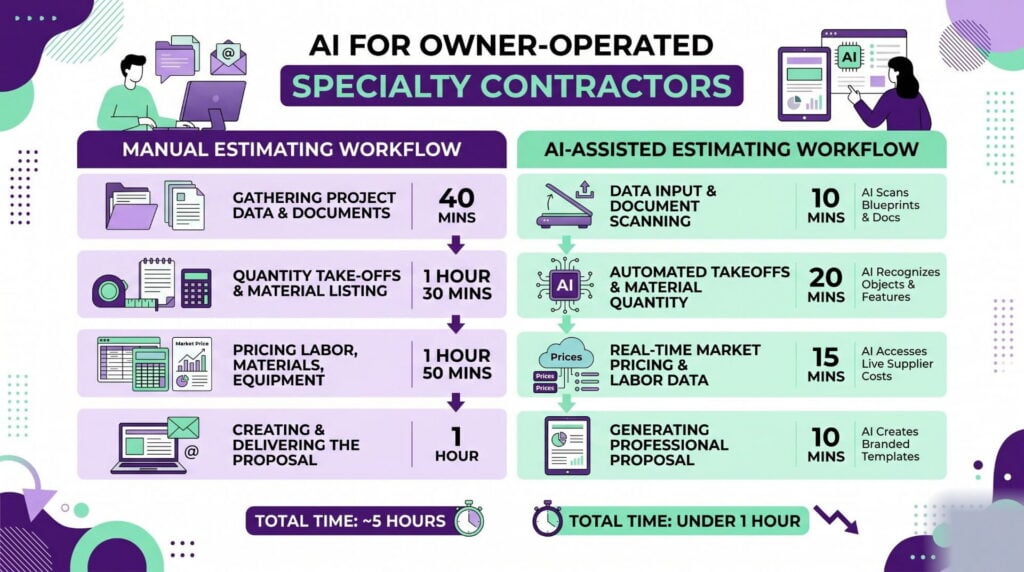
AI cuts bid time from 4 to 6 hours to under 1 hour. The same tools cover scheduling and sub tracking. A full stack costs $200 to $500 per month.
An AI system for owner-operated specialty contractors is a set of tools that handles three tasks. Those tasks are bidding, scheduling, and tracking subs. According to McKinsey’s construction research, AI tools can cut project cost overruns by up to 25%. Contractors who start with bidding see the fastest return.
AI Smart Ventures has guided growing businesses through AI adoption across many industries. For specialty contractors, bidding is the right starting point. The savings show up on the first project.
Contractors who skip AI compete against peers who send bids 4 to 5 hours faster. That gap affects win rates on smaller jobs. The right tools close it without IT support.
Key Takeaways
- Bid Speed – AI tools like StackCT cut bid time from 4 to 6 hours to under 1 hour for most specialty contractor jobs.
- Scheduling Accuracy – AI scheduling tools reduce project delays by up to 20%, per McKinsey’s construction benchmarks.
- Sub Tracking – AI tracking tools reduce missed sub check-ins by 60 to 70%, based on common contractor adoption patterns.
- Stack Cost – A working AI stack for a team of 2 to 10 costs $200 to $500 per month, with Buildertrend starting at $199 per month.
- Adoption Timeline – Most owner-operated specialty contractors see measurable time savings within the first 30 days of using AI bidding tools.
Bidding is the best place to start. Every hour saved on a bid goes back to field work or the next job. These sections cover the tools, costs, and how to roll them out.
Why Are Specialty Contractors Adopting AI Now?
Specialty contractors are adopting AI tools at a faster rate than in prior years. The cost of entry dropped: a basic AI bidding tool starts at $299 per month, down from over $1,500 for enterprise construction software in 2022. That price drop made AI-assisted bidding practical for any owner-operated contractor with a crew of 2 to 10 people.
Bid speed now affects win rates on smaller residential and commercial jobs, where clients often award the contract to the first credible bid they receive. AI tools send a finished bid in under 1 hour; manual takeoffs for the same job take 4 to 6 hours. According to FMI’s AI in construction research, contractors that adopt technology tools report 15% higher project win rates than peers who do not.
How Does AI Help With Project Estimating?
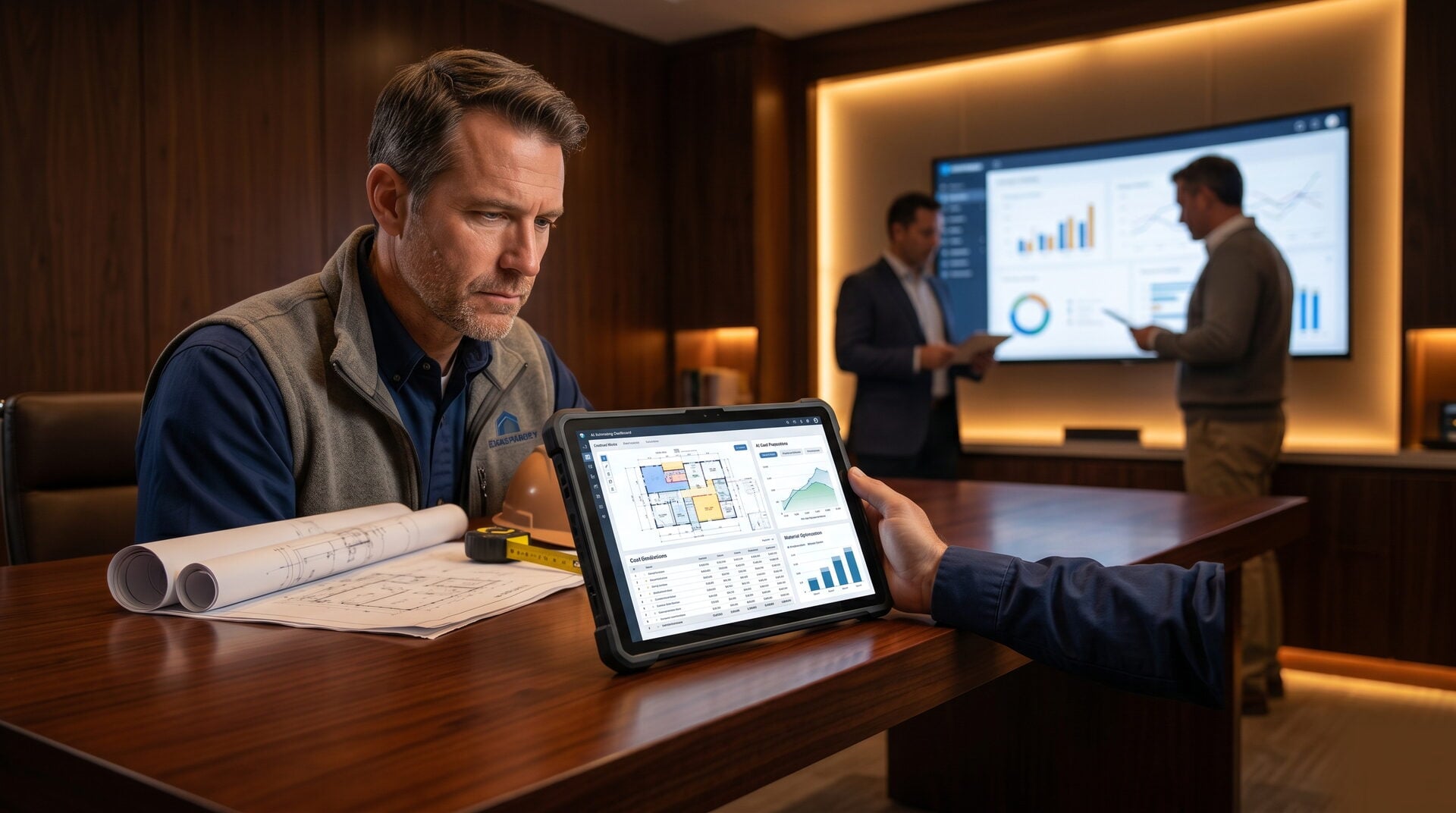
AI estimating tools take project plans or a scope document and generate a full cost breakdown in under 1 hour, covering materials, labor, and equipment. Manual takeoffs require the owner to measure plans by hand, look up prices, and build cost tables from scratch. For most trades, that process takes 4 to 6 hours per bid.
The tool does not replace contractor judgment on scope or pricing. It handles the data work; the owner reviews and adjusts the output before sending. Tools like StackCT and Trimble’s construction platform connect to live material price databases so bids reflect current costs, not last quarter’s figures.
Which AI Tools Work Best for Scheduling?
AI scheduling tools build a project timeline from your scope, crew size, and lead times, then update it when conditions change on site. For a contractor managing 3 to 8 jobs at once, this removes the weekly manual work of updating charts and chasing subs for status. Buildertrend at $199 per month handles scheduling, daily logs, and sub communication in one platform.
The best scheduling tools connect directly to the bidding step, so a scope change automatically updates the project timeline without manual input. Procore is the most complete construction platform but starts above $500 per month, which is more than a lean team needs at first. Start with Buildertrend and switch to Procore once you run more than 10 active jobs at the same time.
AI Smart Ventures offers AI advisory services for growing businesses choosing construction AI tools. Visit the advisory page to see how the process works.
How Do You Manage Subs With AI?
AI sub management tools send check-in messages, track replies, and flag anyone who has not confirmed their schedule or sent a progress update. For a contractor running 4 to 8 subs per project, this replaces 30 to 60 minutes of daily follow-up calls. Buildertrend and CoConstruct both include sub communication in their base subscription at no extra charge.
These tools track what subs say but cannot verify what they have actually done on site. Weekly photos and physical checks should run alongside the auto check-ins. That mix of AI tracking and hands-on review gives you the oversight that manual follow-up alone rarely achieves.
Here is how to structure sub tracking for a lean crew:
- Daily Check-In – Set auto messages asking each sub to confirm crew count, progress, and any blockers for the day.
- Photo Requirement – Require a progress photo with each check-in using Buildertrend’s photo feature or a shared project folder.
- Late Alert – Set a rule: any sub who has not replied by noon triggers an alert. Call directly, do not wait.
- Weekly Report – Export a sub performance summary from Buildertrend before releasing any payment milestone.
Once running, daily follow-up time drops from 45 minutes to under 10 minutes.
What Does an AI Stack Cost for Contractors?
A working AI stack for a specialty contractor team of 2 to 10 costs $200 to $500 per month. Budget for three things: AI bidding, scheduling and communication, and document management. You do not need all three at once to start getting a return.
For a five-person crew, a practical stack is StackCT at $299 per month for bidding plus Buildertrend at $199 per month for scheduling and sub tracking. That is under $500 per month and covers the two highest-value workflows. Adding DocuSign at $15 per month for contract signing brings the full AI implementation ready stack to under $520 per month.
| Tool | Category | Starting Cost | Best For | Limitation |
|---|---|---|---|---|
| StackCT | AI bidding | $299/mo | Fast takeoff from plans | Regional pricing varies by trade |
| Buildertrend | Scheduling + comms | $199/mo | Schedule and sub tracking | No native AI bidding built in |
| Procore | All-in-one | $500+/mo | 10+ active jobs | Too costly for crews under 10 |
| ChatGPT Plus | Proposal drafts | $20/mo | Proposal and contract first drafts | Needs review before sending |
For a vetted list of AI tools, see AI tools and apps on the AI Smart Ventures resource hub.
How Do You Roll Out AI to a Field Team?
The fastest path to adoption is one time saving shown in the first two weeks. An estimator who finishes a bid in under an hour instead of 5 hours will tell the whole crew without any top-down push. That peer proof spreads faster than any formal training session or company mandate.
Introduce one tool at a time. Start with bidding in the office. Move to scheduling after that workflow is solid. Add sub tracking last. Owner-operators who follow this order typically have all three tools running within 60 days of starting.
Here is a 30-day launch plan:
- Week 1 – Set up AI bidding. Run one live bid alongside your manual process. Compare time and output.
- Week 2 – Use the AI bid as the primary quote on a new project. Track time saved versus your old process.
- Week 3 – Set up scheduling in Buildertrend for the same project. Connect it to the sub check-in system.
- Week 4 – Review results with the crew. Share the time data. Ask which tool to roll out first across the full portfolio.
Measure one thing at a time. Adding all three tools at once makes it hard to know what is working.
Frequently Asked Questions
Can AI Do Construction Estimating for Specialty Contractors?
Yes. AI tools like StackCT take plans or a scope and return a cost breakdown in under 1 hour. The output covers materials, labor, and gear. The contractor reviews and adjusts before sending. AI handles the data and math while the owner applies judgment on scope and final pricing. Most specialty trades report saving 4 to 5 hours per bid compared to manual takeoffs.
What Is the 30% Rule for AI?
The 30% rule says roughly 30% of any knowledge worker’s tasks can be automated with current AI tools. For specialty contractors, that 30% includes bidding, schedule updates, sub follow-up, proposal writing, and invoice drafts. The other 70% is field judgment, client relationships, quality checks, and safety decisions. Those parts always need a person on site.
What Is the 10/20/70 Rule for AI?
The 10/20/70 rule is a framework from Google’s AI playbook: 10% on data and tools, 20% on model setup, and 70% on adoption and change management. For specialty contractors, the tool purchase and setup are the small parts. The large part is training your estimators and field leads to trust the output and use the tools every day, not just on the first test.
How Much Does an AI Bidding Tool Cost for a Specialty Contractor?
AI bidding tools start at $299 per month for StackCT and go above $500 for full platforms like Procore. For a crew of 2 to 10, a StackCT plus Buildertrend stack runs under $500 per month and covers bidding, scheduling, and sub communication. AI Smart Ventures offers AI consulting services to match tools to your trade and team size. Schedule a consultation for a specific plan.
Do AI Tools Work for All Specialty Trades?
AI bidding works best for trades with standard material lists and measurable plan quantities: electrical, plumbing, HVAC, framing, and drywall. Highly custom trades need more manual scope judgment before AI can help with pricing. Most tools let you build custom line-item libraries for your trade, which improves output over time as the tool learns from past bids.
How Long Does It Take to Set Up an AI Bidding Tool?
Initial setup takes 2 to 4 hours. This includes creating an account, loading standard material pricing, and running a test bid. The first AI bid takes 30 to 60 minutes longer than later ones. By the third or fourth bid, most users work at full speed. A basic level of computer skill is all you need to get started.
How Do You Handle Sub Disputes With AI Records?
AI tools create a timestamped log of every check-in, photo, and schedule confirmation from each sub. In a dispute, this shows exactly what the sub agreed to and when it was agreed. It does not replace a written contract. It supports the contract with a clear event record. Buildertrend and CoConstruct both export this log in a format that works for legal or insurance review.
Can AI Write Contractor Proposals and Scope Documents?
Yes. Claude and ChatGPT draft proposals, scope-of-work documents, and change orders in under 10 minutes from a short brief. The draft needs contractor review. Most contractors edit the AI draft in 15 to 20 minutes, compared to 60 to 90 minutes from scratch. A reusable prompt built around your standard scope format gives the fastest results.
What Happens When AI Gets a Bid Wrong?
AI bidding tools can miss scope items if plans are incomplete or if the contractor skips the review step. The fix is the same as with manual bids: review line items, adjust quantities, and update pricing before sending. The risk is lower than manual bidding because AI tools show their source calculations. Always build in a 15-minute review for every AI bid before it goes to a client.
How Do You Keep Client Data Private With Contractor AI Tools?
Turn off AI training data in your tool’s privacy settings before uploading client plans or contracts. Request a Data Processing Agreement (DPA) before connecting any tool to a client database. Major platforms like Buildertrend and Procore store data on US servers and provide DPAs on request. Confirm data location and training opt-outs before sharing any project details with a new AI platform.
Executive Summary
Owner-operated specialty contractors who use AI for bidding, scheduling, and sub tracking cut admin time by 4 to 8 hours per project at a cost of $200 to $500 per month. The strongest starting point is AI bidding, which drops bid time from 4 to 6 hours to under 1 hour and improves win rates. A StackCT plus Buildertrend stack runs under $500 per month with no IT staff needed.
What Should You Do Next?
Run one existing scope through a free trial of StackCT this week. Compare the AI output to your last manual bid for accuracy and time. That one test shows you whether AI bidding fits your trade before you commit to a plan.
AI Smart Ventures offers AI advisory services for growing businesses building AI workflows for field and trade work. Schedule a consultation for a recommendation matched to your specialty trade.
People Also Read
About the Author
Nicole A. Donnelly is the Founder of AI Smart Ventures and an AI Adoption Specialist with 20 years of experience as a founder and CEO and over a decade leading AI adoption initiatives. She helps businesses integrate artificial intelligence with clarity and confidence, driving innovation and sustainable growth. Nicole has trained over 20,217 professionals in Applied AI, delivered 624 workshops, and worked with close to 1,000 organizations across diverse industries.
Expertise: AI Transformation, AI Strategy, AI Implementation, AI Adoption, Applied AI, Marketing, Business Operations
Disclaimer: This content is for informational purposes only and does not constitute professional business or technology advice. Results vary based on industry, existing systems and implementation commitment. Contact AI Smart Ventures for a consultation regarding your specific situation.