
AI Predictive Maintenance: How It Works and Is It Worth It
Last Updated: August 2026
AI predictive maintenance for a business is the practice of reading machine signals to spot a failure before it stops the line. Sensors track shake, heat and current draw, while a model learns what normal looks like on that machine. When the pattern drifts, you get an alert with time to book the repair. The point is not fewer repairs; it is repairs that land on your calendar, not the machine’s.
AI Smart Ventures has guided growing businesses through AI adoption on plant floors, in vehicle fleets and across building systems. One pattern repeats: the teams that get value pick the machine before the tool.
Get this wrong and you buy a stream of alerts no one trusts, which is worse than the calendar you had. Get it right and the same crew covers more machines, because the work arrives planned. The gap is rarely the model. It is whether your failure leaves a trace in the data.
Key Takeaways
- This is the most common AI job on a plant floor, running at 57% of plants surveyed in June 2026. It is a proven place to start.
- The model needs the failure to build slowly. A bearing that grinds for weeks leaves a trail; a fuse that pops does not.
- Data quality is the top blocker, named by 47% of plant leaders. Stalled projects lack clean repair records, not a better model.
- Buying the tool does not fix uptime. In a 2026 survey, 79% of maintenance leaders saw unplanned downtime hold flat or worsen.
- Skip it when you run a few simple machines, spares sit on the shelf, and a swap takes an hour. Reactive is often the right call.
- Judge a pilot on planned-work share, mean time between failures, and how many alerts proved real. Those three settle it in two quarters.
Read them as a set and a rule falls out: this is a data project in a hardware costume. The sensor is the easy part. The slow part is agreeing what counts as a failure, then finding enough logged cases to learn from.
How does AI predict a machine failure?
It watches a steady signal, learns the shape of normal, then flags the point where that shape starts to slide. Vibration, heat, current draw and sound all shift in small ways as a part wears out. A model trained on your own repair records learns those patterns, so drift shows up long before a technician would hear it. The output is a risk score with a window on it, never a promise. A good system tells you roughly how long you have, and that is the number that lets you plan the fix.
Two families of method exist, and neither is complete. A 2026 review of predictive maintenance research by Kyle Hamilton and Muhammad Intizar Ali found deep learning beats rule-based systems on accuracy, but it needs big labelled data sets and cannot explain itself. Rule sets raise far more false alarms.
What data do you need before you start?
You need three things: a signal sampled often enough to catch the drift, a log of past failures with dates on them, and an agreed line for what counts as a failure on that asset. The signal is usually the easy part. Failure records are where projects stall, because most logs note what was fixed rather than what broke or when it began to go. With no labelled cases, a model can tell you something is odd but not what kind of odd. That is where most pilots quietly come apart.
Two things shifted in 2026, and together they set the bar for practical AI on the floor:
- Data quality became the top blocker. It was named by 47% of the 501 plant leaders in Augury’s fourth annual State of Production Health report, out on 9 June 2026. The same study put this as the leading AI use case at 57%, with the share of firms running AI across most sites tripling to 42%.
- Pretrained models lowered the entry bar without clearing it. Google Research’s TimesFM, trained on general time-series data rather than your plant, forecasts a fresh signal with no training run of your own.
Which machines are worth watching first?
Start with the machine whose failure stops everything behind it and whose parts wear in a way you can measure. Spinning gear nearly always fits: pumps, motors, fans, gearboxes and air compressors. Bearings and shafts on those decay over days or weeks, so the signal has time to build. Skip the ones that fail all at once, and skip the ones with a spare sitting beside them. The test is not how vital the machine feels. It is whether a failure hands you warning that you could actually act on.
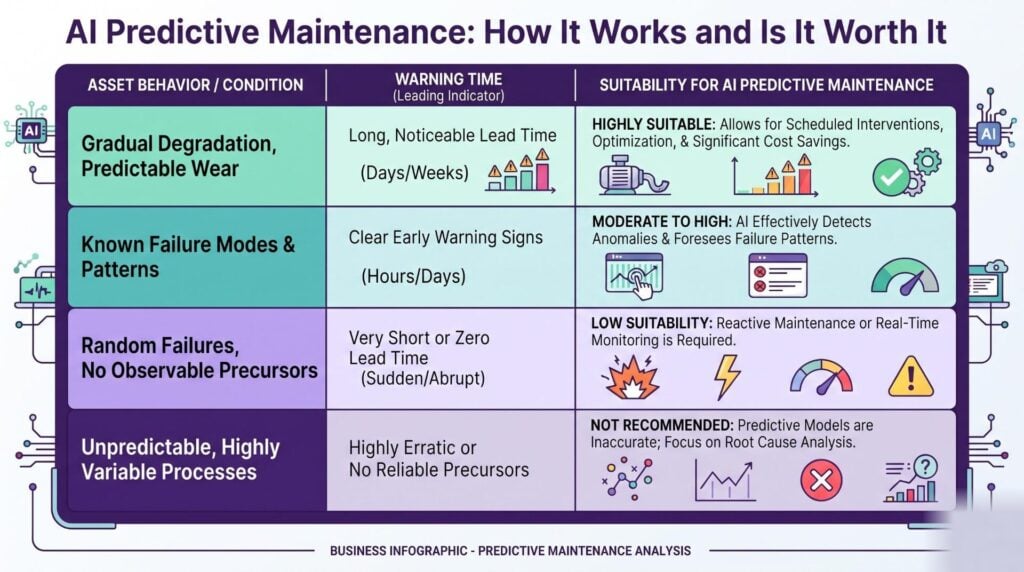
| How the asset fails | Fit? | Why |
|---|---|---|
| Wears out slowly | Yes | Drift builds over days, so alerts arrive early |
| Goes at random | No | Nothing to read until it breaks |
| Spare on the shelf | No | Warning buys back little output |
| Takes the line down | Yes | Lead time beats the sensor work |
Picking that first asset is judgement work, not software work. AI Smart Ventures offers AI Advisory shaped by close to 1,000 organizations, so you can shortlist a machine and a vendor without a sales pitch.
How does an alert become scheduled work?
The alert has to land in the system your planners use, or it dies in an inbox. Current platforms close that loop by turning a flagged asset into a draft work order with a suggested action, a parts list and a window. A person still signs it off, and that sign-off is what protects trust when the model is wrong. It will be wrong sometimes. The measure of a good rollout is not how many alerts it raised; it is how many became booked jobs, which is where real workflow optimization shows up.
That loop is where the 2026 releases are aimed. IBM’s Maximo Application Suite 9.2, out on 25 June 2026, added Condition Insight, which reads work orders, checks and meter readings as one, then names the next action.
When is predictive maintenance not worth it?
Four cases make it a poor trade. You run a few simple machines, so there are not enough logged failures for a model to learn from. Your failures are quick to fix and easy to swap, so warning buys back little. Your gear dies all at once by design, with no slow signal to read. Or your reactive setup works fine, because spares are held, the crew is close and a stop takes an hour rather than a shift. Better software fixes none of those four, and no vendor will say so.
There is a fifth case, and it is the awkward one. If no one owns the alerts, the project fails however good the model is. Change management carries the weight: someone reads them each morning and marks which were real. Without that habit you get a dashboard and no gain in operational efficiency.
How do you judge whether it paid off?
Track four numbers and drop the rest: unplanned downtime hours, mean time between failures, the share of repair hours spent on planned work, and the false-alarm rate on your alerts. Set a baseline before the first sensor goes on, because you cannot build one after the fact. Then give it two quarters. If planned work is climbing and most alerts are proving real, the approach has earned its place on that asset and you can widen it. Three of those four numbers you can start counting today, straight out of the log book.
MaintainX’s State of Industrial Maintenance report, out on 5 May 2026 from 2,234 maintenance and operations leaders in the US and Canada, found 58% of teams using AI, yet 79% saw unplanned downtime hold flat or rise. Half still spend under 40% of their hours on planned work. Capability building moved that number, not the software.
Frequently Asked Questions
How does AI predictive maintenance actually work in practice?
A sensor streams a signal, a model learns the machine’s normal range, and drift from that range raises an alert with a time window on it. In practice that means shake or heat readings from a pump feeding a model that has watched that pump run well for months. The platform drafts a work order, a planner signs it off, and the fix lands in a booked window.
Which equipment benefits most from AI predictive maintenance?
Spinning gear gains most: pumps, motors, fans, gearboxes and air compressors. Their bearings and shafts wear slowly, so the signal builds over days or weeks and a model has something real to read. Assets that fail all at once, or that you swap in an hour from a shelf, make poor picks. Warning matters most on the machine that halts everything behind it.
How much can AI predictive maintenance save a manufacturer?
Measure the gain in downtime hours, failure rates and planned-work share rather than one headline figure, because the answer swings wildly by asset. A line with no backup gains far more from a week of warning than a plant holding three spare pumps. Track unplanned downtime hours per month and mean time between failures against a baseline you set before the pilot.
How do you get started with AI predictive maintenance?
Pick one asset, write down what failure looks like on it, then check whether your logs hold past failures with dates and causes. Fit the sensor after that, never before. Collect a baseline for a month, switch alerts on for that single machine, and note which ones proved real. For a second opinion on the asset, schedule a consultation and bring the log book.
What sensors does predictive maintenance need?
Vibration sensors do most of the work on spinning gear, because bearing wear, imbalance and poor alignment all show up there first. Heat and current sensors catch thermal and electrical decay that shake alone misses, while sound sensors find air leaks. Many machines built in the last decade report some of this already, so check what your gear streams today.
How long before the model gives useful alerts?
Expect 30 to 90 days of baseline collection before alerts mean much, and longer if the asset runs in seasonal cycles. The model has to see normal across a full range of loads, shifts and product changes before drift tells you anything. Pretrained models shorten that wait, since they arrive knowing the general shape of time-series data, but your own records still tune them.
Can you run predictive maintenance without new sensors?
Often yes, at least to start. Machine controllers, variable speed drives and building systems already log heat, current and run hours, and that data is enough to test whether a pattern exists. Oil samples and thermal images taken on rounds count as condition data too. Prove a signal is there with what you hold, then buy sensors for the gaps.
What is the difference between preventive and predictive maintenance?
Preventive work runs on the calendar; predictive work runs on the state of the machine. A calendar plan swaps a part every 500 hours whether it needs it or not, so some parts go early and others still fail between visits. A predictive plan watches the real signal and acts when it drifts. Most plants run both, keeping calendar work for simple items.
How accurate are AI failure predictions?
Accuracy varies by asset and by how many logged failures the model was given, so treat any single vendor figure with care. The 2026 research picture is that data-driven models beat rule sets on hit rate, yet they need big labelled data sets and travel badly to sites they were not trained on. Your own false-alarm rate is the measure that counts.
Does predictive maintenance work on older machines?
Yes, and older machines are often the better picks, because they fail more and the wear is easier to see. Age is not the blocker; wiring is. A machine with no network port can still be watched by a clip-on wireless sensor. What you cannot get back is failure records that no one wrote down, so start logging breakdowns now.
What happens when the model gets it wrong?
There are two ways to be wrong and they hurt differently. A false alarm sends a technician to a healthy machine, which wastes an hour and chips away at trust. A missed failure leaves you where you started, running reactively. Reviewing the wrong calls each week is how alert thresholds get tuned, and it is the step teams drop first.
Executive Summary
AI predictive maintenance reads machine signals to forecast failures early enough to book the fix. It works when wear builds slowly, when the failure has a written record, and when somebody owns the alerts each morning. It is the leading AI job on a plant floor, running at 57% of plants surveyed in June 2026, yet 79% of maintenance teams in a separate study saw no gain in unplanned downtime. Pick one asset with wear you can measure, set a baseline, then judge it on planned-work share.
What Should You Do Next?
List your five most disruptive machines this week and mark which ones fail slowly. For each, open the repair log and check whether the last three breakdowns carry a date and a cause. That check tells you which asset is ready for a pilot and which needs better records.
AI Smart Ventures offers AI Advisory for growing businesses weighing sensor and platform choices on the plant floor. Schedule a consultation to pressure-test your first asset pick before you commit to hardware.
People Also Read
- How to Use AI for Competitive Intelligence and Market Research
- AI for Proposals and SOWs: How to Win More Business in Less Time
About the Author
Nicole A. Donnelly is the Founder of AI Smart Ventures and an AI Adoption Specialist with 20 years of experience as a founder and CEO and over a decade leading AI adoption initiatives. She helps businesses integrate artificial intelligence with clarity and confidence, driving innovation and sustainable growth. Nicole has trained over 20,217 professionals in Applied AI, delivered 624 workshops, and worked with close to 1,000 organizations across diverse industries.
Expertise: AI Transformation, AI Strategy, AI Implementation, AI Adoption, Applied AI, Marketing, Business Operations
Disclaimer: This content is for informational purposes only and does not constitute professional business or technology advice. Results vary based on industry, existing systems and implementation commitment. Contact AI Smart Ventures for a consultation regarding your specific situation.