
AI Review Generation for Business Owners: FTC Rules in 2026
Last Updated: July 2026
An AI review generation program helps you request and manage customer reviews. It uses AI tools to reach customers on many platforms. These include Google, Yelp, and industry directories. These programs send follow-up messages. They time outreach based on purchase behavior and track incoming feedback. You need to know those rules before using any AI review tool. This protects your business from serious legal and financial risk.
AI Smart Ventures helps growing businesses navigate AI-powered marketing and compliance. The team helps owner-operators adopt AI tools that drive real results without creating legal exposure. Review generation sits between customer history and compliance. Building a clear strategy now saves time and avoids costly mistakes.
The FTC’s 2023 rule on fake reviews carries full enforcement authority in 2026. Many owner-operators do not know how broadly this rule applies. It covers any review workflow that uses AI tools. Knowing what AI can and cannot do in review generation is key. It is now part of running a responsible business.
Key Takeaways
- The FTC’s fake review rule directly covers AI-made content. Businesses cannot use AI to write reviews that appear to come from real customers without their genuine input.
- AI is fully legal for automating review request messages, personalizing outreach timing, and tracking customer response rates. The customer must always write the review themselves.
- Violations carry civil penalties of up to $51,744 per offense. A pattern of fake reviews across many platforms can cost millions in total fines.
- Platform policies from Google, Yelp, and Amazon often go further than FTC rules. You must follow both sets of rules on every platform where your business is listed.
- A good AI review program needs a written policy, staff training, and monthly audits. These steps catch issues before they grow.
What Are FTC Rules on AI Reviews in 2026?
The FTC finalized its rule on fake reviews in 2023. This rule carries full enforcement authority in 2026. It bans businesses from creating, buying, or sharing reviews from non-genuine results. It also bans paying for positive reviews without clear disclosure. Hiding negative reviews is banned too. Company insiders cannot post reviews without saying who they are. The rule directly names AI-made reviews as a form of manipulation. It aims to stop this practice.
The FTC’s guidance on AI and deceptive practices is clear on this point. AI-made review text looks like it came from a real buyer. Writing it is a deceptive act. Intent does not matter. The law does not treat a human copywriter and an AI tool differently. Both face the same rules when fake content is made.
Owner-operators must know how every tool in their stack behaves. This includes features they may not have set up on purpose.
What Makes an AI Review Illegal?
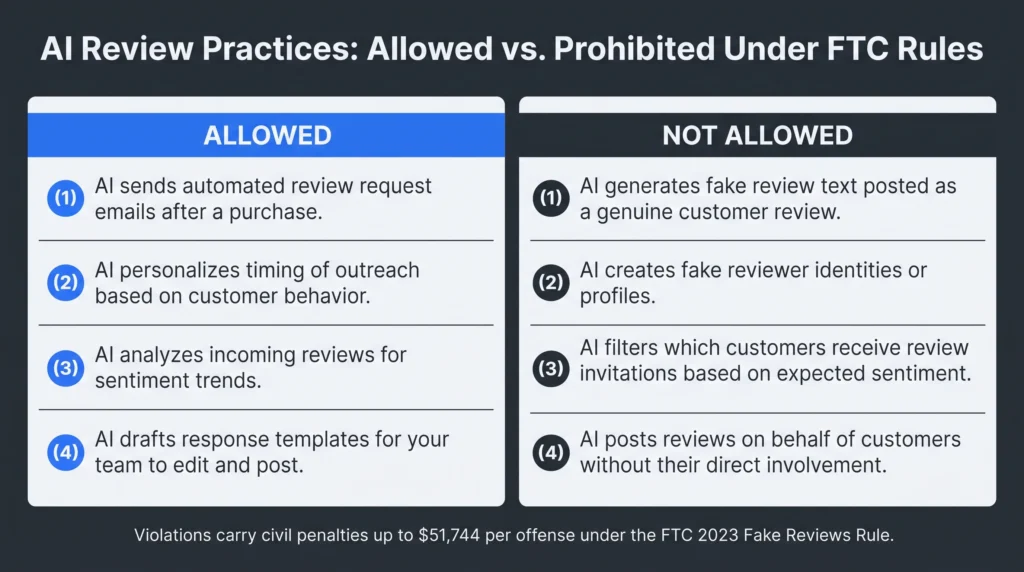
A review breaks FTC rules when it hides where it came from. The most common violations involve using AI to write fake review text. Others include creating fake reviewer profiles. Some businesses post many reviews from one customer to inflate volume. Others filter which customers get sent to review platforms based on their likely rating.
Each of these is a deceptive act. The business owner is responsible. It does not matter if the behavior was set up on purpose or if an AI tool did it on its own.
Review gating is a banned practice. Many owner-operators use it without knowing it breaks the rules. This means asking customers how happy they are. Only then do you send them to a review site. Only satisfied customers end up posting publicly. All customers must get the same neutral invitation to share their honest history. Any AI tool that filters by sentiment must be fixed or replaced.
How Can AI Help You Get Real Reviews Legally?
AI has a key role in a good review strategy. Its job is to help you ask for reviews, not write them. According to HubSpot’s State of Marketing research, AI is now one of the top tools businesses use for customer outreach. Using it the right way in your review strategy can set you apart.
A good AI review program sends follow-up messages to customers after a purchase. It picks the best time to reach out based on purchase history. It routes customers to the right platform. It also tracks who has been contacted to avoid duplicate messages. All of this grows your review count without any legal risk. The customer always writes the review in their own words.
AI tools can also help your team respond to reviews quickly. Drafting response templates, flagging urgent reviews, and summing up feedback themes are all allowed. These uses help build a real reputation. Businesses that respond to reviews quickly see better customer use. AI makes that speed possible even for a small team.
Ready to build a review program that fits within FTC rules? AI Smart Ventures offers AI Advisory for growing businesses that want to adopt AI tools with confidence. Schedule a consultation to get a clear strategy for your review generation program.
What Penalties Can Your Business Face?
Violations of the FTC’s fake review rule carry civil penalties of up to $51,744 per violation. Each fake review counts as a separate offense. A business that posts 50 fake reviews could face fines over $2.5 million. FTC enforcement actions become public record. That exposure damages your brand with customers, partners, and prospects in ways that outlast the legal case.
State attorneys general can pursue separate actions under state consumer protection laws. Competitors harmed by fake review schemes can also sue for damages. The total legal risk from a fake review program is very high. It far beats any short-term gain from higher ratings.
How Do You Build a Compliant Review Program?
Building a good AI review program starts with a written policy. This policy defines how your business will ask for, track, and respond to reviews. This document names which AI tools are approved and what can be automated. It also names who checks the program each month.
Every team member who talks with customers must know the review rules. They need to know what they can and cannot say when asking for a review. This includes rules against steering language and offering incentives. Review request messages must invite customers to share their honest history. Do not suggest a positive outcome.
Use the customer’s name and mention the product or service they bought. Keep the call to action neutral. Keep records of all review requests, including the date, the customer, and the platform. These records protect you if an official investigation starts.
Which Platforms Enforce Review Policies Separately?
Google, Yelp, Amazon, and TripAdvisor each maintain review policies that run alongside FTC rules. Google bans incentivized reviews and employee reviews without disclosure. Yelp uses automated filters to spot suspicious review patterns. It removes listings that break its rules repeatedly. Amazon’s enforcement teams actively watch for review manipulation and will suspend accounts found in violation.
These platform rules often go further than FTC rules. You must meet both sets of needs. Breaking a platform’s review policy can get your listing removed or your account suspended. You may also get a public warning label on your profile. These outcomes can hurt revenue faster than a federal investigation.
Review the full policy for every platform where your business appears. Set a calendar reminder to check for updates at least once a year.
How Do You Monitor Your Review Strategy Ongoing?
Monitoring is not optional once an AI review program is running. Set up a monthly audit that checks three things. First, look at review volume compared to your customer base. Second, check the language patterns in reviews. Third, note which platforms are getting new reviews.
A sudden spike in positive reviews is a warning sign. So are reviews with very similar phrasing. Reviews showing up on platforms where you have few real customers are also a warning sign. Give these a closer look.
Use AI tools to track sentiment trends over time. Do not just count star ratings. A real rise in customer history shows up as a slow, steady climb in scores. A rapid, unexplained jump is worth a closer look. Document each monthly audit. Keep records for at least three years in case of an official investigation.
Frequently Asked Questions
Can I use AI to write review request emails?
Yes. AI can write and send review request emails to customers after a purchase. The email asks customers to share their own real history. The AI handles timing, personalization, and delivery. The customer writes the actual review. This is one of the most good and legal uses of AI in a review strategy for growing businesses.
Does the FTC fake review rule apply to local businesses?
Yes. The rule applies to all businesses in the United States, no matter the size or location. A local service provider faces the same legal risk as a national brand. The FTC keeps a public database of enforcement actions that includes businesses of all sizes. Thinking the rule only targets large companies is a common and costly mistake for owner-operators.
Can I offer a discount in exchange for a review?
No. You cannot offer any incentive for a review. This includes discounts, free products, or service credits. The only exception is if the incentive is clearly stated in the review text itself. Even with proper disclosure, Google, Yelp, and most major platforms ban incentivized reviews. The safest approach is to ask for reviews without any offer attached.
What if a customer gives me permission to post a review for them?
Even with permission, posting review content you or your AI tool wrote raises concerns under FTC rules. Most review platforms also need reviews to come directly from the customer’s own account. The safest approach is to have customers post in their own words. They should use their own profile. Your team should not write any of the content.
What should I do if I find fake reviews about my business?
Report them to the platform using its built-in flagging tools. Google, Yelp, and Amazon all have ways to report suspected fake reviews. You can also file a complaint with the FTC at reportfraud.ftc.gov. Keep screenshots and records in case the situation leads to a legal dispute. Do this especially if you think a competitor created the fake reviews.
How do I know if an AI review tool is FTC-compliant?
Ask the vendor directly whether the tool writes review content. Find out if it creates reviewer profiles or posts reviews without customer involvement. Request a written statement that shows they follow FTC guidelines. If the vendor cannot give this or does not know FTC review rules, that is a red flag. Look for tools that clearly explain what they automate and what they leave to the customer.
What is review gating, and why is it prohibited?
Review gating means asking customers about their satisfaction before directing them to a review platform. Only satisfied customers end up posting publicly. This filters reviews by expected sentiment, which the FTC treats as a deceptive practice. All customers must get the same neutral invitation to leave an honest review, no matter their likely rating.
How much does a compliant AI review program cost?
Costs vary based on the tools you choose and the size of your customer base. Basic AI review platforms fit different budgets. More full-featured tools with CRM links and multi-location management cost more. AI Smart Ventures can help you find which tools fit your needs and compliance goals. Schedule a consultation to discuss options for your specific situation.
Executive Summary
AI review generation is one of the most key areas of AI adoption. This is true for owner-operators in 2026. It is also one of the most regulated. According to Salesforce’s State of AI research, AI adoption in marketing is growing fast. This makes knowing the rules more key than ever.
The FTC’s fake review rule carries civil penalties of up to $51,744 per violation. It applies to businesses of all sizes across the United States. AI tools are good for automating review requests, personalizing outreach, and tracking feedback trends. They become a problem when they write or fake review content. The same is true if they change reviewer identities. A good program needs written policies, approved tools, trained staff, and monthly audits. Owner-operators who build this foundation gain a lasting edge through real customer trust.
What Should You Do Next?
Start by checking every AI tool in your review step. Ask vendors to put their FTC compliance position in writing. Set a 30-day deadline to put a written review request policy in place. Every customer-facing team member should sign off on it. Schedule a monthly review audit to track patterns and catch problems before they grow.
AI Smart Ventures offers AI Advisory for growing businesses that want to use AI tools with confidence and clarity. Schedule a consultation to get expert guidance on building a review generation program that drives real results and stays fully compliant with FTC rules.
People Also Read
- AI Image Generation for Business: When to Use Midjourney, DALL-E, or Flux
- Should You Outsource Your AI Marketing? A Decision Framework for Business Owners
About the Author
Nicole A. Donnelly is the Founder of AI Smart Ventures and an AI Adoption Specialist with 20 years of history as a founder and CEO and over a decade leading AI adoption plans. She helps businesses connect AI with clarity and confidence, driving innovation and lasting growth. Nicole has trained over 20,217 experts in Applied AI, delivered 624 workshops, and worked with close to 1,000 businesses across diverse industries.
Expertise: AI Transformation, AI Strategy, AI Rollout, AI Adoption, Applied AI, Marketing, Business Operations
Disclaimer: This content is for informational purposes only and does not constitute expert business or tech advice. Results vary based on industry, current systems and rollout commitment. Contact AI Smart Ventures for a consultation about your specific situation.