AI Tool Hopping: The Hidden Cost of Switching Stacks Too Often
Last Updated: July 2026
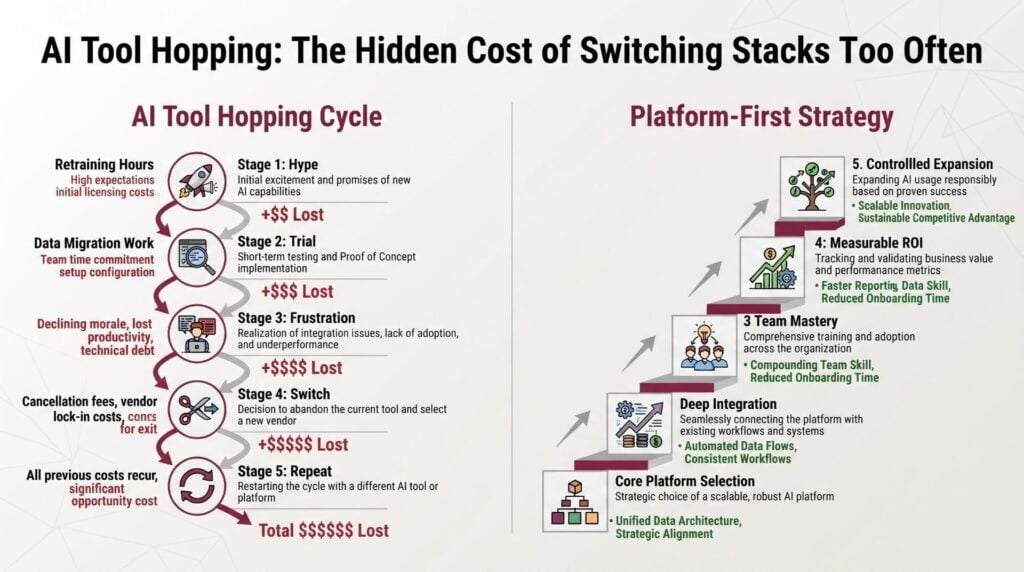
AI tool hopping means switching platforms before the first one is fully set up. It also means switching before results can be measured. Business owners fall into this cycle when new tools launch with bold promises. The result is wasted budget and broken data. Your team never masters any one system. This is one of the biggest drains on time and money for growing businesses today.
AI Smart Ventures has helped hundreds of growing businesses build stable AI stacks. Frequent tool switches are one of the most harmful patterns these businesses face. They are also one of the most preventable. When business owners commit to a platform-first approach, teams adopt new workflows faster and get more consistent results.
Tool switching feels like progress. But it often hides a deeper issue: no clear AI strategy. Every switch adds friction to your team’s workflow. It also delays the point where your AI investment starts paying off. The sections below help you see when switching is a costly mistake. They also show when it is the right move.
Key Takeaways
- Hidden migration costs add up with every platform change. These include data transfer work, retraining hours, and an output gap during each switch.
- Frequent switching causes fatigue. Staff start to resist new tools instead of mastering the ones they have.
- Vendor lock-in becomes a real financial risk. This happens when you sign contracts without checking data portability terms and exit fees first.
- Run a 90-day review against clear metrics before you consider replacing any tool. That is the right test.
- A platform-first strategy creates more lasting value than a set of disconnected tools. Go deep with one core system first.
What Is AI Tool Hopping Costing You?
The cost of switching AI tools goes well beyond a new subscription price. Every change needs your team to move data and rebuild connections. They also have to relearn a new interface. These hours add up fast. During the relearning period, output quality and speed both drop.
Growing businesses that track these hidden costs often find that a single switch uses weeks of work time. There is also a cost that is harder to see. Every switch pushes back the point where your AI investment starts paying off. McKinsey’s research on AI shows that the businesses getting the most value from AI are those with stable, deeply adopted systems.
Frequent switching also breaks up your data. When info lives across separate platforms, your team cannot see a clear picture of operations. Reports take longer to compile. Automation breaks when connections fail.
The skills your team builds around one system are lost each time you switch. These losses add up fast. They often cost more than just staying with a current tool. Training your team to use it well is far cheaper than switching.
The mental cost is just as high. Staff who keep learning new tools spend their energy on learning. They cannot focus on their actual work. They build habits and create templates around a platform. Then all that work is wiped out the next time you switch.
Over time, this cycle breaks your team’s trust in adopting new tech.
How Does Vendor Lock-In Trap Businesses?
Vendor lock-in happens when your data and workflows are tied to one platform. Leaving becomes very hard or very costly. This is not always the result of a bad vendor. It becomes a serious problem when you did not plan for it before signing.
Custom data formats and API connections raise the cost of switching. Long-term contracts with steep exit fees make it even harder. This is true even when a better option exists.
The lock-in problem is often invisible during the sales step. Vendors focus on onboarding ease and connection depth. But they rarely explain what leaving looks like. You may find out too late that your records will not export cleanly. By then, you are already deeply tied to that platform.
Protect yourself by setting data portability terms before you sign any deal. Ask vendors how you export your data, in what format, and at what cost. Confirm whether your connections use open standards or custom connectors.
These questions are easy to ask before you sign. They are very costly to answer afterward.
Why Does Frequent Switching Hurt Adoption?
When teams must adopt a new AI tool every few months, they stop learning deeply. Workers learn just enough to get by. They stop investing before the next change arrives. This creates a shallow, broken connection with tech that gives weak results.
Change fatigue is a real pattern in businesses. Staff who have been through multiple switches in one year are much more likely to resist the next new tool entirely. Harvard Business Review’s AI research highlights that adoption success depends on giving teams enough time and stability to build real skills.
The mental cost of constant change grows over time. Trust is built through predictability. When your team knows a tool may be replaced in six months, they stop investing in it. They do the minimum training. Then they quietly return to older, familiar methods.
Early adopters who would normally become internal leaders stop sharing their knowledge. Broad adoption stalls. Stability is not just a comfort. It is needed for deep, lasting adoption.
When Is It Truly Time to Switch?
A tool switch is right only when you have clear proof. That proof must show the current platform cannot meet a core business need. It is not right just because a competitor releases a new feature. The right test is a structured 90-day review against your set success metrics. If the tool meets those metrics, even partially, the switch is too soon.
Only real gaps justify switching. These include safety risks, missing key connections, or costs that become too high.
Build a simple switching criteria document before you review any new platform. List the features your current tool would need to lack before you replace it. Include cost limits, safety needs, and must-have connections. When a new tool comes up, check it against that document. Do not check it against marketing demos.
If your current tool fails fewer than two of your criteria, stay. If it fails three or more, start a structured review. Set clear success metrics and a decision timeline before you begin.
AI Smart Ventures offers AI Consulting for growing businesses that need a clear framework for tool reviews and AI strategy. Schedule a consultation to build a decision step that keeps your stack stable and your investment moving forward.
How Can You Vet Tools Before You Commit?
Testing a new AI tool before you commit saves far more time. It saves more time than the review itself costs. Start by naming the specific workflow problem the tool must solve. Then test it against that problem during a pilot of at least 30 days. Resist testing features you will not use in the next 90 days.
A tool that solves today’s main problem steadily is more valuable. A feature-rich platform your team cannot fully adopt in time is not.
During the pilot, ask vendors about data export and pricing. Also ask whether the tool works with your current tools. Ask for references from businesses in a similar industry. Find out how the vendor handles support when connections break. Ask what happens if pricing rises after you are committed.
Involve your team in the review. The people who use the tool daily will spot usability issues. These issues do not show up in leadership demos. Write your pilot findings in a simple scorecard. Rate the tool against your set criteria. Share the results with your team before making any final decision.
What Does a Platform-First Strategy Look Like?
A platform-first strategy means choosing one or two core AI systems. You build your team’s workflows deeply around them. You do not add a new tool for every task. This approach values deep adoption over having many tools. When one platform handles multiple functions well, your data stays unified. Your team also builds real skills.
You also spend far less time fixing broken connections between tools. Gartner’s AI research finds that businesses with focused, well-adopted AI stacks get more value than those with many loosely connected tools.
In practice, this means training your team to use most of a platform’s core features first. Only then do you introduce anything new. Teams that follow this model often save close to 50 percent of the time spent on manual reporting. The Salesforce State of AI report shows similar results: businesses that go deep on fewer tools see higher gains in output.
Every new tool added should go through a careful review. Check it against clear success criteria before it becomes a permanent part of your workflow. The result is a tech setup that grows in value over time. It does not break apart with each new addition.
Frequently Asked Questions
What is the main risk of switching AI tools too often?
The main risk is lost output that keeps adding up. Every time you move to a new platform, your team starts the learning curve at zero. The know-how built around your previous tool disappears. The gains you were working toward reset with it. Over time, this cycle stops your business from reaching the depth of adoption where AI tools begin producing real returns. Stable adoption is the key to compounding value from any AI investment.
How long should I commit to an AI tool before checking alternatives?
Give any new AI tool at least 90 days before you decide whether to keep it. The first 30 days are mostly onboarding and setup. The next 30 days often see an output dip as your team adjusts their workflows. By day 90, you have enough real data to judge whether the tool is meeting your set goals. Reviewing earlier than this gives you misleading results. Those results often lead to early switches and costs you could have avoided.
How does data fragmentation slow down a business?
Data breaks apart when info spreads across tools that do not share a common format. Getting accurate reports needs manual work from many sources. Automation becomes unreliable because one tool cannot read data stored in another. Decision-making slows because no single view of your operations exists. Putting data into fewer, well-connected systems is one of the fastest ways to get back speed lost to too many platforms.
What should I look for in a vendor contract to protect my data?
Before signing any AI tool deal, look for three things. First, a clear data export clause that lets you get your data in a standard format. Second, advance notice for pricing changes. Third, a clear exit step with no high termination fees. If the vendor does not include these terms in their standard contract, ask for a change before signing. Protecting your data rights at the start is far simpler than dealing with exit terms later.
How does change fatigue affect AI adoption rates?
Change fatigue reduces how deeply your whole team adopts new tools. When staff have learned new tools many times without enough time to master any of them, they start to treat each new tool as temporary. They do the minimum training without exploring advanced features. Manual workarounds quietly fill the gaps. Businesses dealing with change fatigue often need a sustained period of tool stability before adoption rates begin to recover. This typically takes 60 to 90 days.
What metrics should I track to know if an AI tool is working?
Track three types of metrics: time saved compared to the previous step, output quality measured against a set standard, and team adoption rate based on active usage data. If the tool saves time but adoption is low, you have a training problem, not a tool problem. If adoption is high but quality is inconsistent, the tool may need better setup or prompting. Review all three metrics at the 30, 60, and 90-day marks without exception.
What is a switching criteria document?
A switching criteria document is a simple internal reference. It defines the specific conditions under which you would replace a current tool. It lists the features the tool must lack, the cost limits that make it too expensive, and the safety needs it must meet. Creating this document before you review any new option removes emotion from the decision. It keeps reviews grounded in actual business needs rather than marketing pressure or what competitors are doing.
How much does it cost to get started with AI consulting?
The cost of AI consulting varies based on your needs and the depth of your current systems. Working with a consulting partner helps you avoid the far higher cost of repeated tool switches that do not produce lasting results. AI Smart Ventures offers AI Consulting for growing businesses at different stages of AI adoption. Schedule a consultation to discuss your goals and understand what investment makes sense for your situation.
Executive Summary
Switching AI tools too often costs growing businesses far more than a new subscription fee. Data migration, retraining hours, and connection rebuilds all add up. So does the output gap during each switch. These costs create a serious drag on operations. Beyond direct costs, frequent switching creates change fatigue. This stalls broad adoption and breaks your team’s trust in the tech adoption step.
The path to real AI returns is stability, not novelty. Commit to a platform-first strategy. Run structured 90-day reviews before any switch. Protect your data rights from day one. Disciplined adoption always produces better results than constant experimentation.
What Should You Do Next?
Start by reviewing your current AI stack. Write down the success metrics for each tool you use today. Create a switching criteria document for every platform. This keeps future reviews based on business need, not marketing hype. Run a 90-day review on any tool you are thinking about replacing. Do this before you start any migration.
AI Smart Ventures offers AI Consulting for growing businesses that need a structured approach to tool reviews and AI strategy. Schedule a consultation to build a framework that stabilizes your stack and speeds up your returns.
People Also Read
- How Much Do AI Marketing Services Cost? A Guide for Business Owners
- How Business Owners Beat AI Tool Overload
About the Author
Nicole A. Donnelly is the Founder of AI Smart Ventures and an AI Adoption Specialist with 20 years of history as a founder and CEO and over a decade leading AI adoption plans. She helps businesses connect AI with clarity and confidence, driving innovation and lasting growth. Nicole has trained over 20,217 experts in Applied AI, delivered 624 workshops, and worked with close to 1,000 businesses across diverse industries.
Expertise: AI Transformation, AI Strategy, AI Rollout, AI Adoption, Applied AI, Marketing, Business Operations
Disclaimer: This content is for informational purposes only and does not constitute expert business or tech advice. Results vary based on industry, current systems and rollout commitment. Contact AI Smart Ventures for a consultation about your specific situation.