
AI Vendor Lock-In: Five Patterns to Watch Out for in 2026
Last Updated: July 2026
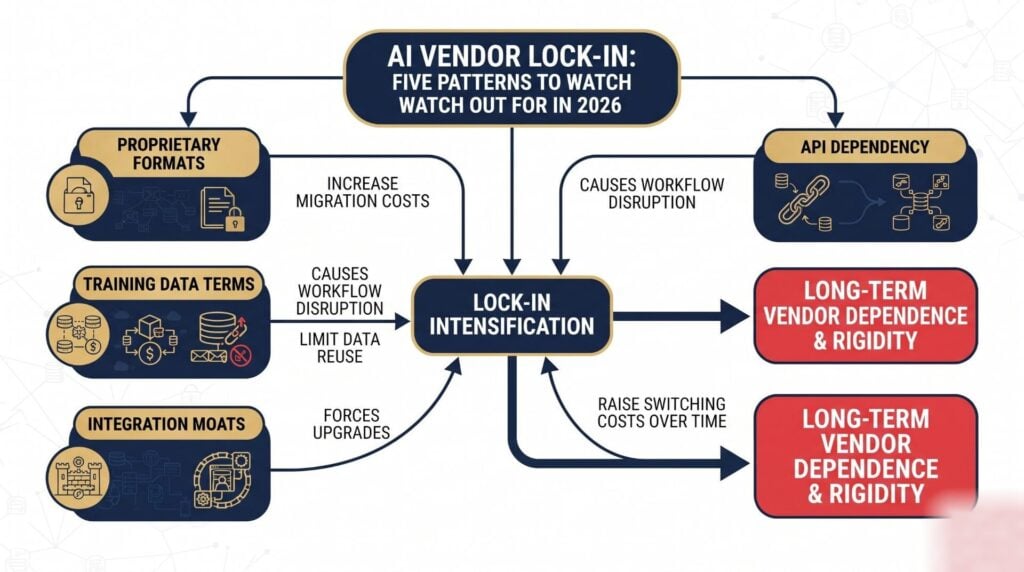
An AI vendor lock-in is a business situation where leaving one platform becomes too costly or complex to act on. These patterns show up in contracts, data formats, API structures, and pricing tiers. Once you spot them early, you can build your AI stack with far more control.
AI Smart Ventures helps growing businesses build AI strategies that protect long-term flexibility. The team reviews tool contracts and ecosystems to keep your options open. Knowing where lock-in risk hides is the first step to making smarter AI decisions.
Most AI contracts look simple at first. Pricing changes, API limits, and data export rules can shift your position fast. Lock-in builds slowly through small dependencies that grow harder to reverse over time.
Key Takeaways
- Proprietary Data Formats – Over 60% of businesses that switch AI platforms report data loss during migration, according to Forrester’s 2025 research.
- API Dependency – Building workflows on a single vendor’s API means one pricing change can break operations across your entire stack.
- Training Data Ownership – Many AI contracts give vendors rights to your input data, limiting how you reuse your own business information.
- Bundled Pricing Traps – Vendors often move must-have features into premium tiers, pushing upgrade costs 2-3x beyond the original price.
- Integration Moats – Deep vendor integrations raise switching costs by 40%, according to IDC’s 2025 AI Adoption Index.
These five patterns rarely appear alone. A vendor may use proprietary formats alongside bundled pricing at the same time. Seeing how they combine helps you set better contract terms before you sign.
What Is an AI Vendor Lock-In?
AI vendor lock-in happens when the cost of switching tools outweighs the benefit of leaving. A 2024 McKinsey survey found that 42% of AI adopters felt “stuck” with their first AI platform within 18 months. Most said the exit barriers formed faster than expected.
The problem is rarely a single contract clause. It builds through technical debt, sunk costs, and team habits tied to one platform. Once your workflows depend on a vendor’s specific outputs, untangling them takes real time and real budget.
What Are Proprietary Format Risks?
Proprietary data formats are vendor-specific structures that do not move cleanly to other systems. A 2025 Forrester report found that 61% of platform migrations led to partial or full data loss due to format issues. This is the most common and most costly lock-in pattern.
When your AI tool stores outputs in a closed format, a clean export is rarely possible. You often need a custom conversion process. That process adds weeks and budget to any transition. Ask vendors upfront about open exports in JSON or CSV format. Even vendors who offer JSON export may limit which data fields are included. Always ask for a sample export during your review.
How Do API Dependencies Create Risk?
API dependency happens when your product relies on a single vendor’s API to work. If that vendor changes pricing or drops endpoints, your workflows can break with no warning. This pattern is especially risky for businesses that build customer-facing tools on a third-party AI API.
OpenAI, Anthropic, and Google Gemini all offer APIs that power thousands of products. Each has changed pricing or access terms at least once in the past two years. Building a code layer between your product and any single vendor helps buffer against sudden changes.
AI Smart Ventures offers AI consulting for growing businesses that want to avoid costly platform traps. Schedule a consultation to review your current AI stack and find where your risk is highest.
What Are Training Data Ownership Risks?
Training data ownership becomes a lock-in issue when a vendor’s terms give them rights to your input data. About 35% of AI service agreements include clauses allowing vendors to use your inputs for model improvement, according to a 2025 IAPP privacy survey. This can put your competitive information at risk.
If your prompts and business data train a shared model, your private knowledge may become part of a broader dataset. Review the data use section of any AI contract before you sign. Tools like Ironclad can flag risky clauses quickly. But contract review tools work best as a first pass. They are not a substitute for qualified legal counsel on high-stakes agreements.
What Are Bundled Pricing Traps?
Bundled pricing traps occur when vendors move key features into higher subscription tiers to force upgrades. A 2024 SaaS Capital report found that AI platform upgrades cost businesses an average of 2.4x the entry tier price. This typically happens within 24 months of signing. This pattern appears across almost every AI tool category.
Before signing with any platform, map which features sit at which tier. This simple step helps you spot the pattern before you are committed.
Here are three signs a vendor may use a bundled pricing trap:
- Key features like data export or API access need a plan upgrade to use
- The vendor’s roadmap shows popular features moving to higher tiers over time
- Contract terms let the vendor change tier assignments with 30 days or less notice
Checking these signals during your vendor review takes about 30 minutes. It can save you thousands in unexpected upgrade costs.
| Pricing Tier | Common Features Included | Common Features Withheld |
|---|---|---|
| Starter | Basic generation, limited API calls | Data export, custom models, support SLAs |
| Pro | More API calls, team seats | Advanced analytics, SSO, priority support |
| Premium | Full features | Negotiated pricing, dedicated account management |
Use this table as a starting point when comparing AI platform tiers. Ask vendors directly which features might move between tiers during your contract.
How Do Integration Moats Form?
Integration moats form when AI tools are wired deeply into a vendor’s own ecosystem. This makes third-party alternatives much harder to connect. IDC’s 2025 AI Adoption Index found that businesses with five or more integrations inside one vendor’s stack face switching costs 40% higher. That compares to businesses with two or fewer integrations.
Platforms like Microsoft Azure AI, Salesforce Einstein, and HubSpot AI build rich ecosystems by design. Each integration you add deepens your tie to that vendor’s roadmap and pricing. Choosing tools that use open standards like REST or GraphQL gives you more room to adapt.
Here are three steps to limit integration moat risk:
- Audit all tools that connect through a single vendor’s platform each quarter
- Set a team rule: no more than three core workflows tied to one vendor at once
- Ask vendors about open API support before adding any new integration
Keeping your vendor dependency list short is not about limiting your tools. It is about staying flexible so you can move fast when better options appear.
Frequently Asked Questions
What does AI vendor lock-in mean for growing businesses?
AI vendor lock-in means switching platforms becomes harder and costlier the longer you rely on them. For owner-operators, platform migrations can cost tens of thousands of dollars and disrupt active workflows. The best defense is to review exit costs before signing any contract, not after your team has built core processes around a tool.
Which lock-in pattern is most common?
Proprietary data formats are the most common lock-in pattern by a wide margin. Sixty-one percent of businesses that switch AI platforms report data loss during migration, according to Forrester’s 2025 research. Choosing vendors that offer clean, open-format data exports from the start is the most direct way to reduce this risk.
What questions should I ask before signing an AI contract?
The most important questions to ask are: what format does your data export in, which features are at your tier, and what happens to your data if you cancel. You should also ask whether the vendor keeps rights to your inputs for model training. These four questions surface the most common lock-in terms before you are bound by them.
Can open-source AI tools prevent lock-in?
Open-source tools like Ollama, LM Studio, and Hugging Face reduce vendor lock-in because you control the model and the data. But these tools need more technical setup and ongoing maintenance than hosted platforms. They are a strong choice if your team has internal technical skills, but they are not the right fit for every business.
What is an API wrapper and why does it help?
An API wrapper is a code layer that sits between your product and a vendor’s API. It means that swapping the underlying vendor needs only minimal changes to your app. Building a wrapper adds a small upfront cost but can cut future switching costs by 50% or more. Wrappers need maintenance as vendor APIs change, so factor that into your plans.
How do I review AI contracts for lock-in risk?
Start by checking clauses on data ownership, exit fees, and auto-renewal terms. Pay close attention to sections labeled “data use,” “intellectual property,” and “termination.” Tools like Ironclad or Lexion can scan contracts and flag risky language quickly. But complex contracts may still need a legal review before you sign.
How much does it cost to manage AI vendor lock-in risk?
Help with AI vendor risk typically costs $2,000 to $10,000 for an initial audit, based on your tool count and integration depth. AI Smart Ventures offers AI advisory services to help growing businesses find and reduce vendor lock-in risk. Schedule a consultation to get a clear view of your current exposure and a plan to address it.
What is the difference between lock-in and a long-term contract?
A long-term contract locks you in by time. Vendor lock-in traps you by cost or technical complexity, often regardless of contract length. A month-to-month plan can still restrict you if your data is in a proprietary format or your workflows depend on a single vendor’s API.
Are all AI vendors equally risky for lock-in?
Not all AI vendors carry the same lock-in risk. Vendors that use open standards, allow full data export, and spread features fairly across pricing tiers carry lower risk. Larger platforms with tightly integrated ecosystems tend to build deeper dependency over time. Checking each vendor against a short lock-in list before onboarding helps you compare risk levels fairly.
How often should I audit my AI vendor dependencies?
A quarterly review of your AI tool stack is a practical baseline for most businesses. The goal is to track which vendors your core workflows depend on and flag when that count grows beyond three. Catching integration moat growth early costs far less than managing a full platform migration later.
Executive Summary
AI vendor lock-in happens when the cost of switching tools outweighs the benefit of leaving. Five patterns drive most of this risk in 2026: proprietary data formats, API dependency, training data ownership clauses, bundled pricing traps, and integration moats. Growing businesses that spot these patterns early, ask the right vendor questions, and audit their tool dependencies regularly can stay flexible as AI evolves.
What Should You Do Next?
Start by listing the AI tools you currently use and finding which ones would be hardest to leave. Review each vendor’s data export format, API terms, and pricing tier structure. Then set a team rule: no new tool gets added without a short lock-in risk check first.
AI Smart Ventures offers AI advisory services for growing businesses that want to build flexible, future-proof AI stacks. Schedule a consultation to get a clear picture of your current vendor risk and a plan to reduce it.
People Also Read
- How Growing Businesses Approach AI Without a Technical Team
- What Is AI Marketing Strategy and Why It Matters in 2026
About the Author
Nicole A. Donnelly is the Founder of AI Smart Ventures and an AI Adoption Specialist with 20 years of experience as a founder and CEO and over a decade leading AI adoption initiatives. She helps businesses integrate artificial intelligence with clarity and confidence, driving innovation and sustainable growth. Nicole has trained over 20,217 professionals in Applied AI, delivered 624 workshops, and worked with close to 1,000 organizations across diverse industries.
Expertise: AI Transformation, AI Strategy, AI Implementation, AI Adoption, Applied AI, Marketing, Business Operations
Disclaimer: This content is for informational purposes only and does not constitute professional business or technology advice. Results vary based on industry, existing systems and implementation commitment. Contact AI Smart Ventures for a consultation regarding your specific situation.