
Best AI Tools for HR and Recruiting in 2026
Last Updated: March 2026
The best AI tools for HR and recruiting in 2026 are Greenhouse for AI-assisted resume screening, GoodTime for interview scheduling automation, and ChatGPT for HR documentation and job description drafting. These tools automate candidate sourcing, screening, scheduling, and onboarding documentation, allowing HR professionals to focus on judgment-intensive decisions rather than administrative volume. Gartner research finds companies using AI-assisted recruiting reduce administrative HR time by up to 40%. AI Smart Ventures helps HR teams select and deploy AI tools matched to their specific recruiting and operations workflows.
Key Takeaways
- AI recruiting tools reduce average time-to-hire by 30% to 50% when deployed with clear process integration rather than as standalone additions.
- Resume screening AI, interview scheduling automation, and onboarding documentation tools deliver the fastest return for HR teams with fewer than five staff members.
- Free AI tools including ChatGPT and Google Gemini cover most HR writing and documentation needs without dedicated HR technology investment.
- Paid platforms including Greenhouse, Lever, and HireVue deliver stronger results for companies running more than 20 active job postings simultaneously.
- Starting with scheduling and documentation automation before judgment-intensive functions like culture assessment is the correct sequence.
Why Are HR Teams Losing Money Without AI Tools?
HR and recruiting inefficiency has a direct cost most growing companies underestimate. A 60-day time-to-hire for a $70,000 role costs approximately $11,500 in lost productivity before accounting for recruiter time and advertising spend. For a company hiring five to ten roles per year, that compounds to $57,500 to $115,000 in recoverable costs.
McKinsey research shows that companies using AI across multiple HR functions see 20% to 40% reductions in time-to-hire and meaningful improvements in candidate experience scores.
Which HR Functions Benefit Most From AI?
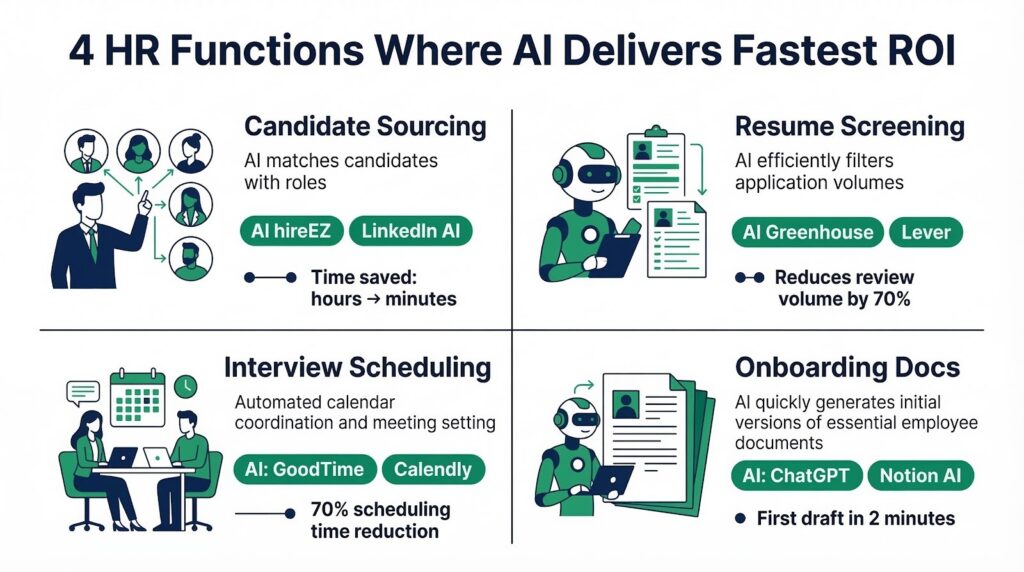
AI does not replace the human elements of HR. It removes the administrative load that prevents HR professionals from doing their highest-value work. Four functions deliver the clearest, fastest return:
Candidate sourcing: AI tools scan job boards, LinkedIn, and professional networks for matching candidates without manual search. Tools include hireEZ, Findem, and LinkedIn Recruiter AI. AI sourcing reduces manual search time from hours to minutes per role.
Resume screening: AI applies predefined criteria to evaluate incoming applications and rank candidates before human review. Greenhouse, Lever, and Workday include AI screening natively within their ATS functionality.
Interview scheduling: AI eliminates back-and-forth email coordination by connecting candidate and interviewer calendars automatically. GoodTime, Calendly, and Paradox (Olivia) match availability and generate confirmation sequences without manual involvement.
Onboarding documentation: AI accelerates creation of onboarding materials, training guides, and policy documentation. ChatGPT and Google Gemini handle this effectively without specialized HR software.

What Are the Best AI Tools for Resume Screening?
Applicant tracking systems with built-in AI screening are the most practical entry point for companies hiring more than five roles per year.
Greenhouse scores applications against job-specific criteria, flags matching candidates, and generates structured interview guides. It integrates with over 300 HR tools and job boards. Pricing starts at approximately $6,000/year.
Lever combines ATS and CRM functionality with AI-assisted sourcing and screening. Its nurture sequences keep teams in contact with promising candidates who were not hired, building a talent pipeline without manual follow-up. Custom pricing.
Workday Recruiting suits companies already using Workday for HR management, with AI features including skills-based candidate matching and automated job description generation. Bundled with Workday HCM.
For companies not ready for a full ATS, ChatGPT and Claude perform effective first-pass resume reviews with a structured prompt specifying role requirements and must-have qualifications.
Which AI Tools Automate Interview Scheduling?
Interview scheduling is one of the highest-friction, lowest-skill tasks in recruiting. The average coordination sequence involves five to eight emails between recruiter, candidate, and hiring manager, consuming 45 to 90 minutes of recruiter time per interview loop.
GoodTime is purpose-built for interview scheduling automation, integrating with ATS platforms and calendar systems. Companies using GoodTime report 70% reductions in scheduling time per hire.
Calendly handles basic interview scheduling through availability links and automated confirmations. Integrates with Google Calendar, Outlook, and Zoom. For companies running fewer than 10 concurrent interviews per month, Calendly covers most needs. Plans from $10 to $16/user/month.
Paradox (Olivia) handles scheduling, initial screening conversations, and FAQ responses through a chat interface on career pages. Particularly effective for companies with high application volumes in customer-facing roles.
Building an AI strategy for your HR team starts with understanding where your current process is losing the most time. Start with a strategy session for your HR team
What Are the Best AI Tools for HR Documentation and Onboarding?
HR documentation is a significant time consumer: job descriptions, offer letters, onboarding checklists, policy summaries, performance review templates, and training guides all require consistent, accurate, and frequently updated written content.
ChatGPT and Claude are the most versatile tools for HR writing across all document types. A well-structured prompt produces a first-draft job description in under two minutes and a customized onboarding checklist in five. Output quality depends on prompt specificity: providing the job title, responsibilities, qualifications, and culture context produces significantly better results than a generic request.
Notion AI summarizes policy documents, generates meeting notes, and creates structured onboarding wikis for teams already using Notion.
Google Gemini in Google Workspace drafts and edits documents in context, summarizes Gmail policy threads, and generates onboarding materials directly within existing tools.
Building a prompt library of 10 to 15 standardized prompts for frequent documentation tasks creates consistency and reduces time spent crafting prompts from scratch.
What Are the Biggest Mistakes HR Teams Make With AI?
Three patterns account for most failed HR AI adoption:
Applying AI to the wrong tasks first. Starting with AI for culture assessment or performance reviews before automating scheduling and documentation is backwards. Start with high-volume, low-judgment tasks and build confidence before applying AI to sensitive functions.
Skipping validation of generated content. Every AI-generated HR document should receive human review before use, particularly during the first 90 days. Job descriptions with inflated qualifications, onboarding materials with outdated policies, and screening criteria with unintended bias all require human oversight.
Deploying without training. HR professionals who understand how to write effective prompts and refine AI outputs produce significantly better results. A 20-minute prompt writing session eliminates most first-month frustration.
How Do AI HR Tools Compare on Price and Features?
| Tool | Best For | AI Features | Starting Cost |
|---|---|---|---|
| Greenhouse | Growing teams, 10+ roles/year | Application scoring, interview guides | ~$6,000/year |
| Lever | Pipeline building, CRM | AI sourcing, nurture sequences | Custom pricing |
| Workday Recruiting | Workday HCM users | Skills matching, analytics | Bundled with Workday |
| hireEZ | Sourcing specialists | AI outreach, talent search | Custom pricing |
| GoodTime | Interview scheduling | Calendar matching, reminders | Custom pricing |
| ChatGPT Plus | Small teams, documentation | Resume review, job descriptions | $20/month |
| Notion AI | Onboarding wikis, policy docs | Summarization, content generation | $10/member/month add-on |
Frequently Asked Questions
Which AI tool is best for HR professionals?
For documentation and writing, ChatGPT and Google Gemini are the most versatile and accessible. For structured recruiting with ATS integration, Greenhouse and Lever offer the strongest AI-assisted candidate management. For interview scheduling, GoodTime and Calendly are the most practical choices. Most HR teams benefit from combining two to three tools rather than one platform for all functions.
What is the best AI tool for recruitment?
For companies running fewer than 20 active roles, ChatGPT combined with a basic ATS covers most needs at accessible cost. For higher-volume hiring, purpose-built platforms including Lever, hireEZ, and Paradox provide more sophisticated sourcing, screening, and coordination. The best tool is the one that integrates most cleanly with your existing hiring workflow and ATS.
How is AI being used in HR and recruitment?
AI in HR is applied across five primary areas: automated job description generation, AI-assisted resume screening, interview scheduling automation, onboarding documentation creation, and predictive analytics for time-to-fill and candidate success probability. Deloitte and McKinsey report companies using AI across multiple HR functions see 20% to 40% reductions in time-to-hire.
Can small HR teams afford AI recruiting tools?
Yes. Most small HR teams can start with ChatGPT Plus at $20/month, Calendly at $10 to $16/user/month, and their existing ATS. Free tiers of ChatGPT and Google Gemini cover most documentation needs. Full platforms like Greenhouse ($6,000+/year) are justified once a company runs 10 or more active roles annually. Get a tailored estimate for your HR team’s AI budget
Does AI in recruiting introduce bias?
AI recruiting tools carry bias risk if trained on historical hiring data that reflects past selection patterns. Resume screening AI can perpetuate underrepresentation if those patterns were not equitable. Responsible use requires regular auditing of screening criteria, human review at every decision point, and selecting vendors who provide transparency about how their models are trained and evaluated.
How do I write a job description using AI?
Provide ChatGPT or Gemini with a prompt including the job title, top three to five responsibilities, required qualifications, preferred experience, and one sentence about your company culture. Ask for a direct, inclusive tone without jargon or inflated requirements. Review the output for accuracy, remove qualification inflation that could deter qualified candidates, and add company-specific context the AI cannot know.
How long does it take to implement AI in HR?
For individual tools like ChatGPT for documentation, implementation takes less than one day. For AI-assisted ATS platforms like Greenhouse or Lever, allow four to eight weeks including data migration and team training. For comprehensive HR AI programs covering multiple functions, allow 60 to 90 days from vendor selection to consistent adoption.
Can AI handle the full recruiting process without human involvement?
No. AI handles the high-volume, pattern-based elements: sourcing, screening, scheduling, and initial communication. Judgment-intensive decisions including culture fit assessment, offer negotiation, and final hiring choices require human involvement. The most effective HR AI implementations automate administrative work to free recruiters for consequential decisions, not to replace them.
What HR data is safe to put into AI tools?
General job descriptions, policy templates, onboarding frameworks, and publicly available role information are safe to use with consumer AI tools. Personally identifiable information including candidate names, contact details, salary history, and performance data should not be entered without reviewing the provider’s data handling terms. For sensitive HR data, use platforms with business-grade data protection like Greenhouse, Workday, or Microsoft Copilot under a business subscription.
Executive Summary
The best AI tools for HR and recruiting in 2026 cover four core functions: candidate sourcing (hireEZ, Findem), resume screening (Greenhouse, Lever), interview scheduling (GoodTime, Calendly), and onboarding documentation (ChatGPT, Google Gemini). Starting with scheduling automation and AI-assisted documentation delivers the fastest return at the lowest adoption cost. ChatGPT Plus covers most documentation needs for $20/month. Purpose-built platforms deliver stronger results for high-volume hiring. Gartner research shows companies using AI in HR report up to 40% reductions in administrative time, recovering capacity for the judgment-intensive work that genuinely requires human expertise.
What Should You Do Next?
If your HR team spends more time on scheduling, documentation, and administrative follow-up than on candidate evaluation and culture decisions, AI tools can change that balance measurably. AI Smart Ventures has guided ~1,000 organizations through identifying which functions are ready for AI. Talk to our consulting team about your HR team’s highest-value AI starting point
People Also Read
About the Author
Nicole A. Donnelly is the Founder of AI Smart Ventures and an AI Adoption Specialist with 20 years of experience as a founder and CEO and over a decade leading AI adoption initiatives. She helps organizations match AI tools to measurable business outcomes.
This content is for informational purposes only and does not constitute professional advice. Results vary based on organization size, industry, and implementation approach.