
Can You Build an AI Agent Without a Developer?
Last Updated: September 2026
Building your own AI agent is the work of giving software a goal, a set of tools, and a boundary, then letting it pick its own next step inside that boundary. A plain automation follows a fixed rule. An agent reads what arrives, decides what to do about it, and acts in a system you already run. Most of that setup now happens in a visual builder or a chat window, so the first working version rarely needs code.
AI Smart Ventures has guided growing businesses through AI implementation since the first agent builders reached teams with no engineer on staff. AI advisory work keeps meeting the same two owners. One built something useful over a weekend. The other paid for a build that nobody on the team can change now, and the gap between them is rarely skill.
What separates them is a decision rather than a skill: what the agent may do while nobody is watching. Get that wrong, and you do not get a broken agent; you get a confident one, sending the wrong thing to a real customer while everyone assumes it was checked. That is the risk founder-led teams carry when the build itself feels easy.
Key Takeaways
- Most first agents need no code: visual and chat-based builders now cover triggers, tools, and wording, so version one is a setup job rather than a build.
- The ceiling has a number: in TheAgentCompany benchmark, the best agent finished 30% of real office tasks on its own, and the long jobs were the ones it failed.
- The platform can move under you: OpenAI said on 3 June 2026 that its visual Agent Builder is being dropped, with shutdown set for 30 November 2026.
- Call an engineer at the write line: once an agent changes records, touches customer data or runs unwatched, you are buying steady output, and that is engineer work.
Those four points describe a short runway, not a closed door. You should build the first agent yourself, because the person who knows the task is the only one who can describe it well. What a builder cannot supply is judgment about what happens when the agent is wrong. That judgment is where practical AI either earns its place or quietly costs you a customer.
Can I Build My Own AI Agent Without Code?
Yes. Someone with no coding background can build a working AI agent today, and the main tools assume exactly that. You describe the job in plain words, connect the apps the work touches, then test on real cases before anyone else sees it. OpenAI’s own migration guide splits the choice cleanly. Its Agents SDK is for building through code, while ChatGPT workspace agents are for building through plain language and sharing the result with a team.
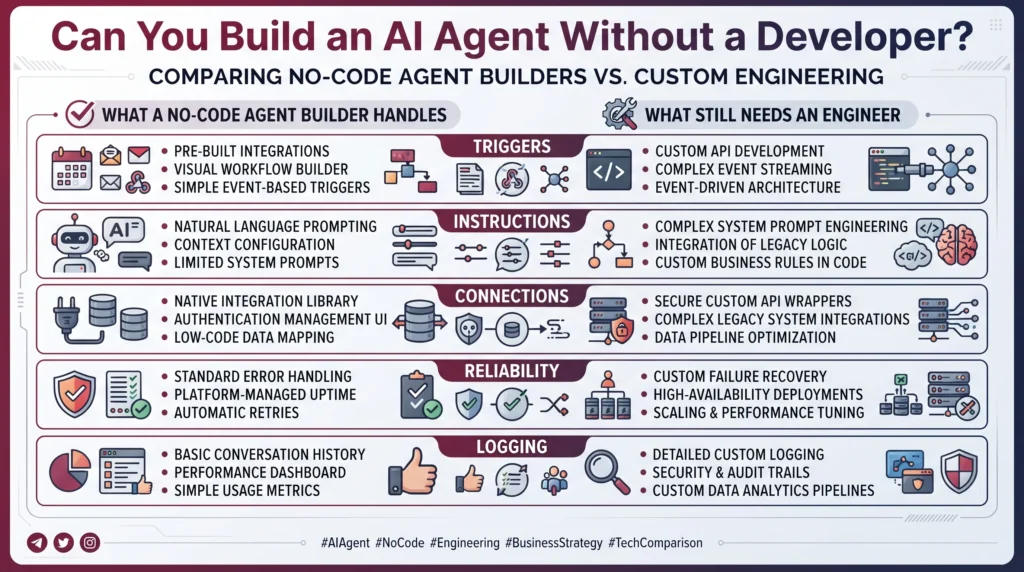
Plain language hides how much thinking the job takes, and that is the catch. A builder will accept a vague brief and produce something that looks right on the three cases you tried. It will not warn you about the fourth, where the customer replied out of order or attached the wrong file. People who do well here spend their time on the wording and the checks, not on the canvas. The reading and writing is the work.
Which Agent Jobs Are Realistic Without an Engineer?
The jobs that work share three traits: they repeat, they have a right answer you can check, and a mistake is easy to undo. Sorting an inbox, drafting a first reply, pulling fields out of messy files into a sheet, summing up a week of tickets, and flagging records that look wrong all qualify. Each one reads, decides and hands back. None of them commits the business to anything on its own.
That last line matters more than how hard the job is to build. An agent that drafts a refund note is easy to watch, since a person reads it before it goes out. An agent that issues the refund is a different animal, because the mistake is out in the world by the time anyone notices. Start on the drafting side of that line. Move a task across only after watching the agent work for several weeks.
- Reading and sorting: the agent labels what arrives and sends it on, and a wrong label takes seconds to fix.
- Drafting for review: it writes the reply, the summary or the record, and a person still presses send.
- Pulling data out of files: fields land in a sheet where they are easy to check by eye.
- Watching for odd cases: it flags what looks wrong instead of acting on it, which is where operational efficiency shows up first.
Where Does Building Without a Developer Stop?
It stops at reliability, and that word is doing a lot of work. Building a first agent is easy now. Making one that behaves the same way on its two-thousandth run is not. In TheAgentCompany benchmark, shown at NeurIPS 2025, the best agent finished 30% of tasks in a mock workplace on its own. The authors put the split plainly: simple jobs went fine, and long ones stayed out of reach.
Teams running agents day to day hit the same wall. LangChain’s State of Agent Engineering, published on 12 June 2026 from 1,340 replies, found 57% already had agents in live use. About a third named quality as their main blocker. Not cost, and not access. Quality here means the agent is right on Monday and odd on Thursday, and closing that last stretch is engineer work whoever built version one.
Oversight is the second wall. Retool’s State of AI Governance in 2026, a June 2026 survey of 307 tech and security leaders, found 93% were worried about tools built by prompting running in live systems. Only 8% called their own controls strong. Those numbers come from software teams who watch this closely. An agent built inside a marketing team sits in the same spot with less of that cover.
What Should a Business Owner Build First?
Build the task you do every week and quietly resent. It should take a person about twenty minutes, repeat several times a week, and produce something a colleague would miss if it stopped. Keep the first agent to one trigger, one or two tools and one output. Resist the second step until the first has run clean for a fortnight, because every extra hop doubles what you must check when output looks odd.
Picking your own task is not about ease. Agent quality tracks how clear the brief is, and nobody can describe a job they have never done. Write out how you decide, including the cases where you pause, then hand that to the agent as its brief. Most owners find the writing is the project and the build takes an afternoon. That is a normal result, and it is how workflow optimization turns into a skill your team keeps.
- One trigger: a new email, a new row, or a set time, never several at once.
- One output: a draft, a row or a flag that a person can see and correct.
- One owner: whoever wrote the brief reads the first fortnight of runs.
Working out which task belongs to an agent, and which stays with a person, goes faster with someone who has done it before. AI Implementation helps growing businesses get a first agent into daily use.
When Do You Actually Need a Developer?
You need one when the agent writes to systems of record, handles customer data the law protects, or runs with nobody reading its output. You need one again when a system you rely on has no ready-made link. Volume matters too. An agent handling a few cases a day can be watched by eye. One handling hundreds needs logs, retries, alerts and access limits that hold, which is plain software work no builder hands you free.
Bring the engineer in as a second pair of hands, not a rescue party. The version you built is the spec, and it beats any written brief, because it already holds the calls you make. Vendors selling automation as AI will offer to rebuild from scratch, which throws away the one thing that captured your judgment. Ask for hardening instead: error handling, logs, tighter access, and a way to switch the agent off in one move.
- Write access: the agent changes records rather than proposing changes.
- Sensitive data: customer names, health details or card details pass through the run.
- No ready link: the system you need has no built-in link, so someone has to build one.
- Unwatched running: the agent acts overnight, and nobody reads the result before it lands.
Frequently Asked Questions
How do I build an AI agent with ChatGPT?
Open the agents area in ChatGPT, describe the job in plain words, then connect the apps the work touches and test on real cases. That path has replaced the visual canvas. OpenAI said on 3 June 2026 that Agent Builder is being dropped, with shutdown set for 30 November 2026, and points people to workspace agents or the code-based Agents SDK instead. Workspace agents sit on team plans, not personal accounts.
How do I build an AI agent with Claude?
Use skills. A skill is a folder holding a plain markdown file that tells Claude how you want a job done, and Anthropic’s skill-creator walks you through writing one by asking questions. Its own notes expect readers of every technical level, from people who have never coded to developers. Write the steps you already follow, save them as a skill, and Claude loads them when that job comes up.
Can I create an AI agent for free?
Yes, for testing. Free tiers on the main chat tools let you build and run a simple agent, which is enough to learn whether the task is clear enough to hand over. Limits show up with volume and connections. Runs on a timer, shared access and links into your own systems mostly sit on paid plans. Treat the free version as a rehearsal, and expect your real outlay to be time, not tools.
What is the difference between an AI agent and automation?
Automation follows rules written in advance, so it does the same thing every time and stops when the input does not match. An agent reads the input and decides, which lets it handle a message written three different ways. That freedom is also its weakness, because the same room to move lets it be wrong in ways a rule never could. Keep rules where rules already work.
How do I build an AI team?
Start with one named owner rather than a hiring plan. That person needs to know the work, not to write code, and their job is to write the brief, test the agent and read its output for the first few weeks. Add a second person who can run and repair it, so nothing rests on one pair of hands. Treat the rollout as change management, and add engineering once agents write to live systems.
How long does it take to build a first AI agent?
The build takes an afternoon. Getting it right takes two or three weeks, most of it spent writing down how you really make the call and then watching runs. Plan a fortnight of watched use before anyone leans on the output. Teams that skip that stretch tend to rebuild later, because the cases an agent gets wrong show up in real traffic, not in the tidy examples you picked.
What skills do you need to build an AI agent?
Process clarity first, then patience. You need to set out the task step by step, including the edge cases you handle without thinking, and to write a brief that survives being read literally. Some comfort with linking apps helps. AI literacy matters more than coding here: knowing what a model is good at, where it guesses, and which parts should stay with a person.
How do I get started building an AI agent?
Pick one weekly task you do yourself, write down how you decide it, and build a draft-only version this week. Run it beside your normal work for a fortnight and log every case it gets wrong, because that log tells you whether to widen its remit or keep it narrow. AI Smart Ventures works with owners at exactly this point. Book a consultation to scope your first agent.
Executive Summary
You can build a useful AI agent without a developer, and the tools now assume you will. What you cannot skip is deciding what the agent may do unwatched. In TheAgentCompany benchmark the best agent finished 30% of workplace tasks on its own, and the long ones were the failures. Keep the first agent to reading, sorting, and drafting, with a person on the send button. Add an engineer when it writes to live systems, handles data the law protects, or runs while nobody is watching.
What Should You Do Next?
This week, name the one weekly task you would hand over first, write down how you decide it, and build a draft-only agent on a tool you already use. Run it alongside your normal work for a fortnight and keep a list of every case it gets wrong. That list, not the demo, tells you whether to widen the agent or stop it.
AI Smart Ventures offers AI Implementation for growing businesses building their first agents. Schedule a consultation to decide what your agent should be allowed to do on its own.
People Also Read
- What Are the Warning Signs of a Low-Quality AI Consultant?
- How Do You Know If Your Business Is Ready for AI?
About the Author
Nicole A. Donnelly is the Founder of AI Smart Ventures and an AI Adoption Specialist with 20 years of experience as a founder and CEO and over a decade leading AI adoption initiatives. She helps businesses integrate artificial intelligence with clarity and confidence, driving innovation and sustainable growth. Nicole has trained over 20,217 professionals in Applied AI, delivered 624 workshops, and worked with close to 1,000 organizations across diverse industries.
Expertise: AI Transformation, AI Strategy, AI Implementation, AI Adoption, Applied AI, Marketing, Business Operations
Disclaimer: This content is for informational purposes only and does not constitute professional business or technology advice. Results vary based on industry, existing systems and implementation commitment. Contact AI Smart Ventures for a consultation regarding your specific situation.