

Can You Trust AI Output? Build the Review First
Last Updated: September 2026
Trusting AI output is a call about your review step, not a verdict on the model. A tool writes smooth, sure-sounding text whether or not the claim inside it is true. It cannot flag which draft is which. Your review step turns a draft into work you can send, sign, or act on. It names who reads it, what they look for, and what fails a draft.
AI Smart Ventures has guided growing businesses through AI adoption in services, health care, freight, and finance. One gap turns up in nearly every rollout. Teams can describe what their tool does in fine detail, yet nobody can say who read the last thing it wrote, or what that reader was looking for.
That gap has a cost, and it lands on the people least able to carry it. Output goes to a client, a bank, or a regulator under your name, and the error is yours once you send it. Founder-led firms take that hit in person, with no risk team behind them to catch a wrong figure.
Key Takeaways
- Trust the step, not the tool: no model can tell you when it is wrong, so trust comes from the check you run, not from the brand on the box.
- Treat errors as a rate: on Vectara’s rebuilt leaderboard from November 2025, the top model still made things up in 3.3% of summaries drawn from over 7,700 articles.
- Most people never check: a study of 48,000 people by KPMG and the University of Melbourne found 66% use AI output without testing it, and 56% have made mistakes at work as a result.
- Name the reader first: review nobody owns drifts up to whoever notices, and Founder Reports found 57% of managers have fixed AI-made work, compared with 38% of other staff.
- Match the check to the stakes: work that leaves the building or moves money needs a named reader every time, while low-risk drafts need only a sample.
- Write the rule down: a review that lives in one person’s head stops the week that person goes on leave.
Read together, they move the question. It stops being whether AI is right often enough in general. It becomes whether your own check catches the errors that would hurt your firm. That one you can settle this month, with people you already employ.
Why does AI sound so sure when it is wrong?
Because smooth writing and true writing are made separately, and sounding sure is part of writing well. Nothing in that step tests a claim against the world. The clearest public record of the gap is the AI Hallucination Cases database kept by researcher Damien Charlotin. It listed 2,006 court rulings built on made-up AI citations when it was updated on 1 September 2026.
Those filings were not the work of amateurs. Trained lawyers read each draft, found it believable, and filed it. A wrong answer that sounds right beats a quick read, because a quick read hunts for something that sounds off, and nothing does. The KPMG and University of Melbourne study of 48,000 people in 47 countries found 66% use AI output without testing it, while 56% say it has led them into mistakes at work.
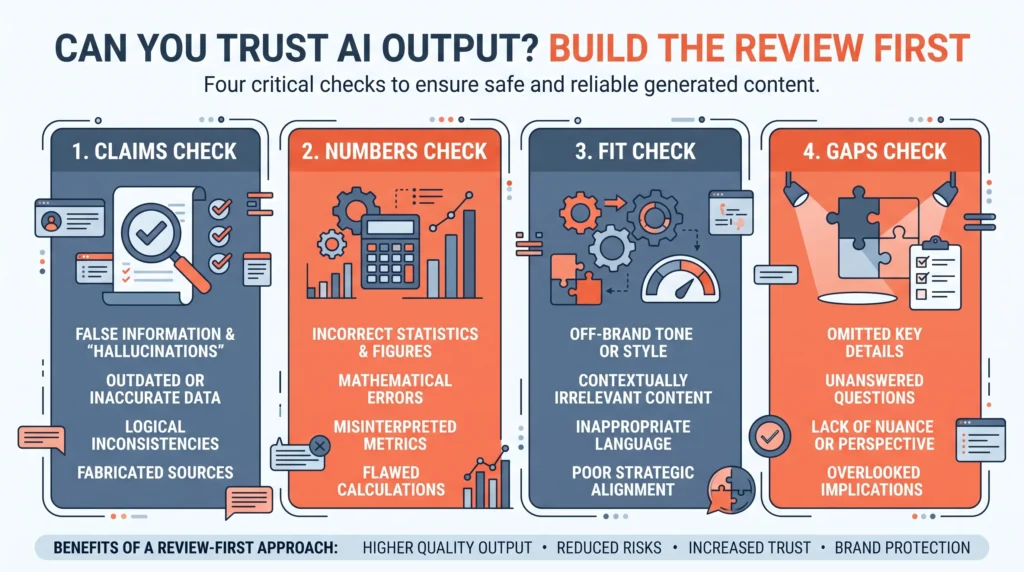
How can you check AI output before you use it?
Validate four things, in this order: the claims, the numbers, the fit, and the gaps. Open every source, name or study the draft cites, then confirm it says what the draft claims. Work out any sum yourself. Ask whether the advice fits your case or a generic one. Look last for what is missing, since a dropped caveat is the failure most readers never catch.
Checking gets faster once you decide up front what would make you reject a draft. A reader with no test skims for tone and passes it on. Give each reader two or three ways the work can fail: a made-up source, a total that does not match your records, a claim about a client nobody can trace. In a January 2026 survey reported by HR Dive, only 17% of workers called workplace AI reliable without human review.
Who should review AI output on your team?
Someone who could have done the task without AI, and who did not write the prompt. Subject knowledge is what makes an error visible. A reader who cannot tell a right answer from a wrong one is only checking spelling and tone. Splitting the reader from the prompter matters too, because whoever shaped the draft has already accepted its logic once and will accept it again.
In most growing businesses, this job lands by chance on whoever is senior enough to spot the problem. Founder Reports, which surveyed 2,078 US workers in 2026, found 57% of managers had fixed AI-made work against 38% of other staff. That is not a review step; it is a leak, and it spends the hours that cost the firm most. Name a reader for each type of output, and give that person clear power to send work back.
Which AI outputs need a check every time?
Anything that leaves your firm, moves money, or affects a person’s rights, health, or job. Client work, proposals, contracts, invoices, regulated content, hiring calls, and public posts all need a named human reading before release. Rough drafts, notes, first-pass research and idea lists can run on a sample. The sorting test is blunt: how costly is this to get wrong, and who finds out?
Sorting by risk is what keeps a review step alive. Check every item, and the team stops checking anything, because the ritual costs more than it returns. Check nothing, and you are betting the firm on an error rate you never measured. Tool-first AI agencies often hand over a workflow that ends at the draft and leaves the release call undefined. Write this tier yourself, before you pick a tool.
| Risk tier | Examples | Review rule |
|---|---|---|
| Full check, every item | Client work, proposals, invoices, public content | Named reader signs off before release |
| Sampled check | In-house reports, research notes, meeting summaries | One in five read each week closely, errors logged |
| No formal check | Rough ideas, outlines, private drafts | Writer’s own judgment, never reused unchecked |
What does a working AI review step look like?
Five parts: a named owner, a written test, a time budget, a record, and a feedback loop. The owner is one person, not a team. The test says what would fail the draft. The time budget keeps the check honest, since an open-ended review is the first thing dropped in a busy week. The record is one line: who approved what, and when.
Start with one workflow rather than a company-wide policy, because a step that survives real deadlines teaches you more than a rule nobody opens. Run it for a month and log every error the check catches. Read that log as AI literacy in practice. It shows which prompts need rewriting, which tasks the tool should not have, and where your team needs training. That is how AI enablement turns into operational efficiency instead of rework.
Building the step is workflow optimization, not policy writing. AI consulting from AI Smart Ventures helps growing businesses design a review step that fits the way their teams already work.
Frequently Asked Questions
Is it a good idea to trust AI?
Trust it to draft, and check it before you act. AI is dependable where checking is quick: summing up a file you gave it, reshaping text, or writing a first version. It is weak as the final word on facts, law or numbers. The global study by KPMG and the University of Melbourne found only 46% of people worldwide are willing to trust AI systems.
What is the 30% rule in AI?
There is no official 30% rule, and the phrase turns up online in two forms. One says AI should do at most about a third of any work that needs real judgment. The other says roughly a third of the tasks in a complex role can be handed to today’s tools. Neither is a standard, so treat it as a rough split.
How can you reduce the impact of AI hallucinations?
Give the model the source material, ask for quotes you can open, and then open them. The risk of made-up answers falls sharply when the reply has to come from a file you supplied rather than from memory. Ask for page or section numbers, then test a sample. Never let an invented detail pass because the text around it reads well.
Why does the same prompt give different answers?
Because these systems are not deterministic in practice. Thinking Machines Lab explained in September 2025 that results shift with server batch size, so the same request takes a slightly different path depending on what else is being processed alongside it. Sampling settings add more spread. For a review step, the lesson is simple: a good answer yesterday is no promise about today.
Why do people trust AI so much?
Because fast, smooth, sure-sounding answers feel like skill, and checking them is work. AI writes in the voice of an expert, replies at once, and never hedges like an unsure colleague. Habit does the rest, since a run of right answers retires the urge to test. That is how 66% in the 48,000-person global study came to use output without testing it.
Do most people actually trust AI?
No, and trust has fallen as use has risen. Fewer than half of people worldwide, 46%, say they are willing to trust AI systems, while 66% already use it with some regularity, per the same 47-country study. That gap is the honest position: people use these tools daily and stay unsure about them. Treat heavy use in your team as convenience, not quality.
What is an AI trust index?
An AI trust index is a score that tracks how far the public or staff say they trust AI, usually from survey questions repeated each year. Several research groups and vendors publish one, useful for reading mood or comparing countries. None of them measure whether your own output was right, so an index shapes how you talk about AI, not how you check it.
How long should reviewing AI output take?
A routine in-house draft takes a few minutes. Client-facing work takes about as long to check as the task would have taken to do. Set that budget before the work starts, then measure it. Time your first few checks before you fix that number. In the survey reported by HR Dive, nearly half of workers said fixing AI mistakes takes roughly as long as doing the job by hand.
Can AI detectors tell you whether output is reliable?
No, and using them that way is a common mistake. Detectors guess whether text was machine-written, which is a question about who wrote it, not whether it is right. A human paragraph can be wrong, and a machine one can be right, so the score tells you nothing about the claims. Scores also swing on light editing. Check the content against sources instead.
What should happen when a review catches an error?
Log it, fix it, then change something so it is less likely next time. A caught error is free information about your workflow: it shows whether the prompt was vague, the source material was thin, or the task was wrong for AI. Read the log with your team each month, since the pattern across errors matters more for change management than any single slip.
Does a review step slow the team down?
Yes, at the start, and less than the rework it prevents. The first weeks feel slower because the check is new and nobody has learned what to look for yet. That settles as readers get to know the failure patterns in their own work. The other option is not speed. It is risk you never measured, plus the hours managers spend repairing unchecked work.
How do we start building an AI review step?
Pick one workflow this week, name the reader, write the three things that would fail a draft, and run it for a month. Scope drives the effort, not company size, and one task with clear failure tests is quicker to set up than any firm-wide policy. AI advisory support can shorten that first month, so schedule a consultation to build the step around your own work.
Executive Summary
Trusting AI output is a property of your review step, not of the model. Sure-sounding text gets written whether or not the claims hold, and the public record now holds over 2,000 court rulings built on made-up AI citations. Most people skip the check, and managers absorb the rework. A working step has five parts: a named owner, a written test, a time budget, a record, and a loop that feeds errors back. Sort work by risk, and check what is costly to get wrong.
What Should You Do Next?
This week, pick the one AI-assisted output that would embarrass you most, and name the person who reads it before release. Write down three things that would fail that draft, and log every error the check catches for a month. That log tells you what to hand over next and what to pull back.
AI Smart Ventures offers AI consulting for growing businesses, putting practical AI into daily work with clarity and confidence. Schedule a consultation to design a review step your team will actually run.
People Also Read
- How to Avoid AI Vendor Lock-In When You Don’t Have a Technical Team
- AI Strategy Consultant vs AI Implementation Partner: Which Do You Need First?
About the Author
Nicole A. Donnelly is the Founder of AI Smart Ventures and an AI Adoption Specialist with 20 years of experience as a founder and CEO and over a decade leading AI adoption initiatives. She helps businesses integrate artificial intelligence with clarity and confidence, driving innovation and sustainable growth. Nicole has trained over 20,217 professionals in Applied AI, delivered 624 workshops, and worked with close to 1,000 organizations across diverse industries.
Expertise: AI Transformation, AI Strategy, AI Implementation, AI Adoption, Applied AI, Marketing, Business Operations
Disclaimer: This content is for informational purposes only and does not constitute professional business or technology advice. Results vary based on industry, existing systems, and implementation commitment. Contact AI Smart Ventures for a consultation regarding your specific situation.

