Canadian AIDA 2026: Owner-Operators Guide
Last Updated: June 2026
Canada’s AI law, Bill C-27, never passed. It died when Parliament shut down in January 2025. Three other laws now apply to your AI tools: PIPEDA, Quebec Law 25, and the EU AI Act. You can build an AI use register in two to four hours. It covers all three.
A Canada AIDA 2026 compliance briefing is a plain-language summary of which AI laws apply to Canadian owner-operators now that Bill C-27, the Artificial Intelligence and Data Act, died when Parliament shut down in January 2025. With no federal AI law in force as of June 2026, three other frameworks govern your AI tools: PIPEDA (Personal Information Protection and Electronic Documents Act), Quebec’s Law 25, and the EU AI Act. Acting now under current law costs far less than waiting for a new bill.
AI Smart Ventures has helped growing businesses use AI with less risk since 2015. Questions about AIDA rose sharply after 2023, as firms tried to plan ahead. AIDA is gone, but three live rules are not. You still need to act.
The OPC (Office of the Privacy Commissioner) acts on AI complaints today. Three live rules apply right now. Get your AI records done. Do it before a review lands.
Key Takeaways
- Bill C-27 Is Dead – Canada’s Bill C-27 and AIDA died in January 2025 when Parliament shut down. No new federal AI law has passed as of June 2026. Three live laws still apply to you now.
- PIPEDA Applies Now – PIPEDA covers AI data use for all firms under federal law today. You must report any data breach that poses a real risk of harm to the OPC. Do not wait for a new law.
- Quebec Law 25 Is Live – Law 25 has been in force since September 2023 and covers AI choices. Any AI tool that makes choices about people needs a PIA if you have Quebec staff or clients.
- EU AI Act Exposure – Selling to EU clients or using EU AI vendors triggers EU AI Act risk rules. This applies no matter what Canadian law says right now.
- AIDA as a Baseline – The OPC uses AIDA ideas in its audits today. Big buyers also ask for AI records as a key contract term. No records means lost deals.
These five points touch all kinds of Canadian firms. Even without Quebec ties, PIPEDA still applies if your AI tools use personal data. Most growing firms in Canada face at least one of these rules today. Check which ones apply to you.
Why Does AIDA Matter If It Never Passed?
Three years of AIDA debate set the bar for AI records in Canada, and that bar still stands today even with no law passed. The OPC now uses AIDA terms in its audits, and according to its 2023-24 Annual Report, AI privacy complaints rose 31% in one year. The NIST AI Risk Management Framework shows firms with no AI records take three times as long to deal with a review.
Big buyers now ask for AI records in contract talks. Owner-operators who lack records face OPC audits and lost deals. That risk is live today. No new law is needed. Start now.
What Would AIDA Have Required?
AIDA would have set three core rules for any high-impact AI tool you deploy in your business. First, run an impact check before you launch the tool. Second, keep logs while the tool runs. Third, report any material harm to an AI and Data Commissioner within 90 days of the event. Top fines for the most serious breaches would have reached CAD 25 million or 5% of total revenue.
Fines for less serious breaches went up to CAD 10 million or 3% of revenue under the draft rules. The bill used three risk tiers to sort AI tools by impact level: general AI at the base with the fewest rules, limited-impact tools in the middle tier, and high-impact tools at the top with the heaviest record and reporting duties. Any owner-operator using AI for hiring, credit scoring, health advice, or access to key services would very likely land in that top tier.
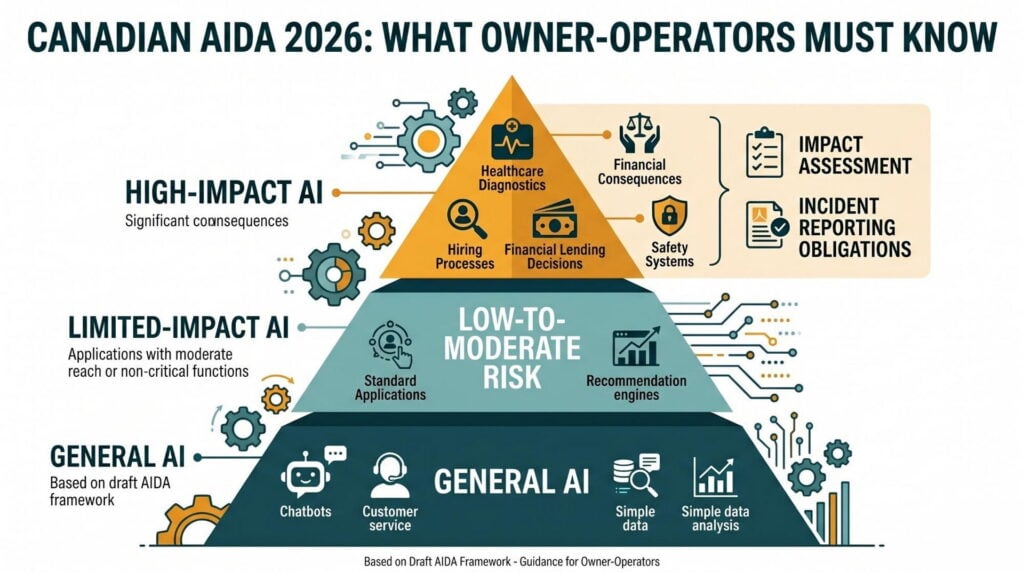
Which AI Tools Count as High-Impact?
High-impact AI tools are any systems that shape a person’s job, health, safety, or access to key services in a direct way. A hiring screener, a performance review tool, or a credit scoring engine all fall in this group because they affect real outcomes for real people. General writing tools like ChatGPT for content and note apps like Notion are almost always out of scope for this tier.
Ask one question about each tool: does it change what a person can do, earn, or access? If yes, record it now. Treat it as high-impact under any future law. Waiting until a law passes can cost tens of thousands of dollars. Start your list today. Most firms finish in under an hour.
How Do You Prepare Without a Final Law?
Start with an AI use register, which is a plain spreadsheet that lists every AI tool, what choices it shapes, what data it uses, and who in your firm owns the deployment. Most firms with five tools or fewer can finish in two to four hours, and it costs nothing to set up. That register is your first and fastest line of defence against any OPC inquiry or buyer audit.
AI Smart Ventures offers AI consulting and AI advisory for growing firms that want to move fast on this. The team has helped close to 1,000 firms build clear AI records. Schedule a consultation to map your tools and find out your real risk level.
Next, check your Quebec Law 25 risk. Do you employ anyone in Quebec or collect data from Quebec residents? If yes, any AI tool that makes choices about those people needs a PIA under Quebec’s Law 25, and the CAI (Commission d’accès à l’information) can fine your firm up to CAD 25 million or 4% of total worldwide revenue.
Here are two clear paths for most owner-operated firms:
Track 1: Record Now (Two to Four Hours) – AI Use Register – List each tool, the choice it shapes, whose data it uses, and who in your firm owns the deployment. – PIPEDA Self-Check – The OPC offers a free PIPEDA self-check tool that most firms finish in under an hour. – Law 25 Check – Find out if you have any Quebec link, then check if your AI tools are in scope for a PIA.
Track 2: Build Governance (For Firms Scaling AI) – Complaint Response Plan – Name who handles an AI complaint, how fast they must respond, and where records are kept. – Vendor DPA Check – Make sure each AI vendor holds a Data Processing Agreement (DPA) and confirm where your data is stored. – Staff Brief – Tell your staff which AI uses are high-impact and what they must flag when something goes wrong.
Track 1 closes the biggest gaps for most firms. Track 2 matters once you have three or more high-impact AI tools running in your business. The more AI you scale, the more Track 2 becomes essential.
How Does Canada’s AIDA Compare to Other AI Laws?
Canada’s draft AIDA used the same three-tier risk model as the EU AI Act, but stopped short of adding a list of banned AI uses that the EU included. The EU AI Act is now the most complete AI law in force anywhere in the world, with a phased rollout running through 2027. The US has no matching federal AI law as of June 2026, running only on executive orders and agency rules.
The UK AI Safety Institute uses a sector-based approach with no set fines yet, and the UK is not expected to pass a full AI law before 2027. For Canadian firms with EU clients or EU-based AI vendors, the EU AI Act is the most urgent law to track and the one most likely to affect your contracts right now. Check your vendor deals today, confirm where your data is stored, and make sure your vendor holds a current Data Processing Agreement (DPA).
| Framework | Status (Apr 2026) | Trigger | Max Fine |
|---|---|---|---|
| Canada AIDA (Bill C-27) | Not in force | Jobs, health, key services | CAD $25M or 5% of revenue |
| EU AI Act | In force (phased) | High-risk and banned uses | EUR 30M or 6% of revenue |
| Quebec Law 25 | In force (Sept 2023) | AI choices about people | CAD $25M or 4% of revenue |
| UK AI Rules | Sector plans only | No set threshold yet | Sector-specific |
| US (Federal) | Orders only | No set threshold | Agency rules |
For a current list of AI tools vetted for growing firms, see AI tools and apps on the AI Smart Ventures resource hub.
Frequently Asked Questions
What is Canada’s AIDA and is it law today?
Canada’s AIDA was the AI part of Bill C-27, first put forward in June 2022. It is not law today. The bill died when Parliament shut down in January 2025, and no new federal AI law has passed as of June 2026. The OPC still uses AIDA ideas in its audits, and firms under federal rules must follow PIPEDA for any AI tool that touches personal data.
Does PIPEDA apply to AI tools used by owner-operated firms?
PIPEDA covers all firms that handle personal data as part of their work. That includes AI tools that process staff records, client data, or any data that can be linked to a real person. If your firm uses an AI hiring tool, a scoring system, or an automated follow-up tool, PIPEDA applies today. Breaches that pose a real risk of harm must be reported to the OPC and to the people affected.
What is Quebec Law 25 and how does it affect AI use?
Quebec Law 25 (Bill 64) has been in force since September 2023 and it covers AI choices about people. Any AI system that makes choices about people through an automated process needs a PIA before you launch it in your firm. Firms with Quebec staff, clients, or data subjects must follow this rule now. Fines reach CAD 25 million or 4% of total worldwide revenue, and this rule stands on its own apart from any federal law.
Which AI tools are most likely to be high-impact?
Tools that affect jobs, credit, or health are the most likely to be classed as high-impact. AI hiring screeners, loan tools, and health advice systems are in scope. General tools, writing aids, and note apps are not. The test is simple: does the tool change what a person can do or earn? If yes, record it now and treat it as high-impact under any future law.
How much does an AI records plan cost for a firm under 50 staff?
Most firms under 50 staff can build their AI records plan for under CAD 5,000 if they act early and use the free OPC self-check tool. That cost covers an AI use list, a PIPEDA self-review, and basic checks on your vendor contracts. Firms that wait tend to spend three to five times more when a formal review or audit arrives. For guidance that fits your firm and tools, contact AI Smart Ventures for a consult.
Does the EU AI Act apply to Canadian firms?
The EU AI Act covers any firm whose AI tools affect EU residents, no matter where the firm is based in the world. A Canadian owner-operator selling software or services to EU clients, or using an EU-based AI vendor that stores EU data, has direct EU AI Act risk. High-risk AI record rules began a phased rollout in 2025. Under the EU Digital Omnibus agreement reached in May 2026, the deadline for standalone high-risk systems was deferred from 2 August 2026 to 2 December 2027.
Is there a truck driver shortage in Canada in 2026?
This question uses a different meaning of AIDA. In trucking, AIDA refers to Transport Canada hours of service rules that limit how long a driver can be on duty. Those rules fall under the Motor Vehicle Transport Act and are not AI law. If you run a fleet and use AI tools for dispatch, routes, or fatigue checks, record those tools since they shape job and safety choices about real people.
What is the 70-hour rule in Canada?
The 70-hour rule limits truck drivers to 70 hours on duty in any 7-day cycle under Transport Canada safety rules. This is a transport rule, not an AI law, and it has no link to AIDA or PIPEDA. If you use AI tools for driver scheduling or fatigue checks in your fleet, keep a record of those tools since they shape job and safety choices about people, which puts them in scope for any future federal AI law.
Executive Summary
Canada’s AIDA died when Parliament shut down in January 2025, and no new federal AI law exists as of June 2026. Three active laws create real AI duties for Canadian owner-operators today: PIPEDA covers AI data use under federal rules, Quebec Law 25 requires a PIA for any AI tool that makes choices about Quebec residents, and the EU AI Act applies directly to any firm with EU clients or EU AI vendors. An AI use register built in two to four hours is the single fastest step that covers all three frameworks at once.
What Should You Do Next?
This week, open a spreadsheet and list every AI tool you use, what choices it shapes, and whose data it touches. If any tool affects jobs or uses Quebec resident data, start a PIA before the end of this quarter.
AI Smart Ventures provides AI consulting for growing firms that need a clear plan for Canadian, provincial, and cross-border AI rules. Schedule a consultation to get a plain-language roadmap for your firm.
People Also Read
About the Author
Nicole A. Donnelly is the Founder of AI Smart Ventures and an AI Adoption Specialist with 20 years of experience as a founder and CEO and over a decade leading AI adoption initiatives. She helps businesses integrate artificial intelligence with clarity and confidence, driving innovation and sustainable growth. Nicole has trained over 20,217 professionals in Applied AI, delivered 624 workshops, and worked with close to 1,000 organizations across diverse industries.
Expertise: AI Transformation, AI Strategy, AI Implementation, AI Adoption, Applied AI, Marketing, Business Operations
Disclaimer: This content is for informational purposes only and does not constitute professional business or technology advice. Results vary based on industry, existing systems and implementation commitment. Contact AI Smart Ventures for a consultation regarding your specific situation.