
Customer Service AI Agents: Are They Right for You?
Last Updated: August 2026
A customer service AI agent is software that reads a buyer’s question, finds the answer in your own systems, and either fixes the request or passes it to a person with the notes attached. It is not a scripted chatbot. A bot walks a fixed menu, while an agent works out what to do next. It can check an order or start a return, then stop where your rules say a human must decide.
AI Smart Ventures has guided growing businesses through this choice across support teams of every size. The pattern holds: the tech rarely fails on its own, and the fit fails first. Teams with current help docs and a clear path to a human see gains inside a quarter. Teams missing either one spend that quarter fixing the base they should have laid first.
A wrong answer here costs far more than a wasted tool. Point an agent at messy files and your buyers meet wrong answers at scale, which is much harder to undo than a slow reply. Get the fit right and your team stops retyping the same four answers each morning.
Key Takeaways
- Repeat questions decide the start, not ambition. If a few asks fill your inbox week after week, an agent has real work to learn; if each request is unique, it does not.
- Your help docs are the real product. An agent is only as right as the files it reads, so dating and cleaning them is the true first project.
- Design the handoff before the answer. Buyers accept an AI first line when reaching a person is fast and clear, and punish brands that trap them.
- Count solved and handed off as one picture. Through 2026 vendors began scoring a part run with a clean handoff as a win, so your reports should too.
Notice what those four share: not one is about the model. Which tool you buy counts for far less than whether your firm already makes the raw stuff an agent needs. Practical AI starts there, which is why two teams can buy the same tool and land in very different places.
What is a customer service AI agent?
A customer service AI agent is a system that takes a support request from start to finish, using a large language model plus live access to your data. It reads the question, pulls the right rule or record, and acts: it checks an order or issues a credit. When the task falls outside its limits, it hands the chat to a person along with all it has learned.
The real gap shows when the script runs out. A bot matches key words and offers a menu, so odd phrasing sends the buyer into a dead end. An agent works from your own files, so it can answer a question nobody wrote a rule for. That freedom is also the risk: a system that can guess can guess wrong.
Does your ticket volume justify an agent?
Raw volume is not the test. What counts is repeat: whether a few asks make up a large share of what arrives. Pull last quarter’s tickets and sort them by topic. If your top five topics cover about half the inbox, an agent has a job worth doing. If your tickets spread across forty topics with no pattern, the tool will struggle to add operational efficiency.
Repeat questions matter because each auto answer needs a source of truth behind it, and writing it takes hours. A question asked twice a year rarely earns those hours; one asked forty times a week pays for itself before launch. Many teams find the audit alone shows a self-serve gap they can close with one help page, which is workflow optimization doing the job first.
Are your help docs ready for an agent?
Your help docs are ready when a new hire could answer a buyer using only what is written down. If your best answers live in someone’s head, in a chat thread, or in a file nobody has touched since spring, the agent picks up that gap. These systems do not invent rules. They repeat what your files say, including the parts that are two versions old.
Run this readiness check before you look at a single tool:
- Pick your ten most common asks and find the written answer for each.
- Check the date on each, then fix or delete anything stale.
- Note where two files clash, because the agent picks one at random.
- Write down the asks that must always reach a person.
Salesforce’s seventh State of Service report, out in September 2025 and built on 6,500 service staff, found that firms unifying their service channel data are 1.4 times more likely to call their AI implementation very successful. The same study expects half of all service cases to be solved by AI during 2027, up from 30% in 2025. Prep work is dull, and it decides the result.
If that check found more gaps than answers, you have an AI implementation problem, not a shopping problem. AI Smart Ventures offers AI Implementation for growing businesses that want the base work put in order first.
What counts as a win for an AI agent?
A win is no longer just full self-service. In March 2026 Intercom changed how it scores its Fin agent, moving from resolutions to outcomes. Now a run where the agent gathers facts, takes an action, then hands off on purpose counts as a win too. That shift matters for your own reports, because a handoff you designed is not a failure. It is the system doing its job.
Intercom reports a mean resolution rate of 76% across more than 7,000 teams using Fin. Treat that as a ceiling set by mature setups, not a number you inherit in week one.
The firm also changed its metrics on 24 June 2026, and the logic is worth borrowing. Chats where the agent was live but never got to answer, because your own handoff rules fired first, now count as constrained rather than failed. The overall rate does not move; the read gets sharper. Ask any vendor how they treat those chats before you compare products.
Can an AI agent handle complaints well?
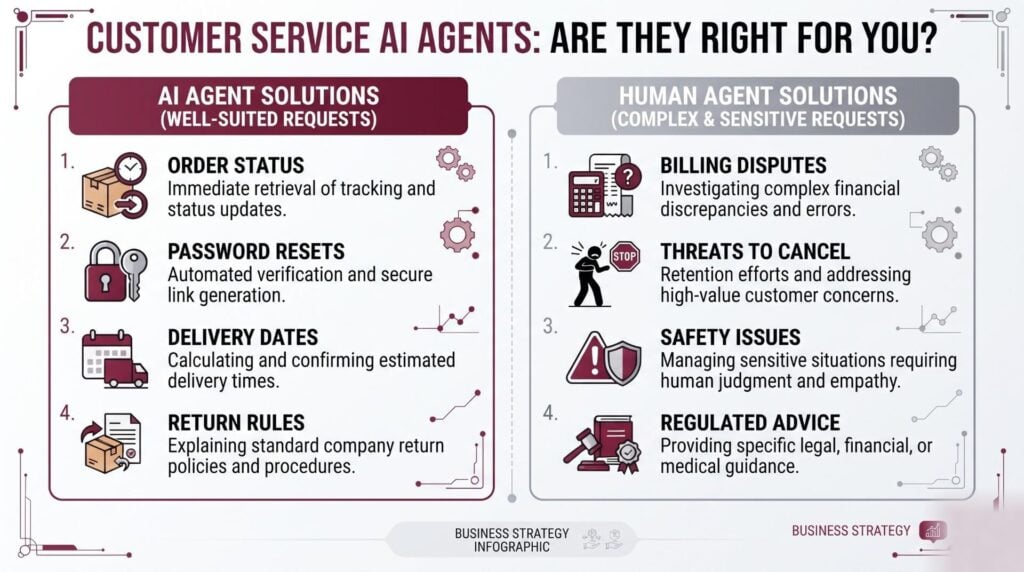
An AI agent handles complaints better than a bot and worse than a good person. It can read a long, messy message, pick out the real ask, and stay calm while a buyer vents. What it cannot do is judge when a rule should bend. That judgment is often the very thing an upset buyer wants, so your handoff trigger counts for more than the wording of the reply.
Hard cases are not the same as heated ones. An agent copes well with a multi-step task when the steps are written down and the systems are joined up: check the order, send the swap, email the buyer. It copes badly when the answer rests on history your files do not hold.
Fixing a problem is also not the same as keeping goodwill. Gladly’s 2026 Customer Expectations Report, a study of 1,000 US buyers out on 29 January 2026, found that 88% of buyers get their issue solved by AI while only 22% prefer the brand after. Human-first AI means you plan for that second number rather than hope it survives the first.
When is an AI agent the wrong choice?
An AI agent is the wrong choice when a wrong answer is costly, when your asks are truly one-off, or when the bond itself is the product. Regulated advice, safety issues, and accounts where one client drives much of your income all belong with people. Low volume is a reason to wait, not a reason to fret. Fix the files now and ask the question again in six months.
Risk is the part owners miss. In February 2024 British Columbia’s Civil Resolution Tribunal held Air Canada to blame for a refund rule its chatbot got wrong, and rejected the claim that the bot was a separate party, as Burnet, Duckworth & Palmer set out. Your agent speaks for you. What it says about refunds or warranties is a claim your firm will be held to.
Two more honest no cases. If nobody owns the weekly review, the agent drifts, and that drift shows up as wrong answers months later. And if you want an agent mainly to dodge a hire, be straight about the trade: the work moves rather than vanishes, and the person who tends it is your best support lead. Sound AI adoption treats that lead as capability building.
Frequently Asked Questions
How do you set up a customer service AI agent on a budget?
Start narrow and stage the work. Pick one common ask, write the answer well, join up one system, then run it for a month before adding a second. Scope drives what you take on far more than the tool does, and most effort lands on your own content. Ask any vendor for a set pilot with named work and a clear exit point. Schedule a consultation to stage your first workflow.
How do AI agents handle complaints better than chatbots?
They read intent instead of matching key words. A bot fails the moment a buyer skips the menu or writes three paragraphs of anger, because no branch exists for that input. An agent sums up the complaint, answers the part it can, and hands off when the tone turns. The gain is real but partial: it lifts the first ninety seconds, and a person still finishes the job.
Can a customer service AI agent handle complex enquiries?
Yes, when complex means several written steps rather than real doubt. Given live access to your order system and clear rule files, an agent can look up an account, check who qualifies, and explain what it did in one reply. It fails when the answer rests on unwritten context, such as a promise a rep made last year. Hard cases your files describe can be automated; those in memory cannot.
How long does it take to launch a customer service AI agent?
Plan in months, not weeks, and expect the writing to take most of it. Auditing tickets, drafting and dating answers, and agreeing handoff rules takes far longer than the setup, which many teams finish in days. A sane first phase runs one workflow in front of real buyers for four to six weeks with daily review. Wide rollouts before that habit exists are the most common way this fails.
What happens if the agent gives a customer the wrong answer?
You are on the hook for it. Moffatt v. Air Canada, ruled in February 2024, confirmed that a firm is liable for what its chatbot tells a buyer, and the logic reaches today’s agents. In practice, wrong answers trace back to old or clashing files far more often than to the model. Sample chats each week, log every error by cause, and fix the source file rather than the prompt.
Do you need coding skills to run a customer service AI agent?
No, though you do need someone who owns it. Most tools use visual builders, so joining up a help centre and setting handoff rules is setup rather than coding. The scarce skill is knowing your own rules well enough to write them down without clashes. Teams win when a senior support lead gets guarded hours each week, and lose when the agent becomes everybody’s side project.
Should customers be told they are talking to an AI agent?
Yes, and say it plainly at the start. Under the EU AI Act, transparency duties apply from 2 August 2026 and include telling people when they deal with an AI system. Beyond the rules, saying so works in your favour. Buyers who know they face software judge it by a different bar and ask for a person sooner, which is the behaviour you want.
How do you measure whether a customer service AI agent works?
Track four numbers as one set: the share of chats the agent closed alone, the share it passed on, how fast those passed cases then closed, and buyer scores on both paths. A high self-serve figure with falling scores means buyers are stuck, not served. Log why the agent stepped back too, because a handoff your own rules caused is a design choice, not a fault.
Executive Summary
Customer service AI agents pose a fit question, not a tech question. They earn a place when a few asks rule your inbox, your answers are current, and a buyer can reach a person fast when the agent steps back. They are a poor fit when each request is unique, when a wrong answer carries legal or safety weight, or when the bond itself is what buyers pay for. The 2026 move from counting resolutions to counting outcomes reflects that balance. Widen only once the review habit sticks.
What Should You Do Next?
This week, export last quarter’s tickets and sort them by topic to find your top five. Write or refresh the answer to each, date it, and list the asks that must always reach a person. That list becomes your handoff rule, and it is worth more than any vendor comparison.
AI Smart Ventures offers AI Implementation for growing businesses weighing whether a customer service agent fits their support model. Schedule a consultation to stress-test your help docs and handoff design before you commit.
People Also Read
- The Real Cost of Running AI In-House vs Using Cloud APIs
- Claude vs ChatGPT for Business in 2026: Honest Comparison
About the Author
Nicole A. Donnelly is the Founder of AI Smart Ventures and an AI Adoption Specialist with 20 years of experience as a founder and CEO and over a decade leading AI adoption initiatives. She helps businesses integrate artificial intelligence with clarity and confidence, driving innovation and sustainable growth. Nicole has trained over 20,217 professionals in Applied AI, delivered 624 workshops, and worked with close to 1,000 organizations across diverse industries.
Expertise: AI Transformation, AI Strategy, AI Implementation, AI Adoption, Applied AI, Marketing, Business Operations
Disclaimer: This content is for informational purposes only and does not constitute professional business or technology advice. Results vary based on industry, existing systems and implementation commitment. Contact AI Smart Ventures for a consultation regarding your specific situation.