
Decagon vs Sierra vs Intercom Fin: AI Support Guide
Last Updated: June 2026
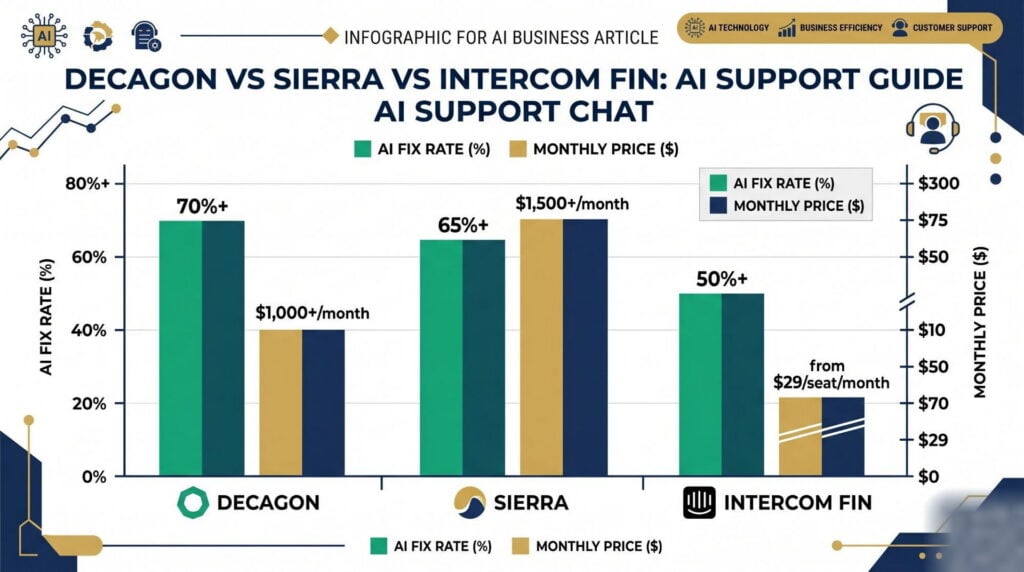
For owner-operated businesses, the Decagon vs Sierra vs Intercom Fin choice comes down to price and ticket volume. Intercom Fin starts at $29 per seat per month, while Decagon and Sierra use custom pricing above $1,000 per month. Most owner-operated businesses should start with Intercom Fin and move up as volume grows.
Choosing between Decagon, Sierra, and Intercom Fin is one of the most common AI support decisions an owner-operator faces. Each tool resolves customer questions without a human agent, but they target very different budgets and team sizes. All three tools use large language models (LLMs) built on OpenAI and similar AI. They resolve support tickets without a human agent. According to Salesforce State of Service (2024), 83% of service teams that added AI saw faster fix times.
AI Smart Ventures has helped growing businesses with AI choices since 2015. Questions about AI support tools have grown fast since 2023. The best pick depends on your team size, your budget, and how hard your support work is.
Choosing the wrong platform wastes money. The gap between a $29 per month tool and a $1,500 per month tool is real. Know what you need before you sign.
Key Takeaways
- Intercom Fin Pricing – Intercom Fin starts at $29 per seat per month on the Starter plan. It is the most affordable choice for owner-operated businesses with budgets under $500 per month.
- Decagon Pricing – Decagon uses custom pricing that typically starts above $1,000 per month. It is built for high ticket volume and complex product support needs.
- Sierra Pricing – Sierra also uses custom pricing, often above $1,500 per month. It is built for voice and chat AI agents with deep brand setup options.
- Fix Rates – According to Intercom’s 2024 Customer Service Trends report, Fin resolves over 50% of support chats without a human agent, which cuts handling time by a large margin.
- Right Fit Rule – Owner-operated businesses under 20 staff should start with Intercom Fin. Decagon and Sierra only earn their cost when you handle more than 1,000 tickets per month.
These five points narrow the field fast. Price and volume are the two things that matter most right now.
The cost gap between Intercom Fin and the other two is not a small detail. A $1,000 per month plan is $12,000 per year. You need to know the volume is there before you sign.
Why Are Owner-Operators Choosing AI Support Tools Now?
AI support tools give owner-operated businesses the same output as a part-time agent. There is no extra payroll cost. A two-person team handling 500 tickets per month can get back 40% of their time when AI handles common questions. If your top five question types drive most of your volume, any of these three tools can show clear results in the first 90 days.
AI support works best when the top 20% of question types cover 60% or more of total volume. When that is true, fix rates climb fast across all three platforms. Businesses that do not know their top question types should pull an inbox report before buying any tool. Setup goes much faster when your help content is in order and your top question types are mapped out.
Here are three signs you are ready to add an AI support tool:
- High repeat volume – More than 60% of your tickets ask the same five to ten questions each month. AI can handle these without a human every time.
- Organized help content – You have at least 20 current, complete help articles, giving the AI enough source material to answer questions well.
- Clear handoff plan – You know which question types always go to a human agent, so you can set up the routing rules before you go live.
Businesses that meet all three conditions will see a return on their spend in the first 30 to 60 days.
What Does Decagon Do Best for Your Business?
Decagon builds AI agents that learn from your support docs, past tickets, and help articles. It uses API (application programming interface) links to take real actions such as giving a refund or changing an account setting. Case studies on the Decagon site show fix rates above 70% for product-led businesses with strong help content and at least 1,000 tickets per month. That is the volume where the cost starts to pay off.
Decagon pricing is custom and typically starts above $1,000 per month. You also need a tech resource to build and manage the API links. This adds to the true monthly cost and total budget needed to run the platform. Before you call their sales team, check whether Decagon connects with your CRM tool and helpdesk. Setup takes real tech work that most lean teams do not have in-house and cannot hire at low cost.
What Does Sierra Do Best for Your Business?
Sierra builds AI agents that match your brand voice and work on both live chat and phone calls. It is the best option here if you need AI on voice and chat at the same time. Sierra lets you set a custom tone and persona for the AI agent. This matters when your brand has a specific voice that must stay the same across every call and chat.
Sierra pricing is custom and typically runs above $1,500 per month. Its main strength is voice AI on phone calls. This only pays off if phone support is a large share of how customers reach you. Most owner-operated businesses handle most support via chat and email. Paying for Sierra without a strong phone channel means paying a large monthly fee for a feature you rarely use and cannot easily justify on a tight budget.
What Does Intercom Fin Do Best for Your Business?
Intercom Fin is the most practical starting point for owner-operated businesses. It lives inside the Intercom platform, so your team gets one tool for live chat, AI support, and inbox work all in one place. Fin pulls from your help center content and tries to resolve each chat before a human steps in. Intercom reports a fix rate above 50% for most businesses that use it.
Fin works best if you are already using Intercom. If you are not, you add a full platform, not just an AI add-on. This raises the true monthly cost beyond the base $29 per seat price on the Starter plan. A team of five on a mid-tier Intercom plan can reach $300 per month before the advanced Fin features turn on. Always check current rates on Intercom’s pricing page before you commit to any plan.
AI Smart Ventures offers AI advisory and AI consulting for growing businesses choosing support tools.
How Do All Three Tools Compare Side by Side?
The table below covers the core differences in price, best fit, and key limits for each tool. Use it as a first filter before you contact any vendor. AI tool prices change often and the figures reflect June 2026 market rates. Always verify current pricing and ask for the minimum contract term before you sign anything with a vendor.
Before you reach out to any vendor, answer three questions: how many tickets do you handle each month, what share comes in via phone versus chat versus email, and do you have a tech resource for setup work. These three data points will point to one clear choice. The right tool is the one that fits your current volume, your main support channel, and your budget. Most owner-operated businesses answer all three and land on Intercom Fin as the right first step.
| Tool | Best For | Price | Limitation |
|---|---|---|---|
| Decagon | Product-led businesses with complex support needs and 1,000+ tickets per month | Custom, typically $1,000+/month (check Decagon site) | Needs API setup and a tech resource; not practical without engineering support |
| Sierra | Businesses where phone and voice is the main support channel and brand voice must match | Custom, typically $1,500+/month (check Sierra site) | Hard to justify if phone is not your main channel; setup is complex |
| Intercom Fin | Owner-operated businesses already on Intercom or wanting one tool for chat and AI support | From $29/seat/month on Starter plan (check Intercom pricing) | Best inside the Intercom platform; adding it as a standalone raises total cost |
For a current list of vetted AI tools for service businesses, visit the AI tools and apps page on the AI Smart Ventures resource hub.
Here are the clearest signals that point to each tool:
- Choose Decagon – You handle more than 1,000 tickets per month. Your top support questions need multi-step actions like refunds or account changes. You have a tech resource for API work.
- Choose Sierra – Phone calls make up more than 40% of your support volume. Your brand voice must stay the same on every call and chat without any drift in tone.
- Choose Intercom Fin – Your budget is under $500 per month. Your team is fewer than 20 people. You already use Intercom as your main support tool.
Most owner-operated businesses reading this will land in the Intercom Fin column. Start there, prove the return on investment (ROI), then revisit the others when volume grows past 1,000 tickets per month.
Frequently Asked Questions
What is the difference between Sierra and Decagon?
Sierra is built for voice and chat AI with strong brand setup options. Decagon builds action-taking AI agents that connect to backend systems via API. Sierra handles phone calls as a main support channel. Decagon handles multi-step ticket work for product-led businesses with detailed knowledge bases. Both use custom pricing above $1,000 per month and need high ticket volume plus tech resources to justify the cost.
What is the difference between Intercom Fin and Decagon?
Intercom Fin is an AI layer built into the Intercom platform, starting at $29 per seat per month on the Starter plan. Decagon is a standalone AI agent platform with custom pricing above $1,000 per month. Fin uses your help center content to resolve chats without any backend actions. Decagon can process refunds, update accounts, and handle complex workflows via API. For most growing businesses, Fin is the right first step before considering Decagon.
Who are Sierra AI’s biggest competitors?
Sierra’s main competitors include Decagon, Intercom Fin, and platforms like Ada Support and Zendesk AI. Freshdesk Freddy AI and HubSpot Service Hub AI also compete for the same budget in the AI support market. Sierra stands out on voice AI and brand setup. For owner-operated businesses that want ease of setup and a lower price, Intercom Fin is often the better fit.
Is Decagon a good fit for owner-operated businesses?
Decagon is not the right starting point for most owner-operated businesses. Custom pricing typically starts above $1,000 per month. You also need a tech resource to manage API work, which adds to the total cost. Decagon is a strong fit for product-led businesses with more than 1,000 tickets per month and in-house engineering. A five-person team handling 300 tickets per month will not see enough ROI to cover the fee and setup time.
How much does Intercom Fin cost in 2026?
Intercom Fin starts at $29 per seat per month on the Starter plan. Total cost depends on seat count and add-ons. A team of five on a mid-tier Intercom plan can exceed $300 per month before the advanced Fin features turn on. Check the current rate on Intercom’s pricing page before you commit. For a tool match based on your budget and volume, schedule a consultation with AI Smart Ventures.
How long does it take to set up an AI support tool?
Intercom Fin can be live in one to three days if your help center is well organized. Decagon and Sierra each take two to six weeks to set up. This includes API work, content review, and agent setup. The timeline depends on how complete your support content is before you start. Businesses with a thin or messy knowledge base will spend most of their setup time writing content, not setting up the AI tool.
Can these AI support tools handle phone calls?
Sierra is the only platform here built for voice AI on phone calls. Intercom Fin handles chat and email. Decagon handles chat and can take backend actions, but it is not built for voice. If phone calls are a big part of your support volume, Sierra is the right option to look at. Most growing businesses get most requests via chat and email, which makes Sierra’s voice feature hard to justify at its price.
What fix rate should I expect from AI customer support?
Fix rates vary by industry and the quality of your knowledge base. According to Intercom’s 2024 Customer Service Trends report, Fin resolves over 50% of chats without a human on average. Decagon case studies report rates above 70% for product-led businesses with detailed docs. These rates drop quickly when your knowledge base is thin or when customers ask questions your content does not address.
Do I need a developer to set up these tools?
Intercom Fin does not need a developer if you are already on Intercom. Decagon needs API work, so you need at least one tech resource, on your team or from a setup partner. Sierra also needs setup support during onboarding, though its own team handles much of that work. Owner-operated businesses without a developer should add setup costs to their budget. Outside tech help for an initial setup typically runs $500 to $2,000.
How do these tools affect service level agreements?
A service level agreement (SLA) is a promise to respond to or resolve support requests within a set time. AI support tools cut average first response time by answering common questions right away. Decagon and Sierra are both built for SLA performance at scale. Intercom Fin cuts first response time on chat once it is live. Businesses with SLA commitments under one hour will see the clearest early benefit from AI support tools.
What happens when AI support cannot answer a question?
All three platforms pass unanswered questions to a human agent. Intercom Fin routes the chat to your Intercom inbox with full context included. Decagon and Sierra each give the agent a brief summary so they do not need to re-read the full chat. The quality of the handoff depends on how the platform is set up. Review each vendor’s handoff docs before you buy, since a poor handoff can frustrate customers more than no AI at all.
Which tool is easiest to maintain over time?
Intercom Fin is the easiest to keep up. It pulls from your help center content and updates when you change an article, with no extra steps needed. Decagon and Sierra need regular content reviews and retraining when your product or policies change. Owner-operated businesses with limited IT staff will spend far less time on upkeep with Intercom Fin than with the other two tools.
Executive Summary
For owner-operated businesses, Intercom Fin is the right first step in AI support. It starts at $29 per seat per month, needs no developer, and resolves over 50% of chat conversations without a human agent. Decagon earns its $1,000-plus monthly cost only when ticket volume exceeds 1,000 per month and multi-step API actions are needed. Sierra is the right pick when phone support is your main channel and brand voice must stay the same. Start with the tool that fits today’s budget and volume, then upgrade when your numbers support it.
What Should You Do Next?
This week, pull your last 30 days of support tickets and count how many fall into your top five question types. If those types cover more than 60% of your volume, you are ready to test an AI support tool. Start with Intercom Fin if your budget is under $500 per month. Then look at Decagon or Sierra when you pass 1,000 tickets per month.
AI Smart Ventures offers AI advisory services for growing businesses selecting AI support tools. Schedule a consultation to get a clear tool match for your support volume and budget.
People Also Read
- Boutique AI Consulting vs Big Four: Which Is Right for Growing Businesses?
- Agentic AI vs Generative AI: What Is the Difference?
About the Author
Nicole A. Donnelly is the Founder of AI Smart Ventures and an AI Adoption Specialist with 20 years of experience as a founder and CEO and over a decade leading AI adoption initiatives. She helps businesses integrate artificial intelligence with clarity and confidence, driving innovation and sustainable growth. Nicole has trained over 20,217 professionals in Applied AI, delivered 624 workshops, and worked with close to 1,000 organizations across diverse industries.
Expertise: AI Transformation, AI Strategy, AI Implementation, AI Adoption, Applied AI, Marketing, Business Operations
Disclaimer: This content is for informational purposes only and does not constitute professional business or technology advice. Results vary based on industry, existing systems and implementation commitment. Contact AI Smart Ventures for a consultation regarding your specific situation.