
Do You Need an AI Disclaimer on Client Work?
Last Updated: September 2026
An AI disclaimer for business is a short line on work you deliver that says where AI was used, what a person checked, and who stands behind the result. It is not a warning label added at the end of a job. Written well, it describes a habit your firm already has. Written badly, it tells a client you knew the risk and passed it to them.
AI Smart Ventures has guided growing businesses through this exact question, and the order almost always runs backwards. Owners settle the wording first, then work out the checking later, if at all. The firms that get it right do the reverse. They decide what gets read, and by whom, before anyone argues about a sentence.
That order carries the real risk. A disclaimer on work no one read does not protect you. It hands the client proof in writing that you knew AI was involved and sent it anyway, which is far worse than the talk the line was meant to prevent. It also costs trust you spent years earning.
Key Takeaways
- Decide the review before the wording: a disclaimer describes a habit, so build the check first and let the line report what really happens.
- Clients expect to hear it from you: Customertimes asked 2,000 US adults in April 2026, and 91% said firms should be required by law to say when they use AI in customer work.
- Your duty depends on your market: bodies in the US and Australia both put out AI guidance in 2026, and the rules differ by trade, contract and country.
- A disclaimer moves nothing off your desk: Australia’s Tax Practitioners Board was blunt, saying AI “does not replace professional judgement or transfer responsibility”.
- Write what is true, not what is broad: name the parts AI touched and the checks a person ran, rather than one blanket line covering all your work.
- Keep the record behind the line: note the prompts, the checks, and the reviewer, so the claim holds up when someone asks you to back it.
All six push the work upstream. The disclaimer is the last thing you write and the least useful thing you own. The review behind it does the protecting, and it is the part a client, an insurer or a trade body will ask to see.
When does client work need an AI disclaimer?
Say so when AI clearly shaped what the client gets, or when their data went into a tool. That covers text you drafted with it, numbers a model produced, advice built on what it found, and any case where client files left your systems. It does not cover a spell check, or notes you rewrote from scratch. The test is simple: would the client read this work differently if they knew? If yes, tell them.
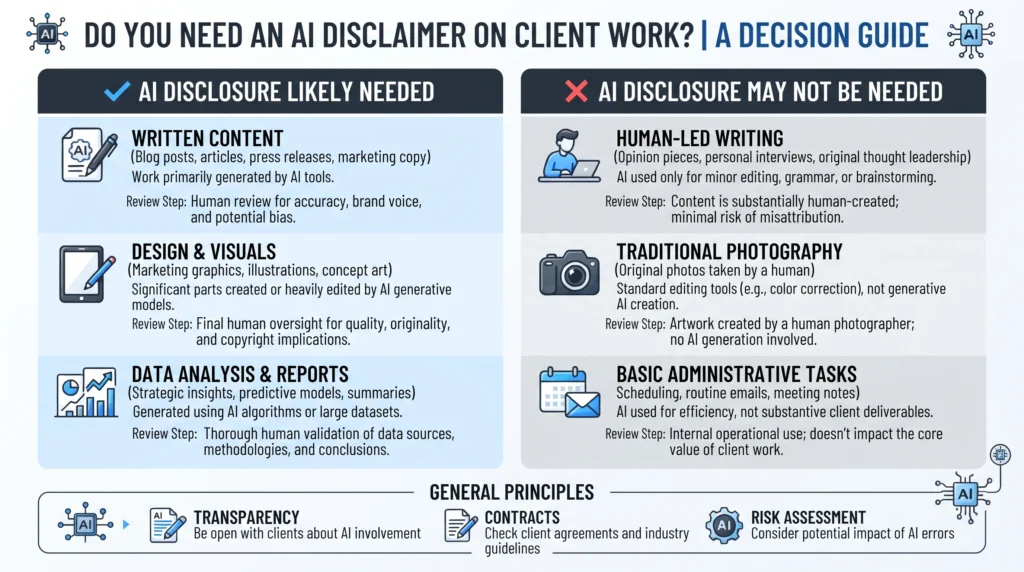
Most owners get stuck in the middle ground, so set the line once and use it everywhere. Research a model you gathered, which you then checked against sources, sits on the tell-them side, because the client leans on your reading of it. A summary of your own meeting notes does not. Write your rule down, share it with everyone who ships work, and revisit it when your tools change rather than arguing each job on its own.
What can an AI disclaimer do for you?
Two useful things: it sets what a client expects before they open the file, and it records what happened while the work is fresh. What it cannot do is make unchecked output safe. Whether it changes your legal exposure depends on your contract, your trade and the market you work in, so put that to your own adviser rather than to a template. Duties differ, and some of them moved this year.
In practice, the value sits in the moment you avoid. Clients rarely mind that AI was used. They mind finding out later, from someone else. A line on the work gives them a place to ask early, while there is still time to change it. It also keeps your team honest, because a claim about review is hard to write when no one reviewed a thing. That is the gap tool-first AI agencies leave open when they treat the line as a formatting step.
Why does the review have to come first?
Because the disclaimer is a claim about how you work, and a false claim is worse than silence. If your line says a person checked the output, someone has to have checked it, by name and against something real. The checking is where the cover lives; the wording only reports it. A December 2025 Resume Now survey of 1,012 employed US adults found 35% rarely or only sometimes review AI output before they use it.
Building that review step is a job in its own right, and it belongs before the wording. At minimum, decide who reads the output, what they check it against, and what stops the work from going out when it fails. AI Smart Ventures observes that most growing businesses arrive here with the habit in one person’s head instead of in writing. Put it on paper first, then describe it. That order is plain change management, not a legal exercise.
What should an AI disclaimer say?
Four things, in plain words: which parts of the work AI helped make, what its limits are, what a person did to check it, and who to ask about it. Keep it to two or three sentences, written the way the client speaks rather than the way your vendor does. Name the job the tool did, not the product, since tools change faster than contracts do and a stale name reads as careless.
Two habits weaken an otherwise good line. The first is the blanket version, which says AI may have been used anywhere in anything, and so tells the client nothing they can act on. The second is a promise you cannot keep, such as claiming the work is right when what you ran was a check. Say what was done, not what was won. A short, exact note earns more trust than a paragraph of hedging, and it stays true for longer.
- Scope: name the parts AI helped with, such as a first draft, a data summary or a transcript.
- Limits: say plainly that AI output can be wrong and has to be checked against sources.
- Oversight: state who read the work and what they checked before it went out.
- Route back: give the client a person to ask, so questions reach you rather than spreading.
Working out which jobs need this line, and which check sits behind each one, is the practical half of AI implementation. Bring your three most common client outputs and we will work through them.
Where should the disclaimer sit on your work?
In two places, doing two jobs. Your contract or engagement letter holds the standing line, so the client agrees once to how your firm uses AI. The work itself carries the short note, telling them what happened on this job. One without the other leaves a gap: a clause no one remembers reading, or a footnote that lands as a surprise after the fact.
Placement decides whether anyone reads it. Put the note where the work is received: at the top of a report, in the email you send, or beside a chat window when a client is talking to a bot rather than a person. Buried fine print reads as an attempt to be honest on a technicality, which is the opposite of what you want. Keep the contract wording broad and durable, and keep the note on the work short and tied to the job.
What do professional bodies say about AI use?
Two bodies wrote it down in 2026, and both landed on checking rather than wording. In June, the IRS Office of Professional Responsibility issued guidance for US federal tax work, telling tax agents to treat AI text as a first draft that needs a full human read, and holding them answerable for what it says. In July, Australia’s Tax Practitioners Board finished its own version. Duties differ by trade and by country.
Neither body says a disclaimer fixes anything, which is the useful signal for firms outside tax and law. The duties they name, skill, care, privacy and oversight, already sit in most codes of conduct and in plenty of client contracts. A July 2026 Journal of Accountancy article gives the working version: note the prompts used, how the output was checked, and who read it. Find out where your own body stands, since it may have moved this year.
Frequently Asked Questions
What skills do I need to work with AI?
Judgement first, then a few habits. You need enough AI literacy to spot where a model is likely to be wrong, the discipline to check its claims against a real source, and clear writing, so your instructions leave little room for guessing. Basic number sense helps you notice when a figure looks off. For client work, the skill that counts most is knowing which output you will put your name to.
How to actually use AI at work?
Treat every output as a draft and never as a finished item. Pick one task you repeat weekly, such as writing up calls or drafting first replies, and run it through the tool for a fortnight while a person checks each result. Keep the manual route open while you do. Widen the scope only once the output holds up, and note what you changed, so the habit survives a busy month.
How to automate a business with AI?
Write down the workflow you want to change, step by step, then mark the steps with clear rules and failures you can spot fast. Those are your safe picks. Join the tool to one of them, give it read access before write access, and name someone to check the output daily for the first fortnight. Broad automation across messy work fails, while narrow workflow optimization on one clean process usually holds.
Is an AI disclaimer legally required?
Sometimes, and it turns on where you work and what you do. Some markets and trades carry rules about telling people when they meet a bot or read AI text, and several bodies put out guidance during 2026. Others have nothing on the books. Because the duty shifts by country, contract and trade, put the question to your own lawyer, and tell clients even where no rule forces it.
Can I use a generic AI disclaimer template?
Only as a starting draft. A template describes a firm that is not yours, so it tends to claim a review you do not run. That gap is the problem, because a wrong statement is still one you may be asked to stand behind. Take the shape from a template, then rewrite every line against what your team truly does before a client sees it.
Does internal AI use need a client disclaimer?
Usually not, with two exceptions. If the internal output shapes advice the client acts on, or if their data goes into a tool, it stops being internal in any real sense. Drafting your own project plan is fine to leave unsaid. Feeding a client’s private files into a tool is not, and it may need their say-so. Judge it by whose data moves, not by which folder it sits in.
What is the difference between a disclaimer and a policy?
A disclaimer faces outward and a policy faces inward. The disclaimer tells a client what happened on their work. The policy tells your team what they may do, which tools are approved, what data may go into them, and who reads the results before anything ships. The policy is the harder document, and it is the one that makes the disclaimer true. Write it first and the wording gets easier.
How do we get started, and what does it involve?
Expect about two weeks of internal work before any wording changes. Check where AI touches client work, decide the review for each, write the internal policy, then draft the lines that describe it. Most of the effort goes into getting people to agree, not into drafting. AI Smart Ventures guides founder-led teams through that order with AI advisory and practical AI support. Book a consultation to run an AI readiness check on how you deliver.
Executive Summary
An AI disclaimer on client work is worth having, but only once you settle the review it describes. Tell the client when AI clearly shaped the work, or when their data went into a tool. Say four things: scope, limits, oversight, and who to ask. Put the standing line in your contract and the short note on the work itself. Bodies in the US and Australia both issued AI guidance in 2026, stressing checking over wording. Duties differ by market, so check yours, then write the line that reports what you really do.
What Should You Do Next?
List every piece of work you sent a client last month and mark the ones AI helped make. For each, write down who checked the output and against what. Where the answer is no one, fix the review before you touch a word of the wording, then draft one honest line per type of work and test it on your next job.
AI Smart Ventures offers AI Implementation for growing businesses building review steps into client delivery. Schedule a consultation to map your review points and the wording that matches them.
People Also Read
- Business Coaches Adding AI Advisory: What to Know
- AI Advisory for Fractional Executives: What to Know
About the Author
Nicole A. Donnelly is the Founder of AI Smart Ventures and an AI Adoption Specialist with 20 years of experience as a founder and CEO and over a decade leading AI adoption initiatives. She helps businesses integrate artificial intelligence with clarity and confidence, driving innovation and sustainable growth. Nicole has trained over 20,217 professionals in Applied AI, delivered 624 workshops, and worked with close to 1,000 organizations across diverse industries.
Expertise: AI Transformation, AI Strategy, AI Implementation, AI Adoption, Applied AI, Marketing, Business Operations
Disclaimer: This content is for informational purposes only and does not constitute professional business or technology advice. Results vary based on industry, existing systems and implementation commitment. Contact AI Smart Ventures for a consultation regarding your specific situation.