
Does an AI Hackathon Actually Change Anything?
Last Updated: November 2026
An AI hackathon is a short, timed event where mixed teams build rough prototypes with AI tools and show them at the end, over a day or two. What comes out is a prototype and a pitch, not a pilot inside your business. Whether any of it lasts past the next week is settled before anyone opens a laptop.
AI Smart Ventures has guided growing businesses through AI adoption since 2015, and the pattern holds. The day goes well. What varies is whether anything built on it still runs in March, which is rarely about the ideas.
Get this wrong and two days of everyone’s time buys a photo and some goodwill, which you then spend explaining the silence. Get it right and one build becomes how a job gets done.
Key Takeaways
- Point the day at one named problem: an open brief returns clever demos no one asked for, while a named problem returns what somebody wanted.
- Fit beats novelty: in a 2018 study of one internal hackathon%20You%20Hacked%20and%20Now%20What%20-%20Exploring%20Outcomes%20of%20a%20Corporate%20Hackathon.pdf), two of five teams were still going four months later, and both had extended a current product.
- The output is mostly borrowed parts: across 22,183 hackathon projects, 85.56% of the code existed before the event and 9.14% during it.
- Name whose hours pay for Monday: follow-through is time out of someone’s week, which no one offers later.
- Some blockers are immune to a weekend: a written rule, missing data or a sign-off will not move for a day of building.
Those five say one thing: a hackathon is a good way to learn what is possible and a poor way to decide what happens next. Deciding is separate work for named people on normal days.
What does an AI hackathon leave behind?
Three things, every time: a rough prototype, a pitch, and a group of people who now know what the tools can do. The prototype is the weakest of the three, since it handles the easy path on sample data, with no error handling, no access rules and no owner. Calling that a pilot is the first mistake, because a pilot runs real work for real users over weeks.
The code tells the same story. The Secret Life of Hackathon Code matched 22,183 hackathon projects from Devpost to their GitHub pages, across company, college and civic events. Of all the code there, 85.56% existed before the event, 9.14% was written during it, and 5.3% after. Speed comes from reuse, so a build is mostly parts other people wrote, which is why it looks finished in a day.
Which decisions have to be made before the day?
Four, and all of them are dull. What one problem is the day pointed at. Who owns what comes out of it, by name rather than by role. What happens on the Monday to the idea that wins. And whose hours pay for it, taken out of jobs they hold now. Settle those four weeks ahead and the event becomes a build; skip them and it is a show.
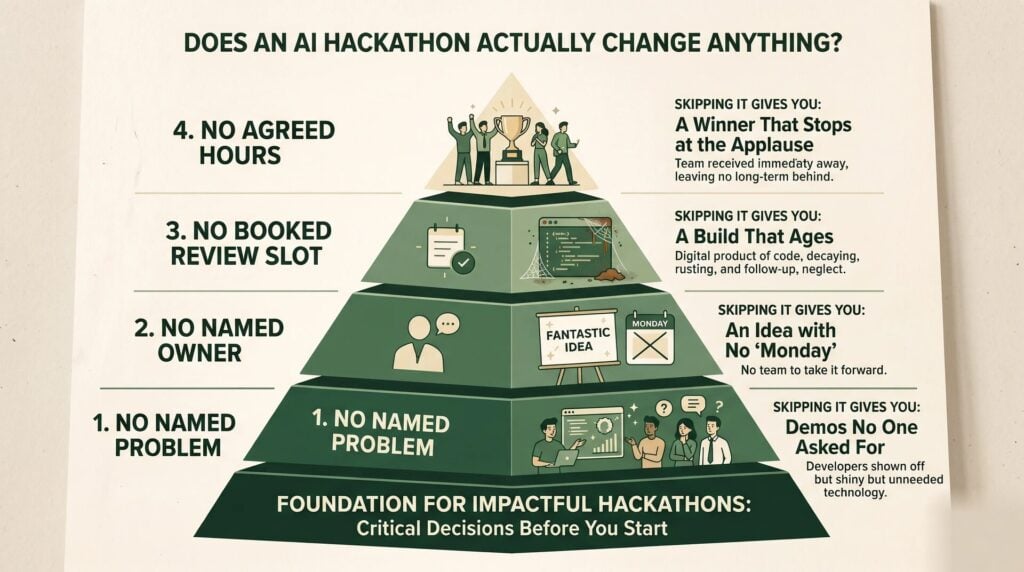
Order matters here: the problem comes first, since it decides who belongs in the room, and the owner comes next, since an idea with no owner has no Monday. Hours are the part people dodge, since someone has to rebuild a rough demo for real use, and that person has a full week, so say which job moves. This is change management in a hoodie, and skipping it is how an event ends in applause.
What happens to the winning idea on Monday?
Often nothing, unless it was close to something you run. Researchers followed five teams through Microsoft’s One Week hackathon%20You%20Hacked%20and%20Now%20What%20-%20Exploring%20Outcomes%20of%20a%20Corporate%20Hackathon.pdf) in 2017, an internal event drawing over 18,000 staff across 4,700 projects, then returned four months later. Two of five projects were still going: both extended a product the firm sold, and both teams had shown the work outside their unit.
Five teams in one tech firm is a narrow base, so treat it as a signal, not a law. The projects that survived were not the boldest; they were the ones with a home to go to, a leader whose career rode on it, and an audience beyond the team. Pax8 research of October 2026 asked 1,150 leaders at firms of 5 to 499 staff: among those building their own AI, documented review tops out at 45%.
When is a hackathon the wrong tool?
When the thing in your way is not a missing build. Three blockers come up again and again, and none yields to a weekend: a written rule that bars the data use, records that are scattered or patchy, and a sign-off one busy person has to give. Building against any of those gives you a demo you cannot switch on, which hurts morale more than no demo at all.
The test is simple: ask what would stop you shipping the idea if the prototype already existed and worked perfectly. Where the honest answer is a policy, a data cleanup or a signature, run the event later and spend the time on the blocker. AI gurus with zero operational depth say build first and sort the rest out after, which hands you a demo and the original problem. Operational efficiency comes from clearing it.
| Real blocker | A hackathon gives | It needs |
|---|---|---|
| A data-use rule | a demo you cannot run | a decision |
| Patchy records | a demo on sample data | a named owner |
| No sign-off | a queue behind one name | a date |
How do public AI hackathons differ from yours?
They are learning and hiring events, not change plans, which changes what they are for. Microsoft’s Agents League hackathon ran in June 2026 and asked entrants to ground their agents in real business data, show a clear design, handle security, and build something a firm could really adopt. Those judging rules are worth copying. The event will not change your workflows, since no one there builds on your systems.
Public events run online as often as in a room, they run all year, and most post their starter code and winning entries after. Read the winners from the big model labs the way you read a rival’s product launch: useful for what has become quick to build, useless as a plan. Send two people if what you want is AI upskilling, then hold your own day for work only your staff understand.
So should you run one, or should you not?
Run one if you have a named problem, an owner for the output, and hours set aside for the work after. Do not run one if you hope the day will supply those three, if your real blocker is a rule or a sign-off, or if the aim is showing a board that something is moving. In that case you are buying a photo with two days of everyone’s week.
A smaller test is worth trying first. Give two people one afternoon, one real task and a written question to answer, then have them show the result to the person who owns that task. It costs almost nothing to arrange, buys the same capability building, and fails quietly when the idea is weak. Three of those landing well is how you earn the bigger event, and by then you know where to aim it.
AI Smart Ventures has delivered 624 workshops, and owners most often ask what to do with the output. Our AI Advisory team helps you settle that first.
Frequently Asked Questions
Is a hackathon prototype the same as a pilot?
No. A prototype handles one path on sample data, with no owner, no access rules and no error handling. A pilot runs real work for real users over weeks, with someone reading the output. Between them sit weeks of dull work: access, odd cases, written steps. Calling a prototype a pilot is how it gets promised to a client who then waits.
What size of problem fits a single day?
One that a single person can state in two sentences and judge by Friday afternoon. Good picks repeat weekly, give you something readable, and belong to someone in the room. Anything needing three teams to agree is too big, and monthly work gives you nothing to test. Write the problem down before you book the room, since the brief is the real design work.
Where do teams get starter code for the day?
Mostly from public code on GitHub, vendor sample projects, and the starter kits that open hackathons publish. That is normal, and it is where the speed comes from. Check two things first: that the licence allows your use, and that no one pastes client records into a tool your own rules have not cleared. Pick the code yourself rather than leaving it to Friday.
Does running the day as a competition help?
A little, and less than organisers hope. Judging adds urgency and gives teams a reason to finish, which matters when there is one day. It also rewards the pitch over the fit, so the winner is often the hardest entry to adopt. If you judge, score on whether a named person would use it next week, and make the prize time or access.
Does a remote AI hackathon work as well as a room?
It works for the building and poorly for the part that decides the outcome. Remote teams finish demos fine, since the tools are online anyway. What drops away is the corridor chat where someone from another team says they have the same problem, and that chat is what gets a project carried on. Running online, schedule the cross-team showing on purpose, since it will not happen alone.
Should you send staff to a vendor’s event instead?
Send two or three if the goal is skills, and expect no change to your operations. Vendor events are built around their own stack, and entrants work on sample data rather than your systems. What comes back is AI literacy and a feel for what is now quick to build. Point that at one of your own repeat tasks within a fortnight.
What can you learn from a public winning entry?
What has become easy to build, and nothing about your own limits. Winners at the big model labs are polished, built by experts, and judged on the pitch rather than on a year inside a business. Read them as signals: if a team built that in a weekend, the hard part of your version is your data and your sign-offs, not the model.
How long should an internal hackathon run?
One full day for a first attempt, two if the teams have built together before. A single day forces the scope down, which is the main benefit, and it costs each person a day rather than a week. Longer events raise hopes without raising the odds of a project lasting. Add a half-day review a fortnight later and book both at once.
Who should be in the room besides the builders?
The person who owns the work being changed, and the person who signs off its use. Builders with no process owner give clever answers to the wrong question, and an owner with no approver gives you something that cannot be switched on. Four to six people per team is plenty. Keep senior visitors for the showing at the end rather than the build.
What do you do with the ideas that did not win?
Write them in one place with the name of whoever raised them, then leave them alone for a month. Most will not survive contact with your real limits, and the two or three that keep coming up in conversation are the ones worth scoping. A list of twenty ideas with no dates on it is a hiding place rather than a plan.
What does running an internal AI hackathon take?
Hours, ownership and a follow-up slot, far more than any tool. Expect a day per head, a week of planning to pick the problem and ready the data, and roughly a day a week after for whoever carries the winner forward. Effort tracks team count and the state of the data. Schedule a consultation to decide whether a day is the right tool.
Executive Summary
An AI hackathon changes how work gets done only when four things are settled first: the problem the day is pointed at, a named owner for the output, a plan for the Monday, and hours out of someone’s week. The day gives you a prototype, not a pilot. Research on internal events suggests the projects that last extend something you run, and most hackathon code predates the event. Where the blocker is a rule, a data problem or a sign-off, no event moves it. Workflow optimization happens after, not in the room. That is practical AI.
What Should You Do Next?
This week, write down the one problem you would point a day at, and who owns the output after. Then find the hours in that person’s week, in writing, before you choose a date. If either is missing, run a two-person afternoon test.
AI Smart Ventures offers AI Advisory for growing businesses weighing whether such an event is worth the week it costs. Schedule a consultation to set the problem, the owner and the follow-up before you book the room.
People Also Read
About the Author
Nicole A. Donnelly is the Founder of AI Smart Ventures and an AI Adoption Specialist with 20 years of experience as a founder and CEO and over a decade leading AI adoption initiatives. She helps businesses integrate artificial intelligence with clarity and confidence, driving innovation and sustainable growth. Nicole has trained over 20,217 professionals in Applied AI, delivered 624 workshops, and worked with close to 1,000 organizations across diverse industries.
Expertise: AI Transformation, AI Strategy, AI Implementation, AI Adoption, Applied AI, Marketing, Business Operations
Disclaimer: This content is for informational purposes only and does not constitute professional business or technology advice. Results vary based on industry, existing systems and implementation commitment. Contact AI Smart Ventures for a consultation regarding your specific situation.