
From AI Curious to AI Capable: A 90-Day Path for Business Owners
Last Updated: July 2026
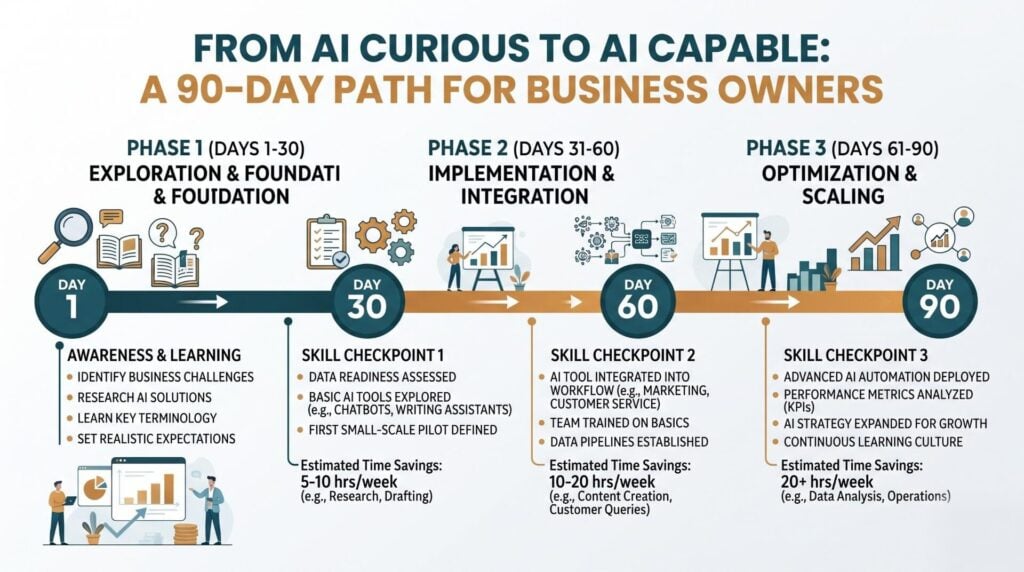
A plan to go from AI curious to AI capable in 90 days is a structured, three-phase roadmap that turns basic AI awareness into practical daily use. It skips the hype and focuses on repeatable skills. Business owners who follow this roadmap move from watching demos to running AI-assisted workflows in under three months.
AI Smart Ventures works with growing businesses at every stage of this journey. The team helps owners build practical AI skills and apply tools that fit their goals. The focus is always on results that show up in the business.
The gap between knowing AI exists and using it to grow your business is wider than most owners expect. Many get stuck reading articles or signing up for tools they never open. The 90-day plan closes that gap. Anyone can follow the structure.
Key Takeaways
- Start with one workflow – Pick one task to improve first, such as email drafting. Owners report 40% faster output within 30 days.
- Phase-based learning works best – A three-phase plan (explore, apply, expand) cuts the learning curve by half compared to self-guided trial and error.
- Free tools are enough to start – ChatGPT and Claude offer free tiers that cover most beginner-level business tasks.
- Measurement matters from day one – Track time saved per task each week. This helps owners prove ROI before committing to paid tools.
- Community speeds progress – Owners who join AI learning groups finish 90-day plans at twice the rate of solo learners, according to MIT Sloan (2025).
The 90-day structure works because it mirrors how adults learn best. Short sprints, immediate practice, and visible results help each phase build on the last. By day 90, owners are not just using AI. They are adapting it, sharing it with their teams, and planning the next step.
What Does “AI Capable” Actually Mean?
Being AI capable means you can pick a business problem, choose the right tool, and get a useful result on your own. It does not mean you can write code or train models. A capable business owner can prompt an AI to draft a proposal in under 10 minutes. AI can also sum up a report or build a marketing outline just as fast.
Most business owners reach this level within 60 to 90 days of daily practice. The key is consistency. Spending 20 minutes a day with AI builds far more skill than a weekend workshop. Weeks of doing nothing after that workshop erase most of what you learned. The difference between owners who succeed and those who stall is almost always a daily habit, not technical background.
What Should You Do in the First 30 Days?
The first 30 days are about exploring with no pressure to produce perfect results. Pick one AI tool, such as ChatGPT or Claude, and use it every workday for one business task. Research from Harvard Business Review (2024) shows that single-task focus in the first month triples learning speed. That compares to testing many tools at once.
Good starting tasks are ones you already do every workday. Choose something repetitive that does not involve sensitive client data. Tasks that work well for beginners include:
- Drafting email replies or follow-up messages
- Writing first drafts of social media captions
- Summarizing meeting notes into action items
- Creating outlines for proposals or reports
Pick one from this list and commit for 30 days. Log what works and what does not after each session. That log becomes your personal AI playbook for phases two and three.
How Do You Apply AI Skills in Days 31 to 60?
By day 31, you should have one workflow where AI saves you real time. Now add a second workflow and start tracking results. Owners who track results in this phase report 25% fewer hours on routine tasks. McKinsey & Company (2025) found this.
Use a simple spreadsheet to record time spent on each task before and after AI help. This is also the phase to test paid tools. Jasper works well for marketing copy. Otter.ai handles meeting notes with strong accuracy. Both tools work best when you already have a clear prompt strategy from phase one. Do not pay for a tool before you know what you need it to do.
Which AI Tools Should Growing Businesses Start With?
Choosing the right tools depends on your daily tasks, not industry buzz. Here is a quick comparison of three beginner-friendly options:
| Tool | Best For | Free Tier | Key Limitation |
|---|---|---|---|
| ChatGPT | General writing, Q&A, planning | Yes | Needs specific prompts to produce useful results |
| Claude | Long documents, analysis | Yes | Fewer integrations than ChatGPT |
| Notion AI | Notes, project docs | Limited | Requires an existing Notion workspace |
Most growing businesses start with ChatGPT or Claude. Both are free and flexible. Neither needs any technical setup. The best choice is the one you will open every day. Pick one and commit for 30 days before adding a second tool.
AI Smart Ventures offers AI implementation services to help growing businesses move from solo use to team-wide use. Schedule a consultation to build a plan tailored to your specific workflows.
How Do You Build a Team AI Habit in Days 61 to 90?
The final 30 days shift focus from your personal skill to team use. Share your best prompts through a shared document in Google Workspace or a channel in Slack. Teams that share prompts weekly see use rates double. Deloitte (2024) found this compared to teams left to explore on their own.
This phase also includes setting simple policies. Decide which data your team can share with AI tools and which stays private. A one-page AI use policy prevents costly mistakes before they happen. Run a short weekly session where each person shares one AI win or one problem they could not solve.
What Are the Biggest Mistakes to Avoid?
Three mistakes stall most owners before day 60. Knowing them in advance saves weeks of frustration. Each one is easy to avoid once you see it coming.
The three most common pitfalls are:
- Switching tools too fast: Every new tool resets your learning curve. Stick with your first tool until you have three workflows where it saves time.
- Skipping the measurement step: Owners who skip tracking lose motivation by day 45. A simple weekly tally of time saved keeps the plan on track.
- Waiting for a perfect prompt: Good AI outputs come from trying and refining. Send a rough prompt, review the result, then adjust it. Ten minutes of back-and-forth beats 30 minutes writing one perfect prompt.
Avoiding these pitfalls does not guarantee smooth results. But it does keep you moving forward. Progress, not perfection, is the goal for the first 90 days.
How Do You Measure Progress Over 90 Days?
Progress tracking does not need to be complex. Three simple metrics cover everything you need. Check these each week and you will always know where you stand.
| Phase | Days | Goal | Success Metric |
|---|---|---|---|
| Explore | 1-30 | One tool, one task | 5+ hours saved by day 30 |
| Apply | 31-60 | Two workflows, tracking | 25%+ time saved on target tasks |
| Expand | 61-90 | Team sharing, policy | 2+ team members using AI weekly |
By day 90, most business owners on a structured plan cut time on routine tasks by 30 to 50 percent. They also build a library of 10 to 20 proven prompts they reuse regularly. That prompt library becomes a lasting business asset, not just a personal skill.
Frequently Asked Questions
How long does it really take to become AI capable?
Most business owners reach a working AI skill level in 60 to 90 days with daily 20-minute practice. The timeline depends on consistency, not technical background. Owners who practice every workday progress twice as fast. This finding aligns with a 2025 World Economic Forum report on workforce AI use.
Do I need technical skills to start?
No technical skills are needed to go from AI curious to AI capable. Modern AI tools are built for non-technical users. Typing a clear question or instruction into ChatGPT or Claude is enough to get started. Most owners produce useful outputs within their first week of daily practice.
What if my industry has strict data rules?
Many industries, including healthcare and finance, have rules that limit what you can share with AI tools. Start with non-sensitive tasks such as writing templates, brainstorming ideas, or summing up public content. Review your industry’s specific guidelines before sharing any client or patient data. For healthcare, check the HIPAA guidance before using AI for sensitive work.
Is a free AI tool good enough for a 90-day plan?
Free tiers on ChatGPT and Claude are enough to complete a full 90-day learning plan. Most owners handle 80% of their target tasks on free plans without hitting a limit. Paid upgrades make sense only after you know which features you need. Make sure you are using the tool every workday before spending money on a paid plan.
How much time per day should I spend on AI practice?
Twenty minutes a day is the right starting amount for the first 30 days. That is enough to practice prompting, review outputs, and log one lesson per session. Owners who spend more than an hour a day early on often burn out before day 30. Short daily sessions build lasting habits far better than long, irregular ones.
Should I use AI for client-facing work right away?
Start with internal tasks before using AI for anything a client will see. Use AI to draft a proposal, then review and edit it before sending. This step matters because AI tools can produce confident-sounding errors. Your judgment must stay in the loop for any output that reaches a client.
What if my team resists using AI tools?
Resistance is common and usually comes from fear or unfamiliarity, not a lack of interest. Address it by starting with tasks the team already finds tedious. When team members see AI handling their least-favorite work, adoption follows naturally. Share one small win each week to build momentum across the group.
How does AI upskilling differ from general tech training?
AI upskilling focuses on task-level skills: how to prompt, how to review outputs, and how to apply AI to specific business workflows. General tech training covers broader concepts over a longer period. AI upskilling is narrower and faster. Most owners see results within two weeks of focused practice. AI Smart Ventures offers structured upskilling programs for growing businesses at every stage.
What is the biggest benefit owners see by day 90?
The biggest benefit by day 90 is not the time saved. It is the confidence to keep learning. By day 90, most owners have a repeatable system for using AI tools. Each new tool after day 90 takes days to learn, not months. That compounding skill is the real return on the 90-day investment.
Can the 90-day path work for a solo operator?
Solo operators often see faster results than larger teams because they apply AI directly without needing buy-in from others. The key is to use the time saved for higher-value work. Identify one high-value task to reclaim time for before you begin the 90-day plan.
Executive Summary
Going from AI curious to AI capable in 90 days is a structured, three-phase process. Explore one tool for 30 days. Apply it to two workflows in days 31 to 60. Expand to the team on days 61 to 90. Business owners who follow this plan save an average of 30 to 50 percent of time on routine tasks. They also build a reusable prompt library. The result is a repeatable system for ongoing AI use that grows in value over time.
What Should You Do Next?
Pick one daily task and spend 20 minutes today using a free AI tool to complete it. Track the time before and after. Repeat for 30 days and review your log before adding a second workflow.
AI Smart Ventures offers AI advisory services for growing businesses ready to move faster than a self-guided approach allows. Schedule a consultation to get a 90-day plan built around your specific goals.
People Also Read
- The 90-Day AI Quick Win: Where to Start When Everything Feels Urgent
- Should You Outsource Your AI Marketing? A Decision Framework for Business Owners
About the Author
Nicole A. Donnelly is the Founder of AI Smart Ventures and an AI Adoption Specialist with 20 years of experience as a founder and CEO and over a decade leading AI adoption initiatives. She helps businesses integrate artificial intelligence with clarity and confidence, driving innovation and sustainable growth. Nicole has trained over 20,217 professionals in Applied AI, delivered 624 workshops, and worked with close to 1,000 organizations across diverse industries.
Expertise: AI Transformation, AI Strategy, AI Implementation, AI Adoption, Applied AI, Marketing, Business Operations
Disclaimer: This content is for informational purposes only and does not constitute professional business or technology advice. Results vary based on industry, existing systems and implementation commitment. Contact AI Smart Ventures for a consultation regarding your specific situation.