

Generative AI for Business Teams: How to Actually Use It
Last Updated: August 2026
Generative AI for business teams is the use of models that write, sum up and draft, put to work on jobs the team already has. It does not arrive as a new department. It arrives as a faster first version of a report, an email or a plan, and then people decide what comes next. The value sits in that second half. A draft nobody reads is not finished work.
AI Smart Ventures has guided growing businesses through AI adoption in operations, finance and client work. The same picture shows up in nearly all of them. Getting hold of a tool is rarely the problem, and most people have one open by week two. What decides the result is whether the work around the tool shifts: who checks it, who signs it off, and what a finished draft has to look like.
Skip that part and you buy speed with no gain. Drafts stack up, people quietly rewrite them, and the hours you thought you had won turn up somewhere harder to see. Teams that treat practical AI as a change to how work flows, not as a new app, are the ones still using it in month six.
Key Takeaways
- Start with one job that repeats, not a tour of tools. A weekly report, a set of meeting notes or a standard first reply gives you something to compare week against week.
- Plan for review time, because checking is real work. Workday research from 14 January 2026 found close to 40% of the time AI saves goes back into rework: fixing errors, rewriting copy and double-checking output.
- Put the human check where a mistake would travel furthest. Notes that stay inside need a quick read. Anything a client, a board or an investor sees needs one named owner of the facts.
- Decide what the saved hours are for before you save them. Teams that spend them on deeper thinking and better calls report real gains. Teams that soak up more work do not.
Those four share one root. AI moves where the effort sits; it does not remove it. Writing gets faster and reading gets harder, so the team that wins is the one that redesigns the reading.
What does generative AI do in a real work week?
Mostly it writes things. Anthropic’s Economic Index report on cadences, out on 26 June 2026, sorted work chats by what each one produced. Reports and documents led at 20%, then explanations at 9%, email drafts at 7%, and analyses and summaries at 6%. That is the plain middle of an office week, not a lab, and most of the gain sits right there.
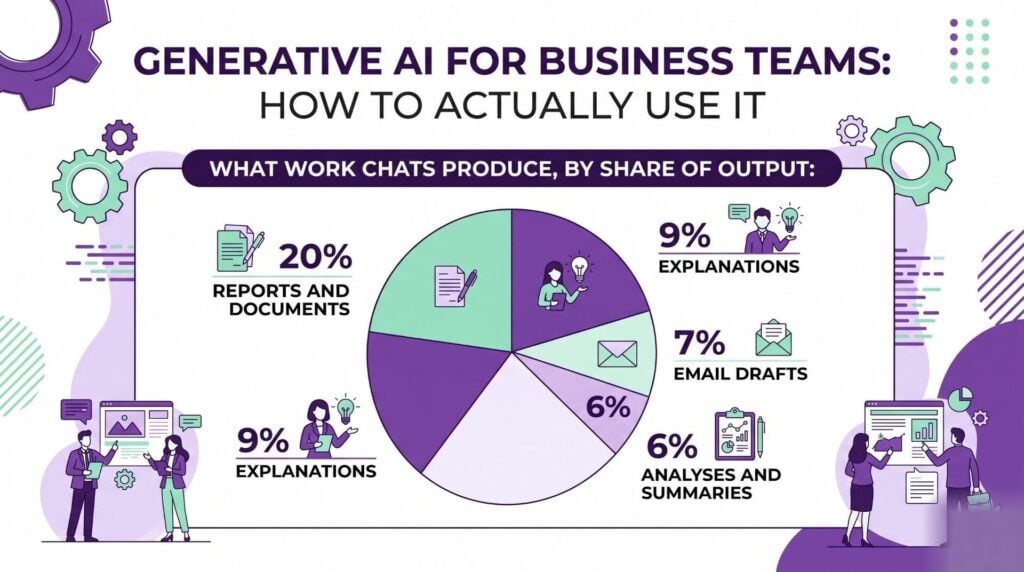
The same study tracked the rhythm of use. Personal questions climb from about 35% of chats on weekdays to just under 50% at weekends, and email drafting peaks between 10 and 11 in the morning. Your team will follow its own calendar too, which is why one tool tour in January rarely lasts to March.
Which jobs should your team hand over first?
Hand over the jobs that repeat, take real time, and stay inside the building. Meeting notes turned into decisions and owners. The weekly update nobody enjoys writing. First-pass replies to routine questions. A long file cut to the five points a manager needs. They share a useful trait: if the output is wrong, someone spots it in minutes and nothing has left the company.
Hold two kinds of work back at the start: anything with a legal or money consequence, and anything a customer reads with no person in between. Those come later, once the team can spot a weak draft on sight. Picking badly here is the top reason a pilot dies quietly in week three.
How does work move when drafts arrive faster?
The bottleneck moves from writing to checking. Once a first version takes four minutes rather than forty, the queue forms at the desk of whoever reads it, and that is usually the most senior person. Workday’s January 2026 study of 3,200 staff and leaders found 89% of firms had updated fewer than half their roles to match what AI now does.
So settle who checks what before you scale. A common failure is routing every AI draft past the founder, then asking why nothing ships faster. Split it instead. Routine work gets a peer read, client work gets a named owner, and only risky items go to the top of the house. That one call is most of the change management this shift needs.
Where does the human check have to sit?
Put the check where a mistake would travel furthest, and give it to someone who knows the subject. The same Anthropic study found Claude’s replies read about one year of schooling above the prompt that produced them, with the widest gap where a user describes a thing to be built. Smooth writing sounds sure of itself whether or not it is right.
The stakes are not just talk. In Workiva’s 2026 mid-year benchmark survey, 26% of finance and audit leaders said internal checks caught AI errors that had already reached outside readers or the board. One in four. Write down what a reviewer must check by hand: figures, names, dates and any claim an auditor could ask about. That is human-first AI in practice.
How do you start with a non-technical team?
Start with one annoying job and two willing people, not a launch for the whole company. Pick something everyone knows, such as turning a meeting recording into decisions with owners against them. Let the pair run it for two weeks and keep the prompts that worked. Then have them show the rest of the team in ten minutes, using real work rather than slides.
Skip the theory. Nobody needs to know how a model was trained to write a better status update, and AI literacy grows fastest from a job a person already cares about. Give the pair clear license to say it did not help, because a pilot allowed to fail is the only kind that teaches you much.
Getting that first job right is worth more than getting ten tools right. AI Smart Ventures offers AI Advisory to help growing businesses pick that job and build the check around it.
What do teams get wrong in the first month?
Four mistakes cause most stalled starts: touring tools instead of finishing one job, letting each person invent prompts in private, hoping for saved time while the process stays the same, and filling the freed hours with more of the same work. Workday found only 14% of staff get a clear positive result from AI, which is what speed does inside an unchanged flow.
The private-prompt problem is the sneakiest. One person gets good, keeps their best prompts in a personal note, then changes role or leaves, and nothing carries over. Put the prompts that work in a shared file from week one, each with a line saying what it is for. It is dull, and it turns a personal trick into a team habit.
How do generative AI habits stick on a team?
Habits stick when practice is steady and shared. Anthropic’s learning curves report from 24 March 2026 found people using Claude for six months or more had a 10% higher success rate in their chats, a link it could not explain by task choice or country. Skill builds with use, so a team that practices weekly pulls away from one trained once.
The shape of the week shifts too. Gensler’s 2026 Global Workplace Survey, out on 10 March 2026 and covering more than 16,400 office workers in 16 countries, found its heaviest AI users spend less of the week working alone (37% against 42%) and more of it learning (12% against 8%). Take-up looks less like people going quiet, more like a team that talks.
Frequently Asked Questions
What is generative AI and how do business teams use it?
Generative AI is software that makes new text, images or code from a plain request, based on patterns it learned from very large amounts of data. Business teams mostly use it to write and to sum up. Anthropic’s June 2026 cadences report found work chats produce reports and documents most often at 20%, then explanations at 9% and email drafts at 7%. In practice: status updates and routine replies.
Which generative AI tools work best for business teams?
There is no single best tool, and picking the job matters far more than picking the brand. Start where the work already sits, so drafts appear beside the files people use each day. Check three things first: whether what you type trains the vendor’s model, whether an admin can see who uses it, and whether it links to the systems you already run. Fit beats fame.
What tasks can generative AI handle for a business team today?
It reliably turns a recording into decisions and owners, cuts long files down to size, drafts routine replies, shapes messy notes into an order, and writes the first version of a weekly report. It is also good at quizzing your own material, such as finding where two files disagree. It handles judgment poorly, and any call about people, money or risk still belongs to a person.
How long before a team sees a real difference?
Expect a clear difference on one job within two to three weeks, and a shift in how the team works within a quarter. The first two weeks go on finding out what the tool is bad at, and that time is well spent. Skill keeps building after that. Anthropic’s learning curves data found longer-standing users had a 10% higher success rate, which is practice showing up.
Who should own generative AI use inside a team?
Give it to the person who owns the process, not the person keenest on the tech. That is usually an operations lead or a team manager, because the calls that matter are about how work flows: which job goes first, who checks what, and what counts as done. A named owner also gives people somewhere to take a bad result. Without one, prompts stay private.
What belongs in a short AI use policy?
Four things fit on one page: which tools are approved, what must never be pasted into them, which output needs a named reviewer before it leaves the company, and how someone flags a mistake without blame. Keep it to a page so it gets read. Look at it again each quarter, because tool settings and default data sharing change far more often than policies do.
How do you stop generative AI drafts sounding generic?
Feed it your own material. A model given nothing to work from writes the average of all it has seen, which is the flat tone people complain about. Give it three samples of writing your team is proud of, a note on who the reader is, and the facts that belong in the piece. Then cut the first paragraph, which is usually throat-clearing.
Can generative AI be trusted with client-facing work?
Not without a named human owner on every piece that goes out. The risk is rarely that the writing reads badly. It is that smooth prose carries the wrong figure. In Workiva’s 2026 mid-year survey, 26% of leaders said internal checks found AI errors that had already reached outside readers or the board. Use it for first drafts, then let the owner check every fact.
What if part of the team refuses to use it?
Treat a refusal as data, not as pushback. People usually opt out because a tool was aimed at a job it does not suit, or because nobody said what happens to the time it saves. Ask what would make their Tuesday easier. Keep it optional for the first month and let results travel by word of mouth, which moves faster than any order.
How should a growing business get started with generative AI?
Start with scope and order, not software. Pick one job that repeats, name the reviewer, run it for two weeks, and write down what changed. What you spend early is attention rather than budget: a few hours to pick the job well, plus a standing slot where people share what worked. Schedule a consultation to map that first job and the check around it.
Executive Summary
Generative AI helps a business team most where work repeats and the reader sits inside: summaries, status updates, routine replies and weekly reports. Anthropic’s June 2026 cadences data shows the pattern plainly, with reports and documents the most common output of work chats at 20%. The catch is that faster drafting shifts the bottleneck to checking. Workday found close to 40% of saved time comes back as rework, and most roles were never redrawn around the change. Start with one job, name a reviewer, and decide up front what the freed hours are for.
What Should You Do Next?
Pick the one job your team repeats every week: the Monday report, the meeting summary, the standard client reply. Run it through a generative AI tool for two weeks with one named reviewer, noting time to first draft and how many rounds of fixing it took. Then decide what the freed hours are for, before anyone quietly takes on more work.
AI Smart Ventures offers AI Advisory for growing businesses working out where generative AI belongs in the week. Schedule a consultation to map your first job, the check around it, and what happens to the time you win back.
People Also Read
- How to Use AI for Business Presentations, Reports, and Pitch Decks
- How to Get Your Team to Actually Use AI Tools
About the Author
Nicole A. Donnelly is the Founder of AI Smart Ventures and an AI Adoption Specialist with 20 years of experience as a founder and CEO and over a decade leading AI adoption initiatives. She helps businesses integrate artificial intelligence with clarity and confidence, driving innovation and sustainable growth. Nicole has trained over 20,217 professionals in Applied AI, delivered 624 workshops, and worked with close to 1,000 organizations across diverse industries.
Expertise: AI Transformation, AI Strategy, AI Implementation, AI Adoption, Applied AI, Marketing, Business Operations
Disclaimer: This content is for informational purposes only and does not constitute professional business or technology advice. Results vary based on industry, existing systems and implementation commitment. Contact AI Smart Ventures for a consultation regarding your specific situation.

