
How Can a Consultancy Use AI on Client Deliverables?
Last Updated: October 2026
AI in consulting is the use of AI tools on the work a consultancy delivers to its clients: desk research, interview synthesis, the evidence pack, and first drafts of slides and reports. It is a way of doing the work, not a thing you sell. The client still pays for one thing a chatbot cannot give them: a judgment they can hold a named firm to. So the real question is where AI sits in the work, and where it has to stop.
AI Smart Ventures has guided growing businesses, including founder-led and boutique consulting firms, through AI adoption in the work they hand to clients. The pattern repeats: firms that treat AI as a research assistant move faster, while firms that let it write the answer end up rebuilding trust they already had.
The stakes are about trust, not tech. A client who finds a made-up source in your report does not blame the tool; they blame the name on the cover. Get the split right and the same team works faster with its thinking intact. Get it wrong, and one bad deck can undo years of referrals.
Key Takeaways
- Split the work before you open a tool: AI can carry research, sorting and first drafts, while the recommendation stays with a named person.
- Check the evidence pack line by line: every claim in it should trace back to a source someone at the firm has opened and read.
- Expect clients to be wary: a 2026 survey of 3,887 companies found 70% would not trust a consultancy report prepared using AI.
- Say what AI did, in plain words: a short method note builds more trust than silence, and far more than being found out.
- Guard client material like the work depends on it: a 2026 breach of one large firm’s in-house AI tool showed how much client work now sits inside these systems.
Read those together, and one design rule appears. The more a task looks like finding and sorting, the more of it AI can carry; the more it looks like choosing, the less. Most deliverables hold both, so the real work is splitting them on purpose.
What parts of a client deliverable can AI do?
AI can safely do the parts of a deliverable that gather, sort, and summarise. That covers desk research, first-pass interview synthesis, tidying data into tables, the evidence pack, and slide text drafted from your own notes. The UK Management Consultancies Association’s 2026 member survey, published on 20 January 2026, found 77% of firms had built AI into their systems, and 76% use it for research. The findings are already moving.
What those tasks share is that a person can check the output against something real. A summary can be held up against the transcript, and a chart against the data behind it. That is the test for any new use: if you cannot check it fast, AI should not do it alone. Tasks that pass become steady workflow optimization, and the rest stay with the team. Write the list down so nobody guesses on a deadline.
Where should the line sit between AI and you?
The line sits at the recommendation. AI can tell you what the facts say, but it cannot decide what this client should do, given their people, their politics, and their taste for risk. A Harvard Business School study of more than 750 BCG consultants found AI users did 12% more work, 25% faster, at 40% higher quality on tasks AI handles well. On a harder business problem, they were 19 percentage points less likely to get it right.
That second result is the one to remember. The harder task was the kind a client pays you for: weighing mixed facts and making a call. People who leaned on the tool there did worse than those who worked alone, because the output sounded sure of itself. Tool-first AI vendors sell the speed; clients buy the judgment. So draw the line in writing: the lead consultant owns the answer and can defend each step without the chat history.
How should you use AI on interview synthesis?
Use AI to do the first sort, then read the transcripts yourself before you trust any theme. A tool can group forty interviews by topic in minutes, pull out quotes and flag where people disagree. What it cannot do is notice the pause before an answer, or know that the boss in the room spoke for everyone else. The first sort is AI’s job, and the meaning stays yours.
A simple habit keeps this honest. For every theme the tool offers, open three quotes behind it and check they say what the summary claims. Then look for the interviews that fit no theme at all, because the odd one out is often the finding. Keep the tool’s grouping as a working file, never as the deliverable. When a client asks why you hold a view, point to people they know, not to a model.
How do you build an AI-assisted evidence pack?
Build it in three passes: AI gathers, a person checks, and the lead consultant decides what goes in. The evidence pack is the backbone of the deliverable, and it is where AI saves the most time. It can also do the most harm, because a made-up source looks just like a real one. Every figure, quote and citation must link to something a person at the firm has opened and read.
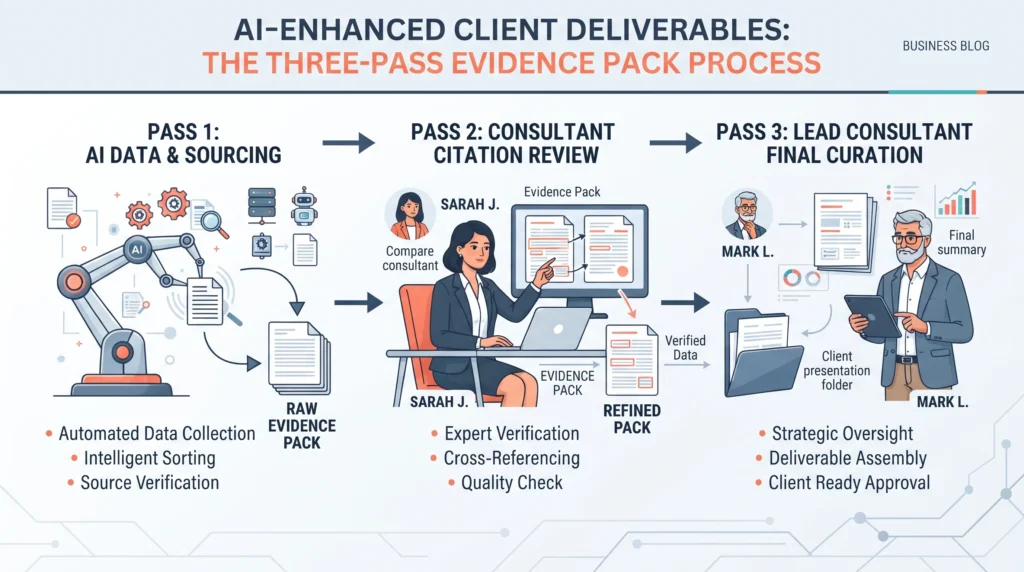
The cost of skipping the middle pass is on public record. The OECD AI incident log records a 2025 case where a report for the Australian government held fake citations and a made-up court quote. The firm behind it agreed a partial refund and added a note on its AI use. A named checker would have caught those errors in an afternoon, so put that step in the plan for every job.
AI Smart Ventures offers AI Consulting for consultancies setting up this kind of checked evidence workflow across their own client teams.
Should you tell clients you used AI?
Yes, and say it plainly in the method note. Clients are more wary than most firms think. A Source Global Research survey of 3,887 companies, reported in August 2026, found 70% would not trust a consultancy report prepared using AI. Almost a third said learning a firm had used AI in a published report would shake their faith in it. Silence does not remove that risk; it only delays it.
The same clients still want the speed. An IBM Institute for Business Value report found 89% of consulting buyers expect AI in the work, and 93% will only buy from firms that are open about how they use it. So the note should say what AI did, what a person checked, and who made the call. That way the note reads as proof of care, not as a confession you were pushed into.
How do you keep client material confidential with AI?
Treat every AI tool as a place where client material now lives, and set rules before anything goes in. The risk is real. In March 2026 the security firm CodeWall reported that its AI agent broke into Lilli, McKinsey’s in-house AI tool, in about two hours. By its account, the agent reached 46.5 million chat messages and 728,000 files, though McKinsey said it found no evidence that client data was accessed.
For a smaller firm, the lesson is about what flows in, not who built the tool. Read your engagement letters and NDAs first, since many were written before AI and may bar sharing client material with any outside party. Then read the vendor’s Data Processing Agreement (DPA), which sets out how they treat data you send. Use business accounts with training turned off, strip names where you can, and list which tools each client has cleared.
How is AI changing the shape of consulting firms?
AI is thinning the bottom of the classic pyramid first. Research, first drafts and slide building were the training ground for junior staff, and those are the tasks AI now does fastest. That changes how firms staff projects and grow people. It does not remove the need for people who can judge, persuade and own an answer in front of a client.
The pricing question follows. When a draft takes an hour rather than a day, charging for time spent gets harder to defend, and more firms now price the outcome or the decision. Whatever model you pick, make the change openly with clients rather than letting them find the gap. Growing the next group of staff needs thought too, because juniors who never build a model from scratch will struggle to spot when one is wrong.
Frequently Asked Questions
Which in-house AI tool do McKinsey consultants use?
McKinsey consultants use Lilli, an in-house AI tool built on the firm’s own library of past research. CodeWall’s March 2026 write-up put use at over 70% of the firm, with more than 500,000 prompts a month. It finds past work and drafts summaries. For a smaller consultancy, the lesson is that the big firms built their tools for research, not for writing the answer.
Does a 30% rule apply to consulting deliverables?
There is no formal 30% rule in consulting. The phrase usually means a rough split where AI handles most routine work and people keep the share that needs judgment. In a deliverable, that share is small in word count but carries most of the value: the framing, the recommendation and the trade-offs. Skip the ratio and list which sections AI drafts and which a named person writes from scratch.
Which consulting work is safest from AI?
Work that rests on trust, judgment and relationships is the safest. That means framing the real problem, reading a room of senior people, weighing evidence that points two ways, and standing behind a call when it goes wrong. Tasks built on finding and laying out facts are the most exposed. Most consulting roles hold both, so the people who shift their week toward judgment keep the part clients pay for.
Can junior consultants still learn the craft if AI drafts?
They can, but only if you design it on purpose. Ask juniors to build some analyses by hand before they use AI on the same kind of task, so they know what good looks like. Have them check AI output against sources and explain the gaps they found. That review work teaches judgment faster than laying out slides ever did, as long as a senior person reads it with them.
Should AI-drafted slides carry a label for the client?
A label on every slide is rarely needed; a clear method note is. Put two or three sentences at the front or back of the deliverable saying where AI helped, how sources were checked and who owns the recommendation. Clients care most about the thinking behind the answer. If a client asks for slide-level labels, agree to it and add the rule to your terms for that project.
What if a client bans AI on its data?
Then you follow the ban, and you plan the work around it from day one. Keep that client’s files out of every AI tool, including note-takers and translation apps, and tell the whole team in writing. You can still use AI on public desk research that holds nothing from the client. Log the rule with the project file so a new team member cannot break it by accident.
How do you catch invented citations before a report ships?
Give one named person the job of opening every source in the final draft, not just the ones that look odd. Check that the link works, that the page says what the report claims, and that the date fits. Search any quote word for word. Invented references look tidy, so a quick skim will miss them. Budget real time for this step, because it protects the firm’s name.
What does it take to set up AI on client delivery?
Start with one deliverable type you produce often, and map which steps AI can carry and which stay with people. Scope depends on how many teams and tools are involved, and whether your client terms need updating first. Most firms can run a first checked project within a few weeks. Schedule a consultation with AI Smart Ventures to map that first workflow.
Executive Summary
A consultancy can use AI on most of the work behind a client deliverable, as long as the recommendation stays visibly its own. AI suits research, interview synthesis, the evidence pack, and first drafts, because a person can check each of those against a source. It does not suit the final call, where it can make skilled consultants worse. Clients are wary, so tell them plainly what AI did and who made the call. Protect client material with clear rules on which tools may hold it.
What Should You Do Next?
This week, pick your most common deliverable and mark each step as AI-gathers, person-checks, or person-decides. Name the one person who will open every source before the next report ships, and draft the two-sentence method note you will send with it. Then check your engagement letters for any clause on third-party tools.
AI Smart Ventures offers AI Consulting for growing businesses that deliver advice to clients and want AI in the work without losing the judgment they are hired for. Schedule a consultation to map your first checked client workflow.
People Also Read
- How to Build an AI Dashboard for the Owner-Operator Without an Analytics Team
- AI Capability Decks for Owner-Operated Agencies: What Clients Actually Want to See
About the Author
Nicole A. Donnelly is the Founder of AI Smart Ventures and an AI Adoption Specialist with 20 years of experience as a founder and CEO and over a decade leading AI adoption initiatives. She helps businesses integrate artificial intelligence with clarity and confidence, driving innovation and sustainable growth. Nicole has trained over 20,217 professionals in Applied AI, delivered 624 workshops, and worked with close to 1,000 organizations across diverse industries.
Expertise: AI Transformation, AI Strategy, AI Implementation, AI Adoption, Applied AI, Marketing, Business Operations
Disclaimer: This content is for informational purposes only and does not constitute professional business or technology advice. Results vary based on industry, existing systems and implementation commitment. Contact AI Smart Ventures for a consultation regarding your specific situation.