
How Do Creative Agencies Use AI to Win More Business?
Last Updated: August 2026
AI for creative agency pitches is the use of AI tools behind the scenes of new business: digging up facts on a client before you meet, widening the spread of early ideas, and testing the story before anyone stands up. Your people still lead the room. What changes is the prep, which gets deeper and faster, so the hours you save go into thinking and craft rather than tidying slides at midnight.
AI Smart Ventures has guided growing businesses through AI adoption inside client-facing teams, including agencies that live or die on new business. One pattern shows up again and again: the shops that win more are not the ones making the most stuff. They are the ones who worked out early which parts of a pitch a machine may never touch.
Owners already feel the squeeze. Search Engine Land’s read of SparkToro’s agency survey puts the share who call AI a real threat to their model at 53%, up from 44% a year before. Meanwhile clients use the very same tools to argue for smaller budgets. Pressed from both sides, the pitch room is where you either prove your worth or quietly lose it.
Key Takeaways
- Start with research, not ideas. Build a short file on the client before anyone opens a design tool, so every idea in the room answers something they said out loud.
- Use AI to widen the field, not to pick the winner. Ask for four very different routes from four points of view, then let your creatives choose one and push it.
- Get your answer to the AI question ready. Buyers now ask where the machine stops and your judgment starts, and “we use AI in everything” is the weakest reply in the room.
- Practice hard, follow up fast. Have a model fire tough questions at the team first, then send your note the same day, while the meeting is still warm.
None of those four is about speed. Speed is the easy win and the least convincing one, because your rivals bought the same tools last quarter. What moves a pitch is the quality of thought you can now afford, plus the will to keep the machine out of the moments that need a person.
How do creative agencies use AI to win more pitches?
Creative agencies win more pitches with AI by moving the work earlier: deeper client research, a wider spread of ideas, and harder practice, rather than faster slide building. Work that used to eat a week, like reading the sector, pulling rival ads and sorting reviews, now takes an afternoon. Those hours go back into strategy and craft. The firms that gain most treat AI as prep, not as the show. The pitch itself stays stubbornly human, because a client is buying the people who will run the account, and no pile of machine output changes that.
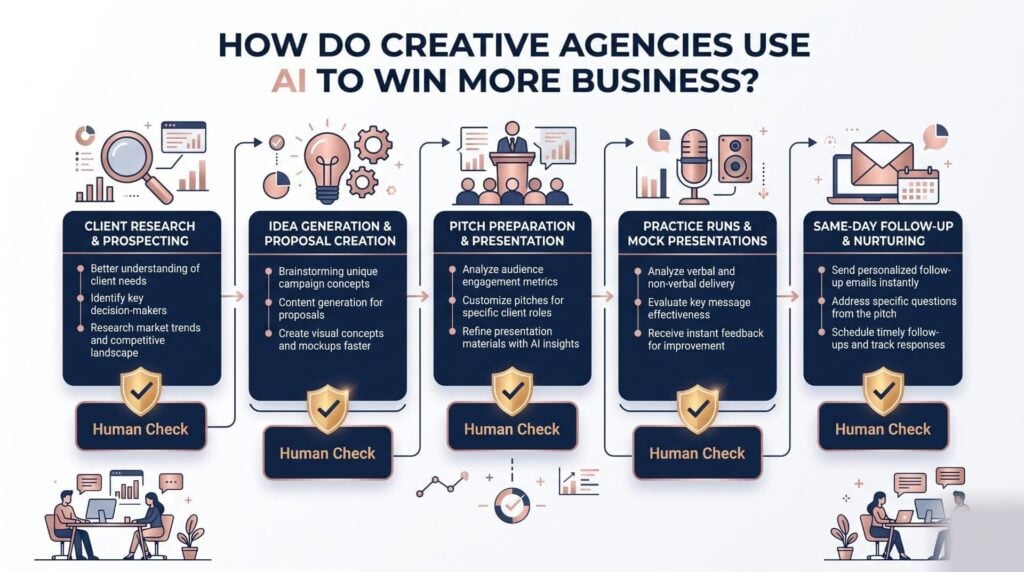
Order matters more than software. New business still runs on trust. SparkToro’s February 2026 survey of agency owners found that referrals from current and past clients are still the biggest source of new work, and only 14% call their pipeline healthy. AI will not fix a thin pipeline. What it does is make each pitch you get much harder to lose, which is a smaller claim and a truer one.
How do you prepare insight before a chemistry meeting?
Build a one-page file, then walk in with two questions nobody else will ask. Point an AI tool with web access at the client’s site, recent news, review pages and trade press, then ask it to weigh what they say about themselves against what buyers say back. The gap between those two is where the real brief hides. Keep it to a page. A chemistry meeting rewards one sharp point far more than a tour of all you found, and a long recital tells them you never worked out what mattered.
Check the file before you trust it. Models misdate news, mix up two firms with like names, and quote a press release as if it were a result, so any line you plan to say out loud needs a source you opened yourself. Ask the tool to list what it could not confirm; that list is often the most useful page you get. Then turn the file into questions, not statements. The fastest route to a second meeting is making the client think, not proving you read their annual report.
Can AI help you concept faster without going generic?
Yes, if you vary how you prompt it on purpose. The risk here is well known: single ideas get better while the whole set narrows, so five people on the same tool tend to land in much the same place. Research by Yun Wan and Yoram Kalman, revised in March 2026, built 300 story plots using ten different AI personas. Mixed inputs held the spread of ideas at or above a human-only baseline. Their point is the useful one for agencies: sameness comes from your habits of use, not from the tool itself.
So build the variety into your brief. Offer four angles, say a doubtful buyer, a rival planner, an outsider, and the client’s finance lead, then ask each for routes rather than finished work. Throw most of it away. The value sits in the spread, which shows your creatives where the obvious ground lies so they can walk straight past it. Human-first AI means the tool maps the field and the people pick the ground.
What do clients now ask about AI during a pitch?
They ask you to show your working. Buyers want to know where the machine stops and human judgment starts, what happens to their data if the deal ends, and what baseline sits behind any claim you make about saved time. Digiday reported in June 2026 that agency AI stories now meet much harder questions. It drew on a white paper that found no public, checked proof, as of early 2026, splitting what the AI did from what the people did. Get that answer ready rather than hoping it goes unasked.
The same paper made a sharper point about wording. 3C Ventures read how the big groups describe their AI platforms and found the wording so alike that you could not tell one from another once the branding came off. Read your own credentials deck with that test in hand. If your AI slide would work unchanged for four rival shops, it is doing nothing for you. Swap it for one workflow you really run, the check that sits on it, and the person who signs it off.
If you want a second view on what your team should hand over and what it must keep, AI Smart Ventures offers AI Advisory shaped around the new business process you already run.
How do you practice and follow up to win the pitch?
Practice against the hardest questions, then follow up fast with proof the client can check. Give a model your deck and the brief, and ask it to play the doubtful buying lead, the marketing head and the finance chair, one at a time. You will get the pushback your team has been dodging. Afterwards the same file gives you a same-day note that answers whatever you fumbled, which is the follow-up most agencies send three days late and half as sharp. Speed here is a courtesy, and it reads as one.
Keep your proof checkable. TrustRadius research published in July 2026, covering 1,862 buyers, found 63% used AI somewhere while buying and 94% of those checked what it tells them, while analyst reports were read by just 13%. Buyers cross-check now. Resist one habit above all: Digiday noted in May 2026 that teams have been pasting AI summaries straight into client decks. Pasted summaries read exactly like pasted summaries.
Frequently Asked Questions
Does using AI in pitches impress or put off clients?
Neither on its own; what counts is whether AI made the work sharper. Clients warm to it when the tool clearly bought you deeper insight into their sector, and cool on it when the output would fit any other agency. The line between the two is human editing. Keep a named person on the hook for every claim and number you show, and be ready to say in one line where the machine helped and where it did not.
How do you use AI to personalize a new business pitch?
Feed the model recent, specific material about the client, then ask for questions rather than copy. Good inputs include their published results, leader comments, buyer reviews and trade news. Ask what tension those sources point to, and build two slides around it. Tailoring fails when it drops a logo and a stat into a template. It works when the client hears something about their own business they had not yet put into words.
Which AI tools help agencies build better pitch decks?
The deck tool is the least important choice you will make. Layout helpers inside the software you already own will get slides looking tidy, and that saves real hours, but tidy has never won a pitch by itself. Spend your review time at the research and practice end instead, where the gains build up across every pitch. Pick what your team knows, and judge it on how fast a non-designer makes something on brand.
What does it cost to add AI to your pitch process?
Less than teams expect in software and more than they expect in time. The commitment tracks how many people must change how they prep, how messy your credentials material is, and how long sign-off takes. It drops sharply when you start with one stage, usually research, instead of rebuilding the lot. AI Smart Ventures helps agencies scope that first stage, so schedule a consultation to map it against your pitch calendar.
What should you say when a prospect asks about your AI?
Answer with specifics and a limit. Name one or two places AI really changes your work, describe the human check on each, and say plainly what you never hand over. Vague breadth invites follow-up questions you cannot answer well. Have a short written line ready, since buying teams now ask for one before the second round, and basic AI literacy across the team keeps that answer steady.
How long does it take to set up an AI pitch workflow?
Plan on one pitch cycle to build it and two more before you trust it. Week one is gathering your credentials, case studies and brand notes into one place a model can read. Week two is writing the prompts your team will reuse and agreeing what needs human sign-off. After that, gains come in small steps. Most agencies stall on the tidy-up, not the tools, because nobody wants to own it.
Can AI help you decide which pitches to decline?
Yes, and it is the most missed use in new business. Score each pitch against your last twenty: sector fit, how ready the buyer is, how many shops were asked, whether a holder is defending, and how the brief reads. A model can sum up a long brief against those tests in minutes. Treat what comes back as a prompt for debate, never a verdict. Turning down two weak pitches funds the prep that wins a good one.
What should AI never touch in a new business pitch?
Three things: the strategic leap, the client bond, and any claim about your own results. The leap is what they are buying, and a model gives the average answer by design. Bonds get built in the room, not in a file. Results claims carry legal risk and risk to your name, so those come from your own records with a named owner. All the rest, research, layout and practice, is fair game.
How do you measure whether AI improved your win rate?
Measure before you change a thing, then track three numbers across a full year: hours per pitch, how far you get in each process, and how many convert at each stage. Win rate alone moves too slowly to read on its own. Add a short note after each debrief about what the client warmed to. Twelve months of that beats any vendor case study when you decide what to keep.
Executive Summary
Winning new business with AI is a story about prep, not output. The agencies gaining ground use it to research clients properly, widen the spread of early ideas, practice against hard questions, and follow up the same day with proof a buyer can check. They keep it away from the strategic leap and the bond with the client. They also get a clear, honest answer ready for the moment a client asks what their AI really does, because that question is now standard, and a vague reply costs far more than a slow deck ever did.
What Should You Do Next?
Pick your next pitch and change one stage only. Build the client file before anyone touches a layout, check every claim you plan to say out loud, and run a practice round where a model plays your toughest questioner. Debrief after on what the prep really changed, and write it down before the next brief lands.
AI Smart Ventures offers AI Advisory for growing businesses building AI strategy, workflow optimization and capability building around client-facing work. Schedule a consultation to design a pitch process your clients will trust.
People Also Read
- How to Use Claude for Business Writing, Analysis, and Operations
- Microsoft Copilot: Do You Actually Need It?
About the Author
Nicole A. Donnelly is the Founder of AI Smart Ventures and an AI Adoption Specialist with 20 years of experience as a founder and CEO and over a decade leading AI adoption initiatives. She helps businesses integrate artificial intelligence with clarity and confidence, driving innovation and sustainable growth. Nicole has trained over 20,217 professionals in Applied AI, delivered 624 workshops, and worked with close to 1,000 organizations across diverse industries.
Expertise: AI Transformation, AI Strategy, AI Implementation, AI Adoption, Applied AI, Marketing, Business Operations
Disclaimer: This content is for informational purposes only and does not constitute professional business or technology advice. Results vary based on industry, existing systems and implementation commitment. Contact AI Smart Ventures for a consultation regarding your specific situation.