
How Do Ecommerce Business Owners Use AI to Grow Sales?
Last Updated: August 2026
AI for ecommerce business owners is the use of AI tools across the whole shop, not in one corner of it. That covers how buyers find your goods, how your product list reads to a machine, how repeat buyers get looked after, and how tickets get closed. The sales lift rarely comes from one clever tool. It shows up when you fix the spots where a shopper quietly gives up and leaves.
AI Smart Ventures has guided growing businesses through AI adoption in online retail, from a first product-data audit to a live workflow. Owners who clean up their product data before buying software get results; owners who do it the other way round just get a bill.
Get that order wrong and you pay in traffic you never see. A shopper who asks an AI chat what to buy never reaches your site if your listing cannot answer the question. No bounce, no visit, no trace in your reports.
Key Takeaways
- Fix your product data first. AI shopping tools read set fields, not sales copy, so gaps in size, stock and returns wording drop you out of answers you ought to win.
- Track AI channels on their own. Orders that start inside a chat behave nothing like search or email traffic, and you cannot improve what no one counts.
- Hand over the repeat questions, not the hard ones. Order status, shipping dates and returns rules make up most of the queue, so they are the safest place to start.
- Run one workflow for a full month before you add a second. A single test with a clear before-and-after number beats any broad tool review.
Those four points share one root cause. Nearly every AI gain in a shop rests on data the owner already holds and no one has tidied. Shops pulling ahead this year are the ones whose records are clean enough for a model to use.
How Are Ecommerce Companies Using AI Right Now?
Online shops use AI in four spots today: getting found, product copy, repeat sales and support. Getting found has moved fastest, since buyers now ask an AI chat what to get before they open a shop at all. Behind the scenes, stock planning does the most for operational efficiency. Most owners run two of these at once rather than trying all four in one go.
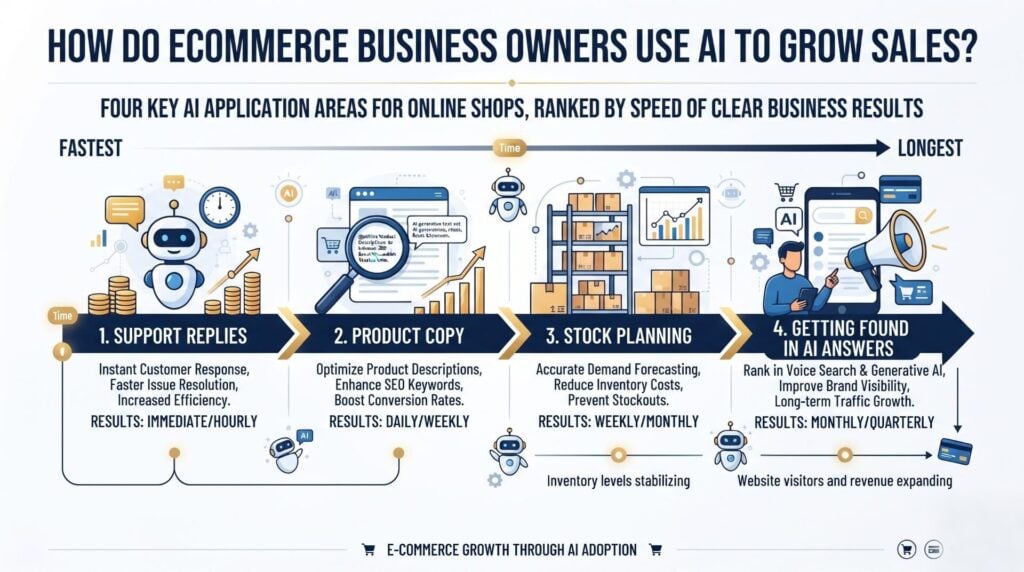
The stock side is least showy and most convincing. Stord’s State of AI in E-Commerce 2026 reports that models built to predict demand cut total stock levels by 20% to 30%, and that 88% of firms now use AI in at least one core task while only 7% run it at full scale. That gap is your opening.
How Does AI Change the Way Shoppers Find You?
More buyers now start in a chat window than in a search box, which means a machine reads your product page first. Two named standards shape that handoff, and both landed in the past year, so this is the newest part of the job for most owners. Your product list has to be clear to software before it can sell to a person.
- On 11 January 2026, Google launched the Universal Commerce Protocol at the National Retail Federation show. It is an open standard that lets AI tools, shops and payment firms work together without a custom link for each.
- Shopify built the standard with Google that same day, alongside Etsy, Wayfair, Target and Walmart, with more than twenty other firms backing it.
- On 10 December 2025, Shopify launched Agentic Storefronts, which pushes a seller’s goods out to ChatGPT, Perplexity and Copilot from one setup.
- In March 2026, OpenAI moved its checkout plans toward shop-run payment, after sellers raised worries about stock counts, tax and repeat billing.
Adobe data reported by Digital Commerce 360 in June 2026 found AI-referred visits to US retail sites up 138% in a year, closing 54% better than non-AI sources.
What Product Data Do AI Shopping Agents Need?
AI tools need set fields they can read: title, type, size, color, stock status, shipping time and returns terms. Filling every field helps, but being right matters far more, since one stale stock flag teaches the tool to stop naming you. Sales adjectives count for almost nothing here. If your size chart sits inside an image, a machine will skip it.
Most shops are not ready. Salesforce work covered by TechInformed in August 2026, drawn from 1.5 billion shoppers across 37 countries, found just 27% hold one joined-up view of the buyer. Adobe’s read is blunter: even the best-performing goods type had a third of its content unreadable to AI.
Can AI Run My Ecommerce Business Without Me?
No. AI can run, set, and repeat parts of your shop with little watching, but it cannot hold the brand judgment that decides what you sell, who you sell it to, or what you say when things go wrong. Treat it as staff you brief, not as a stand-in owner. Machines take the routine work that comes in volume, and you keep the costly calls.
In practice, AI updates stock counts, drafts listing copy, sorts tickets, flags reorder points and writes the first pass of a campaign. You own the pricing, the suppliers, the tone and the odd cases. Owners who skip that review step hear about the fault from a buyer, not from a report. Human-first AI just means keeping that check in the loop.
How Does AI Lift Repeat Orders and Retention?
AI lifts repeat orders by spotting buying patterns no one has time to read by hand, then firing the follow-up at the right hour. It groups buyers by what they did, not by the label someone gave them years ago. Timing does most of the work. A refill nudge two weeks early feels helpful, and the same note a month late feels like noise.
Past orders show when a refill runs out, so the nudge lands before the buyer shops elsewhere. Support history stops you pitching an item the buyer sent back last month, and that slip costs loyalty rather than one sale. None of this needs a data team, but all of it needs one clean buyer record, which is where most shops stall.
Can AI Handle Support and Returns for a Store?
Yes, for the repeat share of the queue. Order status, shipping dates, sizing and standard returns are set problems with checkable answers, so they hand over well. The hard tickets (broken goods, odd refunds and any angry buyer) still need a person on the case. The safe build gives the tool a narrow brief and an easy exit route to your team.
Two rules stop this from backfiring. First, wire the tool to live order data rather than a static help page, because a bold wrong answer about a shipping date does more harm than none. Second, make the handoff to a person quick and easy to see, then track close rate and repeat-contact rate side by side.
Where Should a Store Owner Start With AI?
Practical AI starts with the task your team repeats most, not the one that sounds most advanced. Count the hours it eats each week, pick one tool, run it for thirty days, then compare. That order guards against the common flop, which is buying a platform before anyone has agreed what a win looks like. Owners who finish one narrow project scope the next far faster.
| First project | What to track | When to review |
|---|---|---|
| Order-status replies | Tickets closed with no staff | 30 days |
| Product listing drafts | Edit time per listing | 30 days |
| Reorder planning | Stockouts and spare units | One season |
| AI channel tracking | Orders and sales by AI chat | 60 days |
In June 2026, Shopify shipped tools that let sellers see orders and sales coming from ChatGPT, Gemini and Copilot, plus a view of which buyer questions their data fails to answer. Modern Retail notes that 53% of US buyers have used AI tools to research a purchase, while AI chat still sends under 1% of web traffic.
Picking between four good projects is harder than running one. AI Smart Ventures offers AI Consulting for growing businesses that want a ranked plan rather than a tool list, drawn from training more than 20,000 professionals in Applied AI.
Frequently Asked Questions
Which AI is best for ecommerce business?
There is no single best tool, because the right pick depends on the job you are handing over. For product copy, the features built into your shop platform usually beat a separate app, since they already hold your data. For support, choose a tool that reads live order records. For stock planning, start with whatever already reads your real sales history.
How do I get my products to show up in AI chats?
Make your product data readable by machine, then push it out. Fill in the set fields for size, stock, shipping and returns, and switch on the AI channel settings in your shop platform. Shopify’s Agentic Storefronts, launched in December 2025, does this from one setup across ChatGPT, Perplexity and Copilot. Then check which buyer questions your listings fail to answer.
Can AI write product descriptions for my store?
Yes, and it is one of the fastest wins on offer. Give the tool your spec sheet, your brand voice rules and two samples you like, and it will draft a usable copy at volume. A person still edits, mostly to catch made-up features and keep the tone steady. Build one reusable prompt with your format rules so every draft lands the same way.
Do I need a developer to use AI in my ecommerce store?
Not for most of it. Built-in features and app-store add-ons cover product copy, ticket sorting, email triggers and channel tracking with no code at all. You need technical help for custom data links, odd stock systems, or joining two platforms never built to talk. Test what you already own first, because much of it turns out to be a setting.
How does AI help with abandoned carts?
It improves timing and fit rather than the words themselves. The model reads how deep a buyer browsed, what sat in the cart and what they bought before, then decides who gets a nudge and when. A shopper weighing two sizes needs a different follow-up from one who left at the shipping page. Watch the recovery rate for thirty days against your old flow.
Can AI predict what stock I should reorder?
Yes, and this is where the day-to-day return sits. Planning models read sales speed, season and supplier lead times, then set reorder points that shift as demand moves. Stord’s 2026 research found that models built to predict demand cut total stock levels by 20% to 30%. Give the tool one full season of clean sales history before you trust it.
Will AI replace my customer service team?
No, it shifts what that team does all day. Set queries such as order status and standard returns hand over well, so staff hours move toward tricky refunds, damaged parcels and the talks that decide whether a buyer comes back. Teams that plan for that shift keep their best people, while teams that do not tend to lose them to boredom. Build AI literacy in that team early.
How do I measure sales that come from AI chats?
Track them as their own channel rather than folding them into direct or referral traffic. Shopify’s June 2026 release gives sellers a dashboard for orders and sales arriving from ChatGPT, Gemini and Copilot. If your platform lacks that view, tag AI referrals in your reports and watch sales per visit. Adobe found AI-referred visits closing 54% better than non-AI traffic.
Is my customer data safe in these AI tools?
That depends on the contract and the settings, so read both before you sign. Check whether the vendor trains models on your data by default, and where the records are held. A Data Processing Agreement (DPA) is the contract that sets out how a vendor handles personal data on your behalf, and you want a signed DPA in place before any buyer records move.
How much does it cost to add AI to my ecommerce store?
Scope and order drive it far more than software does. One workflow built on features already inside your shop platform costs the least, and the real spend is staff hours cleaning product data and checking early output. Cost climbs sharply once you link systems that were never built to share records. Schedule a consultation to scope your first project before you commit.
Executive Summary
Ecommerce owners get the most from AI by treating it as four jobs, not one purchase. Getting found is changing fastest, driven by the Universal Commerce Protocol that Google and Shopify launched in January 2026, and by AI-referred traffic that now closes better than search. Product data quality decides whether you show up in those answers at all, and most shops are not ready. Pick one workflow, run it for thirty days, measure honestly, then widen. The limit is rarely the model. It is the state of your records.
What Should You Do Next?
This week, export your product list and check five items for the fields an AI tool really reads: size, live stock status, shipping time and returns terms. Then pick your highest-volume support question and count the hours it eats. Those two numbers give you a baseline and a first project.
AI Smart Ventures offers AI Consulting for growing businesses working out which shop workflow to hand over first. Schedule a consultation to turn your product-data audit into a ranked AI implementation plan.
People Also Read
- Microsoft Copilot for Sales vs Salesforce Einstein: Which AI Wins in 2026?
- Best AI Automation Stacks for Growing Businesses in 2026
About the Author
Nicole A. Donnelly is the Founder of AI Smart Ventures and an AI Adoption Specialist with 20 years of experience as a founder and CEO and over a decade leading AI adoption initiatives. She helps businesses integrate artificial intelligence with clarity and confidence, driving innovation and sustainable growth. Nicole has trained over 20,217 professionals in Applied AI, delivered 624 workshops, and worked with close to 1,000 organizations across diverse industries.
Expertise: AI Transformation, AI Strategy, AI Implementation, AI Adoption, Applied AI, Marketing, Business Operations
Disclaimer: This content is for informational purposes only and does not constitute professional business or technology advice. Results vary based on industry, existing systems and implementation commitment. Contact AI Smart Ventures for a consultation regarding your specific situation.