
How Do You Build an AI Culture in Your Workplace?
Last Updated: August 2026
An AI culture in the workplace is a shared set of habits where people at every level are expected to use AI in real work, say so openly, and check what it gives back. It is not a tool rollout. Culture shows up in the small things: whether a manager praises the person who automated a weekly report, whether staff admit they used AI on a draft, and whether anyone actually knows which tasks are allowed.
AI Smart Ventures has guided growing businesses through AI adoption long enough to see the same split over and over. The licenses get bought and the launch email goes out, yet six months later only two people on a team of thirty have changed how they work. The tools were never the problem. Nobody showed the other twenty-eight what good use looks like.
That gap grows fast. Your rival is not ahead because they bought a better model; they are ahead because their team asks AI first while yours still asks around. Every month the habit fails to form, you pay for software, lose the hours it should have saved, and watch your sharpest people drift somewhere the work feels modern.
Key Takeaways
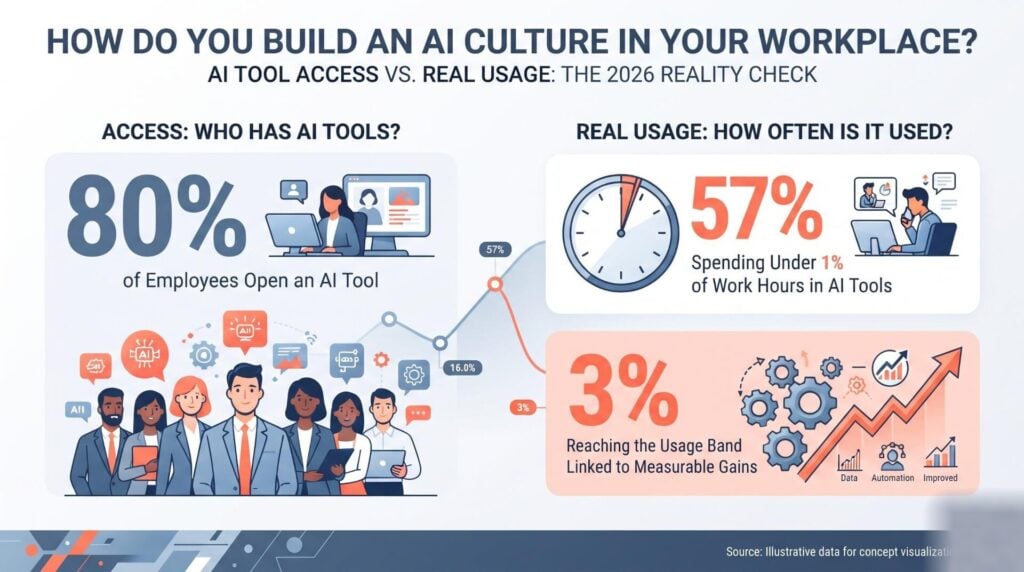
- Access is not adoption. ActivTrak’s 2026 report found 80% of employees now use an AI tool, but 57% of those users spend under 1% of their hours in one.
- Permission beats policy. Most people wait for a clear sign that AI use is welcome, and they wait far longer than leaders think.
- Leaders have to show their own attempts, including the bad ones. A memo about AI adoption changes nothing that a live demo would not change faster.
- Train on the job people actually do. A tool tour builds awareness; a session on one repeat task in your own workflow builds a habit.
- Say the quiet part out loud. Name the tasks AI may touch and the tasks it may not, then put both on one page anyone can find.
- Track habits, not logins. Repeat weekly use by the team tells you more about AI adoption than any seat count on an invoice.
Look at those six together and a pattern shows up. Almost every one is about what people believe they are allowed to do, not what they can open. That is why AI transformation stalls in companies with great software and no shared story about why any of it matters.
What is an AI-first workplace culture?
An AI-first workplace culture is one where using AI is the default first move on routine work, and saying so carries no risk at all. Three things make it real. People know which tasks they may hand to a tool and which they may not. They tell each other what worked, in public, including the attempts that flopped. And a person checks the output before it reaches a client, because human judgment stays in the loop. Take any one of those away and you have tool access with a mandate on top, which fades within weeks.
Human-first AI is the phrase that keeps this honest. The aim is not a team that types prompts all day. It is a team that spends the hours it saves on work only people can do.
Why do teams ignore AI tools they already have?
Because access arrived without permission, practice, or a reason to bother. ActivTrak’s Productivity Lab studied 443 million hours of work activity across 1,111 companies and 163,638 staff, and its findings, published in March 2026, are blunt. Adoption reached 80%, firms now run seven AI tools on average, and yet 57% of users spend less than 1% of their hours inside any of them. Only 3% reach the usage band where real gains show up. Buying more seats will not move that number, and neither will a louder launch email.
The same study found AI is speeding work up rather than taking it away. Time in meetings and chat rose 34%, weekend hours climbed more than 40%, and focus time fell to a three-year low. Culture decides what happens to the time AI frees.
How do you build a culture of AI adoption?
Start with one repeat task, not a strategy deck. Pick a job your team already grumbles about, give one small group four weeks and a named owner, then let them show the rest what changed. Write down the rules for what may be shared with a tool before anyone starts, because vague policy is what keeps careful people frozen. Ask everyone taking part to bring one failure to the review, so nobody learns that AI is only safe to discuss when it works. Then run the same loop again on a second task.
This is capability building, not a launch. Four weeks is enough to prove the point, and short enough that busy people will agree to try. Book the review date on day one, before anyone gets busy again.
What blocks a company from becoming AI-first?
Fear of looking foolish blocks it more often than any budget does. Henley Business School’s World of Work Institute surveyed 2,900 full-time UK workers for its June 2026 pulse check and found 63% sometimes avoid the AI tools available to them. Six in ten said their employer has no clear AI rules, or they were unsure whether any exist. Hope sat at 58%, while 61% still felt swamped by the pace of change. Henley calls that mix FOBO: hopeful and swamped at the same time. Both halves of it are worth naming out loud.
Two other blockers show up in growing businesses. Managers who never use the tools cannot coach anyone through them, so AI literacy stalls at the top. And a team that suspects AI is really a headcount plan will quietly opt out of every pilot.
How do you get employees excited about using AI?
Show them the thing they hate disappearing. Excitement does not come from a keynote about AI transformation; it comes from watching a Friday report build itself in four minutes. Pick the most tedious job in each function, solve that one first, and let the person who did it demo the result to their peers. Then protect what they saved. If two saved hours fill up with new tasks the same week, word spreads that AI is a speed-up scheme, and the next pilot gets a much colder welcome than the first one did.
Praise matters more than prizes here. Name the person, not the tool, when something works.
What should leaders do in the first 90 days?
Use the tools yourself, in front of people, every week. That single habit does more for AI adoption than any policy, and people notice fast when it is missing. SHRM’s 2026 workplace research, based on 5,875 US workers surveyed in March and April 2026, found 74% of directors recalled being told about AI plans before rollout, against just 33% of the staff below them. Trust splits the same way: 61% overall trust leaders on AI, dropping to 47% among the people doing the work. The message stops at the top, and that gap is yours to close.
So do three things this quarter. Open a team meeting with your own AI attempt. Publish the task rules. Fund training before more licenses.
If your people have the tools but not the habit, AI Training builds practice on your own workflows rather than a general tool tour. More than 20,000 professionals have been trained in Applied AI this way.
How do you measure a healthy AI culture?
Measure habits and outputs, never seat counts. Four signals tell you most of what you need to know. Repeat weekly use by the team shows whether the habit survived the pilot. Task cycle time on the specific job you targeted shows whether anything got faster. Ideas raised by staff show whether people feel safe suggesting changes. And openness, meaning whether people say out loud that they used AI, shows whether your permission message landed. Review all four each quarter, with the team in the room, and change one thing before the next review.
| Signal | What it tells you |
|---|---|
| Repeat weekly use | Whether the habit stuck |
| Task cycle time | Whether work got faster |
| Staff ideas raised | Whether people feel safe |
| Open disclosure | Whether permission is clear |
Frequently Asked Questions
How long does it take to build an AI culture?
Plan on 90 days for the first habit and roughly a year for the culture. Weeks one to four cover one task with one small group. Months two and three widen it to a second team while managers start demoing their own use. By month six you should see repeat weekly use without prompting. Firms that rush the first 90 days usually spend the next year paying for licenses nobody opens.
How much does it cost to build an AI culture?
Cost tracks three things: how many people you train, how much of that training is built on your own workflows, and how long the coaching runs after launch. It drops sharply when you start with one repeat task for one team instead of a broad tool tour. Time matters more than tooling here. AI Smart Ventures runs AI workshops on your real work, so schedule a consultation to scope the sequence.
What is the biggest mistake companies make with AI culture?
Treating AI adoption as an IT project instead of a people project. The software gets picked with care, the rollout gets an email, and nobody funds the practice that turns access into habit. With 57% of AI users spending under 1% of their hours in a tool, the buying decision clearly is not the bottleneck. Budget for AI upskilling and coaching at least as seriously as you budget for the licenses.
Who should own AI culture in a company?
The owner or CEO sets the tone, and a named internal lead runs the day-to-day. Splitting it that way matters because staff read leader behavior as permission, while someone still has to book sessions, answer questions and chase the pilot. Handing the whole job to an outside firm or a single manager tends to stall within a quarter. Keep the visible modeling at the top, and pass down the mechanics.
Do we need an AI policy before we start?
You need one page, not a legal document. List the tasks AI may touch, the data that must never be pasted into a public tool, and who to ask when something is unclear. Henley Business School found six in ten workers have no clear rules or do not know whether any exist, which is exactly what makes careful people freeze. A short page now beats a perfect policy in six months.
Should AI use be required or optional?
Make the practice required and the tool choice open. Mandates on their own produce box-ticking, where people open a tool once a week to satisfy a dashboard. What works better is asking each team to bring one AI test to its monthly meeting, then letting them pick the tool. That keeps ownership with the people doing the work while still making the habit a must, which is the balance most founder-led organizations need.
How do you handle employees who fear AI will take their job?
Answer the question straight rather than handing out vague comfort. Say which tasks you expect AI to absorb, what you want people to do with the recovered time, and what happens to roles that change shape. Vague comfort makes the fear worse. Then back the words with AI training, because a person being taught new skills reads that effort as a plan for keeping them, not for letting them go.
What is an AI champions program and does it work?
It is a small group of volunteers who test tools first and help peers after, and it works when the role has real time attached. One or two champions per team is plenty. Give them a few protected hours a month, a direct line to leadership, and public credit when something lands. Champions without protected time become a job title nobody wanted, and the program quietly dies by month three.
Executive Summary
An AI culture in the workplace is built on permission, practice and visible leader habits, not on software. The 2026 data makes the gap plain: 80% of employees now use an AI tool, yet most spend under 1% of their hours in one, and 63% sometimes avoid the tools they already have. Close that gap with one repeat task, one four-week pilot, one page of clear rules, and managers who show their own attempts weekly. Then measure repeat use and cycle time rather than seat counts, and review the numbers with your team every quarter.
What Should You Do Next?
This week, pick one repeat task per team and name the person who will try AI on it for the next four weeks. Ask three managers to show their own AI attempt at the next team meeting, the failures included. Then write your one-page list of what staff may and may not hand to a tool, and send it to everyone.
AI Smart Ventures offers AI Training for growing businesses building AI habits that outlast the launch email. Schedule a consultation to plan your first 90 days of AI enablement.
People Also Read
About the Author
Nicole A. Donnelly is the Founder of AI Smart Ventures and an AI Adoption Specialist with 20 years of experience as a founder and CEO and over a decade leading AI adoption initiatives. She helps businesses integrate artificial intelligence with clarity and confidence, driving innovation and sustainable growth. Nicole has trained over 20,217 professionals in Applied AI, delivered 624 workshops, and worked with close to 1,000 organizations across diverse industries.
Expertise: AI Transformation, AI Strategy, AI Implementation, AI Adoption, Applied AI, Marketing, Business Operations
Disclaimer: This content is for informational purposes only and does not constitute professional business or technology advice. Results vary based on industry, existing systems and implementation commitment. Contact AI Smart Ventures for a consultation regarding your specific situation.