
How Do You Keep Client Data Safe When Using AI?
Last Updated: September 2026
AI client data safety is the work of keeping the promises you made to clients once your team starts using AI tools. Those promises sit in signed paper: contracts, NDAs, statements of work, and privacy notices. They set what you may do with a client’s files, who else may see them, and what you have to tell the client. AI changes none of that wording. It only adds a fast new way to break it.
AI Smart Ventures has guided growing businesses through AI adoption in the work that clients pay for and watch closely. The same order of questions comes up each time, in every trade. Teams reach for a privacy setting first, when the real answer sits in a contract nobody has opened since the deal was signed.
Get that order backwards, and the harm is not really about tech. A tool can be safe and still put you in breach, because what you promised was tighter than what the tool does. Clients rarely learn this from a leak. They learn it when their own auditor asks who touches their data.
Key Takeaways
- Read the contract before the settings: check what your three biggest client deals say about secrecy and scope before you approve one tool.
- Treat the AI vendor as a subcontractor: the European Data Protection Board says EU data controllers should be able to name every firm that touches their data.
- Expect AI wording in new contracts: the US General Services Administration put a draft supplier clause on data inside large language models out for comment in June 2026.
- Get your written answer ready: Ncontracts found AI tied with cyber risk as the top third-party worry in its 2026 survey of banks and credit unions.
- Say it before you are asked: three plain lines in your statement of work beat a client finding out during a review.
- Name the rule that covers you: duties differ by country and by trade, so cite your own regime rather than one global standard.
Read together, those points move the work out of IT and back to the front of the business. The people who can answer them are the ones who signed the deals: the founder, the account leads, whoever wrote the last statement of work. A contract review needs an afternoon and a folder, not a budget. The rest is change management: your team needs to know which accounts are cleared for which client.
What Did You Already Promise Your Clients?
Often more than you recall. Most client contracts carry four promises that AI use touches: keep the work private, use it only for the job described, pass it to nobody else without a written yes, and give it back or delete it at the end. One paste into a public AI tool can break all four. Read those lines in your biggest accounts first, because they set your limit.
Lawyers at Debevoise and Plimpton, writing for NYU Law’s compliance blog in December 2025, argue that these contract limits, not the tech, now block serious AI work. Many were drafted in 2023 and 2024, when the fear was that a model would train on whatever it was shown. Those lines still bind you today, in the plain words that were signed. Your first hour of AI work is reading, not setup.
Does an AI Tool Count as a Subcontractor?
In contract terms, often yes. If a tool holds or handles a client’s files, most contracts treat the vendor behind it as a third party you brought in, and that needs the client’s sign-off. A data processing agreement (DPA), the contract that says how one firm handles personal data for another, names those parties in a list. An AI tool missing from that list is your gap.
Under the EU’s data protection law, the GDPR, this is spelled out. In Opinion 22/2024, adopted in October 2024, the European Data Protection Board said controllers should be able to name every processor and sub-processor at any time, and that the choice to bring one in stays with them. Where your client is the controller, and you are the processor, a quiet new AI vendor takes that choice away.
Which Contract Terms Does AI Use Touch?
Five, in most contracts: secrecy, scope of use, third parties, where data sits, and what security you promised. Each is one sentence you can find and read this week. The first two decide whether a file may go into a tool at all. The other three decide which tool, whose servers, and under what controls. Work through them in that order: a problem in the first two survives a change of vendor.
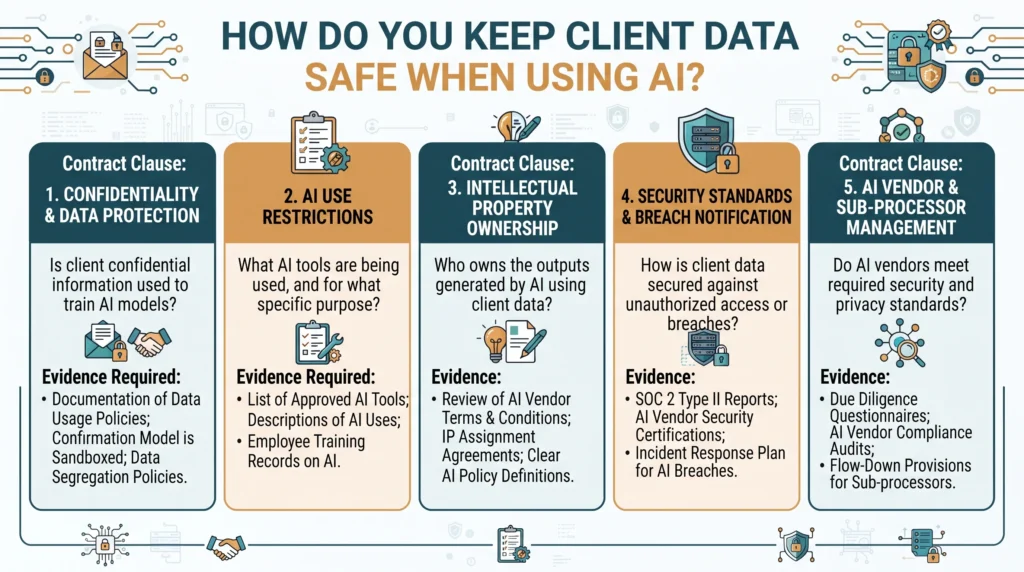
Clause names differ by market and by template, so read for meaning rather than for the heading. A clause called “use of information” can carry the same weight as one called “permitted purpose”. Some contracts fold AI into a wider tech clause without naming it once. Where the wording is old enough to predate all this, treat silence as a limit rather than a green light, and ask before you widen it.
| Clause | Question it answers | Evidence a client asks for |
|---|---|---|
| Confidentiality | May this file leave your systems? | Where it goes, who reads it |
| Permitted purpose | Is AI drafting inside the job you were hired for? | The scope line it sits under |
| Subcontracting | Is this vendor an approved third party? | Is its name on your list |
| Data location | Which country holds the data? | The hosting region |
| Security standards | Do the controls match your promise? | A current certificate |
Do You Have to Tell Clients You Use AI?
Sometimes you must, and it is often wise even when you need not. Your contract sets the floor. Trade body rules can sit above it: for lawyers in the United States, ABA Formal Opinion 512, issued in July 2024, says a client must give informed consent before their matter goes into a self-learning AI tool. Other markets and trades set their own bar, so read yours before assuming silence is safe.
Telling clients works better as a standing line than as a late confession. Add three lines to your statement of work: which parts of the job use AI, which accounts it runs in, and who checks the output first. Framed that way, it reads as capability building. The same facts given in month seven, because a client asked, read as something you hid. AI Smart Ventures observes that the second talk is far harder.
What If a Client’s Terms Rule Out AI Use?
Then you do not use it on that account until the terms change. Four honest routes exist: keep that client’s work manual, ask for a written change, move the job to a tool that fits, or turn down the AI part of the work. Using it quietly anyway is the one option that turns a contract question into a breach. It is also the easiest one to drift into.
Asking is less awkward than most owners expect. A client who wrote an AI limit into the deal has thought about the subject, and many will grant a narrow yes for named uses. Bring the detail rather than the principle. A request that answers the obvious follow-ups gets a decision in days. A vague ask to allow AI gets a no, because nobody can tell what they would be signing off. Send four things:
- Name the tool and the account: which product, which paid tier, and who on your team holds a seat.
- Answer the training question: state in writing whether the vendor trains on your inputs.
- Say where the data sits: give the hosting region and how long prompts and files are kept.
- Name the reviewer: say who checks AI output before any of it reaches the client.
Reading five clauses is a two-hour job that shapes the next twelve months of AI use. AI Advisory helps founder-led organizations turn those clauses into practical AI rules, drawing on Applied AI work with 20,000+ professionals trained.
How Do You Answer a Client’s AI Questions?
With a short written answer you wrote before anyone asked. Clients now raise it in forms, renewals, and security checks. Ncontracts’ 2026 third-party risk survey of banks and credit unions, out in June 2026, found AI tied with cyber risk as the top third-party worry for the first time. Some 72% of those firms were only partly aware of which of their vendors use AI.
Keep the answer to one page and refresh it twice a year. Name the tools used on client work, the account tier, whether the vendor trains on your inputs, the data you never put in, the review step, and who to call when something goes wrong. Hand the same page to every client. Generic AI consultants tend to answer each request from scratch, which is slower and looks made up when two clients compare notes.
Frequently Asked Questions
How do you keep client data safe when using AI?
Start with the contract, then the tool. Read what your biggest client deals say about secrecy, scope, and third parties. Then approve accounts that match those promises, name the data that never goes into a prompt, and record who checks AI output before a client sees it. Controls matter, but they cannot make a use lawful that your own contract rules out.
How do you use AI with confidential client data?
Only where the contract allows it, and only in a paid business or team account whose terms say your inputs are not used for training. Check three things first: what the client deal allows, whether the vendor counts as an approved third party, and where the data is held. If any answer is unclear, strip the names and numbers, or ask the client in writing first.
Does AI keep your data private?
Not by default, and privacy rides on the account rather than the brand. Free and personal tiers often use what you type to improve the service, while paid business tiers switch that off by contract. Read the terms for the exact plan your staff signed into, not the sales page. Keep that answer in writing, because the next client who asks will want the detail.
Should you name your AI tools in client contracts?
Naming them usually beats staying vague. A named list gives the client something to approve and gives your team a clear line. Add a short change process, so a new tool needs written notice rather than a new contract. Where a client wants to approve each one, agree on a reply time up front. Vague wording is easier to sign and much harder to rely on later.
Do you need a client’s permission before using AI on their work?
Often yes, and it comes from your own contract rather than any general AI rule. Secrecy and scope clauses may already ask for written consent before data reaches a third party, and an AI vendor is one. Trade bodies can add a duty on top. Where the wording is old or silent, ask. A written yes costs one email and closes the question for good.
Does an NDA cover putting client files into an AI tool?
Most NDAs signed before 2025 say nothing about it, and silence is not a yes. They bar sharing with third parties and limit use to a stated job, and a public AI tool can break both. Newer ones name AI directly, either barring it or allowing listed tools. Check the date and wording of each one, then treat anything unclear as a no.
Are AI clauses becoming standard in supplier contracts?
They are heading that way, and public buyers are setting the pattern. In June 2026, the US General Services Administration put out a draft supplier clause for comment on guarding data inside large language model systems. It is a proposal, not a rule in force, and Crowell and Moring note its duties would run down the whole supply chain. Private clients tend to copy federal wording.
What does it take to get client contracts ready for AI?
Time rather than money. Most growing businesses need one session to gather the contracts, an afternoon to read the five clauses that matter, and a short page recording what each client allows. Add two weeks for any change letters you send. None of it needs a legal team on staff, though a lawyer should check what you alter. Schedule a consultation to work through your client terms.
Executive Summary
Client data safety is a contract question before it is a technical one. Your contracts already say what may leave your systems, who may see it, and what you must tell the client, and AI use is judged against that wording. Read five clauses in your biggest accounts: secrecy, scope, third parties, where data sits, and security. Treat every AI vendor as a third party your client may name. Say what you use in the statement of work, not in an apology later, and keep a one-page answer ready.
What Should You Do Next?
Pull your three biggest client contracts this week and mark the secrecy, scope, and third-party clauses. Write one line per client saying what AI use those clauses allow today. Where a clause blocks something your team already does, stop that use and send a short change request before the next job goes out.
AI Smart Ventures offers AI Advisory for growing businesses whose AI adoption touches client work under contract. Schedule a consultation to review your client terms and leave with a written answer you can send.
People Also Read
- The Real Cost of Figuring Out AI on Your Own vs Getting Expert Help
- What Does an AI Marketing Audit Actually Uncover? A Guide for Business Owners
About the Author
Nicole A. Donnelly is the Founder of AI Smart Ventures and an AI Adoption Specialist with 20 years of experience as a founder and CEO and over a decade leading AI adoption initiatives. She helps businesses integrate artificial intelligence with clarity and confidence, driving innovation and sustainable growth. Nicole has trained over 20,217 professionals in Applied AI, delivered 624 workshops, and worked with close to 1,000 organizations across diverse industries.
Expertise: AI Transformation, AI Strategy, AI Implementation, AI Adoption, Applied AI, Marketing, Business Operations
Disclaimer: This content is for informational purposes only and does not constitute professional business or technology advice. Results vary based on industry, existing systems, and implementation commitment. Contact AI Smart Ventures for a consultation regarding your specific situation.