How Do You Use AI for RFP Writing Without Sounding Generic?
Last Updated: August 2026
AI for RFP writing is the use of language models to read a request for proposal, pull matching answers from your approved content, and write a first draft your team edits. These tools handle the parts that repeat: rule checklists, standard security answers, firm background. They do not handle judgement. What lifts a bid above a forgettable one is the proof a person adds afterwards.
AI Smart Ventures has guided growing businesses through AI adoption inside bid teams and client delivery. One pattern repeats: firms that win more after bringing in AI are rarely the fastest drafters, because they decide early which parts of a bid a machine may never write.
That call has real money behind it. More teams draft with AI each year, yet win rates have slipped, so raw speed is not closing deals. Answers that read like everyone else’s teach buyers to skim.
Key Takeaways
- AI writes from the average of all it has read, so the default draft sounds like your rivals.
- Ground each draft in a checked bank of your own answers, dated case studies and named results.
- Teams with the best win rates spend more hours per bid, so put the hours AI returns into fitting each answer.
- Write a voice file once: your word list, banned phrases, and the way you state results.
- Name one person who owns each section and log who signed it off, because buyers have started to ask.
There is an awkward point in that list: AI is strongest at the sections buyers care least about, and weakest at the ones that decide the award.
Why does AI make RFP answers sound generic?
AI makes RFP answers sound flat because a language model picks the words most likely to come next, and those are the words everyone else has already used. Ask for a note on your quality process and you get the average quality note. A Cornell study found the same drift in normal writing, where people who took AI suggestions swapped sharp cultural detail for vague warmth. Bids lose their edge in the same quiet way.
In that test of 118 writers, a line about Diwali became “a time filled with happiness and warmth”. Bid answers drift the same way.
How do you use AI to write a winning RFP response?
You write a winning RFP response with AI by fixing the order of work: read the request first, pull your own approved answers second, draft third, then have named experts rewrite each claim that carries proof. Most teams run it backwards, drafting from a blank prompt and pasting evidence in later, which gives you a smooth document with almost nothing a buyer can check. Order is the whole trick here.
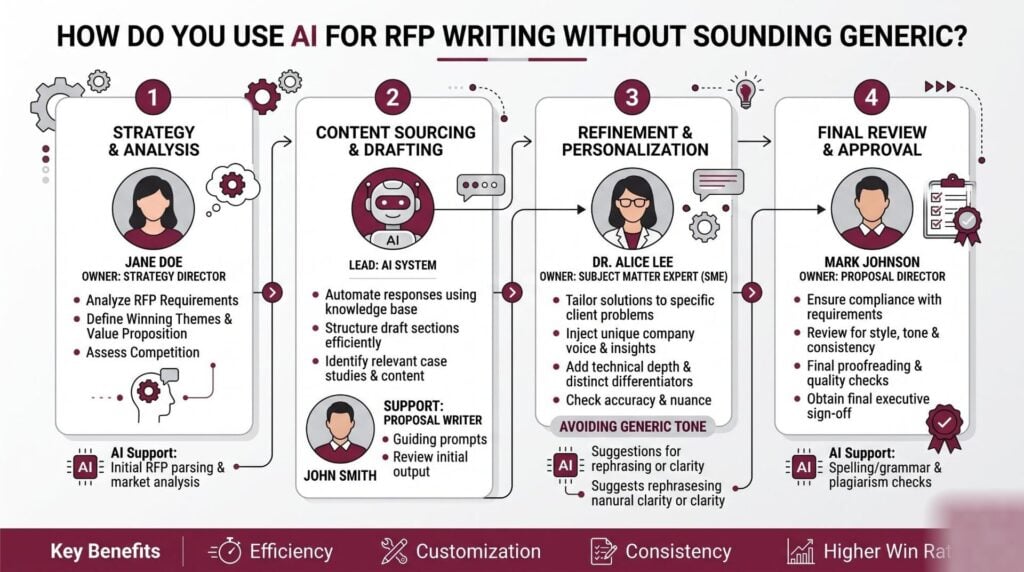
- Read. Have AI pull every requirement, date and scoring rule into one grid.
- Pull. Draw answers from your own bank, because that step keeps a draft true.
- Draft. Build the first version section by section, using the buyer’s own wording.
- Rewrite. A named expert swaps soft claims for dated proof.
Loopio’s 2026 RFP benchmarks, run with the APMP across 1,500 firms, report that almost 80% of teams now use AI in bidding, up from 68% a year before, while win rates slipped to near 39%.
What belongs in a content library AI can trust?
A content library worth trusting holds your approved answers, dated case studies, your security answers and the numbers you would defend in a room. Size matters far less than care. Fifty checked answers beat five hundred stale ones, because search pulls what sits nearest the question, not what happens to be right. Give each entry an owner and a review date, then retire whatever no one will stand behind now.
Responsive’s 2026 State of SRM report, out in July 2026, found that all its top-tier teams let staff find firm knowledge alone, against 1% of the least mature group.
Slow expert sign-off is still the top gripe, named by 88% of the 300 bid leaders in QorusDocs’ 2026 benchmark survey. A good bank captures that answer once, so you stop chasing.
Which AI tools are best for proposals and RFPs?
The best AI tool for bids depends on how many you run and how tidy your content already is. Teams with a few bids a month do fine with a general assistant plus a clean document store, while teams bidding weekly need a purpose-built platform with a shared bank and review routing. In April 2026 Loopio shipped a Microsoft 365 Copilot agent, the first from a bid software firm, so approved answers now reach you inside Word and Outlook.
| Approach | Fits | Risk |
|---|---|---|
| General AI assistant | A few bids a month | Nothing sticks; answers start over |
| Purpose-built bid platform | Weekly bids, several writers | Stale content; no tool prunes it |
| AI advisory support | Scattered content, no system yet | Skipping it, then blaming software |
Vendors keep pushing this work into software people already have open, which removes a real friction point and also the pause where someone checked. Tool choice still matters far less than the state of your content, which is the awkward part.
How do you customize AI drafts so they sound like you?
You customize AI drafts by handing the model a written note on how your firm really talks, then editing in the detail it cannot know. Build a voice file: five lines you are proud of, your standard word list, the words you never use, and the way you state results. Paste it into custom instructions so each draft inherits it. Then run a detail pass, because a voice with no proof still reads flat.
Four edits do most of the work.
Swap each adjective for a fact, so “deep experience” becomes “nine builds in this field since 2023”. Name things: the client, the system, the rule, the month. Cut any line that would be just as true for a rival. Then answer the question in the buyer’s own words, in your first line.
That last edit sounds obvious, yet buyers score against a grid, and a lovely paragraph reaching the point in line four still drops the mark.
If you are unsure which parts of a bid to hand over, AI Smart Ventures offers AI Advisory shaped around the workflow you run. Ask about an AI readiness check first.
Does AI-written RFP content get flagged by buyers?
Yes, often, and rarely by software. Buyers catch AI drafting the way close readers always have, through repeated sentence shapes, bold claims with no dates, and answers that would fit almost any bidder in the field. In one 2025 detection study, five people who use language models daily, voting as a group, misread just one article out of 300 and beat most paid detectors. Your buyer’s bid lead reads like that.
Disclosure is now a live question too. Some tenders carry AI disclosure wording and set out what human review they expect, as GovEagle noted in May 2026. The safe stance is dull: draft from approved content, keep an edit log, and name whoever signed off each section. That is what human-first AI looks like.
How do you know AI is actually helping you win?
You know AI is helping when your win rate holds or climbs while hours per bid fall, not when your bid count rises. Track three numbers: win rate, hours per bid, and how much of each draft survives expert review untouched. That third one is the honest read on your content, because if experts rewrite most of a draft, the fault sits in your bank rather than in the model.
One finding is worth sitting with. In the Loopio data, teams winning more than half their bids spend about 35 hours on each, against a 33-hour average, so they are not moving faster; they pour the hours AI gave back into fitting the answer.
Responsive also found that about a quarter of teams cannot say whether their AI tools pay off, so agree your measures before rollout.
Frequently Asked Questions
How much does AI RFP software cost?
Cost tracks two things: how many people need access, and how much content must be sorted before a tool earns its keep. Software is rarely the bigger commitment. Plan for weeks of sorting, plus review time from experts who are stretched. AI Smart Ventures helps teams scope that first stage, so schedule a consultation to map it against your bid calendar.
How long does it take to set up an AI RFP workflow?
Plan on four to eight weeks before the first assisted bid goes out. Week one covers picking a single bid type and naming an owner. Weeks two and three go on sorting perhaps 40 to 60 answers, the real work. The rest covers review routing, sign-off and a pilot bid. Teams that move the whole archive first stall by month three.
Which parts of a bid should AI never write?
Never let AI write your pricing story, your points of difference, your risk plans or any named client result. Those four carry the claims a buyer will test, and one invented detail ends the bid. Use AI for rule grids, standard capability text and first-pass summaries. If a wrong line would embarrass you in a debrief, a person writes it.
What are the security risks of using AI for RFPs?
The main risk is client material or unreleased technical detail landing inside a public model. Use a business account with training switched off, and check that setting yourself rather than trusting defaults. Set a written rule that no free tool touches a live bid, and strip third-party names before upload. Log which files went where, because your next security form will ask.
Should you tell a buyer that AI helped write your bid?
Answer plainly if the tender asks, and more of them now do. A clear line works well: drafted from approved company content with AI help, then checked and signed off by named staff before we sent it. That reads as a mature process, not a confession. Offering it unasked rarely helps. What counts is an edit log that backs whatever you claim.
Can AI help you find new RFPs to bid on?
Yes, and this is often the fastest payback on offer. Watch tools scan public portals and trade feeds, then rank each listing against your skills and wins. Set the filter narrow at first, because a daily digest of thirty stray listings gets ignored inside a fortnight. Revisit the ranking rules monthly. The gain is seeing the right bid early enough to prepare.
How do you stop AI from inventing experience you lack?
Limit the model to your approved bank and tell it to write “source needed” rather than fill a gap. Most invented claims turn up where your bank is thin, so treat each flag as a content request. Then check every number, date and name against the source file. AI literacy training helps, because writers who grasp how models guess catch those guesses faster.
Who should review AI-drafted bid sections?
Two reviewers, working in order. An expert checks technical accuracy and adds the detail only they hold; the bid owner then checks the rules, the tone and whether the answer matches the question asked. Splitting these roles matters, because one person doing both tends to skip the second pass. Treat the handover as change management, and name both people in your log.
Does AI change how many bids you should submit?
Usually less than teams expect, and that is fine. Faster drafting tempts firms to chase every listing, which drags win rates down and burns out reviewers. A better use of the hours you win back is tighter screening: bid on fewer jobs, prepare each one harder, and walk away sooner from a poor fit. Win a bigger share of what you enter.
Can a two-person team keep up with larger bid teams?
Often yes, because the limit is content quality rather than headcount. A pair with 60 well-sorted answers and a firm review habit will beat a large team working from a messy shared drive. Skill building beats hiring at this stage. Focus on one strong bank, one voice file and one checker, then add tooling later. Sheer volume is the only real ceiling.
What is the first thing to fix if AI drafts read flat?
Fix the input before you touch the prompt. Flat drafts nearly always mean the model had nothing sharp to work from, so check whether your bank holds dated results, named clients and real numbers. Add three genuine case studies and run the same prompt again. If drafts still read bland, your voice file is missing, and writing one takes an afternoon.
Executive Summary
AI for RFP writing works when it handles search, rule checks and first drafts while people supply the proof. Use has climbed to nearly 80% of bid teams, yet win rates have not followed, because flat answers lose to sharp ones. The fix is dull: a checked answer bank, a written voice file, a detail pass on each draft, and a named person behind anything a buyer might test. Practical AI in bidding is a workflow choice rather than a software purchase.
What Should You Do Next?
Pick one bid type this week and pull your last three winning answers into a folder. Add a date and an owner to each, write your voice file in one sitting, then run your next draft through the four-edit detail pass.
AI Smart Ventures offers AI Advisory for growing businesses building AI strategy and AI implementation around bid work. Schedule a consultation to design a review process your buyers can trust.
People Also Read
- Best AI Tools for Professional Services Firms
- How AI Is Changing Workplace Training and Employee Development
About the Author
Nicole A. Donnelly is the Founder of AI Smart Ventures and an AI Adoption Specialist with 20 years of experience as a founder and CEO and over a decade leading AI adoption initiatives. She helps businesses integrate artificial intelligence with clarity and confidence, driving innovation and sustainable growth. Nicole has trained over 20,217 professionals in Applied AI, delivered 624 workshops, and worked with close to 1,000 organizations across diverse industries.
Expertise: AI Transformation, AI Strategy, AI Implementation, AI Adoption, Applied AI, Marketing, Business Operations
Disclaimer: This content is for informational purposes only and does not constitute professional business or technology advice. Results vary based on industry, existing systems and implementation commitment. Contact AI Smart Ventures for a consultation regarding your specific situation.