How Marketing Agencies Get Real Results with AI: Use Cases, Metrics, and Client Story
Wondering how to actually put AI to work in your marketing agency? You are not alone. At AI Smart Ventures, we help agencies move beyond the hype, showing exactly how AI can save time, spark creativity, and make client reporting a breeze. On this page, you will find real world examples, before and after results, and clear next steps to get started, no technical background required.
Let’s define what “using AI” means for agencies today
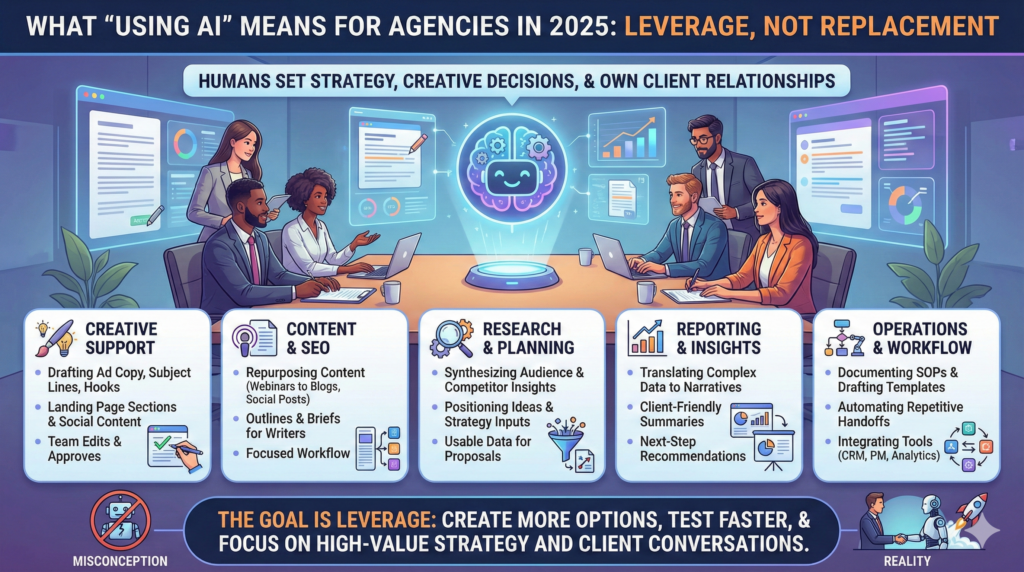
When agency leaders talk about “using AI,” they are rarely talking about replacing strategists, copywriters, or media buyers. In 2026, effective AI adoption in marketing agencies looks more like adding a highly skilled assistant who works at lightning speed and never gets tired. Your team still sets strategy, makes creative decisions, and owns client relationships. AI supports the work by generating options, summarizing data, and keeping workflows moving.
For most agencies, AI shows up in five core areas:
- Creative support
Drafting ad copy, subject lines, landing page sections, hooks, and social content that your team then edits and approves. - Content and SEO
Turning a single webinar or podcast into blogs, emails, social posts, and short video scripts, plus helping with outlines and briefs that keep writers focused. - Research and planning
Synthesizing audience insights, competitor messaging, and positioning ideas into usable input for strategy decks and proposals. - Reporting and insights
Translating complex performance data into clear narratives, client friendly summaries, and next step recommendations. - Operations and workflow
Documenting SOPs, drafting internal templates, and automating repetitive handoffs between tools like CRMs, project management platforms, and analytics.
The biggest misconception is that “AI will replace my team.” In practice, agencies that see the best results treat AI as leverage, not a shortcut. They use it to create more and better options, test ideas faster, and spend more time on high value strategy and client conversations.
Here’s how agency are putting AI to work (with real example)
Below is example client story that show how AI Smart Ventures helps agencies move from experimentation to measurable results.
How HDMZ is reclaiming time and margins with a smarter AI roadmap
HDMZ, a historic life sciences marketing agency, faced a challenge familiar to many established firms: shrinking margins and operational silos that slowed down delivery. By partnering with AI Smart Ventures, they moved from ad-hoc AI experimentation to a structured, enterprise-wide strategy. The collaboration resulted in a clear 12-month roadmap designed to automate administrative heavy lifting like SOW creation and RFP responses allowing their team to get back to high-value creative strategy.
The Problem
Let’s be honest: agency life often involves a lot of “work about work.” Before bringing in AI Smart Ventures, HDMZ was feeling the weight of administrative drag.
In their strategic audit, leadership was transparent: margins had been under pressure for nearly two years, and revenue was less predictable than it had been in the previous decade. While the team was talented, their systems HubSpot, Accelo, Google Drive, and Slack were siloed. They weren’t talking to each other, which meant data had to be moved manually.
The team identified several specific bottlenecks that were eating up valuable brainpower:
- The SOW slog: Creating Statements of Work was a manual, time-consuming process without a consistent template library.
- RFP fatigue: Responding to Requests for Proposals involved repetitive copy-pasting rather than strategic customization.
- Meeting overhead: Countless hours were spent compiling contact reports, agendas, and next steps.
- Siloed data: There was a lack of Standard Operating Procedures (SOPs) across departments, making it hard to scale efficiency.
They needed a way to automate the boring stuff so they could focus on what they actually sell: evidence, insights, and imagination.
The Solution
AI Smart Ventures didn’t just hand HDMZ a login to ChatGPT and wish them luck. We dug into the nitty-gritty of their operations to build a bespoke 12-month transformation roadmap.
The strategy focused on “Force Multiplication” using AI not to replace staff, but to make every employee more effective. Here is how we broke it down:
Phase 1: Foundation & Readiness (The Clean Up)
You can’t build a skyscraper on a swamp. We started by auditing their existing workflows and data infrastructure. This meant centralizing client project folders in Google Drive, defining clear naming conventions, and establishing an external AI Use Policy to ensure client confidentiality (a huge deal in the regulated healthcare space). We also identified the need for n8n workflows to finally get Accelo and QuickBooks talking to each other.
Phase 2: The “Pilots” (Getting Hands-on)
We moved into implementation with specific, high-impact pilots designed to get quick wins:
- Automating SOWs: We set up a library of pre-written templates and used tools like Jasper to allow for fast, accurate customization.
- Meeting Notes: We introduced Read AI to automate summaries and integrated the outputs directly into Confluence for team transparency.
- Creative Concepting: The “Studio 55” creative team started using Adobe Firefly and Midjourney to generate unique concepts for campaigns, drastically cutting down the time spent on initial storyboarding and motion graphics.
Phase 3: Education (Building Confidence)
Tools are useless if people are scared to use them. We rolled out a “Train the Trainer” model, partnering with department heads in Creative and Client Services. This included monthly workshops on specific workflows and enrollment in our “AI Your Agency” program to ensure the team felt empowered, not threatened, by the new tech.
Result
The transformation at HDMZ wasn’t subtle, it was a complete shift in operational momentum. By moving from a reactive stance to a proactive AI strategy, the agency saw immediate improvements in both quality of life and the bottom line.
For HDMZ, integrating AI wasn’t just about speed; it was about quality of life and quality of work. By automating the repetitive tasks that drag down agency margins like SOW creation and data entry they are positioning themselves to serve the next generation of life science innovators.
They are moving toward a future where their data isn’t siloed, their “busy work” is handled by agents, and their brilliant human team is free to create.
Stop drowning in admin work
Book a strategy call and we will map your biggest delivery bottlenecks, identify the fastest AI automation wins (SOWs, RFPs, meeting notes, reporting), and outline a practical 12 month roadmap your team can actually execute.
What results can you expect in your first 90 days?
Agencies want concrete answers, not vague promises. Here is a concise view of what most teams can realistically expect in the first 90 days when they roll out AI with a focused plan and clear workflows.
In your first 90 days with AI, most marketing agencies can expect:
- 25 to 60 percent reduction in time spent on repetitive writing and reporting tasks
- 2 to 4 times more creative or content variants launched per campaign or per asset
- Faster lead response times, often dropping from hours to minutes
- Clearer, more consistent client reports that support retention and upsells
From there, results compound as your team builds skills and refines patterns that work.

A sample 30-60-90 day rollout
Days 1 to 30: Foundation and quick wins
- Identify 2 or 3 high friction workflows, such as ad copy drafts, content repurposing, or monthly reports.
- Choose a single AI assistant tool as your core environment, then plug in any needed integrations later.
- Build a small library of prompt templates tailored to your most common services, industries, and offers.
- Pilot with 1 or 2 existing clients without changing your promises or SLAs yet.
During this phase, the main KPI is time saved per task and internal feedback from your team on usability and quality.
Days 31 to 60: Standardization and scale
- Turn early experiments into documented workflows and SOPs.
- Train your full team on how to use prompts, how to add context, and how to review outputs.
- Expand usage into related tasks, such as creating briefs, summarizing research, or drafting internal documentation.
- Begin tracking output volume (for example number of ad variants per campaign, number of content assets per month) and basic performance trends.
The goal in this phase is to move from “AI curiosity” to “AI is part of how we work.”
Days 61 to 90: Performance and positioning
- Compare performance before and after AI adoption on a few key accounts. Look at metrics like CTR, cost per lead, time to launch, and report completion time.
- Identify where AI is adding the most value and where you still need better prompts or workflows.
- Start folding AI into your positioning and sales narrative, such as “AI assisted testing” or “AI accelerated content.”
- Decide whether to keep AI as an internal efficiency boost, or to offer AI enhanced tiers with expanded deliverables and more frequent testing.
By the end of 90 days, agencies typically have:
- A handful of proven AI workflows that the team trusts
- Documented prompts and SOPs that can onboard new hires faster
- A clearer story for clients about how AI increases value, not risk
Here’s what you need to know about getting started safely and effectively
Getting results with AI is not only about speed and creativity. It is also about protecting client data, respecting regulations, and maintaining quality standards that build trust.
1. Protect client data by default
Before you paste anything into an AI tool, decide what should never leave your secure systems. As a rule, avoid sharing:
- Personally identifiable information (names, emails, addresses, phone numbers)
- Sensitive financial or health data
- Confidential strategic documents that have not been anonymized
Use redacted examples or synthetic data when possible. For recurring workflows, AI Smart Ventures helps clients design prompt templates that automatically strip or mask risky fields before any data is processed.

2. Align with your clients’ compliance requirements
Different industries carry different expectations. Agencies working with financial services, healthcare, legal, or publicly traded companies need to be especially careful. That can include:
- Reviewing platform terms and data retention policies
- Adding language about AI usage into client agreements
- Defining which tasks can use AI support and which are strictly human only
We encourage agencies to treat AI governance as a competitive advantage. Being able to clearly explain how you use AI, how you protect data, and where humans stay in control can differentiate you in a crowded market.

3. Keep humans firmly in the loop
AI can accelerate drafts and analysis, but it should not be the final decision maker. High performing agencies follow three simple rules:
- AI drafts, humans edit
- AI analyzes, humans interpret
- AI suggests, humans decide
That means every client facing deliverable gets a human review for brand voice, factual accuracy, and compliance. Over time, your prompts can be tuned to reduce edits, but human oversight remains the safety net.
Common pitfalls include over trusting AI generated numbers, letting generic copy slip through without voice alignment, and using AI outputs without verifying source data. AI Smart Ventures helps agencies set review checkpoints so speed never comes at the cost of quality.

How can AI Smart Ventures help your agency succeed?
AI Smart Ventures specializes in helping marketing agencies turn AI from a buzzword into a reliable engine for creativity, efficiency, and growth. We combine strategic consulting, hands on workflow design, and team training so your agency gets real results rather than scattered experiments.
Here is what that looks like in practice:
- Custom AI workflow design and prompt engineering
We map your current processes, identify the highest leverage use cases, then design AI assisted workflows tailored to your services, tool stack, and clients. That includes prompt templates, data flows, and governance guidelines your whole team can follow. - Team training and ongoing support
We train your writers, strategists, analysts, and account managers on how to use AI effectively, review outputs, and continuously improve prompts. You get playbooks, examples, and office hours that turn AI into a shared capability instead of a siloed experiment.
You can also pair strategy and training with implementation, such as integrating AI into your CRM, project management system, or reporting stack. The result is an AI workflow that feels like a natural part of your agency, not another tool your team has to remember to use.
Download the AI for Agencies Starter Guide for practical prompts and rollout plans.
Ready to see what AI could do for your agency?
Book a free AI workflow assessment and we will identify your highest leverage use cases, recommend the right tools and guardrails, and outline the next steps to turn AI into repeatable workflows your whole team can use. Prefer to start solo?
Optional FAQ section for search visibility