
How Professional Services Firms Use AI to Win Large Clients
Last Updated: July 2026
AI for selling professional services into large accounts is a system that uses tools and data to find high-value buyers, build account intelligence, and guide sales teams through complex buying cycles. Large accounts often have six or more decision-makers. Deal timelines run six to twelve months. AI helps your team focus on the right contacts at the right time instead of guessing who to reach next.
AI Smart Ventures helps growing businesses apply AI to real sales and growth challenges. The team works with owners and leaders who want to compete for large accounts without adding headcount. Their work turns AI tools into clear, measurable results.
Selling into large accounts is hard. Deals take longer and more people are involved. Buyers expect you to know their world before the first meeting. AI changes what is possible. It cuts research time and surfaces buying signals early. It keeps every team member aligned across a long deal cycle.
Key Takeaways
- AI cuts research time by half – Firms using AI for account research save up to 50% of manual prep time, according to McKinsey (2024).
- Intent data sharpens targeting – Tools like 6sense track buyer signals across the web. They help firms focus on accounts that are actively researching solutions.
- Call analysis improves pitch results – Gong analyzes sales calls and shows which talk tracks lead to more second meetings. Users report 28% more closed deals.
- AI meeting tools save hours weekly – Otter.ai transcribes and summarizes calls on their own. This frees reps to focus on the next deal step.
- Deal tracking reduces lost opportunities – Clari gives teams a shared view of deal health and flags at-risk accounts before they go dark.
These tools do not replace good judgment. They give your team better information at every stage. When you know more about your buyer, you ask better questions and offer sharper solutions. That is what wins large accounts.
How Does AI Help You Find the Right Accounts?
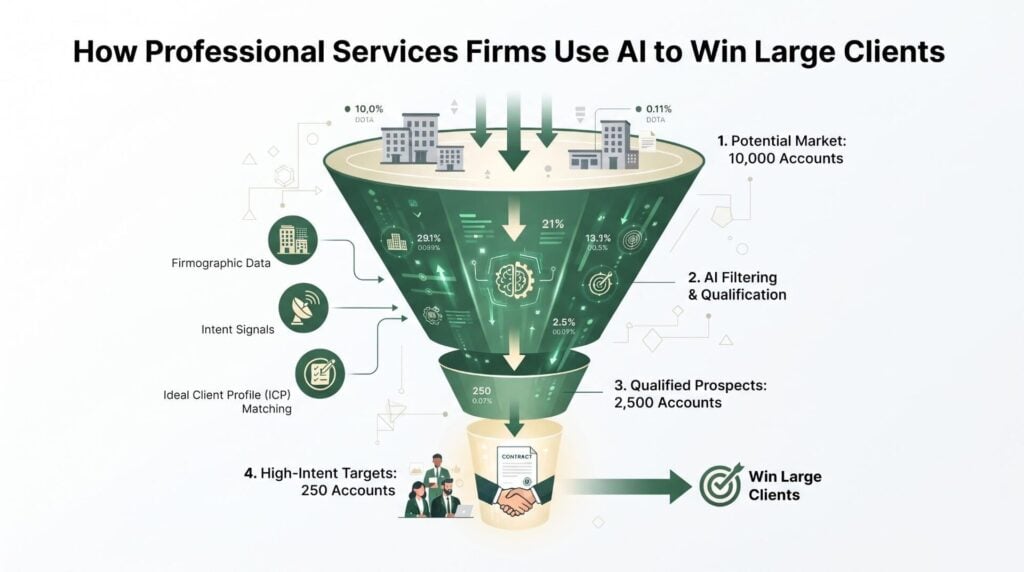
AI tools scan public data, intent signals, and firmographic filters. They surface accounts that best match your ideal client profile. They also flag accounts that show early signs of active research. 6sense and Bombora track signals like content downloads and vendor comparisons. They also watch job postings tied to major initiatives. Firms using intent data report 30% higher pipeline quality than cold list outreach, according to Forrester (2024).
Finding the right accounts used to mean cold lists and guesswork. AI tracks which companies are researching your topics right now. You can see who visits competitor sites or hires for roles that signal a major project. This keeps your team focused on accounts most likely to move in the next 90 days.
Intent data has limits. It shows interest, not a guarantee of fit. You still need a real conversation to qualify an account and build trust.
How Can AI Improve Your Pitch Process?
AI helps firms tailor pitches by pulling insights on each buyer’s goals and recent news. It also surfaces leadership changes and competitive pressures. Tools like Crystal profile decision-makers. They suggest how to talk with each person in the buying group. Teams using AI-assisted pitch prep report 20 to 35% higher rates of turning first meetings into formal proposals.
A strong pitch shows the buyer you understand their world. AI helps you gather that context fast. You can pull recent earnings calls, press releases, and industry reports in minutes. Then you build a story that links your service to their real priorities. Buyers notice the difference between a generic deck and one built around their problems.
AI-generated briefs always need a human review before you send them. A tool may flag a story that has no link to your pitch. Context matters more in large account selling than anywhere else.
Which AI Tools Work Best for Account Research?
The best AI tools for large account research each cover a distinct step. LinkedIn Sales Navigator maps contacts and org structure. Perplexity Pro gathers context fast. Apollo.io handles contact data and email outreach. Pairing two or three tools gives you a more complete view of each target. It also reduces blind spots in your outreach.
| Tool | Best For | Key Limitation |
|---|---|---|
| LinkedIn Sales Navigator | Mapping decision-makers and org structure | Gaps in newer or smaller organizations |
| Perplexity Pro | Fast news and context gathering | May surface low-quality or dated sources |
| Apollo.io | Contact data and email outreach sequences | Data accuracy varies by region and sector |
| Bombora | Buyer intent signals across the web | Signals can lag real buying activity by weeks |
Start with one tool that solves your biggest research gap. Add a second tool once you see clear results from the first.
Before you buy, list the three biggest gaps in your current research process. Match each gap to a tool’s core strength. This saves money and avoids the overload of managing too many platforms.
How Does AI Help Teams Stay Aligned on Deals?
AI platforms like Clari and Salesforce Einstein give sales, delivery, and leadership a shared view of deal status, risks, and next steps. Teams using deal intelligence tools cut slippage by up to 25%, according to Salesforce (2024). Without this view, deals can go quiet while your team assumes everything is on track.
Large account deals involve many people inside your firm. Delivery teams need buyer context. Leadership needs to know when to step in. AI tools keep everyone in sync. They capture emails, calls, and CRM notes on their own. You see where a deal stands without chasing reps for updates.
These tools only work if your CRM data is clean. AI speeds up what is already working. It does not fix a broken process.
Here are three alignment benefits from AI-powered deal tracking:
- Real-time deal health scores so leaders know which accounts need attention this week
- Auto-generated call summaries that reps can share with delivery teams in one click
- Risk alerts when a key contact goes quiet or a deal timeline slips past a threshold
These features cut time in pipeline reviews. They also give reps faster feedback on which actions moved a deal forward.
AI Smart Ventures helps growing businesses build the systems that make these tools deliver results. Learn more about AI consulting support, and Schedule a consultation to see what is possible for your firm.
What Results Can You Expect From AI in Sales?
Firms that use AI for large account selling report shorter sales cycles and higher win rates. They also make better use of team time across the full pipeline. McKinsey (2024) found that AI-enabled sales teams close deals 20 to 30% faster than those using manual methods. These gains depend on how well you adopt the tools, not just which ones you pick.
Firms that train their teams and build clear workflows see the biggest gains. AI speeds up what is already working. Here is what strong adoption looks like over 90 days:
- Weeks 1 to 4: Tool setup, data cleanup, and team training on one core platform
- Weeks 5 to 8: First AI-assisted pitches go out; teams log what worked and what did not
- Weeks 9 to 12: Workflows and outreach sequences refined based on real results and rep feedback
Most firms see time savings within the first month. Win rate improvements show up in month two or three as new habits take hold.
How Do You Start Using AI for Large Accounts?
Start by naming one bottleneck in your current sales process. Then find one AI tool that directly addresses it. Teams that take this focused approach reach results faster than those who try to change everything at once. Most platforms offer free trials or starter plans so you can test value before committing a budget.
The bigger challenge is building new habits, not the tool setup. That is where leadership focus matters most. Here are three steps to get moving:
- Pick your biggest bottleneck: research, pitch prep, or follow-up. Find one tool that solves it directly.
- Run a 30-day pilot with two or three reps and track time saved and pipeline impact.
- Share results with the full team and build a simple playbook before scaling to everyone.
Avoid buying too many tools at once. One tool done well beats five tools done poorly every time.
Frequently Asked Questions
What is AI for selling professional services into large accounts?
AI for selling professional services into large accounts is the use of software tools to research buyers, personalize outreach, and manage complex deals more efficiently. It covers intent data platforms, call analysis tools, pitch prep assistants, and deal tracking systems. Firms use these tools to compete for high-value accounts without expanding their sales teams.
How much do AI sales tools cost?
Costs range from free to several thousand dollars per month depending on the platform. Entry-level tools like Otter.ai start at no cost. Platforms like 6sense or Clari can run from $1,000 to $5,000 per month for a small team. AI Smart Ventures helps growing businesses find tools that match their budget so they avoid paying for features they will not use.
Do I need a large sales team to use AI?
You do not need a large team. Many AI sales tools are built for teams of two to five people and solo sellers. A small team can research more accounts, send better pitches, and track deals with the same efficiency as a much larger sales operation. No added headcount needed.
Which tool is best for researching large accounts?
The best tool depends on your current gap. LinkedIn Sales Navigator is best for mapping decision-makers. Bombora or 6sense is best for tracking intent signals. Perplexity Pro is best for fast news and context research. Most firms get the best results by pairing one contact-mapping tool with one intent-data tool.
Can AI replace sales reps in professional services?
AI cannot replace sales reps in professional services. Buyers at large accounts make high-stakes decisions that need a trusted human relationship built over time. AI handles research and data work so reps can spend more time on the conversations that actually move deals forward.
How long does it take to see results from AI in sales?
Most firms see measurable time savings within the first 30 days of using AI for research or call notes. Pipeline and win rate improvements show up in 60 to 90 days. By then, the team has built new habits and refined their outreach using real data from the tools.
What are the risks of using AI in sales?
The main risks are poor data quality, over-reliance on AI-generated content, and privacy compliance gaps. Always review AI-generated content before sending it to a buyer. Make sure your tools comply with GDPR or CCPA rules whenever you handle client or prospect data in your pipeline.
Does AI help with proposal writing for large accounts?
Yes, tools like Notion AI and Copy.ai can draft proposal sections, tailor case studies, and structure executive summaries. Every proposal for a large account still needs a human review. Make sure it reflects the specific needs and tone of that buyer. AI gives you a strong starting point, not a final draft.
Executive Summary
AI for selling professional services into large accounts gives firms a clear edge in research, personalization, and deal management. Firms that use tools like LinkedIn Sales Navigator, 6sense, Gong, and Clari report shorter sales cycles, higher win rates, and better use of team time. Success depends on starting focused, training your team, and building habits that turn AI output into strong client relationships.
What Should You Do Next?
Start by mapping your current sales process and finding where the most time is lost. Pick one AI tool that directly addresses your biggest gap and run a 30-day pilot with a small group. Track time saved and pipeline impact before you scale to the full team.
AI Smart Ventures offers AI consulting services for growing businesses. Schedule a consultation to get a clear plan for using AI to win more large accounts.
People Also Read
- What Is AI Transformation for Professional Services Firms
- Best AI Tools for Professional Services Firms
About the Author
Nicole A. Donnelly is the Founder of AI Smart Ventures and an AI Adoption Specialist with 20 years of experience as a founder and CEO and over a decade leading AI adoption initiatives. She helps businesses integrate artificial intelligence with clarity and confidence, driving innovation and sustainable growth. Nicole has trained over 20,217 professionals in Applied AI, delivered 624 workshops, and worked with close to 1,000 organizations across diverse industries.
Expertise: AI Transformation, AI Strategy, AI Implementation, AI Adoption, Applied AI, Marketing, Business Operations
Disclaimer: This content is for informational purposes only and does not constitute professional business or technology advice. Results vary based on industry, existing systems and implementation commitment. Contact AI Smart Ventures for a consultation regarding your specific situation.