How to Run an AI Quarterly Review for Your Business in 2026
Last Updated: July 2026
An AI business quarterly review is a set step you run every 90 days. You use it to check the output and cost of your AI tools. It helps you see which tools are worth keeping and which ones drain your budget. Running it every quarter keeps you in control of your AI spending.
AI Smart Ventures has helped hundreds of growing businesses build AI review systems that work. Most owner-operators skip the review step entirely. They move from one tool to the next without checking if the last one worked. The result is a messy stack of subscriptions, confused teams, and no clear picture of what is helping.
Tech moves fast. The tools you chose in January may look very different by April. A quarterly cycle gives you a fixed window to review and redirect tools. This stops small problems from turning into costly habits. This article walks through the exact steps, participants, metrics, and follow-up actions you need.
Key Takeaways
- A quarterly review stops AI spending from becoming a source of waste. It links every tool to a specific business goal.
- Keep the review team small, cross-functional, and focused on decisions. Do not invite the whole company.
- Track adoption metrics, output outcomes, and a clear ROI calculation each quarter. Together they give you the full picture.
- Every review must end with a written action plan. Each task needs an owner and a deadline.
- Growing businesses benefit most from starting now. Do not wait for the perfect system.
- A quarterly cadence catches failing experiments early. It also helps you double down on what works.
Why does quarterly matter for AI success?
Without a regular review, AI spending becomes an unmanaged cost center. A quarterly review creates a steady rhythm. You check actual returns against expected outcomes every 90 days.
Growing businesses without this step buy tools based on hype. Teams end up paying for software they rarely open. No one is assigned to fix the problem.
Three months is the right gap. It balances speed with depth. Monthly reviews rarely give enough time to measure real impact. Annual reviews leave problems untouched for too long.
A 90-day window gives tools enough time to show results. It also keeps leaders close enough to fix problems before they get worse. According to McKinsey’s State of AI report, businesses that measure AI output always get better returns on their investments. The cadence itself becomes a competitive edge.
Who should attend your AI review?
The right group is small and covers different areas of the business. It is not a company-wide meeting. Good decisions need the people closest to both strategy and daily work. Too many voices slow things down and reduce ownership.
The core group should include the founder or CEO, the operations lead, and the finance lead. Add one or two department-level AI champions who run active tool pilots. These people bridge the gap between strategy and workflow reality.
Keep the group to five or fewer decision-makers. This keeps the conversation tight and focused. Each person in the room should own at least one tool under review. That way, every voice carries real ownership.
What metrics should you track?
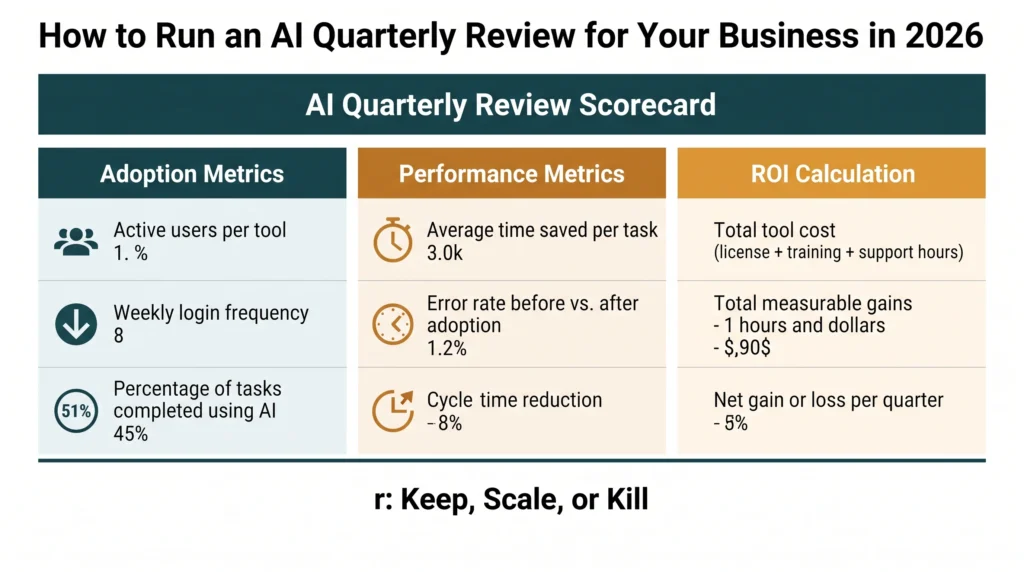
Track three things each quarter: adoption metrics, output metrics, and a clear ROI calculation. Together, these give you a full picture of where AI helps and where it creates drag. No single metric tells the whole story.
Adoption metrics show whether your team always uses tools. Watch login frequency and query volume per user. Also track the share of tasks done with AI. Output metrics measure quality and speed. Look at time saved on manual work, fewer errors, and faster cycle times on recurring tasks.
For ROI, compare the total cost of each tool against the measurable gains. Include licenses, training time, and support hours. Gartner’s AI research shows that tracking both cost and outcome data is key to making sound AI investment decisions. A short survey rounds out the picture. It captures how team members feel about each tool. Numbers alone often miss that.
What is the step-by-step agenda?
A productive 60-minute review follows a fixed agenda. Structure is what separates a useful review from a wandering status update. Every minute should produce a shared insight or an assigned action.
Open the first ten minutes by checking the tool inventory. Confirm whether any new subscriptions were added since the last review. Spend the next 20 minutes reviewing scorecard data for each tool. Each champion shares their adoption and output numbers. The finance lead presents cost data. The group assigns a quick preliminary rating: keep, scale, or kill.
Use the following 20 minutes to discuss the outliers. These are tools performing far above or well below expectations. These conversations surface step issues that data alone cannot explain. Close the final ten minutes by locking in the action plan. Assign owners and deadlines for every decision made. Adjourn only after the plan is written down.
Once you have a repeatable review structure, the next step is helping your team act on its findings. AI Smart Ventures offers AI Advisory services to help growing businesses build and sustain this kind of review step. Schedule a consultation to turn your next quarterly review into a real driver of growth.
How do you score your AI tools?
Scoring your tools gives the review a shared language. It removes personal bias from the decision. A simple three-tier framework works well: keep, scale, or kill. Each level should tie to specific thresholds set before the meeting.
A tool gets a “keep” rating when adoption is steady and ROI is positive but modest. A “scale” rating applies when a tool shows strong adoption. It also needs clear, measurable gains. Expanding access would grow those gains across the business.
A “kill” rating applies when adoption is low or costs are higher than benefits. Use the same scorecard for every tool in your stack. Carry your ratings into the next quarter as a baseline. This lets you track whether things improve or worsen over time.
How do you build your action plan?
An action plan turns your review from a talk into a tool. Every decision from the session must go to a specific owner. That owner gets a clear deadline too. Without ownership, the best intentions disappear within days.
For each “kill” decision, write down who cancels the subscription and when. Also note how the workflow it supported will be covered. For “scale” decisions, assign someone to plan the rollout. Set a target adoption milestone for next quarter. For “keep” decisions, confirm who monitors the tool. Note what data they will bring to the next review.
Store the action plan in a shared document that all participants can access. Review the previous quarter’s plan in the first ten minutes of every new session. This closes the ownership loop and measures follow-through.
What mistakes should you avoid?
The most common mistake is treating the review as a reporting task. When teams spend the whole time sharing data without reaching conclusions, nothing changes. Every session must end with written plans tied to specific people.
A second mistake is using different criteria across reviews. Changing your scoring rules makes it hard to track progress or compare tools fairly. Set your scorecard thresholds before the first review. Hold to them every quarter.
A third mistake is skipping qualitative feedback. Numbers show what is happening, but team surveys reveal why. Without the human view, decisions often miss what holds tools back. Finally, do not delay the review when business gets busy. The busiest quarter is often where a structured review gives the most clarity. It can also bring real financial relief.
Frequently Asked Questions
How often should you run an AI review?
Run the review once every quarter, four times per year. A 90-day cycle gives enough time to observe meaningful adoption trends. It also keeps problems from going on too long.
Some growing businesses add a lighter monthly check-in to catch urgent issues between full sessions. This does not add much meeting time.
What is the difference between a tool audit and a quarterly review?
A tool audit is a one-time inventory of your software stack. You use it to find waste or overlap at a specific moment. A quarterly review is a recurring step. It tracks output, measures ROI, and produces action plans over time.
The audit is a snapshot. The quarterly review is a continuous improvement cycle built into your operating rhythm.
How long should each review meeting last?
A focused 60-minute session is enough for most businesses with five to ten tools. If your stack is larger or you are reviewing a new strategic plan, allow 90 minutes. Longer meetings tend to lose momentum. Use a tight agenda to make sure every minute leads to a decision or a follow-up task.
What tools do you need to run the review?
You need a spreadsheet or simple dashboard for your scorecard. You also need a shared document for the action plan. Add a brief survey to collect feedback before the session. Many teams start with a Google Sheet and a short form. Simple tools work well at the start and can be refined over time.
How do you handle tools that are partially working?
When a tool shows mixed results, assign a conditional “keep” status. Set a clear improvement target for the next quarter. Define the metric that would move it to “scale” and the threshold that would trigger a “kill” decision.
Partial output often signals a training gap, not a tool problem. Check whether low-adoption users got enough onboarding before you decide to remove the tool.
What if team members resist the review step?
Resistance usually means team members fear more work or tool removals without good replacement plans. Address this before the first session. Explain that the review protects the team’s time by removing tools that create friction.
Bring department champions in early to help design the step. They will feel ownership rather than pressure from leadership.
How do you track ROI when benefits are hard to quantify?
Start with the easiest metrics: time saved, fewer errors, and faster turnaround on recurring work. Assign a dollar value to time savings by multiplying hours saved by the average hourly rate for the role. The Salesforce State of AI report shows that businesses with clear benchmarks for AI tools see better returns and faster adoption.
For harder-to-measure benefits, use a simple before-and-after rating scale. Have the team members closest to the work fill it out.
What if you run out of budget mid-quarter?
A mid-quarter budget shortfall is a signal to act on your kill decisions from the last review. Most growing businesses find that removing two or three low-performing subscriptions frees up enough budget. If the stack is over-resourced, pause new tool evaluations. Use the next quarterly review to stabilize spending before adding anything new.
How do you prepare the scorecard before the meeting?
Assign data collection to each tool champion two weeks before the review. Each champion gathers adoption metrics, output data, and cost figures for their tools. The finance lead consolidates total cost data across the stack.
Send a qualitative survey to all tool users one week before the session. Compile results in the shared scorecard before the meeting. This ensures the session focuses on decisions, not data gathering.
How do you get started for the first time?
AI Smart Ventures supports growing businesses through their first AI quarterly review as part of their AI Advisory service. Schedule a consultation to get a custom starting point for your business.
If you prefer to start on your own, list every active AI tool you now pay for. Assign a named owner to each one. Set a date for your first 60-minute review within the next 30 days.
Can this step work for a solo founder?
Yes. Solo founders can run a lighter version. Review your personal tool stack and apply the same keep, scale, or kill criteria. The step takes about 30 minutes when done solo.
Some solo founders bring in a trusted advisor for the review. This gives an outside perspective and helps avoid blind spots when you are checking your own habits.
How do you keep the review from becoming a checkbox routine?
Add a rotating focus area each quarter. In one quarter, focus the deeper analysis on customer-facing tools. In the next, review internal operations tools. In the third, look at content and outreach tools.
This rotation stops the review from feeling repetitive. It also ensures every category of your stack gets thorough attention across the full year.
Executive Summary
A structured AI quarterly review gives founders a disciplined way to manage their tech investments. You convene a small team every 90 days and apply a consistent scorecard to every tool. This helps growing businesses catch waste early and double down on what works.
The review does not need complex systems. It needs a clear agenda, defined metrics, honest data, and written action plans. Businesses that build this habit find that AI investments deliver better returns. They also create less internal confusion over time.
Start with one session this quarter. Keep the step simple. Improve it with each cycle.
What Should You Do Next?
List every AI tool your business now pays for. Assign a named owner to each one. Set a date for your first quarterly review within the next 30 days. Use the agenda and scorecard from this article to structure the session.
Share the qualitative survey with your team one week before that date. You want real feedback ready when the meeting starts. AI Smart Ventures offers AI Advisory for growing businesses that want an expert-guided approach to managing their AI investments. Schedule a consultation to build a review step that fits your team and scales with your business.
People Also Read
- How Do You Measure AI ROI? A Framework for Business Leaders
- Should You Outsource Your AI Marketing? A Decision Framework for Business Owners
About the Author
Nicole A. Donnelly is the Founder of AI Smart Ventures and an AI Adoption Specialist with 20 years of history as a founder and CEO and over a decade leading AI adoption plans. She helps businesses connect AI with clarity and confidence, driving innovation and lasting growth. Nicole has trained over 20,217 experts in Applied AI, delivered 624 workshops, and worked with close to 1,000 businesses across diverse industries.
Expertise: AI Transformation, AI Strategy, AI Rollout, AI Adoption, Applied AI, Marketing, Business Operations
Disclaimer: This content is for informational purposes only and does not constitute expert business or tech advice. Results vary based on industry, current systems and rollout commitment. Contact AI Smart Ventures for a consultation about your specific situation.