
Is Google Gemini Better Than ChatGPT for Work?
Last Updated: February 2026
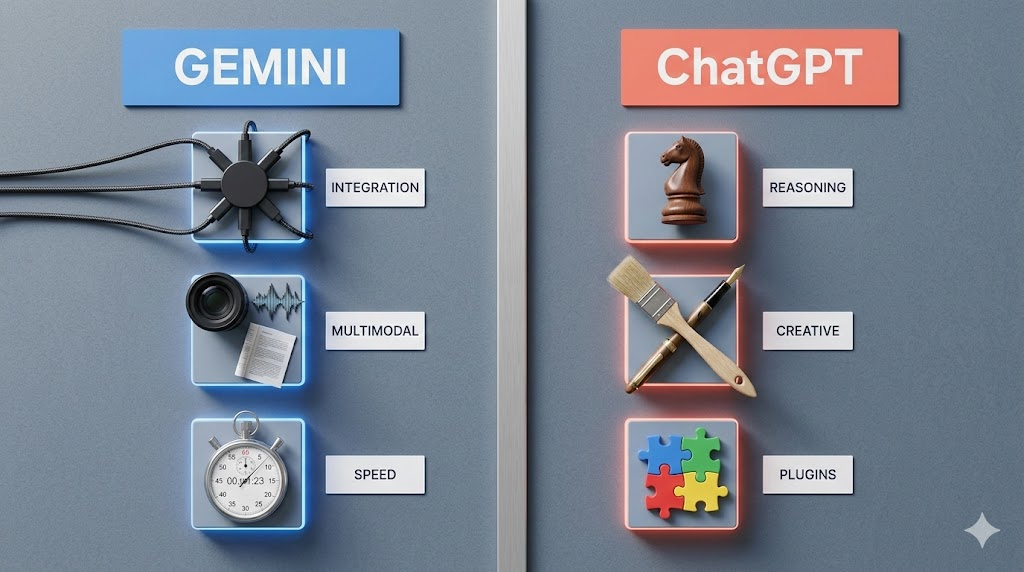
Google Gemini and ChatGPT serve different workplace needs despite similar capabilities. Gemini excels for teams already using Google Workspace with integrated access to Gmail, Docs, Sheets, and Calendar plus superior multimodal processing handling text, images, and video simultaneously. ChatGPT delivers better conversational quality for creative work, stronger reasoning for complex analysis, and broader third-party integrations through 8,000+ apps via API access. Market data from Similarweb shows Gemini capturing 21.5% market share (up from 5.7% in 2025) while ChatGPT holds 64% (down from 86%), indicating genuine competition for first time since 2022. AI Smart Ventures has found that teams choosing based on their existing ecosystem rather than feature lists consistently achieve faster adoption and higher sustained usage rates.
Neither platform wins universally. The better choice depends entirely on your team’s existing infrastructure.
The question isn’t which AI is smarter. It’s which platform fits the tools your team already uses daily.
Key Takeaways
Platform selection should match workflow realities rather than feature comparisons or benchmark scores:
- Ecosystem integration determines adoption – Teams using Google Workspace achieve 40% faster Gemini adoption while Microsoft 365 users see similar gains with ChatGPT through Copilot integration compared to standalone tools
- Market share shifted dramatically – Gemini grew from 5.7% to 21.5% share in 12 months while ChatGPT dropped from 86% to 64%, ending the single-platform monopoly era (Similarweb January 2026)
- Multimodal needs favor Gemini – Native image, video, and audio processing in single interface makes Gemini 3 Pro stronger for marketing teams, designers, and visual workflows requiring cross-media analysis
- Complex reasoning favors ChatGPT – GPT-5.2 delivers superior performance on multi-step logic, structured analysis, and technical documentation requiring deep reasoning over creative generation
- Pricing converged at similar levels – Both platforms charge $20/month for standard tiers and $200-$250 for premium access, making cost a neutral factor in most workplace decisions
- Professional users drive adoption – Enterprise and workplace integration now represents more stable monetizable demand than consumer usage, explaining aggressive workplace feature development from both companies
Independent testing across business use cases shows neither platform dominates all categories, requiring strategic platform selection based on specific team workflows and existing technology investments.
What Makes Gemini Better for Some Teams?
Gemini’s advantages center on Google ecosystem integration and multimodal processing capabilities.
Native Google Workspace integration eliminates friction. Teams spending 6+ hours daily in Gmail, Docs, Sheets, and Calendar benefit from AI embedded where work happens. Gemini summarizes email threads without copy-paste, analyzes spreadsheet data inline, drafts document sections maintaining formatting, and schedules meetings reading calendar context automatically.
This integration matters because context switching wastes enormous time. Research shows knowledge workers lose 23 minutes regaining focus after interruptions. AI requiring platform switching creates the same problem it claims to solve. Gemini avoids this by operating inside existing workflows.
Google identity and access control extends to Gemini when organizations already have mature Google Workspace governance. The marginal effort to standardize on Gemini becomes lower than implementing standalone AI requiring separate security policies. For IT teams managing hundreds of users, this operational simplicity justifies Gemini even when ChatGPT might deliver marginally better outputs.
Multimodal processing handles diverse content types. Gemini 3 processes text, images, video, and audio simultaneously rather than requiring separate tools or conversions. Marketing teams analyzing campaign assets across media formats, designers reviewing visual concepts alongside brand guidelines, and educators processing lecture videos with transcripts benefit from unified multimodal analysis.
The one-million token context window allows processing extremely large inputs. Teams analyzing 200-page reports, reviewing entire codebases, or summarizing multi-hour meeting recordings use Gemini’s massive context capacity for tasks exceeding ChatGPT’s limits. This matters for research-intensive work requiring comprehensive document analysis.
Deep Research mode delivers structured investigation. Gemini’s research capability goes beyond web search by conducting multi-step investigation across sources, synthesizing findings into structured reports, providing direct citations to sources, and delivering results faster than manual research processes. Academic researchers, market analysts, and strategic planners use Deep Research for comprehensive topic coverage.
The transparency citations linking back to specific spreadsheet cells, PDF paragraphs, or web sources provide verification that generic AI responses lack. For business decisions requiring source validation, Gemini’s grounding in actual documents reduces hallucination risk.
Speed advantages matter for high-volume work. Gemini 2.5 Flash delivers exceptional speed for routine queries. Teams processing hundreds of requests daily (customer support, content review, data validation) benefit from faster response times reducing cumulative wait time. The speed difference becomes meaningful at scale even when output quality matches ChatGPT.
For comprehensive platform comparison including Claude, see ChatGPT vs Claude vs Gemini for Business.
What Makes ChatGPT Better for Other Teams?
ChatGPT’s strengths center on conversational quality, complex reasoning, and platform flexibility.
Superior conversational tone for creative work. ChatGPT generates text that feels natural and engaging with varied sentence structures avoiding formulaic patterns. The writing style works better for marketing copy, blog content, social media posts, and customer communications requiring personality and warmth. Teams valuing tone and readability over pure information density prefer ChatGPT’s output.
This matters for content teams where AI-generated text needs light editing rather than complete rewrites. ChatGPT produces drafts closer to final quality for creative applications reducing total time from generation to publication.
Complex reasoning outperforms competitors. GPT-5.2 delivers superior multi-step logic, handles structured analysis requiring sequential reasoning, maintains consistency across long-form technical content, and excels at debugging code with detailed explanations. Engineering teams, financial analysts, and researchers working with complex problems benefit from ChatGPT’s reasoning depth.
The ability to orchestrate multiple tools within single session (data analysis, web search, code execution) creates workflow efficiency. Teams needing to validate reasoning against datasets or perform calculations inline save time with ChatGPT’s integrated tool execution.
Broader ecosystem through custom GPTs and API. ChatGPT’s marketplace of custom GPTs provides specialized assistants for specific tasks without configuration. The extensive API integration connects with 8,000+ third-party applications through platforms like Zapier enabling workflow automation that Gemini can’t match currently.
Organizations building AI into products or services use ChatGPT’s API more frequently due to earlier market entry, better documentation, and established developer community. The network effects from ChatGPT’s 64% market share mean more tutorials, integrations, and community support exist compared to newer platforms.
Platform-agnostic flexibility. ChatGPT works equally well for Microsoft 365 users, Google Workspace teams, or organizations using neither ecosystem. This flexibility matters for companies with mixed infrastructure or those wanting AI independent of productivity suite decisions. Teams can adopt ChatGPT without renegotiating existing software contracts.
The Team and Enterprise tiers provide stronger governance controls than Gemini’s consumer-focused approach. Organizations requiring strict data isolation, audit logs, and administrative oversight find ChatGPT’s business features more mature than Gemini’s relatively newer enterprise offering.
For implementation guidance, review How to Integrate AI Into Existing Workflows.
How Do They Compare on Key Business Criteria?
Different factors matter depending on team size, industry, and use cases.
| Category | Gemini | ChatGPT | Winner |
| Google Workspace Integration | Native – works inside Gmail, Docs, Sheets | Requires copy-paste or API | Gemini |
| Microsoft 365 Integration | Limited integration | Native through Copilot partnership | ChatGPT |
| Multimodal Processing | Native text, image, video, audio | Multimodal with some limitations | Gemini |
| Complex Reasoning | Good for factual queries | Superior for multi-step logic | ChatGPT |
| Creative Writing | Concise, fact-driven style | Natural, engaging tone | ChatGPT |
| Context Window | 1 million tokens (Gemini 3 Pro) | 200,000 tokens (GPT-5.2) | Gemini |
| Speed | Faster (Gemini 2.5 Flash) | Slightly slower | Gemini |
| Third-Party Integrations | Limited API ecosystem | 8,000+ apps via API | ChatGPT |
| Custom Assistants | Limited customization | Custom GPTs marketplace | ChatGPT |
| Enterprise Controls | Workspace-dependent | Mature governance (Team/Enterprise) | ChatGPT |
| Pricing (Standard) | $19.99/month (AI Pro) | $20/month (Plus) | Tie |
| Pricing (Premium) | $200/month (Advanced) | $200/month (Pro) | Tie |
| Free Tier Capabilities | Generous access with limits | Limited GPT-4o access | Gemini |
| Source Citations | Transparency citations to sources | Generic responses without links | Gemini |
| Market Share Growth | +15.8 points (5.7% to 21.5%) | -22 points (86% to 64%) | Gemini |
For Google-centric teams: Gemini reduces operational friction significantly. The native integration with Workspace tools creates seamless workflows where AI feels like natural extension of existing applications. Organizations already paying for Google Workspace gain AI capabilities without additional infrastructure complexity.
For Microsoft-centric teams: ChatGPT through Microsoft Copilot integration delivers similar native experience within Microsoft 365 ecosystem. The partnership between OpenAI and Microsoft ensures ChatGPT capabilities flow into Outlook, Teams, Excel, and other Microsoft applications familiar to Windows-based organizations.
For mixed or independent teams: ChatGPT’s platform-agnostic approach provides more flexibility. Teams using Slack, Notion, Asana, or other collaboration tools connect ChatGPT through APIs without being forced into Google or Microsoft ecosystems. This independence matters for organizations prioritizing best-of-breed tools over integrated suites.
For budget-conscious teams: Both platforms price similarly making cost neutral in most cases. The free tiers differ significantly: Gemini provides more generous access making it better for teams testing AI before committing budget, while ChatGPT’s free tier limits usage more aggressively.
For cost analysis across platforms, see How Much Does AI Implementation Cost.
What Do Usage Patterns Reveal?
Market behavior shows how different teams actually use these platforms.
Professional usage drives enterprise adoption. Both companies aggressively pursue workplace integration because professional users represent stable, monetizable demand compared to students using free tiers for homework. The enterprise focus explains rapid feature development for admin controls, data governance, and security compliance.
Organizations typically deploy AI differently than individuals. Workplace adoption requires admin dashboards showing usage patterns, single sign-on integration with identity providers, compliance helpers for regulated industries, audit logs tracking data access, and zero-retention modes preventing training on proprietary data.
Specialized tools collapse as general platforms expand. Similarweb data reveals specialized AI writing and coding tools declining 10% as ChatGPT and Gemini add similar capabilities. Users prefer platforms handling multiple tasks in single interface rather than maintaining separate subscriptions for writing, coding, image generation, and analysis.
This consolidation trend suggests organizations will standardize on one general-purpose platform rather than deploying multiple specialized tools. The total cost of ownership favors platforms delivering 80% quality across many use cases over 100% quality in narrow applications requiring integration overhead.
Mobile and voice usage accelerates. Gemini’s Android integration and voice capabilities through Google Assistant reach users where they work. ChatGPT’s mobile apps see heavy usage but lack the OS-level integration Google provides. For field teams, sales representatives, and mobile-first workers, Gemini’s accessibility advantages outweigh ChatGPT’s reasoning superiority.
Regional and demographic patterns emerge. Younger users (18-34) show stronger Gemini preference while older professionals (45+) favor ChatGPT’s established interface. Geographic distribution shows Gemini gaining faster in regions with strong Google ecosystem presence while ChatGPT maintains dominance in enterprise markets.
For adoption strategies across demographics, review How to Prepare Your Workforce for AI.

Should You Deploy Both or Choose One?
Strategic platform decisions require considering total cost of ownership and adoption complexity.
The “triple stack” approach works for some teams. Power users deploy ChatGPT for creative and complex reasoning work, Gemini for Google Workspace integration and research, and Claude for long-form writing and code review. This $60/month per user approach delivers best-of-breed capabilities across use cases.
However, most organizations should standardize on one platform. Multiple platforms create confusion about which tool to use when, reduce adoption by splitting training resources, complicate data governance and security policies, and increase total subscription costs without proportional value.
Pilot both before committing. Run 30-day pilots with 5-10 representative users testing actual workflows, not theoretical use cases. Measure time savings on specific tasks, quality of outputs requiring minimal editing, user preference after hands-on experience, and integration friction with existing tools.
Document wins and failures for both platforms. ChatGPT might excel at drafting strategy documents while Gemini wins at analyzing spreadsheet data. Understanding specific strengths for your workflows drives better decisions than relying on generic benchmarks.
Consider hybrid deployment for large organizations. Deploy the platform matching each team’s primary ecosystem: Gemini for marketing teams living in Google Workspace, ChatGPT Enterprise for engineering teams using GitHub and technical tools, and Microsoft Copilot for finance teams working in Excel and Power BI.
This segmented approach maximizes integration benefits while standardizing within departments. The governance complexity increases but may justify better adoption rates when teams get AI fitting their daily workflows.
Factor in switching costs. Standardizing on one platform creates dependency making future changes expensive. Teams invest in training, workflow integration, and custom configurations that don’t transfer between platforms. Consider 12-18 month commitment when choosing platforms even though subscriptions are monthly.
The rapid evolution in AI capabilities makes long-term vendor lock-in risky. Maintain flexibility by using platforms through standard interfaces (API, web) rather than deep custom integrations requiring engineering resources to change later.
For strategic planning guidance, see How to Create an AI Strategy for Your Business.
Frequently Asked Questions
Can I use both Gemini and ChatGPT in my organization?
Yes, though most organizations should standardize on one platform to reduce complexity and increase adoption. Using both makes sense when different teams have genuinely different needs (Google Workspace users vs Microsoft 365 users) or when specific use cases strongly favor one platform (multimodal work for Gemini, complex reasoning for ChatGPT). However, deploying both doubles training requirements, complicates data governance, and reduces per-platform utilization. For teams under 50 people, pick one platform and maximize its capabilities before adding alternatives.
Which platform is better for small businesses with limited budgets?
Gemini’s free tier provides more generous access making it better for testing AI capabilities before committing budget. Small businesses already using Google Workspace gain AI features without additional infrastructure complexity. However, if your team uses Microsoft 365, ChatGPT through Copilot integration delivers better value despite similar pricing. The “better” platform depends entirely on which productivity suite you already pay for since ecosystem integration drives adoption more than marginal capability differences.
How do enterprise security and compliance compare?
ChatGPT Team and Enterprise tiers provide mature governance controls including admin dashboards, audit logs, zero-retention modes, and SOC 2 compliance. Gemini’s enterprise features depend heavily on Google Workspace governance which can be advantage when existing Google identity and access controls are mature. Both platforms meet standard enterprise security requirements but ChatGPT’s business features are more developed due to earlier enterprise focus. Organizations in highly regulated industries should evaluate specific compliance needs (HIPAA, GDPR, SOC 2) against each platform’s current certifications rather than assuming equivalence.
Will Gemini overtake ChatGPT in market share?
Current trajectory shows Gemini gaining rapidly (5.7% to 21.5% in 12 months) while ChatGPT declines (86% to 64%), but total dominance seems unlikely. The market is fragmenting toward multiple strong platforms serving different needs rather than converging on single winner. Google’s distribution advantages through Android, Chrome, and Search provide massive reach, but ChatGPT’s established developer ecosystem and Microsoft partnership create defensible position. Expect continued competition with both platforms holding significant share alongside Claude, Perplexity, and emerging alternatives.
Which platform better handles proprietary company data?
Both platforms offer enterprise controls preventing training on customer data, but implementation differs. ChatGPT Enterprise provides explicit zero-retention modes with contractual guarantees. Gemini’s data handling ties to Google Workspace policies which can be advantage for organizations with mature Google governance or concern for teams unfamiliar with Google’s data practices. Neither platform should be used with truly sensitive data on free or consumer tiers. Organizations handling confidential information must deploy enterprise-grade subscriptions with proper configuration and employee training on acceptable use policies.
How do custom GPTs compare to Gemini’s customization options?
ChatGPT’s custom GPTs marketplace provides thousands of pre-built specialized assistants for specific tasks without configuration work. Users can also create custom GPTs for internal workflows with specific instructions, knowledge bases, and tool integrations. Gemini currently offers limited customization beyond prompt engineering making ChatGPT significantly stronger for organizations wanting tailored AI assistants. However, Gemini’s deep Google Workspace integration may eliminate need for customization when AI already accesses relevant data through native connections to email, documents, and calendars.
Which platform integrates better with our existing tools?
Integration strength depends entirely on your current technology stack. Gemini wins for Google Workspace (Gmail, Docs, Sheets, Calendar, Drive) while ChatGPT wins for Microsoft 365 through Copilot partnership. For third-party tools like Slack, Salesforce, HubSpot, or Notion, ChatGPT’s API and 8,000+ integrations through Zapier provide broader connectivity. Organizations using best-of-breed tools across multiple vendors typically achieve better integration with ChatGPT’s platform-agnostic approach compared to Gemini’s Google-centric design.
Should we wait for the next version before committing?
No, because AI platforms evolve continuously rather than through discrete version launches. Both Gemini and ChatGPT improve weekly with model updates, feature additions, and capability enhancements making “wait for the next version” a permanent state of inaction. The productivity gains from starting now (even with current limitations) exceed benefits from waiting for marginally better future versions. Organizations delaying AI adoption fall further behind competitors already achieving 25-50% time savings on routine tasks. Start with limited pilots testing actual workflows then expand based on measured results rather than waiting for perfect platforms that will never arrive.
How do we prevent team members from using unapproved AI platforms?
Shadow AI usage runs 78-86% across organizations according to security research, indicating prohibition doesn’t work. Instead, provide approved platforms meeting security requirements, train teams on acceptable use policies, explain why specific platforms are approved versus blocked, and monitor usage through admin dashboards identifying risky behavior. Most shadow AI usage stems from approved platforms being too difficult to access or lacking capabilities teams need. Making official platforms easy to use and genuinely helpful reduces unauthorized tool adoption more effectively than blocking attempts.
Which platform will matter more in 2027 and beyond?
Predicting AI platform dominance 12-24 months out is futile given current innovation pace. The market is fragmenting toward specialized use cases where different platforms excel rather than converging on single winner. Expect continued competition with multiple strong platforms serving different needs. Organizations should focus on solving today’s productivity problems with currently available tools rather than betting on future market winners. The teams succeeding with AI are those maximizing existing platforms for real workflows, not those constantly chasing the newest releases or waiting for perfect solutions.
What Should You Do Next?
Most teams waste 2-3 months testing both platforms separately before realizing they chose the wrong one based on feature lists rather than actual workflow integration.
Here’s the faster path: Schedule a 30-minute AI Platform Assessment. We’ll analyze your team’s actual workflows (not theoretical use cases), identify which platform matches your Google or Microsoft ecosystem, and show you exactly which capabilities justify subscription costs based on your team size and daily work patterns.
You’ll receive:
- One-page decision framework showing total cost of ownership, expected time savings by role, and realistic adoption timeline based on your infrastructure
- 30-day implementation roadmap with pilot structure, success metrics, and training requirements
- Platform-specific use case library showing exactly how similar organizations use ChatGPT or Gemini for your industry
- Risk assessment identifying integration barriers, security gaps, and adoption obstacles before you commit budget
This assessment is free and includes our AI Platform Selection Guide with comparison matrices we’ve used with 73 organizations choosing between ChatGPT, Gemini, and Claude in the past 6 months.
We’ve trained over 20,217 professionals and documented 50% average time savings across close to 1,000 organizations. We know exactly when Gemini beats ChatGPT and vice versa based on actual implementation data, not vendor marketing.
The catch? We only work with organizations serious about implementation within 90 days, not endless research. If you’re ready to standardize your team on one platform and start measuring productivity gains, schedule your assessment now.
Whether you need AI Consulting for strategic planning, AI Implementation for hands-on deployment, or AI Training for team enablement, you’ll get honest recommendations based on your actual situation, including “neither platform yet” if that’s the right answer.
Not ready to schedule? Start with our AI Tools Directory comparing 50+ platforms by specific business use cases, or read our complete AI implementation guide for small businesses.
People Also Read
- ChatGPT vs Claude vs Gemini for Business: Which Is Best in 2026? Complete three-way comparison including Claude’s unique strengths for technical writing and code review alongside ChatGPT and Gemini analysis.
- How Much Should I Pay for AI Tools? Platform Cost Analysis Understanding total cost of ownership across AI platforms including hidden costs, team licensing, and ROI calculation frameworks.
- Why Your Team Stopped Using the AI Tools You Bought Common adoption failures and proven strategies for ensuring teams actually use ChatGPT, Gemini, or other AI platforms after initial enthusiasm fades.
About the Author
Nicole A. Donnelly is the Founder of AI Smart Ventures and an AI Adoption Specialist with 20 years of experience as a founder and CEO and over a decade leading AI adoption initiatives. She helps businesses integrate artificial intelligence with clarity and confidence, driving innovation and sustainable growth. Nicole has trained over 20,217 professionals in Applied AI, delivered 624 workshops, and worked with close to 1,000 organizations across diverse industries.
Expertise: AI Transformation, AI Strategy, AI Implementation, AI Adoption, Applied AI, Marketing, Business Operations
This content is for informational purposes only and does not constitute professional technology advice. Platform capabilities and pricing subject to change. Results vary based on implementation approach and team adoption.