Open Source AI Models Explained: Llama, Mistral, and DeepSeek for Business
Last Updated: March 2026
Open source AI models are AI systems whose weights and architecture are publicly released, allowing businesses to run them on their own infrastructure rather than paying per query to a cloud provider. AI Smart Ventures has guided technically capable teams through evaluating when open source models like Meta’s Llama 3, Mistral’s Mixtral, and DeepSeek-V3 are the right choice over commercial APIs – the answer consistently comes down to data privacy requirements, cost at scale, and customization needs. In 2026, these models have matured significantly and are in active production use across a wide range of business applications.
Key Takeaways
- Open source AI models can be run on your own hardware or private cloud, keeping data entirely within your infrastructure – a critical advantage for regulated industries and privacy-sensitive use cases
- Meta’s Llama 3.3, Mistral AI’s Mixtral 8x7B, and DeepSeek-V3 are the leading open source models as of 2026, well-suited for structured, well-defined business tasks such as summarization, classification, and code generation
- Running open source models requires either self-hosted infrastructure (GPU servers or cloud compute) or managed hosting through providers like Groq, Replicate, or Together AI
- Cost at high volume is the primary financial argument for open source: API costs for leading commercial models can reach $5,000 to $50,000 per month for high-volume applications, while self-hosted open source models have predictable infrastructure costs
- Open source models require significantly more technical capability to deploy than commercial APIs – this is not a low-friction option for non-technical teams
Here is the honest framing: open source AI is not a shortcut. It is a deliberate architectural choice that pays off for specific use cases and requires genuine technical investment to deliver. For most growing businesses without engineering teams, commercial APIs remain the practical default. But understanding when and why open source changes the equation is increasingly relevant – especially for businesses with data privacy requirements, high usage volumes, or deep customization needs.
What Are Open Source AI Models?
Open source AI models are large language models whose weights – the billions of trained parameters that define the model’s behavior – are publicly released for anyone to download, run, and modify. Unlike proprietary models that run exclusively on the provider’s servers and are accessed via API, open source models can be downloaded and run on local hardware, private cloud infrastructure, or specialized inference platforms. This means data never leaves your network – a significant advantage for healthcare, legal, financial services, and any business with strict data residency requirements.
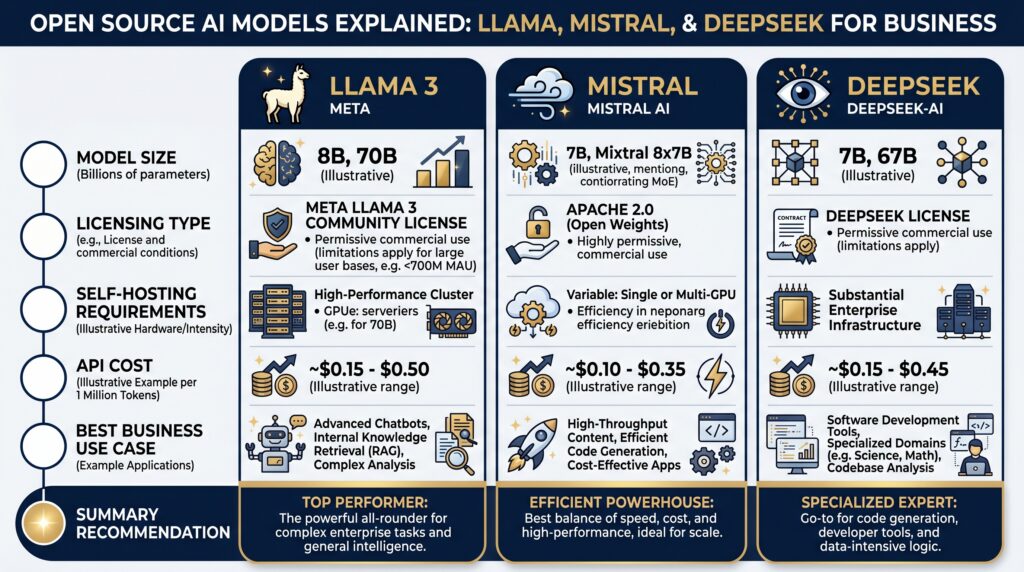
The performance of leading open source models has improved dramatically since 2022. Meta’s Llama 3.3 70B and Mistral AI’s Mixtral 8x7B deliver strong results on structured text tasks. DeepSeek-V3, released by a Chinese research team in late 2024, demonstrated strong results on coding and reasoning tasks at a fraction of the training cost reported by major US AI labs, attracting significant attention from organizations running cost-sensitive AI applications.
Which Open Source AI Models Are Best for Business?
[IMAGE: Terminal window showing Ollama running a local open source LLM with a conversational interface on a developer workstation, demonstrating self-hosted AI model deployment]
Three open source models stand out for business deployment in 2026. Meta’s Llama 3.3 70B offers strong general-purpose performance across text generation, summarization, and reasoning tasks, with Meta’s Apache 2.0 license permitting commercial use. Mistral AI’s Mixtral 8x7B uses a mixture-of-experts architecture that delivers strong performance relative to its compute requirements, making it more cost-efficient to run than same-size dense models. DeepSeek-V3 delivers competitive performance on coding and reasoning benchmarks and has become widely used for technical applications despite ongoing questions about training data provenance.
| Model | Developer | License | Best Use Case | Relative Size |
| Llama 3.3 70B | Meta | Apache 2.0 | General text, summarization | Large |
| Llama 3.2 11B | Meta | Apache 2.0 | Lighter deployment, edge | Medium |
| Mixtral 8x7B | Mistral AI | Apache 2.0 | Efficient general tasks | MoE (medium) |
| Mistral 7B | Mistral AI | Apache 2.0 | Low-cost, fast inference | Small |
| DeepSeek-V3 | DeepSeek | MIT | Coding, reasoning | Large |
For teams starting with open source AI, Mistral 7B on a managed inference platform like Groq provides a low-cost way to test open source capabilities without infrastructure setup. For production deployments, Llama 3.3 70B is the most widely adopted choice for general business tasks.
When Should You Choose Open Source Over Commercial AI?
Open source AI makes sense for three scenarios: data privacy requirements, high-volume cost optimization, and deep customization needs. Data privacy is the most common driver: healthcare organizations subject to HIPAA, financial firms with strict data residency requirements, and law firms with attorney-client privilege concerns often cannot send data to a third-party API even under a data processing agreement. Self-hosted open source models eliminate this constraint entirely.
Cost optimization at scale is the second scenario. At moderate usage volumes – under 1 million tokens per day – commercial APIs are typically less expensive than self-hosted infrastructure when you account for engineering time. Above that threshold, the economics shift: the infrastructure cost of running open source models becomes less than the API costs for equivalent commercial model access. Organizations processing large volumes of internal documents, customer interactions, or data pipelines often find the crossover point within 12 to 18 months of high-volume API usage.
Deep customization is the third scenario. Fine-tuning a model on your proprietary data to optimize performance for a specific, repetitive task – document classification, internal knowledge retrieval, structured data extraction – is only possible with open source models. Commercial APIs do not expose the underlying weights required for this kind of customization.
How Do You Run an Open Source AI Model?
Running an open source AI model requires one of three approaches: self-hosting on your own GPU servers, using cloud GPU compute (AWS, Google Cloud, Azure), or using a managed inference provider. Self-hosting gives maximum control over data and costs, but requires GPU hardware and ongoing engineering support. Cloud GPU instances on AWS or Google Cloud provide flexible scaling without upfront hardware investment, with costs ranging from $1 to $32 per GPU-hour depending on the instance type.
Managed inference providers are the lowest-friction entry point for teams exploring open source models without deep infrastructure experience. Groq and Together AI offer API-compatible access to open source models at lower per-token costs than major commercial providers, without requiring any infrastructure management. The trade-off is that data leaves your network to reach their servers – the data privacy advantage of self-hosting does not apply. For teams testing open source performance before committing to self-hosted infrastructure, managed inference platforms are the practical first step.
What Are the Limitations of Open Source AI Models?
Open source AI models have meaningful limitations compared to commercial alternatives for most business teams. Technical complexity is the primary barrier: deploying, maintaining, updating, and troubleshooting a self-hosted model requires dedicated engineering resources that most growing businesses do not have. Commercial APIs abstract away this complexity entirely – you call an endpoint, get a response, and the provider handles model updates, scaling, and uptime. With open source, model version management, hardware maintenance, and inference optimization become your responsibility.
Open source models perform best on well-defined, structured tasks: document classification, summarization of consistent document types, code generation for specific frameworks, and high-volume data processing where prompt consistency is high. For tasks that require nuanced judgment, complex multi-step reasoning, or high-quality creative output – client-facing content, strategic analysis, open-ended research – they are generally better suited to use cases where you have validated output quality through testing specific to your business context. The key is matching the model to the task rather than assuming any model is universally strong or weak.
Frequently Asked Questions
What open source AI models are available for business deployment?
The leading open source AI models available for business deployment in 2026 include Meta’s Llama 3.3 (70B and smaller variants), Mistral AI’s Mistral 7B and Mixtral 8x7B, DeepSeek-V3, Falcon (by Technology Innovation Institute), and Google’s Gemma. All are available for download via Hugging Face and carry licenses permitting commercial use. Meta’s Llama models and Mistral models are the most widely deployed in production business applications due to their performance, documentation quality, and breadth of community-developed tooling.
When should a business use an open source model instead of a commercial AI?
Choose an open source model when your use case involves data that cannot be sent to a third-party API due to regulatory or confidentiality requirements, when you process high enough volumes that per-token API costs exceed self-hosted infrastructure costs, or when you need to fine-tune a model on proprietary data to optimize performance for a specific task. For most businesses without these specific drivers, commercial APIs offer a simpler and more cost-effective starting point.
What tasks are open source AI models best suited for in a business context?
Open source models deliver strong, reliable results on structured, repetitive tasks: document summarization, content classification, data extraction, code generation for defined frameworks, and high-volume internal data processing. They are most valuable when the task is well-scoped, the inputs are consistent, and you have the ability to test and validate output quality before deploying at scale. Tasks that require nuanced judgment, complex reasoning across long contexts, or high-quality creative output benefit most from careful testing before any model – open source or commercial – is deployed in production.
What is DeepSeek and why is it significant?
DeepSeek is a Chinese AI research lab that released DeepSeek-V3 in late 2024, an open source model achieving strong performance on coding and reasoning benchmarks at a fraction of the training cost reported by major US AI labs. Its significance is primarily economic: it demonstrated that competitive AI performance is achievable without massive training budgets, and it provided a capable, openly licensed alternative to proprietary frontier models. Questions about training data provenance remain relevant for businesses in regulated industries considering deployment.
Is Mistral AI a good option for growing businesses?
Yes, for businesses with specific requirements that justify open source complexity. Mistral AI’s models – Mistral 7B and Mixtral 8x7B – offer strong performance relative to their size, making them cost-efficient to run. They are fully open source under Apache 2.0 licenses with no usage restrictions. Mistral also offers a commercial API (Mistral La Plateforme) for teams that want managed access without self-hosting, which reduces the technical barrier significantly for teams that want to test the models before committing to infrastructure.
How much does it cost to run an open source AI model?
Costs depend heavily on the deployment method. Managed inference platforms like Groq and Together AI charge substantially less per million tokens than major commercial providers, without requiring infrastructure management. Self-hosted deployment on cloud GPU instances involves hourly compute costs that scale with usage, plus engineering time for setup and maintenance. The economics favor open source most clearly at high usage volumes – the crossover point varies by use case, but most organizations find it becomes financially meaningful above 1 million tokens processed per day.
What is the difference between open source and proprietary AI models?
Open source AI models publish their weights and architecture publicly, allowing anyone to download, run, and modify them without paying per query. Proprietary models (ChatGPT, Claude, Gemini) run exclusively on the provider’s servers, accessed via API with per-token pricing and no access to underlying weights. Open source gives data control, customization flexibility, and cost predictability at scale. Proprietary models provide easier deployment, consistently strong frontier performance, and no infrastructure responsibility. The choice is primarily driven by data privacy requirements, usage volume, and available technical resources.
Do open source AI models require technical expertise to use?
Yes. Running open source models requires GPU hardware or cloud compute, model configuration, API serving infrastructure, and ongoing maintenance. Managed inference platforms like Groq reduce complexity but still require API integration work. For non-technical teams, commercial APIs are the practical choice. For teams with engineering resources that have specific data privacy or cost optimization requirements, open source infrastructure is worth the investment. An AI advisory engagement can help assess whether your team has the technical readiness for open source deployment before committing to the infrastructure.
What Should You Do Next?
Identify one use case in your business where data privacy or cost at scale makes a commercial API impractical. Test one open source model using a managed inference provider like Groq before committing to any infrastructure investment. Document the performance and cost difference against your current commercial API to build your business case.
If you want an independent assessment of whether open source AI is the right fit for your specific situation, schedule a consultation. Whether you need AI Advisory to evaluate your model options or AI Consulting to build the right architecture for your compliance and cost requirements, you will get specific guidance based on your actual technical and business situation.
People Also Read
- Claude vs ChatGPT for Business in 2026: Honest Comparison
- What Is AI Workflow Automation and How It Actually Works
About the Author
Nicole A. Donnelly is the Founder of AI Smart Ventures and an AI Adoption Specialist with 20 years of experience as a founder and CEO and over a decade leading AI adoption initiatives. She helps businesses integrate artificial intelligence with clarity and confidence, driving innovation and sustainable growth. Nicole has trained over 20,217 professionals in Applied AI, delivered 624 workshops, and worked with close to 1,000 organizations across diverse industries.
Expertise: AI Transformation, AI Strategy, AI Implementation, AI Adoption, Applied AI, Marketing, Business Operations
Connect: LinkedIn | WebsiteThis content is for informational purposes only and does not constitute professional business or technology advice. Results vary based on industry, existing systems, and implementation commitment.