
Should AI Search Your Old Client Files? Check First
Last Updated: October 2026
An AI document search is a tool that reads the files you already hold and answers questions from them, rather than matching words in a file name. Point it at a shared drive, and it finds the contract, the note, and the email thread that touch a topic. That is useful. It also means every closed matter in that folder can be found again, which is a different call from whether the tool works.
AI Smart Ventures has guided growing businesses through AI implementation in client service, finance, and advisory work. Owners ask which tool to buy. The question that bites earlier is quieter: of all the files you are about to make searchable, how many are you still allowed to hold?
Skip that check, and you can break a promise you made years ago without touching a thing. A file you agreed to destroy, a record you kept past its use, a folder a client asked you to clear: none of it stays buried once an index covers it. Your team finds it, and so does anyone who asks the tool a fair question.
Key Takeaways
- Sort before you index: settle what you may still keep before anything is indexed, because one index makes every kept file easy to find at once.
- Your own paperwork answers first: client contracts, destroy clauses and your published privacy notice already say what you promised to do.
- Deleting from an index is not clean: a 2026 study, Ghost Echoes, found files deleted the right way still left “measurable residual influence” on later searches.
- This already happens: in a 2026 survey of 850 IT and security leaders, 29% said AI tools had surfaced data they should not have reached.
- Out of reach is a real third answer: files you cannot sort yet belong where the tool cannot read them, never in the index “for now”.
Read those together and the usual order flips. Most teams pick the tool, load the drive, then tidy up afterwards. Done that way, the tidying happens in public, after your team has read the file you meant to destroy. The dull order works: sort first, index second. Most of this is AI advisory work, done before any tool is switched on.
What happens when AI indexes old client files?
All of it becomes easy to find in one step. An index does not care whether a matter closed last month or nine years ago; it reads what is there and answers from it. So work you had forgotten comes back into daily use: draft advice you never sent, or the file a former client asked you to destroy. Nothing was hacked. The folder just stopped being hard to search.
This catches people out because the old guard was friction. A closed matter was safe from casual reading because finding anything in it took an hour and a lucky guess at the file name. Search by meaning removes the hour. Research across growing businesses shows the same first week every time: questions nobody planned for, answered out of files no one had opened since the work ended. The sort never happened.
Which of your own papers answer this first?
Four of them, all already in the building. Your client contract says how long you hold their files and what happens when the work ends. Any destroy clause says the rest. Your published privacy notice tells clients how long you keep what, and you are held to that wording. Your trade’s own record rules set a floor under both. Read those four before you ask a vendor a thing.
Read the destroy clause closely; it is the one that trips firms up. Wording drawn up years ago often promised to return or destroy client files once the work ended, with no carve-out for a copy in a shared drive. Keep that copy and the file is not yours to index. The IRS tells businesses to keep records backing an item on a tax return until the time limit for changing it runs out.
Who decides what you are allowed to keep?
Your lawyer or adviser does. Not the tool, not the vendor, and not this article. What you may hold turns on your contracts, your privacy notice, your trade’s rules and the state law that reaches you. Those four rarely line up neatly. The brief you send is short: our contracts, our privacy notice, the kinds of files we hold, and please tell us the limits. One sitting often settles it.
The ground has moved recently enough to deserve a fresh look. Three more state privacy laws took effect on 1 January 2026, and by one February 2026 count twenty states now have broad privacy laws on the books. A January 2026 note from Jackson Lewis quotes California’s line: a business “cannot retain a consumer’s personal information for longer than is reasonably necessary”. Your own state may differ, so make this a legal call.
How do you split files into index and archive?
Ask one question of each closed matter: do we still have a written reason to hold this? Matters that pass go into the index. Matters that fail get deleted on the schedule your lawyer sets. Matters you cannot answer for yet go to a store the tool cannot read. Three outcomes, one pass. Work matter by matter, not file by file, or you will stall in year two.
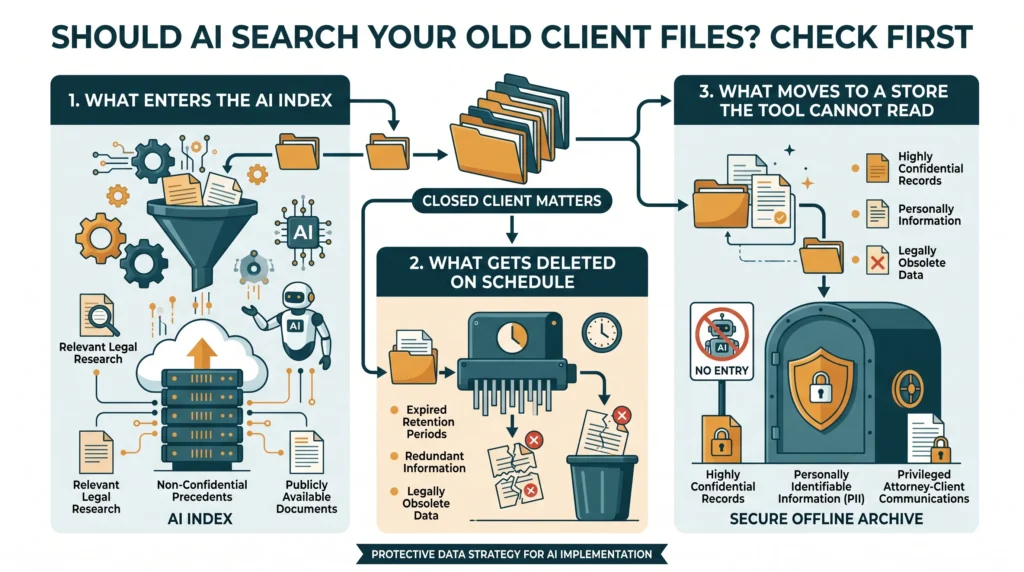
Sorting by matter instead of by file is what makes this finishable. Closed matters often share one time limit, so a single call covers a hundred files at once. Keep a short log as you go: the matter, the date it closed, the rule you used, who signed it off. That log is what you show a client who asks, and it stops the next person re-opening the same argument.
What do you do with files you cannot sort yet?
Move them out of reach and give the call a date. A store the tool cannot read is not a delay tactic; it is the honest answer when no one can yet say whether a file may be kept. The pull is to index it for now and come back later, which never happens, and the file is live the moment the index covers it. Out of reach with a review date keeps your options open.
Be clear what out of reach means in your setup. It is a separate place the tool’s connector does not cover, open only to the people running the sort. Test it by asking the tool something only those files could answer. If it answers, the store is not out of reach. Vendors selling automation as AI will tell you an access setting is enough. Access settings change by accident; places change on purpose.
Can you really delete a file once it is indexed?
Less cleanly than you would hope. Ghost Echoes, posted on 16 June 2026, tested vector databases that delete records the right way through their own tools and found those deleted records still left “measurable residual influence on downstream retrieval contexts”. Full index rebuilds did not remove the drift the authors measured. So treat removal as a repair, not an undo, and keep a file out of the index until you know it belongs.
A second paper from the same group, Ghost Vectors, reports that systems often mark a record as deleted while leaving the data in place, where names and places could be pulled back out of raw index files. Both papers describe the storage layer rather than any one product, and both point the same way. The part you fully control is the front of the job. Nothing you never indexed needs un-indexing.
AI Smart Ventures runs AI Implementation for growing businesses putting document search in place, with the sort scoped before a single old file is indexed.
How do you keep the rule working as matters close?
Tie the call to the moment a matter closes, so no backlog builds again. The closing checklist gains two lines: which time limit applies, and whether these files go to the index or out of reach. Whoever closes the matter answers both, and the files land in the right place that week. A yearly sweep then picks up anything whose review date has arrived.
Name one person who owns the schedule, check it whenever your contracts or privacy notice change, and re-run the out-of-reach test after any change to how the tool connects. The sweep stays short while the closing step works and grows long when it slips, making its length a useful signal. Practical AI here is one small step at closing time, not a clean-up project you repeat every few years. The operational efficiency comes from the small step.
Frequently Asked Questions
What counts as an old client file?
Anything from a matter that has closed, in any form: contracts, working papers, email attachments, scanned paper, chat threads and recordings. Form is beside the point to an index, and to your sort. What matters is whether a written reason to hold the file still exists. Treat the folder no one has opened in years as in scope, because that is where the nasty surprises sit.
Where is the promise to delete usually written down?
In three places, and they can disagree. Your client contract carries the destroy clause. Your published privacy notice carries the time limits clients can read for themselves. Your trade’s own record rules sit under both as a floor. Where two clash, the stricter one is the safer guess until your lawyer rules. Pull all three into one file before you sort, because arguing from memory wastes the pass.
Does a free AI document search tool change what you may keep?
No. Free or paid has nothing to do with how long you may keep a file: your contracts and your privacy notice decide that. Google’s Document AI sits inside Google Cloud rather than being a free standalone app, and good open-source options exist too, yet all ask you the same question. Read the terms as well, since plans differ on how uploaded files get handled.
Can you have ChatGPT review a closed client file?
Technically yes, because you can upload a file and ask for a review. The keeping question still comes first. If you agreed to destroy that file, or no longer have a reason to hold it, the review is not the problem; still having it is. Check where the file stands, then check your rules on what may be uploaded. Whether client work should leave your systems is its own call.
What if a client asked you to destroy their file?
Then it should not be in the index, and ideally not on the drive. Find out what happened then: whether the delete reached backups and shared folders, and whether anyone kept a copy. Write down what you find. If a copy survived, your lawyer decides what happens to it now. Indexing it would put that work straight back into daily use.
Should you index a matter when no one can confirm its status?
No. Park it out of reach with a review date and move on down the list. An unconfirmed matter inside the index is a call made by default, and default calls here are the ones that get awkward later. Parking costs nothing beyond a line in your log, and the review date pushes the question onto a named desk. A short parked list is a healthy sign.
Who should sign off on the list of matters to index?
One named person, usually the owner or whoever runs the day to day, working from the limits your lawyer set. Signing off means initialling the list of matters going in, not reading every file. Keep the log of what went in, what stayed out, what was parked and why. Change management lands better when your team can see a clear call, and one name stops the question circling.
How do we get started on a keep-or-delete check before indexing?
Start with three papers: your standard client contract, your privacy notice and your trade’s record rules. List the kinds of client files you hold, then take that list to your lawyer and ask for the limits in writing. Scope tracks how many closed matters you carry and how alike your older contracts are, and most growing businesses finish the sort in a few weeks. Schedule a consultation with AI Smart Ventures to sequence it.
Executive Summary
An AI document search makes everything it covers easy to find at once, which is why the keeping question comes first. Before you index old client files, read your client contracts, your destroy clauses, your privacy notice and your trade’s record rules, then let your lawyer set the time limits. Sort closed matters three ways: indexed, deleted on schedule, or held out of reach with a review date. Removal from an index is a repair, not an undo, so the real control sits at the front.
What Should You Do Next?
This week, pull your client contract, your privacy notice and your trade’s record rules into one place, then list the kinds of closed client files you hold. Send that list to your lawyer and ask for the time limits in writing. Nothing gets indexed until the answer comes back.
AI Smart Ventures offers AI Implementation for growing businesses putting document search in place across closed and current files, with the sort scoped before the index is built. Schedule a consultation to plan the keep-or-delete pass ahead of your rollout.
People Also Read
- AI Adoption Across Generations in Owner-Operated Businesses: Coaching Long-Tenured Staff
- AI Quality Scoring for Owner-Operators: Auditing AI Output Without Reading Every Word
About the Author
Nicole A. Donnelly is the Founder of AI Smart Ventures and an AI Adoption Specialist with 20 years of experience as a founder and CEO and over a decade leading AI adoption initiatives. She helps businesses integrate artificial intelligence with clarity and confidence, driving innovation and sustainable growth. Nicole has trained over 20,217 professionals in Applied AI, delivered 624 workshops, and worked with close to 1,000 organizations across diverse industries.
Expertise: AI Transformation, AI Strategy, AI Implementation, AI Adoption, Applied AI, Marketing, Business Operations
Disclaimer: This content is for informational purposes only and does not constitute professional business or technology advice. Results vary based on industry, existing systems and implementation commitment. Contact AI Smart Ventures for a consultation regarding your specific situation.