

The AI Vendor Demo Trap: Five Sales Tactics to See Through
Last Updated: July 2026
An AI vendor sales demo tactic is a prepared technique that software companies use to shape what buyers see during a product presentation. Vendors pick their best data and hide error cases. They script the 20 minutes that make the tool look perfect.
AI Smart Ventures helps growing businesses cut through vendor noise. Their advisors have reviewed thousands of AI tools across many industries. They know what vendors show and what they leave out.
AI software vendors face pressure to close deals fast. Their demos are built to impress, not to teach you the real limits. Businesses that skip a structured review often find the real cost only after they sign.
Key Takeaways
- Demos Use Curated Data – Vendors use pre-cleaned data in demos, not yours. This can inflate stated accuracy by up to 40%.
- Pricing Is Never Simple – The average AI platform has 3-5 hidden cost layers. These include API fees, storage, and per-seat pricing, per Gartner (2025).
- Integration Takes Longer – Most AI tools take 3-6 months to fully connect. Demos show instant results.
- ROI Claims Need Proof – Ask for a customer reference with verified ROI numbers before you trust any slide.
- Security Gaps Are Common – Only 38% of AI vendors provide a third-party security audit at demo time, per IBM Security (2025).
Knowing these tactics does not mean you should distrust every vendor. It means you enter the room with the right questions. A structured review turns a sales pitch into a real product test.
What Does a Scripted Demo Actually Hide?
A scripted demo hides failure cases, edge cases, and the real friction from messy data. Forrester (2025) found that 67% of AI buyers said their product performed worse than the demo within 90 days. Vendors spend weeks polishing a 20-minute path that makes the tool look error-free.
Scripted demos almost always skip slow processing. They also avoid showing what happens when your data is not clean. Real business data is never as tidy as demo data. Ask the vendor to run your actual files or records. If they say no, that is a signal worth noting.
How Do Vendors Inflate ROI Numbers?
Vendors inflate ROI by picking their best-case customers, using short time windows, and leaving out rollout costs. A vendor may show a 300% ROI figure based only on direct time savings. That number rarely includes setup costs, staff retraining, or the drop in output during rollout.
Ask every vendor three direct questions. What is the full cost over 24 months? Which specific customer produced this ROI, and can you speak with them? Does the ROI include your team’s time for setup and change management? If the vendor cannot answer all three, the number is a marketing claim, not data.
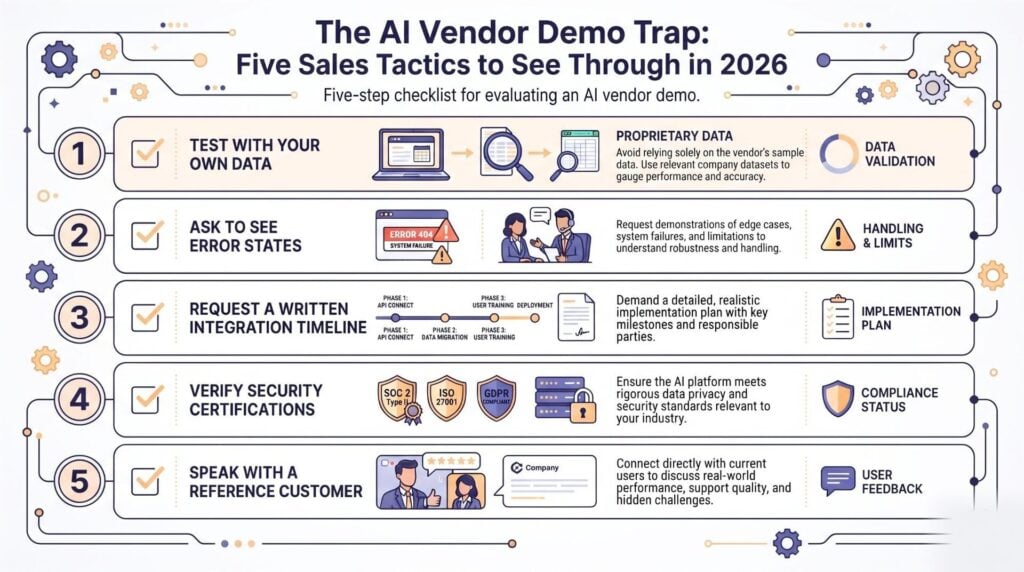
What Are the Five Core Demo Tactics?
The five core tactics are curated data, limited scope demos, buried pricing, vague integration timelines, and reference-stacking. Each one lowers your guard and speeds up your buying decision. Tools like Microsoft Copilot for Sales and Salesforce Einstein are often shown in tightly controlled demo settings. Here is what each tactic looks like in practice.
- Curated data: The vendor uses their own clean dataset, not yours. Ask them to load a file you bring to the meeting.
- Limited scope: The demo shows one polished workflow. Ask to see error handling and edge cases too.
- Buried pricing: The quoted price is the entry tier. Ask for the full cost breakdown including overages, add-ons, and year-two increases.
- Vague integration timelines: “Connects to everything” often means your team must set up the API. Ask for a written timeline for your tech stack.
- Reference-stacking: A logo wall is not proof of results. Ask for a direct reference at a similar business.
These tactics appear across most B2B software demos. With AI tools, the stakes are higher. Setup complexity and switching costs are both greater.
| Tactic | What You Hear | What to Ask |
|---|---|---|
| Curated data | “Our accuracy is 94%” | “Can we run this on our data right now?” |
| Limited scope | “Watch this workflow” | “Show me what happens when an error occurs” |
| Buried pricing | “Starts at $499/month” | “What is the 24-month total cost?” |
| Vague integration | “It connects to your CRM” | “Give me a written integration timeline” |
| Reference-stacking | “Used by 2,000 companies” | “Can I speak with a similar business owner?” |
How Should You Test a Tool Before Buying?
Run a paid pilot before committing to any AI tool that costs over $10,000 per year. A pilot gives you real performance data inside your own systems. Set a 30 to 60 day window, define three success metrics upfront, and measure against them at the close.
Many vendors resist pilots or try to replace them with a free trial that limits features. A real pilot uses your data, your workflows, and your team. Growing businesses that run structured pilots before buying report 35% fewer post-purchase surprises, per McKinsey & Company (2024). If a vendor refuses a genuine pilot, factor that into your final score.
AI Smart Ventures offers AI advisory services for growing businesses that want a structured vendor review. Schedule a consultation to get a clear evaluation checklist before your next demo.
What Questions Expose Weak AI Claims?
The questions that expose weak AI claims focus on specifics: data sources, failure rates, and setup needs. Most vendors prepare answers about features. Few prepare for questions about what the tool gets wrong or how it handles errors.
Ask these in your next demo:
- “What share of outputs are incorrect, and how does the system flag them?”
- “Where is our data stored, and who has access to it?”
- “What happens to our data if we cancel the contract?”
- “Can you show your most recent security audit, such as SOC 2 or ISO 27001?”
- “Which three customers are most like us, and can we speak with them before we sign?”
These questions are not aggressive. They are specific enough to show whether a vendor has real answers or rehearsed ones. Ask them early in the conversation.
How Do You Compare AI Vendors Fairly?
Use a scoring matrix weighted to your top needs. Pick five criteria that matter most to your business. Score each vendor before and after every demo. Common criteria include total cost, setup complexity, data security, support quality, and vendor stability.
| Criteria | Weight | Vendor A Score | Vendor B Score |
|---|---|---|---|
| Total 24-month cost | 30% | 7/10 | 9/10 |
| Integration complexity | 25% | 6/10 | 7/10 |
| Data security rating | 20% | 9/10 | 6/10 |
| Support quality | 15% | 8/10 | 7/10 |
| Vendor stability | 10% | 7/10 | 8/10 |
| Weighted total | 7.3 | 7.7 |
A matrix forces objectivity and makes your decision easier to explain to a team or board. The vendor with the best demo is rarely the best fit once cost and setup are factored in.
Frequently Asked Questions
What is the most common AI vendor demo tactic?
The most common tactic is using pre-cleaned data instead of the buyer’s real data. This makes accuracy and speed look better than they will in a live setting. Ask the vendor to run the demo on a sample of your actual data during the meeting. If they decline, factor that into your score and weight it heavily.
How long should an AI tool pilot last?
A proper pilot should last 30 to 60 days with your own data and full team. This window lets you see the tool across many real workflows. Define your success metrics before the pilot starts, not after. Pilots shorter than 30 days often miss the friction that shows up once the initial setup is done.
What hidden costs should I ask about before signing?
Ask about API call overages, per-seat pricing beyond your initial user count, storage fees, and annual price increases. Many vendors start with a low base price that doubles at normal usage. Request a written cost estimate for your expected usage over 24 months. Compare that number, not the headline price on the demo slide.
How do I verify an AI vendor’s ROI claims?
Speak directly with a reference customer who runs a similar type of business. Ask them for the exact metrics they tracked before and after deployment. Also ask what the full cost was, including staff time and outside help. Slides and case studies can be selective. A real conversation reveals more.
What security questions should I ask an AI vendor?
Ask whether they have a third-party security audit and which certifications they hold, such as SOC 2 or ISO 27001. Also ask where your data is stored, who can access it, and what happens when you cancel. Only 38% of AI vendors can provide a security audit on request, per IBM Security (2025).
Is a free trial the same as a pilot?
A free trial is not the same as a pilot. Free trials typically limit features, data volume, or access so you cannot see full performance. A pilot is a structured, time-limited test using your full workflow and real data. Pilots sometimes cost money, but that cost protects you from a bad long-term contract.
How many vendors should I evaluate before buying?
Check at least three vendors before making a final choice. Three gives you good comparison data without overwhelming your team with back-to-back demos. Use the same scoring matrix for each vendor so the comparison stays fair. Rushing to two options often means you miss a better fit or lack data to negotiate terms.
Should I use a consultant during vendor evaluation?
Using a consultant is worth it for any AI buy over $25,000 per year. A good advisor helps you define needs, run pilots, and spot red flags before you sign. AI Smart Ventures helps growing businesses run structured vendor reviews so they buy the right tool the first time. Schedule a consultation to learn how this works for your situation.
What does “AI-powered” actually mean on a vendor slide?
“AI-powered” on a vendor slide can mean anything from a basic rules engine to a true large language model. Ask the vendor to explain the underlying model type, whether it is their own or a wrapper around a model like GPT-4o or Gemini, and how it is trained on your data. That answer reveals both your options and long-term cost.
What should I look for in a vendor contract?
Look for data ownership clauses, exit terms, and price lock provisions. The contract should clearly state that you own your data and can export it at any time. Watch for auto-renewal clauses that lock you in before you can measure results. A SaaS-savvy lawyer is worth the fee for any deal over $50,000 per year.
Executive Summary
AI vendor demos are sales tools, not product tests. The five core tactics – curated data, limited scope, buried pricing, vague integration timelines, and unverified references – appear in most B2B AI presentations. Business owners who ask specific questions about failure rates, total cost, and data security are far better placed to buy the right tool. A structured pilot, a scoring matrix, and at least three vendor reviews are the minimum steps for a sound AI buying decision in 2026.
What Should You Do Next?
Before your next vendor demo, prepare five specific questions. Cover data sources, total 24-month cost, integration timelines, failure rates, and security certifications. Run a 30 to 60 day pilot for any tool with an annual cost over $10,000. Use a weighted scoring matrix to compare at least three vendors before you sign.
AI Smart Ventures offers AI consulting services for growing businesses that want expert guidance during vendor selection. Schedule a consultation to get a structured review framework built for your systems and budget.
People Also Read
- Microsoft Copilot for Sales vs. Salesforce Einstein: Which AI Wins in 2026
- What Is AI Marketing Strategy and Why It Matters in 2026
About the Author
Nicole A. Donnelly is the Founder of AI Smart Ventures and an AI Adoption Specialist with 20 years of experience as a founder and CEO and over a decade leading AI adoption initiatives. She helps businesses integrate artificial intelligence with clarity and confidence, driving innovation and sustainable growth. Nicole has trained over 20,217 professionals in Applied AI, delivered 624 workshops, and worked with close to 1,000 organizations across diverse industries.
Expertise: AI Transformation, AI Strategy, AI Implementation, AI Adoption, Applied AI, Marketing, Business Operations
Disclaimer: This content is for informational purposes only and does not constitute professional business or technology advice. Results vary based on industry, existing systems and implementation commitment. Contact AI Smart Ventures for a consultation regarding your specific situation.

