
UK AI Regulation in 2026: A Practical Guide for Founders Selling Into Britain
Last Updated: June 2026
The UK has no single AI law. The UK government’s AI regulation framework uses five shared principles. Each sector body applies these rules in its own area.
AI Smart Ventures has helped growing businesses with AI adoption for over ten years. The UK approach differs from the EU AI Act. These gaps affect your product design.
The EU AI Act sets binding rules with fines up to 35 million euros or 7% of global turnover. The UK system lets each sector regulator decide how the five principles apply. You can move faster in the UK. But you need to know which regulator covers your product before you go live.
Key Takeaways
- No Single AI Law – The UK has no standalone AI law as of 2026, per the UK Government AI White Paper (2023). You must meet your sector regulator’s rules. There is no central body to report to.
- UK GDPR Still Applies – Any AI product that processes personal data must meet UK GDPR, enforced by the ICO. Fines reach up to 17.5 million pounds or 4% of global turnover.
- EU AI Act Does Not Cover UK Sales – The EU AI Act covers products sold into EU markets only. Selling in both regions means running two separate compliance paths.
- FCA and MHRA Are Key Regulators – The FCA and the MHRA (medicines regulator) have both published AI guidance. Founders in fintech and healthtech should read both guidance sets before launch.
- High-Risk AI Requires More – Products used in credit, medical diagnosis, or hiring face stricter rules. A 2024 IBM report found 77% of AI leaders say their business has no clear AI governance plan.
Founders who map their duties before building save money. Late fixes cost far more. Starting before you have any UK customers is the cheapest time to act.
Why Does UK AI Regulation Matter Right Now?
The ICO, FCA, and CMA have all issued AI guidance. It all applies now. There is no phase-in period. The ICO’s 2023 AI guidance says businesses using AI to decide about people must explain those decisions clearly. Start now, before your first UK customer.
Which UK Regulators Cover AI Products?
Six UK regulators have published AI guidance. The FCA covers financial services tools. The MHRA covers AI in medical devices. The ICO covers any AI product that handles personal data at scale. Most founders selling B2B SaaS into Britain deal with the ICO as their main regulator. One sector body usually applies too.
If your tool touches financial data or credit, the FCA guidance applies. The Office of Communications (Ofcom) covers AI in online safety and broadcasting. Knowing your two or three key regulators gives you a clear target.
How Does UK GDPR Apply to AI Products?
UK GDPR requires any AI product using personal data to have a lawful basis. It must be clear about any automated decisions that affect users. A Data Protection Impact Assessment (DPIA) is required before you deploy any high-risk AI. Fines run up to 17.5 million pounds or 4% of global turnover.
Article 22 of UK GDPR limits fully automated decisions with serious effects on people. If your product scores users, this rule applies to your design. Check the ICO’s DPIA guidance before you write your UK terms. That review takes one or two days and helps you avoid common legal issues at launch.
How Do UK, EU, and US AI Rules Compare?
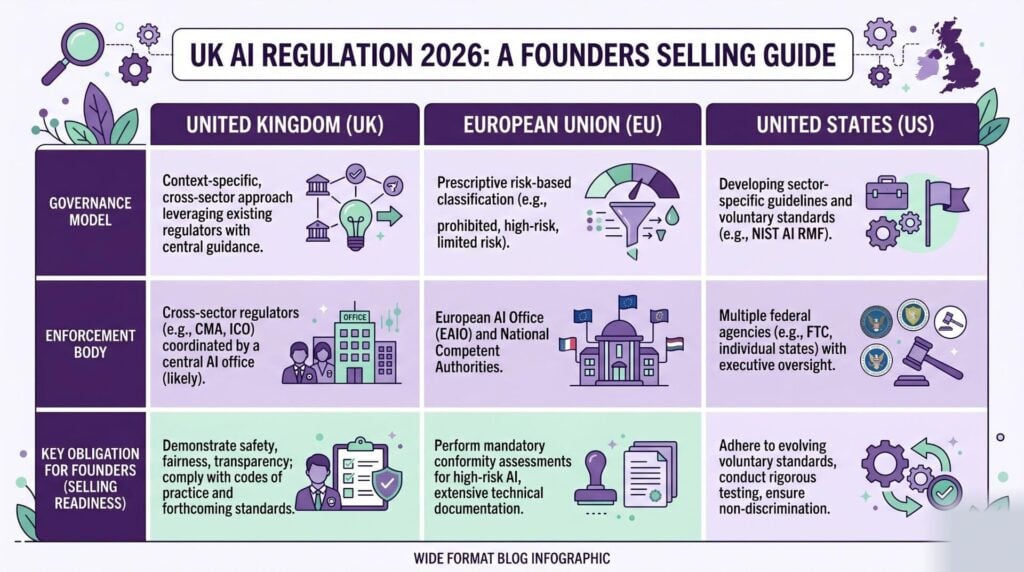
Founders selling into all three markets face different paths. The EU system is the most clear. It uses a four-level risk model with binding rules. The US system is the most split. Rules vary by state and sector. The UK falls between the two.
| Aspect | UK | EU | US |
|---|---|---|---|
| Governing law | No single AI law; sector-led principles | EU AI Act (binding from 2025) | No federal law; agency guidance plus state laws |
| Enforcement body | ICO, FCA, MHRA, CMA | National authorities plus EU AI Office | FTC, EEOC, FDA by sector; state AGs |
| Risk model | Sector regulators set expectations | Four-tier risk classification | No unified classification |
| Data rules | UK GDPR (similar to EU GDPR) | EU GDPR | HIPAA, FCRA, CCPA vary by state |
| Top fine | 17.5 million pounds or 4% of turnover | 35 million euros or 7% of turnover | Varies by agency and state |
| Founder timeline | Rules active now; no phase-in | Full act from August 2026; Annex III high-risk AI deferred to December 2027 | No fixed federal deadline |
For a vetted list of AI compliance tools, see AI tools and apps on the AI Smart Ventures resource hub.
Here is how to map your product to the right rules:
- find your sector first – The regulator that applies is set by what your product does. A lead-scoring tool in financial services is an FCA concern. The same tool in retail is mainly an ICO concern.
- Check automated decision rules – If your product makes automated decisions that affect people, map Article 22 of UK GDPR before launch.
- Review the EU AI Act risk tier – Most founders expand to the EU within two years. Know your risk tier early so your product does not need a major rework later.
These three steps take one afternoon. They save weeks of backtracking once you have UK customers.
What AI Governance Do UK Buyers Expect?
UK buyers in finance and healthcare ask to see data records and a DPIA. They also want the name of the person in charge of data compliance. These items are standard in UK deals. You cannot add them later.
The ICO’s 2024 Annual Report shows over 60% of UK data cases involve businesses with no data records. A one-page data record, a short DPIA summary, and a plain privacy notice will satisfy most UK buyers. Most founders can create all three in one afternoon using the ICO’s free templates.
AI Smart Ventures helps growing businesses get ready for regulated markets. Learn about AI consulting and AI implementation services for your stage.
How Do You Handle UK Rules Without a Legal Team?
Most founders entering Britain have no in-house legal help. You do not need it to start. The ICO offers a free DPIA template and a free checklist. The FCA lists its AI rules on its AI ethics page in plain language.
The AI regulations that matter most to growing businesses cover data use and automated decisions. The ICO has free guidance for both. The oversight checklist takes about two hours. Writing one clear paragraph about your AI data use takes about an extra hour.
Here is a 30-day checklist for founders before a UK launch:
- Complete the ICO oversight checklist – Takes about two hours. It shows gaps in your data practices. Free at ico.org.uk.
- Name your sector regulator – Confirm which of the six main UK AI regulators applies to your product. Start with the UK government’s AI regulation guidance.
- Draft a one-page DPIA summary – Use the ICO’s free template. Cover what personal data your AI uses, why, and how you protect it.
Most founders finish all three steps in under a week.
Frequently Asked Questions
Is there a specific UK AI law founders must follow?
There is no single UK AI law as of 2026. The UK uses a sector-led approach. Founders must meet the rules of their sector regulator. The ICO covers data protection. The FCA covers financial services tools. This is more flexible than the EU AI Act. But you need to know your regulator before you launch.
Does the EU AI Act apply to UK sales?
The EU AI Act does not apply to products sold only in the UK. It applies when your product enters the EU market or when its output is used in the EU. Selling in both regions means two separate paths running at once. If you plan to expand to the EU in two years, meet EU AI Act rules now. This avoids a big rework later.
What is UK GDPR and how does it differ from EU GDPR?
UK GDPR is the UK version of EU GDPR. It was kept in UK law after Brexit. The core rules are nearly the same. You need a lawful basis for using data, clear disclosure about automated decisions, and person data rights. The key difference is who enforces the rules. The ICO runs UK GDPR, not EU bodies. Founders who already meet EU GDPR will find UK GDPR mostly the same. They still need a separate UK privacy notice though.
Do I need a Data Protection Officer to sell AI in the UK?
A Data Protection Officer (DPO) is required in three cases. You need one if you are a public body, if you monitor many people at scale, or if you process special-category data at scale. Most B2B SaaS founders do not meet any of these three cases. You still need a named person inside your business to own data rules. That can be a founder, a senior staff member, or an outside consultant. Name this person before your UK launch.
What does the FCA expect from AI tools in financial services?
The FCA expects AI tools in financial services to be fair, clear, and meet conduct rules. Firms must explain how their AI makes a decision that affects a consumer. Black-box models with no audit trail are a legal risk in this sector. If your product touches credit or insurance, review the FCA’s AI guidance before finalizing your design.
How long does UK compliance take for a founder?
Most founders finish the core UK steps in four to eight weeks. This covers the ICO checklist, a DPIA, an updated privacy notice, and your sector rules. Complex products in healthcare or finance may take three to six months. Starting before you have paying UK customers is the cheapest route.
What are the five UK AI principles?
The UK government published five AI principles in its 2023 White Paper. On their own, they are not binding. The five principles are: safety and robustness; openness and explainability; fairness; oversight and governance; and contestability and redress. Sector regulators use them to check whether businesses handle AI responsibly. Founders should be ready to explain how their product meets each principle.
Is AI bias a legal risk in Britain?
AI bias is a legal risk when it produces unfair results under the Equality Act 2010 or UK GDPR. The ICO expects businesses to test AI for bias. This is most key in hiring, credit, and services. The ICO can fine any business whose AI outputs unfair outcomes without a clear reason. A basic bias check takes one to three days using free open-source tools.
How much does UK AI compliance support cost?
Basic compliance support costs 2,000 to 15,000 pounds. A DPIA review and privacy notice update from a specialist costs 1,500 to 5,000 pounds. Full advice for a regulated product costs more. Schedule a consultation with AI Smart Ventures for guidance matched to your stage.
What is a DPIA and when do I need one?
A DPIA reviews the data risks of a new system. UK GDPR requires a DPIA before any high-risk data use. This covers most AI systems that use personal data at scale or make decisions that affect people. The ICO publishes a free DPIA template at ico.org.uk. Most founders selling a B2B AI tool into the UK need at least one DPIA.
Can I sell the same AI product in the UK and EU?
You can often use the same product in both markets. But each region needs its own legal documents. UK GDPR and EU GDPR are similar but different bodies enforce them. The EU AI Act adds risk grouping rules that do not yet exist in UK law. The most common product change is adding explainability and audit logs. This meets both the ICO rules and the EU AI Act rules.
What is the UK AI Safety Institute?
The UK set up the AI Safety Institute (AISI) in 2023. Its job is to assess safety risks from advanced AI models. It focuses on large frontier models and does not cover most B2B products. Its work shapes what sector regulators expect from AI products. If your product uses a frontier model, check whether the AISI has guidance for your sector.
Executive Summary
UK AI regulation in 2026 is sector-led. There is no single AI law. UK GDPR applies to any AI product that handles personal data. Fines reach up to 17.5 million pounds. The FCA and MHRA set binding AI rules in their sectors. The EU AI Act does not apply to UK-only sales. It creates a parallel path for founders selling into both markets. EU high-risk AI rules apply from August 2026 (Annex III high-risk systems deferred to December 2027 per Digital Omnibus). Founders who complete a DPIA, name their sector regulator, and record their data use before launch avoid the most common gaps.
What Should You Do Next?
This week, complete the ICO’s free checklist at ico.org.uk. Then name the sector regulator that covers your product. Then write one clear paragraph about what your AI does with customer data. These steps prepare you for UK buyer and regulator conversations.
AI Smart Ventures offers AI consulting for growing businesses preparing to enter regulated markets. Schedule a consultation to get a plan for your product and sector.
People Also Read
- How Do You Deploy AI Agents in Your Business? A Practical Guide
- How Much Does AI Implementation Cost? A Budget Guide for 2026
About the Author
Nicole A. Donnelly is the Founder of AI Smart Ventures and an AI Adoption Specialist with 20 years of experience as a founder and CEO and over a decade leading AI adoption initiatives. She helps businesses integrate artificial intelligence with clarity and confidence, driving innovation and sustainable growth. Nicole has trained over 20,217 professionals in Applied AI, delivered 624 workshops, and worked with close to 1,000 organizations across diverse industries.
Expertise: AI Transformation, AI Strategy, AI Implementation, AI Adoption, Applied AI, Marketing, Business Operations
Disclaimer: This content is for informational purposes only and does not constitute professional business or technology advice. Results vary based on industry, existing systems and implementation commitment. Contact AI Smart Ventures for a consultation regarding your specific situation.