
What Is ISO 42001 and Does Your Business Need It in 2026?
Last Updated: July 2026
ISO 42001 is an international AI standard. The International Organization for Standardization published it in December 2023. It sets rules for how businesses manage AI. The standard covers AI risk, governance, and how you document AI use. Any business that builds, sells, or uses AI falls within scope.
AI Smart Ventures helps growing businesses act on AI standards early. The team works with owners across many industries to turn complex rules into clear steps. They focus on steps that fit real operations, not just theory. They have helped businesses at every stage, from first AI tools to full governance programs.
ISO 42001 is moving fast. The EU AI Act took full effect in 2024. It points to ISO 42001 as a path to compliance for high-risk AI. Regulators in the UK, Canada, and Singapore are watching this standard closely. The real question for growing businesses is whether to act now or wait.
Key Takeaways
- Published December 2023 – ISO 42001 is the first global AI management standard. The International Organization for Standardization created it.
- EU AI Act Alignment – ISO 42001 maps to the EU AI Act (2024). It gives businesses a shortcut to compliance in European markets.
- Certification Costs Range – Full certification typically costs $15,000 to $80,000. Timelines run 6 to 18 months based on how strong your governance is today.
- Gap Assessment First – Run a gap assessment before you spend on certification. It takes 4 to 6 weeks. It shows exactly where your AI practices fall short.
- Competitive Advantage Window – Fewer than 5% of businesses globally hold ISO 42001 certification. Early movers gain a real trust edge with large clients and regulators.
Early ISO 42001 adopters use their certificate in sales calls. They can show clients a verified AI governance framework. That proof is worth real money when competing for big contracts. The window for early movers is open now. It will not stay open long.
What Is ISO 42001 Exactly?
ISO 42001 is an AI management standard. The International Organization for Standardization published it in December 2023. It gives businesses a clear way to govern how they build, use, and watch over AI.
The standard does not require specific AI tools. It sets rules for governance, risk checks, and ongoing review. Think of it as ISO 9001 for quality or ISO 27001 for data security – but built for AI. If your business has worked with either of those before, this structure will feel familiar.
Who Does ISO 42001 Apply To?
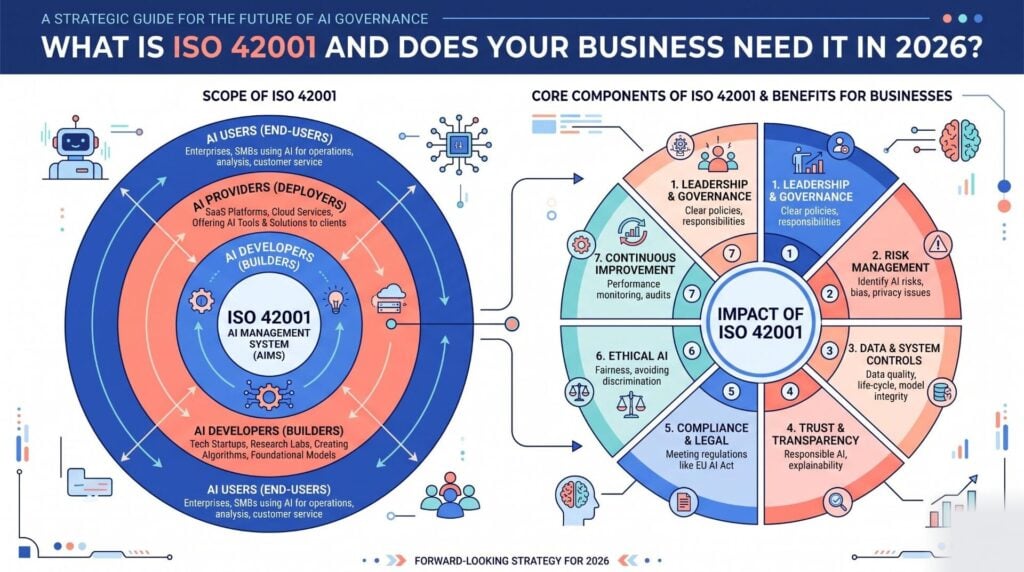
ISO 42001 applies to any business that builds, sells, or uses AI. That scope is wide by design. It covers software vendors, internal AI teams, and businesses that use third-party AI tools in client work.
Growing businesses using AI for marketing, customer service, or internal decisions fall within scope. The standard has no size limit. A five-person firm using AI-generated client reports has the same basic rules as a 500-person company running automated underwriting.
How Does ISO 42001 Relate to the EU AI Act?
The EU AI Act sorts AI systems by risk level. High-risk systems in hiring, credit, healthcare, or critical work face strict rules. ISO 42001 gives you documented proof of safe AI governance. That maps directly to what EU regulators want to see.
The European Commission AI Act guidance (2025) says alignment with standards like ISO 42001 can serve as proof of compliance for some AI Act rules. That is a big benefit. Certification can shorten your compliance path in European markets by a lot.
What Does Certification Actually Involve?
Certification follows four phases. Phase one is a gap check against the standard’s clauses. Phase two is building or updating governance documents, risk records, and AI policies. Phase three is an internal audit. Phase four is a third-party audit by an approved certification body.
Most growing businesses finish in 9 to 15 months. Businesses with ISO 27001 or ISO 9001 frameworks often move faster. Approved audit bodies include UKAS in the UK and ANAB in the US.
| Phase | Activity | Typical Duration |
|---|---|---|
| 1 | Gap Assessment | 4-6 weeks |
| 2 | Policy and Framework Build | 3-6 months |
| 3 | Internal Audit | 4-6 weeks |
| 4 | Third-Party Certification Audit | 2-4 weeks |
What Does ISO 42001 Cost?
Costs vary by business size and governance maturity. For most growing businesses, total costs fall between $15,000 and $80,000. That total includes consultant fees, document work, staff time, and audit fees.
Yearly review audits cost $3,000 to $10,000 to keep your certificate active. Businesses with ISO 27001 frameworks in place spend 30 to 40% less. Core governance work carries over and cuts the setup cost.
Here is a typical cost breakdown for a growing business:
- Gap assessment: $3,000-$8,000 (external consultant)
- Policy and framework build: $8,000-$40,000 (consultant or internal effort)
- Staff time: 80-200 hours across the full process
- Certification audit: $5,000-$15,000 (approved body)
- Yearly review: $3,000-$10,000 per year
If you sell to large clients or regulated sectors, the ROI often shows in your first contract renewal. You skip a long vendor review process. That saves time and money for both sides.
AI Smart Ventures provides AI consulting to help growing businesses scope their ISO 42001 readiness before committing a budget. Schedule a consultation to get a realistic cost estimate for your situation.
Should Your Business Pursue Certification Now?
The answer depends on three things: your client base, your industry, and how much you use AI. If you sell to large clients, regulated sectors, or European markets, the case for certification is strong. If your AI use is light and clients are not asking about governance, a lighter framework may be enough in 2026.
Here are clear signs that certification is worth pursuing this year:
- Large clients have sent AI vendor questionnaires in the past 12 months
- You work in healthcare, finance, legal, or insurance
- You sell or plan to sell into EU markets
- You use AI in any client-facing decision process
- A competitor has announced ISO 42001 certification
If none of those apply, start with an AI advisory engagement. Building ISO 42001-aligned governance documents gives you a solid base. It also serves as your starting point when you are ready to certify.
How Does ISO 42001 Compare to Other AI Frameworks?
Several AI governance frameworks exist alongside ISO 42001. Each serves a different purpose. This table shows how the main ones compare for growing businesses:
| Framework | Published By | Mandatory? | Certification Available? | Best For |
|---|---|---|---|---|
| ISO 42001 | ISO | No | Yes | Global certification, sales trust signals |
| NIST AI RMF | NIST (US) | No | No | US-based risk management |
| EU AI Act | EU Commission | Yes (EU market) | No (compliance only) | EU regulatory compliance |
| OECD AI Principles | OECD | No | No | Policy alignment |
ISO 42001 is unique because it offers third-party certification. That makes it verifiable to clients and regulators. The other frameworks do not offer this. But certification does not replace EU AI Act compliance for businesses in Europe. It supports it.
Frequently Asked Questions
What is ISO 42001 in simple terms?
ISO 42001 is an international standard that tells businesses how to manage AI responsibly. It was published in December 2023 by the International Organization for Standardization. The standard covers AI risk checks, governance setup, document practices, and ongoing review. It works like ISO 9001 for quality management but is built entirely for AI. Any business using AI in client work should know this standard.
Is ISO 42001 mandatory for businesses?
ISO 42001 is not mandatory right now. No government requires it as standalone law. But the EU AI Act points to it as a path to compliance for high-risk AI. Growing businesses selling to large clients or government agencies may find it becomes a contract rule in practice. The pressure is growing each year.
How long does ISO 42001 certification take?
Most growing businesses finish ISO 42001 certification in 9 to 15 months. Businesses with ISO 27001 or quality frameworks often finish in 6 to 9 months. The timeline depends on how much governance documentation you already have. It also depends on how much staff time you can put in each week. Starting with a gap check gives you a clear timeline estimate.
What is the difference between ISO 42001 and the EU AI Act?
ISO 42001 is a voluntary standard with third-party certification. The EU AI Act is binding EU law. It applies to any AI system used or sold in the EU. The two work together. ISO 42001 certification gives you documented proof that supports EU AI Act compliance. This is especially true for high-risk AI categories.
Who should get ISO 42001 certified?
Growing businesses in regulated sectors are the strongest fit. This includes healthcare, finance, legal, and insurance. Any business selling into European markets also benefits. If your clients ask about AI governance, certification gives you a clear, verified answer. It shows your AI use is managed, checked, and documented.
Does ISO 42001 cover all AI tools a business uses?
ISO 42001 covers AI systems within your control. If you use a third-party AI tool for client work, that tool falls within scope. You document how you chose it, how you check its outputs, and how you manage its risks. The standard does not require you to audit the tool’s code or models.
How much does ISO 42001 certification cost?
Total costs for most growing businesses range from $15,000 to $80,000. AI Smart Ventures offers AI consulting to help you scope the cost before you commit. Yearly review audits add $3,000 to $10,000 per year. Businesses with existing ISO frameworks typically spend much less to reach certification.
What happens if I fail the certification audit?
A failed audit does not end the process. The auditor gives you a gap report that lists the specific areas you need to fix. You have 30 to 90 days to address those issues. A partial or full re-audit then confirms your fixes. Most businesses treat the first audit as a learning step, not a hard pass-or-fail test.
Can a growing business self-certify for ISO 42001?
No. ISO 42001 requires a third-party audit by an approved certification body. Self-checks are useful for gap analysis but they do not produce a certificate. The value of certification comes from independent review. Clients and regulators trust third-party audits, not internal claims. Self-assessment is a start, not a finish.
How does ISO 42001 help with AI vendor management?
ISO 42001 includes rules for managing AI providers and third-party tools. It requires written steps for checking, choosing, and tracking AI vendors. This gives growing businesses a clear way to review any AI tool they bring in. It also reduces risk and improves how you make decisions about AI tools.
Executive Summary
ISO 42001 is the first international standard for AI management systems. The International Organization for Standardization published it in December 2023. It gives growing businesses a certifiable framework for AI risk, governance, and oversight.
Certification costs $15,000 to $80,000 for most growing businesses. Timelines run 6 to 18 months. Businesses selling to large clients, regulated sectors, or EU markets have the clearest case for early certification. For others, building ISO 42001-aligned governance documents is a smart first step before committing to full certification.
What Should You Do Next?
Start with a gap check against the ISO 42001 clauses. This shows where your current AI practices stand. Then focus on the three to five governance gaps most likely to affect client trust or regulatory risk.
Build documents in layers. Start with your AI risk register and AI use list. Move toward full certification after that. Most businesses complete the gap phase in under six weeks.
AI Smart Ventures offers AI consulting services for growing businesses ready to assess or pursue ISO 42001 readiness. Schedule a consultation to get a clear picture of where you stand and what certification would cost your business.
People Also Read
- Best AI Automation Stacks for Growing Businesses in 2026
- What Is an AI Revamp and Why You Do Not Need Another AI Tool in 2026
About the Author
Nicole A. Donnelly is the Founder of AI Smart Ventures and an AI Adoption Specialist with 20 years of experience as a founder and CEO and over a decade leading AI adoption initiatives. She helps businesses integrate artificial intelligence with clarity and confidence, driving innovation and sustainable growth. Nicole has trained over 20,217 professionals in Applied AI, delivered 624 workshops, and worked with close to 1,000 organizations across diverse industries.
Expertise: AI Transformation, AI Strategy, AI Implementation, AI Adoption, Applied AI, Marketing, Business Operations
Disclaimer: This content is for informational purposes only and does not constitute professional business or technology advice. Results vary based on industry, existing systems and implementation commitment. Contact AI Smart Ventures for a consultation regarding your specific situation.