
What Should Financial Planners Ask AI Before a Review?
Last Updated: October 2026
AI financial planning meeting prep is the work of getting ready for a client review with help from an AI tool. Most planners point that tool at the plan and ask for a summary. The plan is the one thing you know by heart. What you don’t know is what’s shifted in the client’s life since you last sat down, and that’s what a good review turns on.
AI Smart Ventures has guided growing businesses, including founder-led planning practices, through AI adoption in work where the client bond is the product. The same pattern shows up each time: the gain comes from asking a better question, not from making a faster summary.
Miss a change, and the review goes flat. A client who sold a business in March, or buried a parent in June, notices when nobody asks. Catch it and the same hour becomes the meeting they describe to a friend, and the difference sits in what you asked the tool for the day before.
Key Takeaways
- Ask what changed, not what the plan says: a review lives on new facts, and the plan is the one thing sitting in your head.
- Summaries drop what matters most: a Georgetown study reported on 25 September 2026 found AI summaries left out 51.6% of central details, and 95% missed the main event.
- Prep time is not the real bottleneck: Kitces Research puts prep at almost 30 minutes per hour of meetings, and the hard part is choosing what to raise.
- Nothing reaches the client unread: in Advisor360’s 2026 report on 300 US advisors, 93% want the final say before any AI output goes to a client.
Read as a set, they narrow the tool’s job in a useful way. You are not asking AI to think about the client; you are asking it to read more of the file than you have time to read, then hand back the few lines where something moved. What those lines mean is yours to work out, and so is the meeting.
What should AI surface before a client review?
Ask it for change, not for content. Point the tool at your notes and messages from the past twelve months and ask one question: what did this client tell us that is new since the last review? A new job. A house move. A birth, a death, a business sold, a parent moving in. Even a quiet shift in what they said they wanted the money for. Those lines are the meeting.
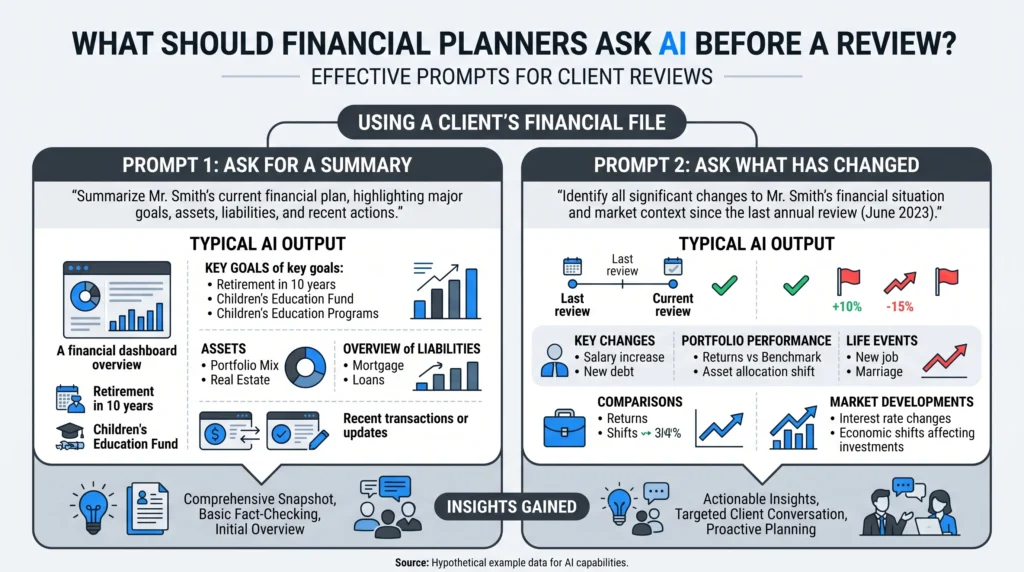
How you ask matters more than the tool does. A summary request hands you the average of a file, and that average is what you know. A change request hands you the odd ones out, which is where a review earns its keep. Orion’s survey of 571 advisors, fielded in December 2025 and released on 25 February 2026, found firms see the most value in automating admin work and preparing for client meetings. Prep is the harder half, and most firms still do it by hand.
Where does AI find what changed since last time?
In four places, and none of them is the plan. Your meeting notes hold what the client said out loud. Email and texts hold what they said in passing and no one filed. The client file holds forms, named heirs and papers they sent in. Your task list holds the follow-ups agreed last time that never closed. A tool reading all four at once spots a pattern that no single record shows on its own.
Most firms cannot do that yet, and the survey data says so plainly. Orion found only 3% of firms have fully joined-up data across their systems, while 60% call theirs mostly joined up with hand work still needed. So start narrow: give the tool one folder of notes for one client, ask the change question, then read the answer against your own memory of the last meeting. That one test tells you whether your notes are good enough to be worth reading at all.
| Where you look | What it usually holds |
|---|---|
| Meeting notes | Life events said out loud, in the client’s own words |
| Email and messages | Changes mentioned in passing and never written down |
| The client file | New forms, beneficiary edits, papers the client sent |
| Open task list | Follow-ups agreed last time that nobody closed |
How do you pick the two or three things to raise?
Rank the changes by how far they move the plan, then stop at three. A house move that shifts a mortgage and a state of residence outranks a new streaming habit, and a death in the family outranks a job title change. Ask the tool to sort what it found by likely effect on the client’s stated goals, then argue with that order yourself, because you know what this client really wants to talk about.
Michael Kitces’ March 2026 advisor tech column puts the point sharply. Advisors spend almost 30 minutes of prep for every hour of meetings, yet writing the agenda is not the pain. The pain is “selecting what to cover (or not) in the agenda itself,” since packing too much in leaves no room for the talk the client came for. Three items with space around them beat nine read at speed. That is workflow optimization, not a longer list. Generic AI consultants tend to sell the summary, because a summary demos well and a short, hard list does not.
AI Smart Ventures offers AI Consulting that maps where AI fits inside a planning practice and where the planner decides. That is the change management behind a prep habit that survives a busy quarter.
What client details stay out of a general AI tool?
Names, account numbers, health notes, family disputes and anything else private stay out of any tool your firm has not cleared. CFP Board’s privacy standard asks a planner to take reasonable steps to protect non-public personal information about a client, held on paper or on a screen, from access that could cause harm or upset. A public chatbot is not a cleared place, however good its answers look.
That still leaves plenty you can do in a general tool. You can shape a neutral agenda, draft the wording of a hard question, or rehearse how to open a touchy subject, all without one client detail in the box. Work that touches the real file belongs in a tool your compliance lead has cleared, with a contract, tight access and records you can search later. Ask two questions before the first upload: who can see this, and how long is it kept?
What checks run before you walk into the room?
Trace every line back to a source before you trust it. AI summaries both drop things and invent them, and the research is blunt about how often. In work written up on 25 September 2026 by researchers at Georgetown and the University of Washington, summaries left out 51.6% of the key details on average, and 95% of them missed the one main event in the clip they described. A brief you cannot trace is a draft.
So treat the output as a list of leads rather than findings. Open the note behind each line and check the tool read it right, and where a figure shows up, confirm it against the record rather than the summary. Where the tool says a client mentioned something, find the sentence they said it in. Advisor360’s 2026 report found 93% of advisors want the final say before AI output reaches a client, and the advice itself always stays with the licensed planner.
Frequently Asked Questions
How far back should the AI look for changes?
Back to your last review with that client, plus a few weeks on either side. Twelve months is the normal window for a yearly review, and the extra weeks catch things said just before or just after you last met. Reaching further back mostly buys noise, since older items have been covered, and if the client lived through a big event you can run a second pass on that period alone.
Can AI build a financial plan on its own?
No, and the body behind the CFP mark has said so plainly. CFP Board’s Leading the Future report on AI in the field argues for openness, human judgment and someone who answers for the advice, alongside the time savings. A July 2026 test written up in its newsroom put five money challenges to chatbots and found they handled broad questions well but struggled once a person’s own life and feelings entered the picture.
How should a client get ready for a review meeting?
Ask them for changes, not for papers. A short note a week ahead works well: tell us what has changed since we last met, in work, family, health, property, or in what you want the money to do. Two or three lines is plenty. Sending a long list of papers to gather turns prep into homework, and most people quietly skip homework.
Is a public chatbot safe enough for review prep?
Only for work that carries no client details at all. A public assistant is fine for shaping questions, drafting a neutral agenda outline, or practicing a hard opening line. It is not the place for names, account numbers, health notes or family matters. CFP Board’s privacy standard asks for reasonable steps to protect non-public personal information, and a public tool your firm has never checked does not clear that bar.
What if the AI invents a change that never happened?
Assume it sometimes will, and build the check in. The September 2026 research found AI summaries do not only drop things, they also invent them, and people who read a wrong summary recalled the real facts just 44.8% of the time against 83.6% for a sound one. So open the note behind each line before you say it out loud in front of the client.
Should AI choose the order of the agenda?
It can propose an order, and you set it. Sorting by likely effect on the client’s goals is a fair first pass, and a tool does that quickly across a year of notes. What software cannot weigh is mood. Someone who has just lost a parent may need the small, easy item first. Take the ranking, move one thing by hand, and you usually end up with the right agenda.
Who checks the brief when a planner works alone?
You do, and the check is quicker than it sounds. Pick the three lines you plan to raise and trace each back to the note it came from. Two minutes a line covers it. Working alone changes nothing about who carries the review, so the AI brief adds no duty you did not already hold. What it changes is how much of the file you got through first.
How long should review prep take with AI?
Aim to halve it, not to wipe it out. Kitces Research puts prep at almost 30 minutes for every hour spent in client meetings, and a change brief cuts the reading part sharply while the checking and the thinking stay put. Anyone promising near-zero prep is counting the reading only. The time you save belongs inside the meeting, which is the part the client remembers.
Does a spouse’s change belong in the same brief?
Yes, whenever both are your clients and the file is joint. A partner’s new job, retirement date or health news moves the household plan as much as the named client’s would. Ask the tool to read across the household rather than one person. Where only one spouse is your client, privacy rules still cover the other, so keep what you learn separate and ask before you act on it.
How does a planning firm start using AI for review prep?
Take your next five reviews and run the change question by hand first, reading the notes yourself. That tells you whether your records hold much a tool could find. Then pick one cleared tool and repeat it. Scope drives what you take on: one workflow with a named checker takes weeks, not a rebuild. Schedule a consultation to design that first workflow with your compliance lead present.
Executive Summary
AI financial planning meeting prep works when you ask the tool what changed in the client’s life, not what the plan says. Notes, email, the client file and open tasks are where change hides, and twelve months is the normal window. Rank what comes back by its effect on the client’s stated goals, then stop at three items. Keep private client details out of any tool your firm has not cleared. Check each line against the record before the meeting, since summaries both drop things and invent them, and the planner still owns every judgment in the room.
What Should You Do Next?
This week, take your next five review meetings and run one question across each client’s notes from the past year: what has changed that we have not discussed yet? Write the answers down, pick the top three per client, and trace each one back to the note it came from. That short list, not the plan summary, is your agenda.
AI Smart Ventures offers AI Consulting for growing businesses that want practical AI inside client work, built for operational efficiency rather than novelty. Schedule a consultation to build a review-prep workflow your planners and your compliance lead can both sign off.
People Also Read
- Industry 4.0 vs Applied AI: Which Pays Back First
- AI Implementation for Wellness Brands: A 90-Day Roadmap
About the Author
Nicole A. Donnelly is the Founder of AI Smart Ventures and an AI Adoption Specialist with 20 years of experience as a founder and CEO and over a decade leading AI adoption initiatives. She helps businesses integrate artificial intelligence with clarity and confidence, driving innovation and sustainable growth. Nicole has trained over 20,217 professionals in Applied AI, delivered 624 workshops, and worked with close to 1,000 organizations across diverse industries.
Expertise: AI Transformation, AI Strategy, AI Implementation, AI Adoption, Applied AI, Marketing, Business Operations
Disclaimer: This content is for informational purposes only and does not constitute professional business or technology advice. Results vary based on industry, existing systems and implementation commitment. Contact AI Smart Ventures for a consultation regarding your specific situation.