
When Should You NOT Use AI? A Practical Guide for Business Leaders
Last Updated: March 2026
Knowing when you should and should not use AI is as important as knowing when to adopt it, and most business AI implementations fail because of misapplied use cases rather than poor technology. AI Smart Ventures works with leaders across industries and consistently finds that the organizations losing money on AI investments are the ones that deployed AI in the wrong workflows before understanding what the technology cannot reliably do. This guide identifies the specific scenarios where AI creates risk, adds cost, or produces worse outcomes than non-AI alternatives.
Key Takeaways
- Generative AI and other AI models produce unreliable outputs in high-stakes, real-time, and emotionally complex situations that require nuanced human judgment.
- Legal advice, medical diagnosis, financial planning, and crisis communications are categories where AI errors carry serious consequences.
- AI underperforms when the underlying data is poor, sparse, or unrepresentative – AI amplifies existing data quality problems rather than solving them.
- Automation of a broken process makes the process faster but keeps it broken – fix the process before automating.
- AI adds unnecessary cost and complexity for simple, low-volume tasks that a human handles faster and better.
- Gartner (2025) found that 55% of AI proof-of-concept projects fail to reach production, with use case misalignment cited as the leading cause in 42% of failures.
When Does AI Produce Unreliable Outputs in Business?
AI produces unreliable outputs when decisions require real-time contextual awareness, emotional intelligence, or regulatory accountability that the AI cannot provide. Real-time situations – a customer in distress, a negotiation in progress, a safety incident – require adaptive human judgment that AI models trained on historical data cannot replicate accurately. Regulatory and legal decisions require a traceable, accountable decision-maker that AI cannot be. AI confidence does not correlate with AI accuracy in these contexts – models give confident answers in domains where they are fundamentally unsuited.
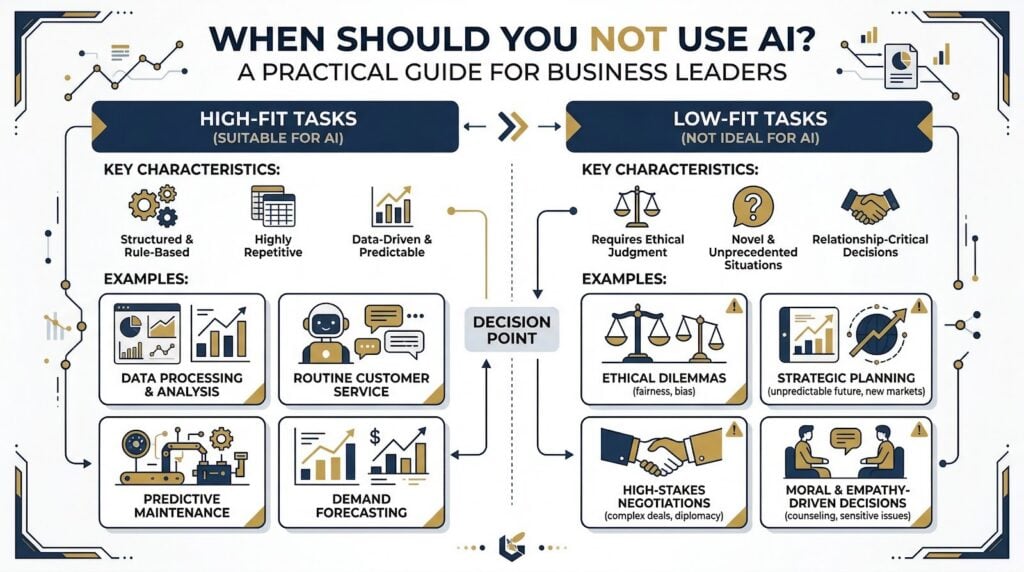
McKinsey 2025 State of AI found that organizations deploying AI in mismatched use cases spent an average of 2.3x more on remediation and rework than organizations that conducted structured use case validation before deployment. AI strategy that begins with a “no-go zone” list prevents the most expensive AI implementation mistakes.
Which Core Business Functions Should Avoid AI Decisions?
Several core business functions should not rely on AI for final decisions. Legal judgments require licensed professionals accountable for their advice – AI legal summaries are useful for research but not for advice. Financial planning for regulated businesses requires fiduciary judgment that AI cannot hold. Medical diagnosis requires licensed professionals with patient-specific context. Crisis communications require empathetic, real-time situational awareness. HR decisions including performance reviews and terminations carry legal liability that requires human judgment.

Harvard Business Review (2024) found that organizations using AI for performance evaluations faced 34% higher employee relations disputes than those using AI only for data synthesis and human-led final decisions.
If you are unsure whether a specific function in your organization is suited for AI, explore AI consulting services from AI Smart Ventures to assess use case fit before committing to a deployment.
When Does Poor Data Quality Make AI a Bad Choice?
Poor data quality makes AI a poor choice because AI models amplify whatever patterns exist in their training or input data, including errors, gaps, and biases. Sparse data – fewer than a few thousand relevant examples – produces unreliable predictions that look confident. Biased historical data produces AI outputs that replicate and scale those biases into future decisions. Stale data produces AI that reflects past market conditions rather than current reality. Forrester (2025) found that 68% of failed AI deployments cited data quality as a contributing factor.
Forrester AI readiness research confirms that skipping data audits before deployment consistently produces underperforming AI systems. AI implementation in data-poor environments produces worse outcomes than simpler statistical methods, rules-based logic, or experienced human judgment. Fixing data infrastructure before deploying AI is the single most reliable predictor of AI ROI.
When Should You Fix the Process Before Adding AI?
Adding AI to a broken or poorly defined process accelerates the production of wrong answers. Automating a customer support workflow with inconsistent routing rules produces faster incorrect resolutions. Adding AI to an onboarding process that lacks clear steps produces AI-generated documentation for an undefined workflow. AI cannot diagnose or fix process logic failures – it can only execute the logic it is given, faster. A process audit before any AI automation engagement identifies whether the workflow is ready for AI or needs redesign first.
Accenture 2024 Technology Vision report found that 47% of AI workflow failures traced back to an undocumented or inconsistent underlying process. Addressing process clarity before AI deployment prevents the most avoidable workflow automation failures.
When Is AI Overkill for a Simple Task?
AI is overkill when the task is simple, low-volume, or already handled reliably by a person or a rules-based system. Sending a single recurring email, generating a standard monthly report from a fixed template, or routing a predictable customer query does not require generative AI or machine learning. A spreadsheet formula, an email template, or a simple if-then routing rule costs less, runs faster, and fails more predictably than an AI system. Applied AI creates value at scale and in contexts requiring synthesis – not for tasks a workflow already handles.
| Scenario | AI Recommended? | Better Alternative |
|---|---|---|
| Complex document synthesis | Yes | – |
| Fixed-format report from known data | No | Spreadsheet or template |
| High-volume pattern detection | Yes | – |
| Single recurring standard email | No | Email template |
| Legal advice or medical diagnosis | No | Licensed professional |
| Customer support at scale | Partial | AI triage + human resolution |
Frequently Asked Questions
What tasks should never be automated with AI?
Tasks involving legal advice, medical diagnosis, financial fiduciary decisions, and mental health support should not be automated with AI because errors carry severe consequences and require licensed, accountable professionals. AI can assist these professionals with research and documentation but should not generate the final advice or recommendation. Additionally, tasks requiring real-time empathy – crisis intervention, conflict resolution, bereavement support – should not be handled by AI because the lack of genuine situational awareness creates harm risk that outweighs any efficiency benefit.
How do you know if an AI use case is a good fit?
A use case fits AI well when the task is high-volume, data-heavy, time-consuming, produces consistent inputs, and errors are catchable before they cause harm. A poor fit includes tasks requiring real-time judgment, high-stakes decisions with legal or safety consequences, sparse or biased data, or tasks simple enough that a template already handles reliably. Structured AI readiness scoring against these criteria before deployment prevents the majority of misfit deployments.
Does AI always save time and money?
AI does not always save time and money. Poorly matched use cases cost more than the baseline because of implementation costs, error correction, and remediation. Gartner (2025) found that 30% of AI projects delivered negative ROI when full lifecycle costs were factored in. AI delivers best ROI in high-volume, well-defined, data-rich tasks. The real AI strategy question is not “can we use AI for this” but “does AI produce a better outcome per dollar.”
What are the signs that an AI implementation went wrong?
Signs that an AI implementation went wrong include: outputs requiring constant human correction, team members reverting to manual workflows, accuracy metrics that worsen over time, and stakeholder complaints about incorrect or off-brand content. A subtle indicator is AI producing plausible-sounding but unverifiable outputs that create false confidence in decisions. These patterns point to a use case mismatch, a data quality problem, or an insufficient human review layer in the workflow.
Should small businesses avoid AI entirely if they lack technical resources?
Small businesses without technical resources should start with no-code, managed AI tools rather than custom builds. Managed platforms handle infrastructure, updates, and data privacy, reducing technical requirements significantly. The main risk is over-scoping the first AI project based on vendor promises. Start with one specific, high-volume task where AI can produce a measurable improvement, validate the result, then expand. AI adoption with a clearly defined problem and measurable success criteria delivers value far more reliably than adoption driven by competitive pressure.
Can AI make ethical mistakes in business?
AI makes ethical mistakes when it perpetuates biases in training data, applies rules rigidly to situations requiring contextual exceptions, or produces outputs in sensitive domains without human oversight. Facial recognition errors, credit scoring biases, and AI-generated hiring screens that disadvantage protected groups are documented cases. AI governance policies defining which decisions require mandatory human review and how AI errors are corrected are essential for responsible AI implementation. Skipping AI governance creates legal and reputational exposure.
When is it better to hire a human than deploy AI?
Hiring a human is better when the task requires relationship-building, empathetic communication, professional judgment, or real-time adaptability in unpredictable situations. Negotiators, strategic consultants, therapists, and senior managers making organization-wide decisions create value that AI cannot replicate. AI is the better choice when the task is high-volume, repeatable, and output quality is measurable. The decision is not AI versus humans – it is which combination produces the best outcome for each specific task.
What is the cost of using AI where it should not be used?
The cost of misapplied AI includes direct costs – implementation, maintenance, and error correction – plus indirect costs including employee distrust, customer complaints, and regulatory risk. McKinsey (2025) found that organizations spending heavily on AI remediation had deployed AI in customer-facing workflows without adequate testing. The greatest AI cost is organizational time spent cleaning up outputs that should not have been AI-generated. Schedule a consultation to evaluate whether your current AI deployments are cost-justified.
How should business leaders evaluate AI use cases before approving them?
Business leaders should evaluate AI use cases against four criteria: decision consequence (what happens if the AI is wrong), data quality (is input data representative and current), process clarity (is the workflow well-defined), and team capacity (can the team review and correct AI outputs). Approving an AI project without satisfactory answers to all four questions creates predictable deployment failures. Gartner confirms that structured use case evaluation before AI investment is the leading differentiator between successful and failed deployments.
What should you do if AI is already deployed in a poor-fit use case?
If AI is deployed in a poor-fit use case, assess severity: is it causing harm, eroding trust, or producing legal risk, or merely underperforming on efficiency? For harmful deployments, pause the AI layer and revert to manual processes immediately. For underperforming deployments, conduct root cause analysis against use case fit, data quality, process clarity, and oversight capacity. Most poor-fit AI deployments can be redirected to a better-matched use case rather than shut down entirely.
Executive Summary
AI should not be used for legal, medical, and financial decisions requiring licensed professionals; high-stakes decisions where errors have severe consequences; workflows dependent on real-time emotional judgment; tasks with poor or biased underlying data; broken or undefined processes; and simple, low-volume tasks that a template or rules-based system already handles reliably. The cost of misapplied AI exceeds the cost of not using AI at all. AI strategy, AI readiness assessment, and AI implementation planning that begin with use case validation – not technology selection – consistently deliver better outcomes than deployments driven by competitive pressure or feature enthusiasm. AI enablement for business leaders starts with an honest capability boundary assessment. AI Smart Ventures helps organizations map workflows to realistic AI fit criteria before a budget is committed.
What Should You Do Next?
Audit your current AI deployments against the criteria in this article. For each use case, score it on data reliability, judgment complexity, and relationship sensitivity. Pause any deployment scoring high on all three and redirect those resources to use cases with a genuine fit.
AI Smart Ventures offers AI advisory and AI consulting services for small businesses assessing which workflows are genuinely ready for AI. Schedule a consultation to build an AI readiness assessment for your business.
People Also Read
- How to Use AI for Competitive Intelligence and Market Research
- AI for Project Management: How Asana AI, Monday AI, Notion AI, and ClickUp AI Compare
About the Author
Nicole A. Donnelly is the Founder of AI Smart Ventures and an AI Adoption Specialist with 20 years of experience as a founder and CEO and over a decade leading AI adoption initiatives. She helps businesses integrate artificial intelligence with clarity and confidence, driving innovation and sustainable growth. Nicole has trained over 20,217 professionals in Applied AI, delivered 624 workshops, and worked with close to 1,000 organizations across diverse industries.
Expertise: AI Transformation, AI Strategy, AI Implementation, AI Adoption, Applied AI, Marketing, Business Operations
Disclaimer: This content is for informational purposes only and does not constitute professional advice. Results vary based on organization size, industry, and implementation approach.