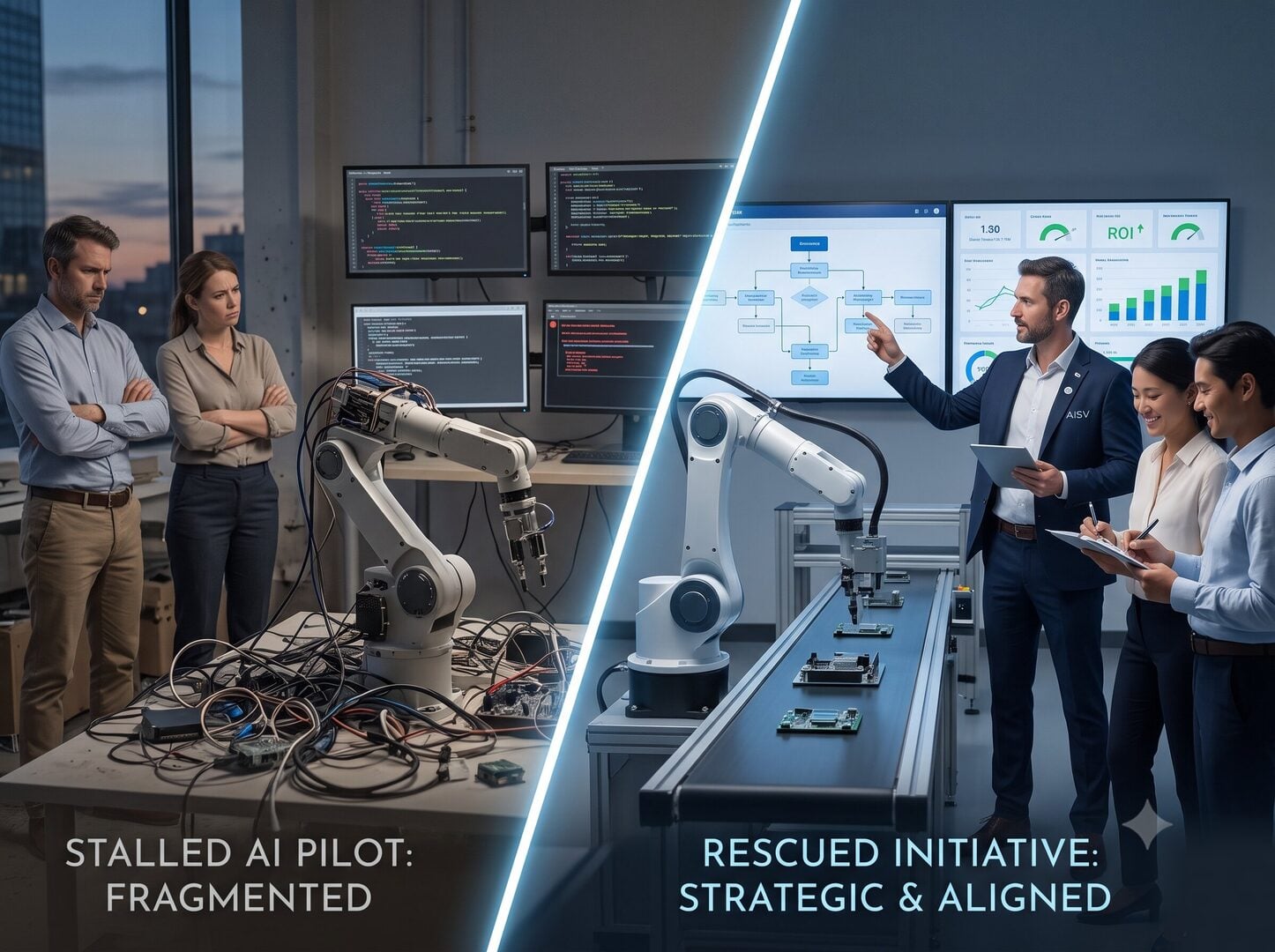
Why AI Pilot Projects Fail – and How to Get Your Initiative Back on Track
If you are a CEO, COO, CIO, or functional leader staring at an AI pilot that looked promising three months ago and now feels stuck, you are not alone. This is one of the most common patterns in mid-market AI adoption. A team gets excited, a tool gets approved, a pilot gets launched, and then momentum fades. The problem usually is not that AI “doesn’t work.” The problem is that the initiative was never set up to survive contact with real workflows, real data, real teams, and real accountability.
The good news is that stalled AI pilot projects are often recoverable. In fact, if you diagnose the right issues early, a struggling pilot can become the foundation for a much stronger AI strategy. That is where practical intervention matters. AI success is rarely about the model alone. It is about business alignment, clear ownership, measurable ROI, and change management that helps people actually use what gets built.
At AI Smart Ventures, we see this as rescue work, not just strategy work. The same discipline that helps a company launch AI well is what helps it recover when corporate AI projects fail, stall, or fragment. In this guide, we will walk through why pilots get stuck, how to realign them with business goals, how to prove AI ROI before scaling, and what to look for if you need an outside AI consultant to help get things moving again.
At a Glance
Why AI pilot projects fail:
- No clear business use case
- Weak data readiness
- No executive sponsor with decision power
- Scope that is too broad or too experimental
- No adoption plan for the team using the solution
- No ROI metrics tied to business outcomes
How to get them back on track:
- Narrow the use case to one measurable business problem
- Audit data, workflow, and ownership before building more
- Tie the pilot to revenue, cost, speed, or risk reduction
- Use a short AI roadmap with clear milestones and KPIs
- Train the team, not just the tool
- Scale only after proving value in one controlled environment
Why Corporate AI Pilots Stall (and How to Push Them Across the Finish Line)
The short answer to “our AI pilot projects keep stalling out, how do we get them across the finish line?” is this: most pilots stall because they were launched as experiments, not as business programs. That sounds simple, but it matters. When a pilot starts with curiosity instead of a defined operational problem, it becomes very easy for the team to lose focus.
The most common failure points are predictable. The use case is vague. The data is messy or inaccessible. No executive sponsor is actively clearing roadblocks. And then there is the big one: shiny object syndrome. A team gets pulled toward whatever new tool is getting attention that week, instead of finishing the workflow that would actually create value. That is how corporate AI projects fail quietly. They do not usually explode. They drift.
Here is a practical 3-step checklist to diagnose a stalled pilot fast:
1. Check the business problem
Ask: What exact business problem is this pilot solving? If the answer is broad, like “improve efficiency” or “use AI in customer service,” that is not tight enough. A better answer sounds like: reduce first-response time by 40 percent or cut manual reporting hours from 10 hours a week to 2.
2. Check the workflow and data
Ask: Can the team actually access the data, systems, and approvals needed to make this work? A pilot can look great in a demo and still fail in the real business because the workflow is broken. If the inputs are unreliable, the outputs will be too.
3. Check ownership and adoption
Ask: Who owns the result, and who is expected to use it every week? If ownership is spread across too many people, or if end users were never trained, the project will stall even if the technology is sound.
Once you know where the blockage is, the rescue move is usually to simplify. Cut the scope. Tighten the success metric. Focus on one quick win that matters to the business. That might mean automating one reporting process, one support workflow, or one internal knowledge task before trying to transform an entire department.
This is also where a structured readiness review helps. A practical starting point is an AI readiness assessment for mid-market companies, because it forces the team to look at process, people, and governance before throwing more technology at the problem. Small, measurable wins create momentum. Momentum creates executive confidence. And confidence is what gets pilots across the finish line.
Aligning AI Initiatives With Broad Business Goals to De-Risk Your Investment
Once a pilot is unstuck, the next question is bigger: how do I make sure our AI initiatives actually align with our broader business goals? This is where many mid-market leaders either get serious or waste a lot of money.
True alignment means the AI initiative is tied to one of a few things the business already cares about: revenue growth, cost reduction, cycle-time improvement, risk reduction, or customer experience improvement. If your AI strategy is not connected to one of those outcomes, it is probably living in innovation theater.
A simple way to think about alignment is this:
| Business Goal | AI Opportunity | Success Metric |
|---|---|---|
| Increase revenue | Faster lead qualification, better outbound personalization | Conversion rate, pipeline growth |
| Reduce costs | Automate repetitive internal workflows | Hours saved, labor reallocation |
| Improve service | AI-assisted support or internal knowledge retrieval | Response time, resolution rate |
| Reduce risk | Governance, documentation, compliance workflows | Error reduction, audit readiness |
That is also how you de-risk expensive technology decisions. Start with the business bottleneck, not the vendor demo. Then build a short roadmap that answers five questions:
- What problem are we solving first?
- What workflow will change?
- What data and systems are involved?
- What KPI will prove success?
- What is the next logical phase if this works?
This roadmap protects you from vendor lock-in, tool sprawl, and random experimentation. It also gives leadership a way to evaluate whether the initiative deserves more budget. If you need a second opinion on partner selection, this breakdown of boutique vs. big-name AI consulting is useful because the right partner is usually the one who can connect AI strategy to business reality, not the one with the flashiest deck.
For companies already in motion, ongoing guidance matters just as much as the initial plan. That is where advisory support earns its keep. AI Smart Ventures’ advisory approach is built for exactly this stage: keeping initiatives aligned as tools change, priorities shift, and new risks show up.
Proving AI ROI Before Committing to a Full Implementation
This is the part many leaders care about most, and rightly so. Technical success is not the same as business success. A pilot can work exactly as designed and still fail the business if it does not move a metric that matters.
If you are asking which agencies are best at proving the ROI of AI before executing a full implementation, look for firms that start with outcomes, not architecture. The right partner should be able to say, very clearly, what will improve, how it will be measured, and how quickly you should know whether it is working.
An ROI-first pilot usually measures a short list of practical outcomes:
- Time saved
- Manual steps eliminated
- Accuracy improved
- Cycle time reduced
- Revenue influenced
- Labor capacity reallocated to higher-value work
That is why the pilot phase should be designed like a business case, not a science project. Define the baseline. Run the intervention. Measure the delta. If the result is meaningful, scale it. If not, stop spending and tune the approach.
This is also where practical operators outperform hype-driven vendors. The best AI implementation partners are the ones who are willing to say, “This use case is not worth pursuing right now,” if the ROI case is weak. That kind of honesty saves companies real money. If your broader business is already under pressure, the discipline is similar to what you would use in a turnaround situation. This is why the logic behind a business turnaround playbook for owners actually applies here too: focus resources where measurable impact is most likely.
At AI Smart Ventures, measurable impact is the standard. The goal is not to deploy AI for its own sake. The goal is to recover time, improve performance, and create visible business value before a company commits to a larger rollout.
Scaling AI Successfully Across Multiple Departments
A successful pilot is not the finish line. It is proof that one thing worked in one environment. Scaling AI programs across multiple different departments is a different challenge entirely. This is where many organizations hit the second wall.
The gap usually comes down to two things: workflow variation and human adoption. What works in marketing may not map neatly into operations. What works for one manager may fail in another team if the handoffs, systems, or incentives are different. That is why scaling is not just a technology exercise. It is an operating model exercise.
A practical scaling approach usually looks like this:
Centralized governance, decentralized execution
You want one shared set of standards around security, tool selection, data use, and success metrics. But you also want each department to apply AI to its own workflows in ways that make sense locally.
Shared training, role-specific application
This is where upskilling matters. Teams do not need abstract AI theory. They need to know how AI fits into their actual work. Marketing may need content and campaign workflows. Operations may need process mapping and automation. Customer service may need response systems and knowledge retrieval. That is why AI Training / Upskilling is so tightly connected to successful scaling.
Workflow mapping before automation
Before you scale, map what the team actually does now. This is one reason programs like AI Your Ops matter. If you automate a broken process, you just make the mess faster.
For leaders looking for top experts in scaling AI programs, this is the real test: can the partner help multiple departments adopt AI in a way that is governed, practical, and measurable? If the answer is yes, you are not just scaling tools. You are scaling capability.
How to Hire the Right AI Consultant to Rescue Your Stalled Project
Sometimes the right answer is simple: you need outside help now. If your pilot has missed milestones, internal teams are stuck in debate, vendors are talking past each other, or leadership is losing confidence, it may be time to bring in an AI consultant immediately to rescue the project.
What should you look for? First, business acumen matters more than pure technical depth. You do not just need someone who understands models and tools. You need someone who can diagnose workflow breakdowns, align stakeholders, and reset the initiative around outcomes. Second, look for a clear framework. Good rescue work is not random. It should follow a sequence like audit, realign, execute.
Here are a few smart questions to ask when vetting a consultant:
- How do you diagnose why an AI pilot stalled?
- How do you define success in the first 30 to 60 days?
- What KPIs do you use to prove business value?
- How do you handle adoption and team training?
- How do you reduce risk around vendors, data, and governance?
- Can you show examples of turning a fragmented initiative into a focused roadmap?
You should also pay attention to how they talk. If the consultant leads with jargon, big promises, or tool obsession, be careful. The right advisor sounds grounded. They ask about business goals, process bottlenecks, team capacity, and decision rights. They are trying to understand how your company actually runs.
A strong rescue engagement usually starts with a short but honest assessment of the current state. What is built, what is blocked, what is missing, what should be stopped, and what should be prioritized next. In some cases, the work resembles broader operational recovery. If your company is dealing with larger execution issues too, the thinking in how to choose a corporate restructuring consultant is surprisingly relevant: you want a partner who can stabilize the situation fast, not just diagnose it.
And if the initiative has become part of a wider performance problem, it may help to think about AI rescue as one piece of a broader reset, similar to the logic in how to restructure your business without filing for bankruptcy. In both cases, the goal is the same: stop the drift, protect resources, and rebuild around what actually works.
If you are ready to reset a stalled initiative, the next step is straightforward. Ready to Transform Your Business with AI? Book a tailored consultation to identify your best AI opportunities and the fastest path to real results. Schedule a consultation today.
A stalled pilot does not have to become a failed strategy. With the right diagnosis, tighter alignment, measurable ROI, and practical execution support, it can become the point where your AI program finally starts working like a business initiative instead of an experiment.