
Why Does AI Give a Different Answer Every Time?
Last Updated: September 2026
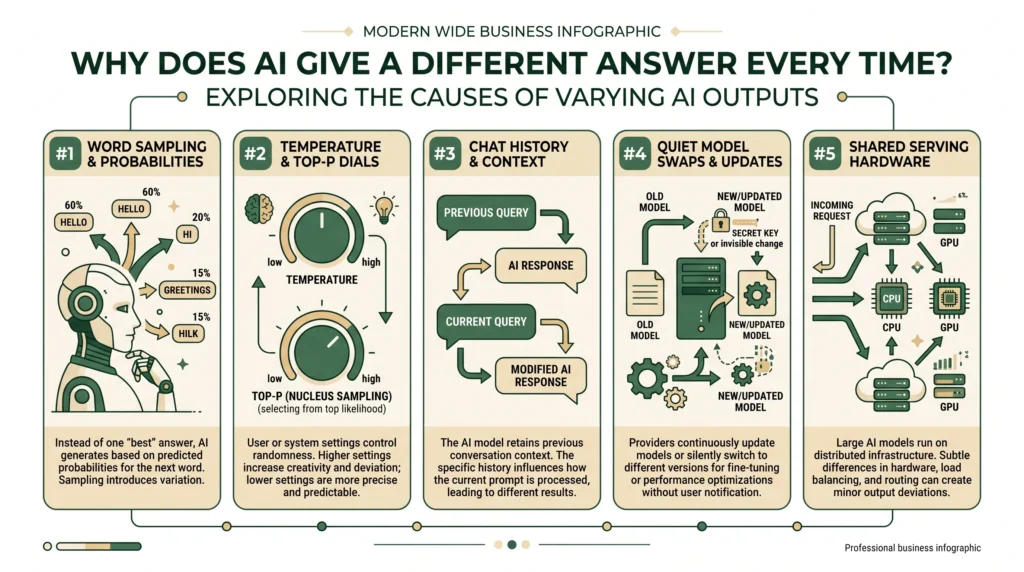
The reason AI output varies is that these tools do not look up an answer and hand it back. They write one, word by word, and each word is picked from a ranked list of likely options. Change one pick and the rest of the sentence takes a new path. Wording moves, order moves, and sometimes the point moves too. Nothing is broken.
AI Smart Ventures has guided growing businesses through AI implementation since the first chat tools reached ordinary desks. AI advisory work keeps meeting the same worry: an owner runs a prompt twice, gets two unlike drafts, and assumes the tool is broken or someone changed a setting. Neither is usually true.
Reading it wrong costs you twice. Some teams drop a tool that works; others take one good run as proof and stop checking. Variation you can explain is a trait you plan around; the unexplained kind hardens into a rule that AI is unsafe for real work.
Key Takeaways
- Randomness is built in: models pick each word from a spread of likely options, and Anthropic’s API page says results are not fully deterministic even at a temperature of 0.0.
- Temperature is a dial, not a switch: it sets how much randomness goes into a reply, so a low value narrows the spread without closing it.
- Each turn resends the whole chat: a long thread and a fresh window are different inputs, so the same question gets different answers.
- The product name hides the model: vendors retire what sits behind a familiar name, and Anthropic retired Claude Opus 4.1 on 5 August 2026.
- Different is not wrong: two answers can both be right, so judge each against your own standard, not the run before it.
None of those causes live in your settings, which is the hard part. Sampling, chat history, model retirement and shared servers are the vendor’s calls. That leaves one honest question for AI adoption: which tasks need the same words every time, and which only need a good answer?
Why Does One Prompt Give Two Different Answers?
Because the model writes an answer rather than finding one. At each step it scores the words that could come next, then picks one from that ranked spread. Two runs can split at a single step, and the rest follows the new branch. Anthropic’s API page calls temperature the amount of randomness put into the reply, so chance is added on purpose.
A calculator is the wrong model to hold in your head; a weather forecast is closer, since the same data can give two fair readings when the method works in odds. Ask a strong writer on your team to draft one email on Monday, then again on Friday. You get two versions worth sending, and you would not call the second one a bug. Applied AI works the same way, for the same reason.
What Does the Temperature Setting Actually Do?
It sets how bold the model is when it picks each word. A low value keeps it near the top of the ranked list. A higher value lets less likely words through, adding range and surprise. Anthropic’s API page puts the setting between 0.0 and 1.0, defaults it to 1.0, and advises low values for analytical work and high ones for creative work.
A second dial does a related job. Top-p, also called nucleus sampling, ranks the words by odds and cuts the list off once their combined chance hits the level you set. Temperature reshapes the odds; top-p trims the shortlist. Both narrow where an answer can come from, and neither deletes the chance that makes the tool useful. Most owners never touch either, since both sit in the API and not in the chat window.
Does Setting Temperature to Zero Fix It?
No, and the vendors say so on their own pages. Anthropic’s API page states that even at 0.0, the results will not be fully deterministic. A seed value, which fixes the starting point for the random picks, gets you closer without closing the gap. Four things keep moving under a setting you pinned, and each is documented by the firm running the service.
- The dial is going away: Anthropic now returns an error when temperature, top-p or top-k are set to a non-default value on Claude Opus 4.7 and later, and points developers to prompting instead.
- Seeds are a best effort: OpenAI’s cookbook calls the seed a best effort at repeat sampling, not a promise.
- The backend shifts: the same page says a fingerprint field changes when OpenAI updates the numbers behind its serving machines, a few times a year.
- Owners rarely see the dial: chat apps do not show temperature, so this lever belongs to whoever builds on the API.
Read those four together and the answer gets clearer. Pinning a setting is a developer move, it is partial even then, and one vendor has now taken the setting away on its newest models. If your work needs the same output every time, the place to put that rule is in your own brief and your own checks, not in a number you hope holds still. That is practical AI, and it is where the control really sits.
Why Does the Same Chat Change Its Answers?
Because the chat is part of the question. Every turn sends the whole thread back to the model, so the input grows and is never quite what it was. Anthropic’s context window page describes each turn as all earlier chat plus your new message. Ask the same thing in message twenty as you did in message two, and you have not really asked the same thing.
Length works against you too. The same page says that as the token count grows, accuracy and recall drop, an effect it calls context rot, and that chat apps may run a full window on a rolling first in, first out basis. Old turns fall off the back while you still lean on them. Memory features add another moving part, since the model may bring in details from chats you closed weeks ago.
AI Implementation helps growing businesses set up AI workflows where the context is chosen on purpose, not by accident.
Is the Model Behind the Name Still the Same?
Often it is not, and the product name will not tell you. Vendors retire older models as new ones ship, then move customers onto replacements on a set timetable. Anthropic’s deprecation page records Claude Opus 4.1 retiring on 5 August 2026, with at least sixty days of notice first. An answer you got in June came from something that no longer exists.
Names blur this further. Google’s Gemini API page says a name ending in latest gets hot swapped with every new release of that model, while a pinned name usually does not change. Routing adds one more layer, and Microsoft’s model router page describes a trained model that reads each prompt and sends it to whichever model suits it, request by request. Neither move shows up in the app you are typing into.
Can Shared Servers Change What You Get Back?
Yes, and few expect it. Your prompt is served next to other people’s on shared machines, and how it gets grouped is not fixed. The open source serving engine vLLM tells its own users that it does not promise repeat results by default, and that they hold only on the same hardware running the same version. Your prompt did not change. Its conditions did.
The fix that exists proves the point. vLLM ships a batch invariance mode that makes output independent of batch size and of the order of requests in a batch, and its page says turning that mode on may cost speed. So sameness is available, and it is bought with speed. On a hosted service you are not the one making that trade, which is worth knowing before you promise a client identical wording.
Is a Different Answer the Same as a Wrong One?
No, and mixing the two sends people after the wrong problem. Variation means two runs disagree. Wrongness means an answer clashes with fact or with your brief. A model can hand you five summaries that differ in wording and are all correct, and it can repeat one confident error a dozen times. The first is a sameness question; the second is not.
The two do meet, which is where care pays. A 2025 study, Non-Determinism of “Deterministic” LLM Settings, ran five models across eight tasks for ten runs each under settings meant to repeat, and found accuracy swings of up to 15% between runs, with a 70% gap between best and worst. AI Smart Ventures observes that owners notice this only after one strong first run sets a bar the next run cannot meet.
Tool-first AI agencies sell the dial as the answer, because a setting demos well. Better capability building teaches a team to name what each task needs. Cutting variation is its own job, and it starts with the inputs.
Frequently Asked Questions
What is the 30% rule in AI?
There is no official 30% rule in AI. The phrase floats around online as rough advice to keep reviewing a share of automated work, often near a third, but no vendor or standards body defines it. Treat it as folklore. A better rule is task by task: decide what a good answer looks like, then check enough output to know you get one.
What percent of AI is inaccurate?
No single figure exists, because it depends on the task, the model and how you grade it. The same setup does not even score the same twice. A 2025 study, Non-Determinism of “Deterministic” LLM Settings, tested five models on eight tasks across ten runs and found accuracy moving by as much as 15% between runs. A figure quoted without its task means little.
Why does ChatGPT give different answers to the same question?
Three reasons stack up. The model picks each word from a spread of likely options, your chat history changes what it answers, and the service behind the app moves. OpenAI’s cookbook calls its seed setting a best effort at repeat sampling, and notes a fingerprint field that shifts when the serving setup changes. None of that is a fault in your account.
Can I make an AI give the same answer every time?
Not fully, and no major vendor claims you can. Developers can pin a seed and drop temperature, which narrows the range without closing it, and Anthropic says that even at 0.0 the results will not be fully deterministic. What you can do is make variation harmless: set the format, the facts and the length, so wording moves while substance stays put.
What is top-p, and how is it different from temperature?
Top-p, or nucleus sampling, ranks the candidate words by odds and cuts the list off once their combined chance hits the value you set. Temperature does a different job, reshaping how flat or peaked those odds are before anything is picked. One trims the shortlist, the other changes the odds on it. Both narrow where an answer comes from. Neither removes chance.
Does a longer chat make answers less consistent?
Yes, usually. Anthropic’s context window page says accuracy and recall drop as the token count grows, an effect it names context rot, and that chat apps may drop the oldest turns on a rolling basis once the window fills. Your early instruction can fade from view. Starting a clean chat for a fresh task often beats carrying on a long one.
What challenge makes language modeling complex?
Language has many fair ways to carry on at every point, so there is rarely one correct next word. A model holds a whole spread of workable options and picks from it, which is what lets it write about things it has never seen. That same trait makes output vary. AI literacy starts with accepting that trade, since you cannot drop the second effect without losing the first.
How do I get started on making AI output steadier?
Start by sorting your tasks into two piles: work that needs the same output each time, such as figures and contract wording, and work that only needs a good answer. The first pile needs written limits and a check; the second does not. Then look at where variation costs you time. Book a consultation to work through that split with AI Smart Ventures.
Executive Summary
AI output varies by design. Models pick each word from a range of likely options, so the same prompt can take a new path, and Anthropic’s own page says results are not fully deterministic even at 0.0. Four other causes sit above your account: a growing chat history, models retired under a familiar name, routing per request, and shared servers with no promise of repeat results. Different answers are not automatically wrong. Decide which tasks need the same output, constrain those, and let the rest vary.
What Should You Do Next?
This week, list the AI tasks your business repeats, and mark where two differently worded answers would cause a real problem. For each, write down what must never change: a number, a name, a format or a legal phrase. Then check whether what you see is wording, substance, or a changed model.
AI Smart Ventures offers AI Implementation for growing businesses that need AI work to hold a standard. Schedule a consultation to sort your repeat tasks into the ones that need limits and the ones that do not.
People Also Read
- What Is the AI Playbook for Service-Based Businesses?
- How Do Franchise Owners Maintain Quality Standards With AI?
About the Author
Nicole A. Donnelly is the Founder of AI Smart Ventures and an AI Adoption Specialist with 20 years of experience as a founder and CEO and over a decade leading AI adoption initiatives. She helps businesses integrate artificial intelligence with clarity and confidence, driving innovation and sustainable growth. Nicole has trained over 20,217 professionals in Applied AI, delivered 624 workshops, and worked with close to 1,000 organizations across diverse industries.
Expertise: AI Transformation, AI Strategy, AI Implementation, AI Adoption, Applied AI, Marketing, Business Operations
Disclaimer: This content is for informational purposes only and does not constitute professional business or technology advice. Results vary based on industry, existing systems and implementation commitment. Contact AI Smart Ventures for a consultation regarding your specific situation.