Will Staff Use an AI-Written Employee Handbook?
Last Updated: October 2026
An AI employee handbook is a staff handbook drafted or rewritten with an AI tool from the rules a company already has. The tool does the first pass on layout, tone, and plain wording, while people own every rule it states. Done well, it reads less like a legal file and more like a set of answers. That matters, because most staff skim the handbook on day only open it again when something goes wrong.
AI Smart Ventures has guided growing businesses through AI implementation across HR, finance, and client work, and the handbook comes up more often than you might think. Owners want it rewritten, and AI makes that look like an afternoon’s job. The draft does come fast. Whether anyone uses it depends on how it was built.
A handbook nobody can use under stress costs you twice. The worker who cannot find the sick-day rule calls a manager, who guesses, and the guess quietly becomes the rule. When it differs from the written text, you have a gap that tends to show up at the worst time, often inside a complaint.
Key Takeaways
- Write for the bad day: people open a handbook when they are sick, need leave, want to raise a complaint or have made a mistake, so each section should answer that moment first.
- Collect questions before you draft: pull three months of HR inbox messages and ask managers what they hear most, then use those exact words as section headings.
- Let AI rewrite, not decide: give it your current policy text, ask for the answer first and the detail after, and never let it make up a rule you do not have.
- Put a person on the last word: a lawyer or HR pro checks the law, state rules and whether the text matches what managers really do.
Taken together, those four points move where the effort goes. Drafting used to be the slow part, and now it takes an hour. The careful work sits at both ends: gathering real questions at the start and checking each answer at the end.
When do employees actually open the handbook?
Mostly when they need an answer right now. A new hire signs for the handbook, skims it and puts it away. It comes back out on the morning someone wakes up sick, the week a parent needs leave, the day a coworker crosses a line, or the hour after a bad mistake. In XpertHR’s 2020 survey of 619 US employers, 66% of HR staff said getting people to read the handbook was somewhat or very hard.
Those moments share one trait: the reader is worried and short on time. They search for a word, jump to a heading, and want the answer in the first two lines. Writers call this the inverted pyramid, and the Nielsen Norman Group puts it simply: the main point comes first, so someone who reads one sentence still gets it. Most handbooks do the reverse. They open with purpose statements and terms, and bury who to call three paragraphs down.
How do you find the questions staff really ask?
Start where questions already land. Pull the last three months of messages from your HR inbox or help channel and sort them by topic. Then ask every manager for the five questions their team asks most, in the words people really use. Add what new hires asked in their first month. That list, not the contents page of your old handbook, becomes the outline of the new one.
The wording matters as much as the topic. A worker types “can I work from home when my kid is sick”, not “remote work eligibility”. The plain language guide on Digital.gov says question headings are useful when you know what your readers will ask, and that a question-and-answer format helps them scan for what they need. Once you have the list, you do know, so use their questions as your headings.
- HR inbox: three months of real messages, sorted by topic.
- Managers: the five questions each one hears most, word for word.
- New hires: what they asked in their first 30 days.
- Exit and complaint notes: where people felt the rules were unclear.
How does AI draft answer-first sections from policy?
Yes, AI can write an employee handbook, as long as it works from your own policy text rather than from what it knows in general. Paste one policy and its matching staff questions into the tool. Ask it to answer each question in two or three plain sentences, put the steps and exceptions after that, and flag any question the policy does not answer. That last ask does more work than the other two put together.
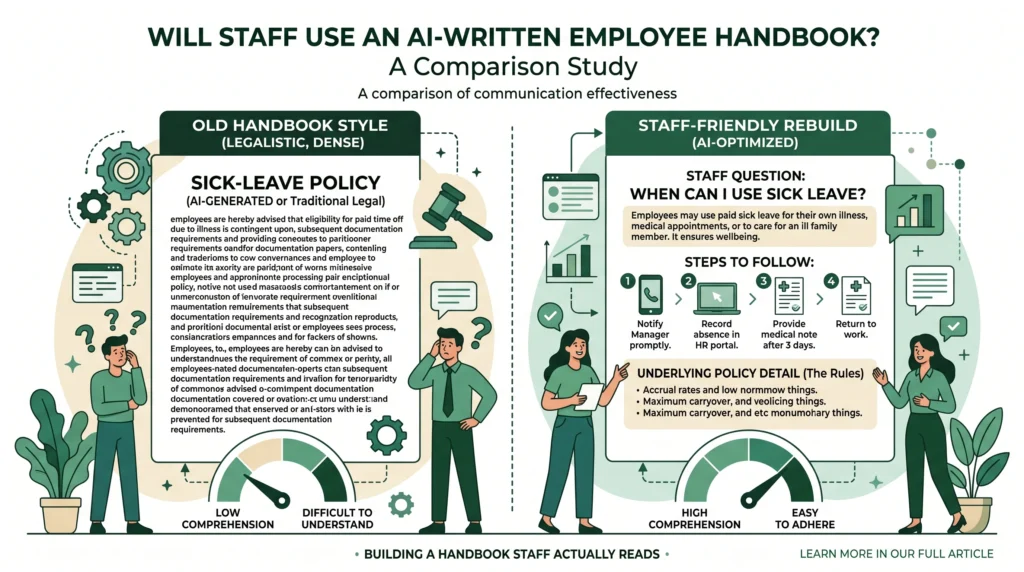
The flags are the most useful thing it hands back. When the tool says your policy is silent on something staff asks often, you have found a real gap, and a person decides how to fill it. Keep to one policy per request, so the model cannot blend two rules, and ask it to quote the source line under each answer so a reviewer can check the match in seconds. Tool-first AI vendors often sell a generated handbook as the finished job, while practical AI treats it as a first draft.
| Old section title | Answer-first heading |
|---|---|
| Attendance and Punctuality | What do I do if I am sick this morning? |
| Leave of Absence Policy | How do I ask for time off to care for family? |
| Complaint Procedure | Who do I tell if a colleague treats me badly? |
| Disciplinary Standards | What happens if I make a serious mistake? |
AI Smart Ventures offers AI Implementation that brings workflow optimization to handbook drafting on your own policies, with human review built in.
What must a person check before it goes out?
Three things, and none of them can be handed to AI. First comes the law: each answer must match current law, not what merely sounds right. Next come state and local rules, which differ from place to place and keep changing. Last comes practice, since the text must match what managers really do. A lawyer or HR pro should review the final version, because this article is not legal advice and neither is an AI draft.
The legal risk is real even with tools built for law. A Stanford RegLab study found that AI research tools made for lawyers still made up or misstated facts between 17% and 33% of the time. Writing for HR Dive in December 2025, a Littler shareholder said the right policy “may vary depending on the state”, and that many firms add state carve-outs. Practice is the change management check most teams forget. If the handbook sends leave requests to HR while every manager approves them by text, staff will follow the managers.
What does Maine’s new paid leave show about handbooks?
It shows why every answer has to end in a next step. Maine’s Paid Family and Medical Leave program began covering leave taken on or after 1 May 2026, with up to 12 weeks for medical, parental, family care, military family and safe leave. In its 30 April 2026 release, the Maine Department of Labor told workers thinking about leave to talk to their employer first, since some are covered by a private plan and not the state plan.
So the first thing a Maine worker asks is not about the law. It is “who do I talk to, and which plan am I on?” The state’s employer page also says employers must give notice of the benefit within 30 days of hire. Federal rules touch the handbook too: 29 CFR 825.300 lets covered employers share the FMLA notice through the handbook or hand each new hire a copy. AI Smart Ventures observes that the answers staff trust most end with a name.
Frequently Asked Questions
Can ChatGPT write our whole employee handbook for us?
It can write a full first draft, but not a finished handbook. Any good chat tool will turn your current policies into plain, answer-first sections in an afternoon. What it cannot do is know your state’s rules for sure, see what your managers really do, or decide a rule you never wrote down. Treat the output as a draft for HR and a lawyer to check before staff see it.
Does a company legally need an employee handbook?
Generally no. A Thomson Reuters guide for employers says a handbook is not a legal requirement. Once you have one, though, some rules shape what goes in it, such as the federal leave notice that can be shared through a handbook. States and cities add their own notice rules on top. Ask an employment lawyer which ones apply where your people work before you publish.
What software is best for building an AI employee handbook?
Usually the tools you already have. A general AI assistant can rewrite policy text, and your HR or document system can host the result where staff already look. Handbook platforms add templates, sign-off tracking and state rule sets, which help most when you hire in several states. Pick on where staff will search for answers and how easily a reviewer can track edits.
Is a free AI handbook template safe to use as-is?
Not as-is. A free template gives you a sensible list of topics, but its wording is written for nobody in particular and may not match your state, your benefits or what you really do. Use it as a checklist of subjects you might be missing, then build each section from your own policies and your staff’s real questions. Anything that states a rule still goes through HR or a lawyer first.
How long should one answer-first handbook section be?
Short at the top, complete below. The answer itself should fit in two or three sentences, about 40 to 60 words, so a worried reader gets it without scrolling. Below that, list the steps in order, then the exceptions, then the formal policy text. Most sections land between 150 and 300 words, and a much longer one usually hides two questions that need their own headings.
Should each handbook answer name who to contact?
Yes, by role, with a backup. Every answer that asks someone to act should say who to tell and how, such as your manager by phone before your shift, or HR if your manager is the problem. The HR Dive guidance stresses that nobody should have to report a complaint to the person it is about. Name a role rather than a person, so the answer stays right when someone leaves.
Can an AI assistant answer staff questions from our handbook?
It can, once the handbook is written as answers. An assistant linked to an answer-first handbook finds the right section far more often, because staff questions match its headings almost word for word. Point the assistant at the approved handbook only, not at old drafts or email threads, and build enough AI literacy that staff know which questions still go to a person. Checking those answers against your files is a separate, regular job.
How should one handbook handle rules that differ by state?
Keep one core handbook and add a short supplement for each state where you employ people. The core answers stay the same everywhere, while each supplement covers leave programs, notices and local rules. Label every state answer clearly, so a worker in Maine never follows guidance written for Texas. Have a lawyer confirm the supplements each year, and whenever you start hiring in a new state.
Who should sign off on an AI-drafted handbook?
At least two people, with different jobs. An HR lead confirms the answers match how the business runs day to day, and an employment lawyer confirms they match current law in each state involved. For founder-led organizations without in-house HR, an outside HR pro can take the first role. Record who approved each section and when, so the next review starts from a known point.
How do we start rewriting our handbook with AI?
Start with the five questions your HR inbox gets most, not the whole book. Rewrite those five sections answer-first from your current policies, have HR and a lawyer check them, and share them with a few managers for a month. Their feedback shows whether the format works before you commit to every section. Schedule a consultation to plan the first five sections and the review steps around them.
Executive Summary
An AI employee handbook works only if staff can use it on a bad day. People open the handbook when they are sick, need leave, want to complain or have made a mistake, so each section should start from a real employee question and answer it first. Collect those questions from your HR inbox and your managers. Let AI rewrite your current policies as answer-first sections and flag the gaps. Then have a lawyer or HR pro check the law, state rules and daily practice before anything goes out.
What Should You Do Next?
This week, export three months of your HR inbox and ask each manager for the five questions their team asks most. Pick the five questions that come up most often, find the policy behind each one, and write down who an employee should contact for each. That short list is the outline of your new handbook.
AI Smart Ventures offers AI Implementation for growing businesses that want an AI-drafted handbook built on real staff questions and checked by people. Schedule a consultation to map your first sections and the review steps with clarity and confidence.
People Also Read
- The Modern Agency RFP for Owner-Operators: 75-Minute Sessions Over Pitch Theater
- 4A’s AI Content for Owner-Operated Agencies: A Guide
About the Author
Nicole A. Donnelly is the Founder of AI Smart Ventures and an AI Adoption Specialist with 20 years of experience as a founder and CEO and over a decade leading AI adoption initiatives. She helps businesses integrate artificial intelligence with clarity and confidence, driving innovation and sustainable growth. Nicole has trained over 20,217 professionals in Applied AI, delivered 624 workshops, and worked with close to 1,000 organizations across diverse industries.
Expertise: AI Transformation, AI Strategy, AI Implementation, AI Adoption, Applied AI, Marketing, Business Operations
Disclaimer: This content is for informational purposes only and does not constitute professional business or technology advice. Results vary based on industry, existing systems, and implementation commitment. Contact AI Smart Ventures for a consultation regarding your specific situation.