
How to Run AI Office Hours for Your Member Organization in 2026
Last Updated: July 2026
An AI office hours program is a recurring session for member businesses. Members bring real work problems to a trained facilitator for live help with AI tools. Sessions run 30 to 60 minutes. They follow a two-part structure: a short skill presentation, then open questions from the group. The format focuses on immediate, practical use over broad theory. This makes it easy for any member to join. First-time AI users and those already using automation are both welcome.
AI Smart Ventures has helped hundreds of growing businesses build AI adoption programs. These include recurring office hours that put learning directly into weekly work. This hands-on support helps members move from AI tool access to confident, daily use faster. The result is a member base that stays engaged longer and renews more steadily.
Member businesses that run regular AI support sessions see clear gains in use and retention. When members solve a real problem in under an hour, they come back the next week. These small wins build momentum. Over time, occasional attendees become active, loyal members. The sections below cover the key choices you need to make. They will help you launch this program in 2026.
Key Takeaways
- Regular AI office hours give members a practical reason to stay engaged with your business beyond basic networking.
- A hybrid format combining a short topic presentation with open Q&A serves the widest range of member needs.
- Starting with an external AI expert builds immediate credibility and sets a quality standard for future sessions.
- Focus promotional messaging on the specific problems you will solve, not on the tech itself.
- Track attendance, session satisfaction scores, and member renewal rates to measure the program’s long-term impact.
- An internal champion who owns scheduling and facilitation keeps the program running without burning out your leadership team.
Why offer AI office hours to members?
Regular AI office hours give members clear value. They can point to this value when renewing their membership. This format moves your business past static newsletters and recorded webinars. It delivers live, hands-on help instead. Members who get direct help with AI tasks adopt tools much faster. They move to confident daily use up to 40% faster than those learning on their own. Research from McKinsey shows that hands-on AI support drives faster adoption across businesses. When your business becomes the place members go to solve problems, retention improves and referrals follow.
The business case is clear. Growing businesses need to adopt AI tools fast. But most owner-operators do not have internal tools to do it well. Businesses that fill this gap with support sessions become essential partners, not optional memberships. Members who use more than one service from their association renew at much higher rates. The Salesforce State of AI report shows that ongoing AI support drives stronger use over time. AI office hours become a second high-value touchpoint. They deepen the member bond without needing a large budget increase.
What format works best for office hours?
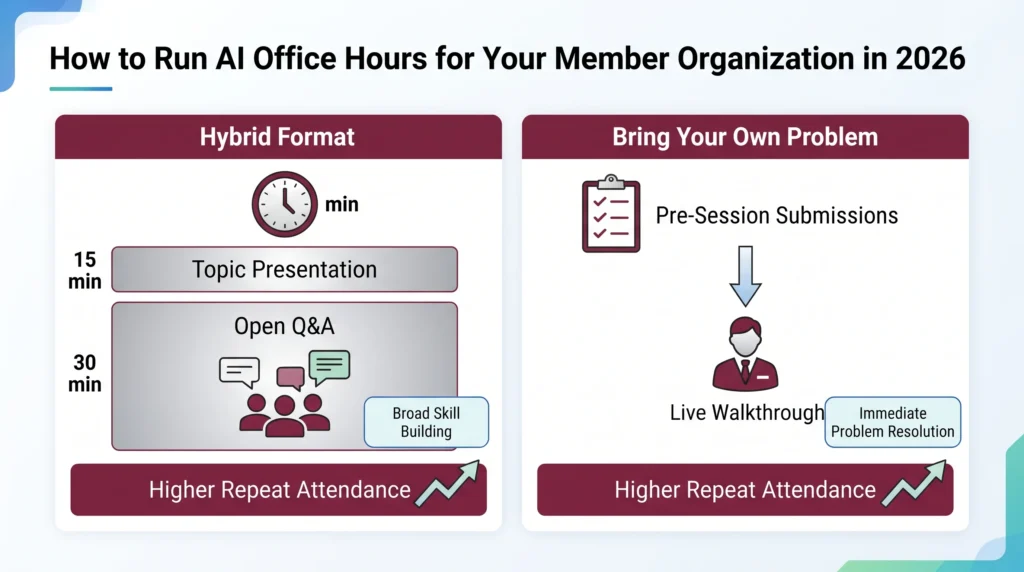
A hybrid model balances broad learning with individual problem-solving. Start each session with a 15-minute presentation on one specific tool or workflow. Good examples include drafting proposals with an AI writing tool or summarizing reports with a language model. Follow this with an open Q&A segment. Members raise current issues from their own work. This two-part structure works for members who want to learn something new. It also works for those who need help with a specific problem right now.
Another strong option is the Bring Your Own Problem clinic. Attendees submit a manual task or workflow issue before the session. The facilitator picks two or three examples to work through live. This approach keeps content grounded in real problems. It shows value right away. Sessions that solve real member problems draw more repeat attendees. They do better than sessions on general AI topics.
Who should lead your AI office hours?
An external AI facilitator is the best starting point. Most businesses run their first sessions this way. A third-party expert brings broad, unbiased knowledge of AI tools across industries. This builds immediate trust with your members. When members see you bring in outside help, they take the content seriously. Starting with a consultant also sets a quality benchmark. Your internal team can watch and learn. They can then replicate it as the program grows.
After three to six months, move facilitation to a trained internal champion. This person attends every session and manages logistics. They gradually take on more content delivery. The external consultant shifts to a coaching role. This handover protects the program and reduces ongoing costs.
The best internal champions are often not the most technical staff members. Look for someone who communicates clearly. They should enjoy helping others and keep up with AI trends. The right person is comfortable saying they do not know an answer. They also follow up after every session.
How do you choose the right topics?
Topic selection drives attendance. Sessions built around problems members face right now do better than those focused on future trends. Start by surveying your members with three to five multiple-choice questions about workflow issues. Ask which tasks take the most time each week. Common answers include writing emails, reviewing documents, preparing reports, and summarizing meeting notes. These are exactly the areas where AI tools deliver the fastest results.
Build a rolling 90-day topic calendar based on survey results. Revisit the survey each quarter. This keeps content aligned with where members are in their AI journey. Pair each topic with a clear outcome. A session on AI-powered meeting notes should end with every attendee having set up one tool. They should run it on a recent recording before leaving. This outcome-first approach shifts sessions from passive learning to active skill transfer. Members value this far more than a general overview.
How do you promote sessions to members?
Promotion messaging determines whether your best content reaches the right people. Lead with the specific problem you will solve, not the tech you will use. Do not say “AI office hours covering ChatGPT prompts.” Instead try “How to draft a full client proposal in under 20 minutes.” The second framing speaks to a real pain point. It always drives higher sign-up rates than tech-first messaging.
Use multiple channels. Match your outreach timing to your members’ habits. Send a 48-hour email reminder with a clear subject line. Send a day-of message on your group platform. Send a calendar invite two weeks in advance. Together, these steps increase attendance without overwhelming members. Include one concrete example of what a past attendee accomplished. This reduces doubt from members who have never joined before.
After each session, send a short follow-up email. Include the recording link and a one-page summary of the tool covered. Add a prompt asking what topic members want next. This loop keeps members active between sessions. It also feeds into your next topic selection.
A structured AI Advisory program can help you map out session formats, topic calendars, and facilitation plans. Schedule a consultation to build an AI office hours program your members return to every month.
How do you measure program success?
Measuring the right things from the start gives you data to justify ongoing investment. Record attendance for each session. Track whether the same members return from one session to the next. A session that draws 20 members and retains 15 the next month shows strong value. That is stronger than one that draws 30 once and then drops to 10. Consistent retention is the clearest early sign that your format and topics are working.
Collect feedback right after each session. A three-question survey captures satisfaction ratings, the most useful takeaway, and the next topic members want. This fast loop takes less than two minutes per respondent. You get data you can act on within 24 hours.
The metric that matters most is member renewal rates. Compare renewal data for members who attended at least three office hours sessions against those who did not. Businesses that see clear differences in renewal rates can justify dedicated staff time and budget for this program.
What tools do you need to run sessions?
You need fewer tools than most people expect. Get a video platform with screen sharing and a recording feature. Zoom, Microsoft Teams, and Google Meet all work well. The recording feature matters most. Members who cannot attend live can still access the content at their own pace.
For promotion and follow-up, your current email platform and group forum are enough. Avoid adding new tech in the first three months. Get the session format and topic selection right first. Then add polling tools or virtual whiteboards later. Simplicity reduces friction for both facilitators and attendees in the early weeks.
As the program grows, add a shared document where members can submit questions before each session. A Google Doc or Notion page works well and needs no new subscriptions. This pre-session intake step improves facilitation quality. It also gives members a visible way to shape the agenda.
Frequently Asked Questions
How long should each session run?
Most businesses find 45 to 60 minutes is the right length for AI office hours. This window allows depth on a single topic while respecting member schedules. If attendance drops after the first few sessions, try shortening to 30 minutes. Focus on one very specific task instead. Shorter sessions with a clear, measurable outcome often do better than longer, open-ended formats. This is especially true when members are still building the habit of showing up.
How often should you hold these sessions?
A biweekly cadence works well for most businesses starting out. Twice a month gives members enough time to apply what they learned. It also keeps the program present in their schedules. Once you confirm consistent attendance and demand, move to weekly sessions. Monthly sessions are less good. The gap is too long to build the learning habits that drive real adoption.
Do members need prior AI history to attend?
No prior AI history is needed. The best programs welcome members at every skill level. Sessions that open with a short, clear demonstration help first-timers feel safe to engage. Experienced members use the open Q&A time to ask more advanced questions. When facilitators acknowledge different skill levels at the start of each session, participation increases. First-timers are far less likely to drop out after their first session.
What AI tools should you cover first?
Start with the tools your members are most likely already using or paying for. Microsoft Copilot, Google Gemini, and ChatGPT are strong starting points. They work with common tasks like email drafting, document summarization, and meeting notes. Avoid introducing niche or specialized tools in early sessions. Focus on one or two tools that save time on daily tasks. Then expand the tool set as member confidence grows. The Harvard Business Review covers which AI tools are delivering the most value for business teams right now.
How do you handle a question you cannot answer live?
Prepare a standard response before your first session. Something like “Great question, I will follow up on that in the recap email” works well. Always follow through. Members notice when you do not. You can also invite other members to share their own history with the question. Peer answers back the group side of the program. A facilitator who admits the limits of their knowledge builds far more trust. This is better than guessing and getting it wrong.
How do you get busy members to show up?
Share evidence of relevance before asking for their time. A 60-second written or video case study from a previous session works best. Show one specific outcome a member achieved. This works better than general claims about AI features. Offering a recording for those who cannot attend live also increases sign-ups. It removes the pressure of showing up in real time. Always lead with specifics: what problem, what tool, what result.
Can AI office hours replace formal AI training?
Office hours complement formal training but do not replace it. Formal training covers foundational concepts and structured skill-building. Short sessions cannot match that depth. Office hours fill the gap between training and daily use. They help members work through the real problems they hit after a course ends. The two formats work best together. Office hours act as the ongoing support layer. They keep adoption going long after initial training is done.
How much does it cost to run this program?
Costs vary based on whether you hire an external facilitator and which tools you already have. Many businesses run early sessions using current video conferencing tools at no added cost. If you bring in an external consultant for the launch period, fees vary based on history and session length. AI Smart Ventures works with growing businesses to design AI office hours programs that fit typical association budgets. Schedule a consultation to discuss your specific situation.
Executive Summary
AI office hours give member businesses a practical, repeatable way to improve AI adoption. They close the gap between tool access and real-world use. A clear session format, the right facilitator, and topics driven by member surveys build the foundation. Businesses that run these sessions always report stronger member use and faster AI adoption. Launch with a 45-minute biweekly session. Track attendance and satisfaction scores from day one. Build your topic calendar around the problems members face right now. This program does not need a large budget or deep technical expertise to launch. It needs consistency and a genuine commitment to solving real problems every time you show up.
What Should You Do Next?
Choose one AI topic that matches a common workflow issue your members face today. Schedule your first session within the next 30 days. Survey your members now to confirm the topic resonates. Then set up a recording so every member can access the content after it ends. AI Smart Ventures offers AI Advisory for growing businesses looking to design and launch structured AI adoption programs. This includes member-facing office hours. Schedule a consultation to build a program your members return to every month.
People Also Read
- AI Office Hours: A Lightweight Adoption Ritual for Owner-Operators
- When Should You Start AI Transformation? 7 Signs Your Business Is Ready
About the Author
Nicole A. Donnelly is the Founder of AI Smart Ventures and an AI Adoption Specialist with 20 years of history as a founder and CEO and over a decade leading AI adoption plans. She helps businesses connect AI with clarity and confidence, driving innovation and lasting growth. Nicole has trained over 20,217 experts in Applied AI, delivered 624 workshops, and worked with close to 1,000 businesses across diverse industries.
Expertise: AI Transformation, AI Strategy, AI Rollout, AI Adoption, Applied AI, Marketing, Business Operations
Disclaimer: This content is for informational purposes only and does not constitute expert business or tech advice. Results vary based on industry, current systems and rollout commitment. Contact AI Smart Ventures for a consultation about your specific situation.