

AI Office Hours: A Lightweight Adoption Ritual for Owner-Operators
Last Updated: May 2026
An AI office hours ritual is the simplest way for an owner-operator to build team AI skills without a training budget or a dedicated learning lead. Gartner’s 2025 AI adoption report found that teams that set aside 30 to 60 minutes each week to try and share AI tools adopted new skills three times faster than those that left learning to each person individually. For a lean team with no IT or HR function, a regular office hours block is the one ritual that compounds over time.
AI Smart Ventures has worked with close to 1,000 growing businesses on AI use, including owner-operators who built strong AI habits within their teams using nothing more than a standing weekly call. The steps below show you how to run this ritual and keep it going.
Key Takeaways
- Adoption Speed – Teams with a set weekly AI learning ritual adopt new tools three times faster, per Gartner’s 2025 AI adoption report. A 30-minute block each week is enough to start.
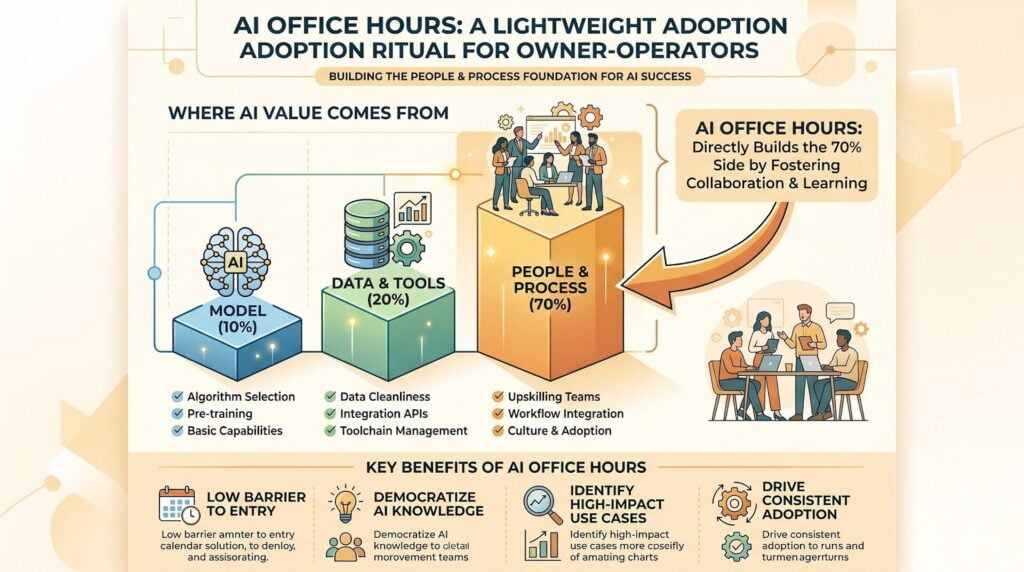
- The 10 20 70 Rule – 10 percent of AI value comes from the model, 20 percent from the data and tools, and 70 percent from the people and processes that use it. AI office hours build 70 percent.
- Format – AI office hours work as a weekly or biweekly team call where one person shares a tool, a shortcut, or a result and the group asks questions and tries the same approach.
- Cost – An AI office hours ritual costs nothing beyond a calendar block. No software, no budget, and no outside trainer needed.
- Longevity – The teams that keep this ritual going longest use a rotating host, not a single owner, so no one person carries the full load every week.
The owner-operator who commits to this ritual for 90 days will have a team that surfaces new AI use cases on their own.
What Are AI Office Hours?
AI office hours are a set block of time each week where one team member shares how they used AI to do something faster, better, or in a way they had not tried before. The rest of the team asks questions and tries the same approach in their own work. The block runs 30 to 60 minutes with no agenda beyond one share and open discussion.
McKinsey’s 2024 AI adoption research found that teams that ran a set weekly AI sharing session were 40 percent more likely to report steady AI use across all functions six months later compared to teams that left AI learning to each person. The format is not a class or a training. It is a ritual where knowledge moves peer to peer, which is what makes it stick in lean teams with no formal learning structure.
What Is the 10 20 70 Rule for AI?
The 10 20 70 rule for AI says that 10 percent of AI value comes from the model, 20 percent from the data and tools built around it, and 70 percent from the people and processes that use it each day. For an owner-operated team, no AI tool works well without the team knowing how to use it. Office hours is the ritual that builds the 70 percent.
Deloitte’s 2022 AI workforce report found that growing businesses that invested in team AI skills through structured learning sessions saw 2.5 times the return from their AI tools compared to those that bought tools without any team training. The 10 20 70 rule shows exactly where that return comes from, and AI office hours is the most lightweight way to build the 70 percent of value without a formal training program or outside help.
Is It Acceptable to Use AI at Work?
Yes, and most teams that use AI well at work do so because someone took the time to show them how, since the issue for most owner-operated teams is not permission but confidence. Staff who have seen AI used to solve a real work problem are far more likely to try it on their own. A regular office hours ritual is the fastest way to build that confidence across a whole team.
PwC’s 2024 workforce AI report found that 82 percent of workers say they are open to using AI at work when they feel their employer supports and guides the use. The key word is guides, since most staff do not resist AI because they fear it but because they have not been shown how it works in their specific role. A 30-minute office hours block answers that need without a formal policy or a long training rollout.
How Do You Run AI Office Hours for Your Team?
The setup that works best for a lean owner-operated team is a standing 30-minute block on the same day each week, a rotating host who picks one AI tool or shortcut to share, and an open 15 minutes at the end for questions and tries. The host does not need to be the most AI-skilled person on the team. They just need to share something that worked for them that week.
Accenture’s 2021 change management research found that growing businesses that used a rotating host model for AI learning sessions saw 60 percent higher long-term attendance than those that kept a single host or trainer in the role, since no single person carried the full load of preparing and running each session. The key is that rotation spreads both the work and the load, so the ritual does not stall when the main host is busy, out, or simply runs out of new things to share.
- Set a Standing Block – Pick the same 30-minute window each week and put it on the team calendar. Treat it like any other recurring team call.
- Rotate the Host – Each person on the team takes one session per month to share a tool or shortcut they used that week. No preparation beyond the one share.
- Keep a Running Log – Create a shared doc where each host adds their one share after the session. This log becomes a team AI knowledge base over time.
- Start With a Win – In the first session, the owner shares one AI tool that saved real time. A concrete first example sets the tone for the whole ritual.
Most teams reach a point where staff bring ideas to office hours without being asked within 60 days of starting the ritual.
| Session Format | Best For | Duration | Cadence |
|---|---|---|---|
| Share + Q&A | Teams new to AI | 30 min | Weekly |
| Share + Try + Log | Teams building habits | 45 min | Weekly |
| Theme + Group Try | Advanced teams | 60 min | Biweekly |
What Should Every AI Office Hours Session Cover?
Each session needs one share and one open block: the share is a tool, prompt, shortcut, or result the host used to do something faster or better that week, and the open block is 15 minutes of questions and tries where the rest of the team tests the same approach in their own work. That structure repeats every session without variation and is what makes the ritual easy to sustain.
Accenture’s 2024 learning and development study found that the most effective AI learning rituals at growing businesses used a simple fixed format for every session rather than varying the agenda each time, since the fixed format is what kept turnout and hosting easy to sustain. The format matters more than the content of any single session, since a team that shows up every week with a consistent structure will learn more over time than one that does a more elaborate session once a month.
- One Share – The host shows one AI tool, prompt, or result from their own work. This takes five to ten minutes and needs no slides or prep.
- Open Try – The team spends ten minutes testing the share in their own work. No pressure to share results, just a chance to try the same approach.
- One Question – Close with one question to set up next week: what is one task on your list this week that AI might help with? This keeps the cycle going.
See the AI tools and apps page for a full list of tools reviewed for fit with lean teams and owner-operated businesses. The AI implementation team at AI Smart Ventures can run your first three AI office hours sessions with your team before you hand off the host role.
Frequently Asked Questions
What is the 10 20 70 rule for AI?
The 10 20 70 rule for AI says that 10 percent of AI value comes from the model itself, 20 percent from the data and tools around it, and 70 percent from the people and processes that use it daily. For an owner-operated team, this means your AI tools are only as good as the habits your team builds around them. AI office hours is the ritual that builds the 70 percent side of that rule over time.
What are AI office hours?
AI office hours are a set 30 to 60-minute block each week where one team member shares how they used AI to do something faster or better and the rest of the team asks questions and tests the same approach. The format is peer to peer, not lecture, and runs on a rotating host model so no single person carries the full load. The goal is consistent, low-friction AI learning that compounds over time.
What is ritual AI?
Ritual AI is the practice of building structured, repeatable habits around AI tool use so that a team adopts AI as a normal part of their work rather than a one-off experiment. AI office hours is one of the most effective ritual AI formats for growing businesses. The ritual makes AI use feel routine and shared rather than individual and optional, which is what drives sustained adoption across a whole team.
Is it acceptable to use AI at work?
Yes. Most growing businesses with clear guidance on how AI should be used report high staff acceptance and consistent AI use across functions. The issue for most teams is not permission but confidence, since staff who have been shown how AI solves a real work problem are far more likely to use it on their own. Contact AI Smart Ventures to set up an AI use policy and an office hours ritual for your team.
How long should AI office hours sessions be?
Thirty minutes is the right starting length for most growing businesses. The first ten to fifteen minutes cover the share, and the last fifteen cover open questions and tries. Once the team is comfortable with the format, some groups extend to 45 minutes, but 30 minutes is enough to build the habit and keep attendance high across a full team week after week.
How do you keep AI office hours going long term?
The rotation model is what keeps the ritual going. When each team member hosts one session per month, no single person carries the full load and the ritual does not stall when the main host is busy or out of new ideas. A shared log of past shares gives new hosts a starting point and keeps the team’s AI knowledge base growing between sessions over time.
Who should host AI office hours?
Anyone on the team can host. The host does not need to be the most AI-skilled person. They just need to share one thing they used AI for that week and be ready to answer questions about it. The owner should host the first session to set the tone, then rotate the role to the rest of the team so the ritual becomes shared rather than owner-dependent.
What AI tools are best for office hours sharing?
Pick tools your team already has access to or tools that are free to try. The best shares are from tools the host used to do a real task that week, not tools they tested just for the session. Tools that connect to work your team does every day, such as writing, sorting, and planning, tend to generate the most useful discussion and the most follow-on use by the rest of the team.
Executive Summary
AI office hours are the simplest ritual an owner-operator can run to build team AI skills without a training budget. A 30-minute weekly block with a rotating host, one share per session, and a shared log creates a learning habit that compounds over 90 days. The 10 20 70 rule for AI explains why this matters: the people and process side accounts for 70 percent of the value your AI tools create.
What Should You Do Next?
Put a 30-minute block on the team calendar for next week and host the first session yourself. Share one AI tool you used this week, show the result, and ask each team member to try it on one of their own tasks before the next session.
AI Smart Ventures offers AI consulting for growing businesses that want to add AI without months of trial and error. Schedule a consultation to plan your first AI office hours session and get a rotating host schedule your team can follow from week one.
People Also Read
- How Do You Address Employee AI Anxiety Without an HR Department?
- How Do You Measure AI ROI? A Framework for Business Leaders
About the Author
Nicole A. Donnelly is the Founder of AI Smart Ventures and an AI Adoption Specialist with 20 years of experience as a founder and CEO and over a decade leading AI adoption. She helps businesses add AI with clarity and confidence. Nicole has trained over 20,217 professionals in Applied AI, delivered 624 workshops, and worked with close to 1,000 organizations across diverse industries.
Expertise: AI Transformation, AI Strategy, AI Implementation, AI Adoption, Applied AI, Marketing, Business Operations
Disclaimer: This content is for informational purposes only and does not constitute professional business or technology advice. Results vary based on industry, existing systems and implementation commitment. Contact AI Smart Ventures for a consultation regarding your specific situation.

